50 Corporate Leaders, A Cancelled Summit And The Investment Reality Northeast India Must Understand
Over the last few days, disappointment has been spreading across Assam and much of Northeast India after reports emerged that the proposed India–Japan summit in Guwahati may no longer take place as originally expected. Social media conversations quickly began framing the development as a lost opportunity. For many observers, the conclusion appeared almost automatic. If Japanese political leadership and corporate leaders were not coming, Northeast India had somehow lost a major investment opportunity.
At first glance, that reaction may seem perfectly understandable. However, beneath this disappointment lies a much deeper economic misunderstanding, one that Northeast India has repeatedly fallen victim to for decades. We have gradually conditioned ourselves to believe that high-profile diplomatic visits, investor delegations and political summits automatically translate into economic development.
The uncomfortable truth is that they rarely do.
A summit is fundamentally a protocol event, while an investment decision is ultimately a supply chain calculation. Unfortunately, Northeast India has often confused the two. This misunderstanding has repeatedly prevented the region from asking far more important questions about what actually attracts global capital in the first place.
Why Northeast India May Be Reacting To The Wrong Story
For many years, India has increasingly celebrated economic diplomacy through highly visible investment summits. Government delegations travel abroad, foreign leaders visit Indian states, memorandums of understanding are signed, cameras capture smiling handshakes and headlines immediately begin projecting large investment expectations.
Yet history repeatedly shows that such events rarely determine where long-term investment eventually flows.
Capital behaves very differently from how many people imagine. Investors do not allocate hundreds of millions of dollars simply because political leaders share a stage or because regional governments organize highly visible investment conferences. Large-scale investment decisions usually emerge only after careful economic evaluation and long-term strategic assessment.
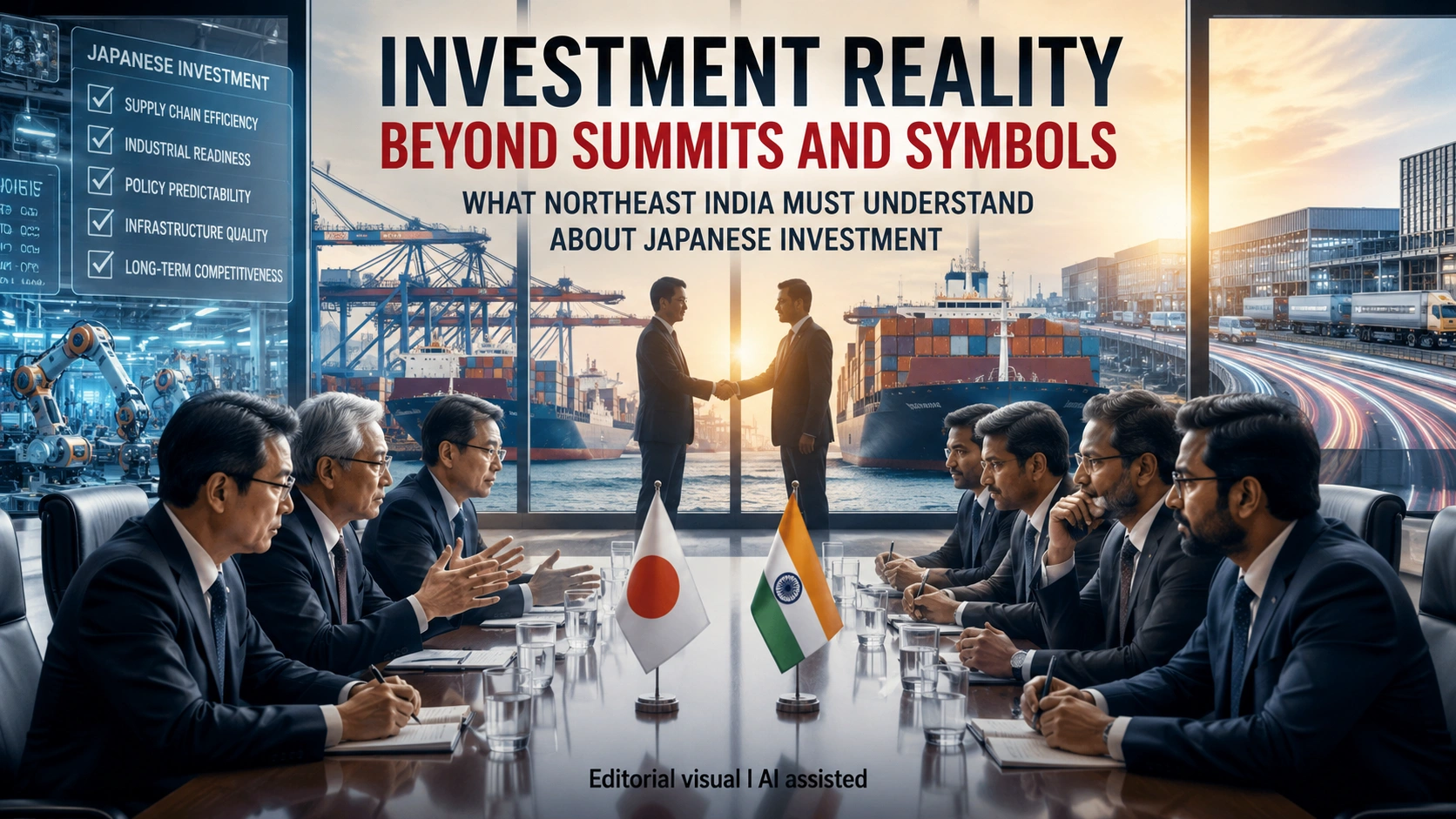
Companies study logistics efficiency, market size, supply chain reliability, policy predictability, vendor ecosystems, infrastructure quality, labor productivity and long-term competitiveness before making capital commitments.
Political theater can certainly create optimism and help generate positive public sentiment. However, optimism alone does not move capital. In reality, investment almost always follows hard economic fundamentals rather than diplomatic visibility.
And understanding that distinction is becoming increasingly important for regions like Northeast India.https://thequantiq.com/northeast-india-exports-global-opportunity/
The India–Japan Economic Relationship Is Far Bigger Than One Summit
To understand why the cancellation of one summit changes very little, it helps to first examine the scale of the broader India–Japan economic relationship.
India and Japan today share one of Asia’s most important strategic partnerships. Bilateral trade between the two countries crossed approximately US$ 25 billion during FY 2024–25. India exported goods worth nearly US$ 6.79 billion to Japan, while imports from Japan stood significantly higher, creating a trade imbalance of roughly 2.7 to 1 in Japan’s favor.
Japanese investment in India has also remained consistently strong. Japanese Foreign Direct Investment into India during FY 2024–25 stood at nearly US$ 2.48 billion, while more than 1,400 Japanese companies now maintain active business presence across various Indian sectors.
These numbers immediately reveal something important. The India–Japan economic relationship does not depend on one summit, one diplomatic visit or one political event. Instead, it represents a long-term strategic partnership that has been built steadily over decades through trade architecture, industrial collaboration and carefully structured capital deployment.
Which raises an uncomfortable question. If this economic relationship is already so large, why does Northeast India barely participate in it?
Why Northeast India Remains Largely Invisible In India–Japan Trade
This is where the real story begins.
Despite decades of discussion surrounding India’s Act East Policy and Northeast India’s geographic proximity to Southeast Asia, the region continues occupying only a marginal place within India’s actual trade relationship with Japan.
The reason is surprisingly simple.
The region has not yet built the economic architecture global investors typically look for.
Northeast India continues producing significant quantities of tea, bamboo, petroleum, spices, horticulture products, handloom products and mineral resources. Yet much of this production remains trapped within primary or minimally processed economic activity. Higher-value downstream processing, large-scale manufacturing ecosystems, export-oriented industrial clusters and globally compliant production systems remain severely underdeveloped.
This reveals an uncomfortable economic truth that many regions continue ignoring. Investors rarely commit capital simply because a region possesses strategic geography. They invest where systems already exist and where economic structures make long-term industrial operations viable.
And this distinction matters far more than many policymakers currently acknowledge.
How Japanese Companies Actually Make Investment Decisions
Japanese capital behaves differently from speculative investment flows seen elsewhere.
Unlike short-term capital chasing immediate returns, Japanese corporations typically prioritize long-term stability and supply chain efficiency before committing major investments.
Companies usually examine several variables before entering new markets. They evaluate whether the region can support long-term industrial production, whether transport networks are efficient enough to move goods predictably, whether local vendor infrastructure exists to support manufacturing operations and whether electricity supply systems remain stable enough for industrial continuity.
They also study institutional consistency. Can local governments maintain policy predictability over multiple years? Can suppliers meet strict international quality standards? How quickly can finished products reach export markets? Can the region support industrial ecosystems rather than isolated factories?
These questions matter far more than diplomatic ceremonies.
This is precisely why Japanese investment has historically concentrated around industrially mature states such as Gujarat, Maharashtra, Tamil Nadu and Karnataka, where supply chain ecosystems already exist. Northeast India, despite its strategic location, has yet to build similar confidence.https://www.jetro.go.jp/en/?utm_source=chatgpt.com
The Dangerous Illusion Created By Investment Summits
One of the most persistent economic misconceptions across developing regions is the belief that investment summits themselves generate development.
They do not.
At best, summits serve as signaling mechanisms. They communicate political intent, open diplomatic conversations and allow governments to showcase regional opportunities to visiting investors.
Memorandums get signed, announcements are celebrated and visiting delegations receive enormous public attention. Gradually, a perception begins forming that economic development has somehow already begun. In reality, however, very little may have structurally changed beneath all the optimism.
Factories are not built because of ceremonies. Factories are built because economic fundamentals justify investment.
And far too often, Northeast India continues confusing visibility with actual economic preparedness.
Japan Has Already Invested In Northeast India — But The Structure Matters
Interestingly, Japan is not absent from Northeast India.
In fact, Japanese development financing has already played an important role across the region.
Through Japan International Cooperation Agency, Japan has reportedly committed more than ₹22,000 crore across infrastructure projects in Northeast India, including roads, water supply systems and connectivity improvements.
However, an important distinction needs to be understood carefully. Much of this financing falls under Official Development Assistance frameworks rather than private industrial investment. In simple terms, Japan has helped finance infrastructure development, but that is very different from committing large-scale private industrial capital.
And the reasons deserve careful examination.https://www.jica.go.jp/english/?utm_source=chatgpt.com
The Hidden Problem Of Extractive Investment
Even when external capital enters resource-rich regions, another structural risk often remains ignored.
What economists sometimes describe as enclave economics.
This occurs when capital enters a region primarily to access raw materials, low-cost labor or geographic advantages, while higher-value economic activity happens elsewhere.
Under such economic structures, raw materials are often extracted locally while only minimal processing happens within the region itself. Profits gradually move outward, tax structures disproportionately benefit corporate headquarters located elsewhere and higher-value downstream industries develop far away from the communities where the original resources originate.
The local population receives temporary employment, but very little long-term wealth remains embedded within the regional economy.
Northeast India has repeatedly experienced variations of this model across tea, crude oil, coal extraction, timber, hydroelectric development and multiple natural resource sectors.
The lesson is becoming increasingly clear.
External investment alone does not automatically create prosperity. The structure of that investment matters equally.
What Northeast India Should Actually Focus On
Instead of reacting emotionally to summit cancellations or high-profile diplomatic visits, Northeast India needs to begin focusing on the economic fundamentals that genuinely attract long-term global investment.
The region needs industrial clusters capable of supporting manufacturing ecosystems. It needs export certification infrastructure capable of meeting international compliance requirements. It needs stronger logistics systems connecting production centers to ports and global shipping networks.
It needs predictable policy frameworks that survive political cycles. It needs skilled workforce pipelines aligned with advanced manufacturing. It needs stronger supplier ecosystems capable of supporting global production standards.
Most importantly, it needs to stop thinking of investment as an external event and start viewing investment as a consequence of internal preparation.
This is perhaps the most important distinction policymakers need to understand. Global capital rarely arrives simply because it has been invited through diplomatic outreach or policy announcements. It arrives when economic conditions become so compelling that investors find it increasingly difficult to ignore the opportunity.https://thequantiq.com/northeast-india-green-industrialisation-bamboo-manufacturing/
The Bigger Question Nobody Is Asking
Perhaps the most important lesson from this entire episode has little to do with Japan itself.
The bigger lesson is about how Northeast India continues misunderstanding development.
For decades, the region has measured economic ambition through symbolic milestones. A business delegation arrives, a summit is announced, an MoU gets signed, partnership is celebrated, and optimism immediately follows.
Yet real development rarely begins on conference stages.
It begins much earlier through invisible systems.
Inside supply chains, manufacturing ecosystems, logistics systems, certification standards and industrial preparation that often remain unnoticed long before the cameras arrive.
The uncomfortable reality is that Northeast India does not actually suffer from a lack of investor interest. The region’s larger challenge lies in insufficient economic preparation and the absence of systems that global capital typically requires. Until that distinction is properly understood, the region may continue celebrating the wrong milestones while waiting for investment that never fully arrives.
Because ultimately, prosperity is not created when investors visit, but when a region becomes economically impossible for investors to ignore. And perhaps that is the investment reality Northeast India finally needs to understand.https://thequantiq.com/gi-tags-not-business-models/