
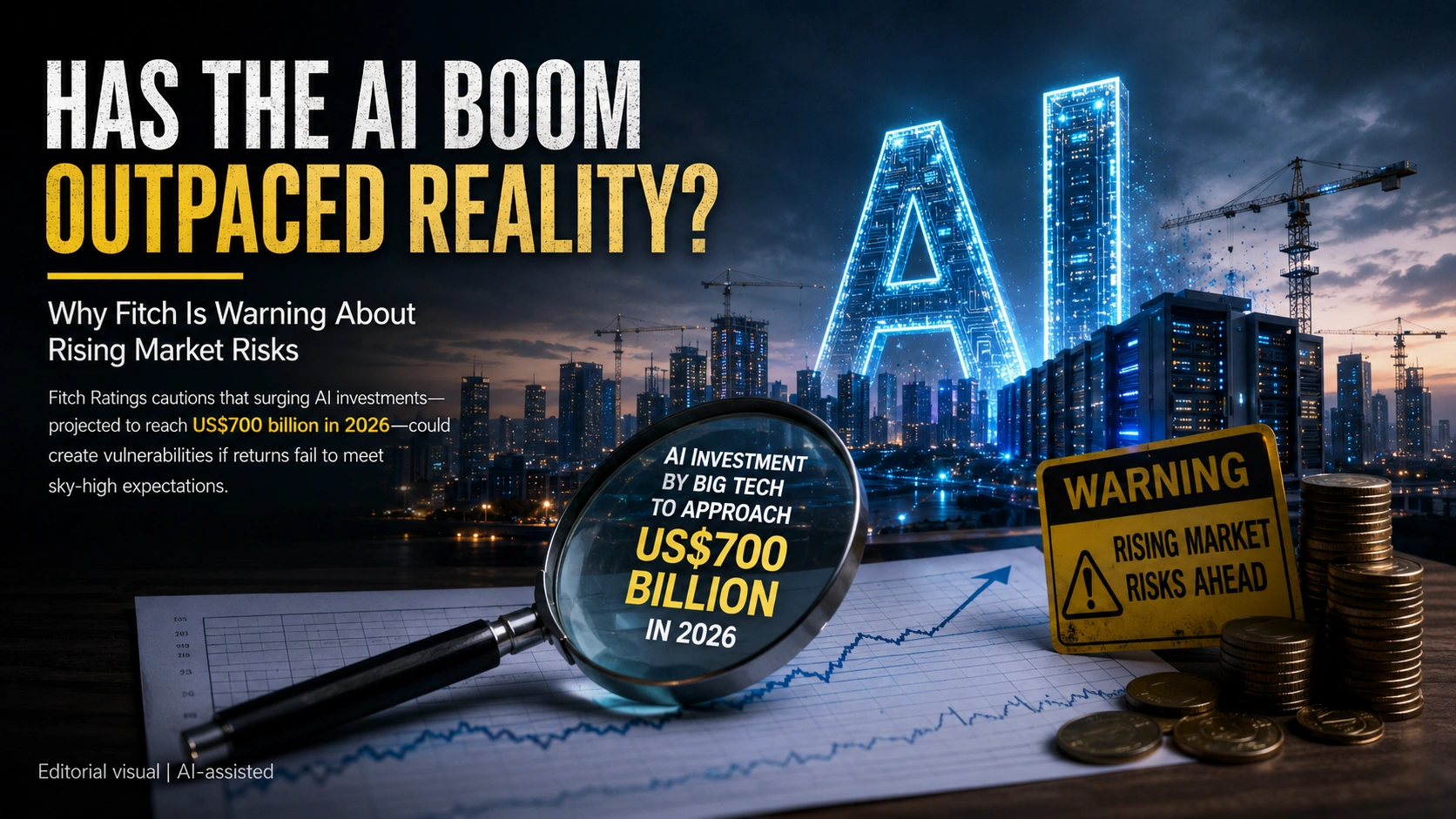
Has the AI Boom Outpaced Reality? Why Fitch Is Warning About Rising Market Risks
Artificial intelligence is reshaping industries, rewriting business strategies and attracting unprecedented levels of investment. Yet, as optimism surrounding AI reaches new heights, global credit rating agency Fitch Ratings has sounded a note of caution. Its latest assessment is not a warning against AI itself, but against the financial expectations building around it. For investors, businesses and policymakers, the message is both timely and significant.
Artificial intelligence has rapidly evolved from being a technological breakthrough into one of the most influential economic forces of the twenty-first century. Governments are racing to develop national AI strategies, technology companies are investing heavily in next-generation computing infrastructure and businesses across industries are redesigning products and operations around generative AI.
The scale of investment is unprecedented. According to Fitch Ratings, capital expenditure by the world’s largest technology companies is expected to approach US$700 billion in 2026, reflecting the extraordinary pace at which AI infrastructure is being built. Massive spending on advanced semiconductors, hyperscale data centres and cloud platforms is already stimulating economic activity, creating jobs and strengthening supply chains. At the same time, Fitch cautions that such unprecedented investment also increases financial exposure if future earnings fail to justify today’s expectations.
That observation deserves careful attention—not because it predicts an imminent crisis, but because it highlights an economic reality that has accompanied every major technological revolution.https://www.fitchratings.com/
AI Has Become a Global Economic Force
Artificial intelligence is no longer simply a technology story.
It has become a central driver of global capital markets, corporate investment, industrial policy and productivity expectations. Companies such as Microsoft, Alphabet, Amazon, Meta and Nvidia have committed hundreds of billions of dollars to AI infrastructure, convinced that artificial intelligence will define the next era of economic growth.
Investors have shared that confidence. AI-related companies now account for a significant share of global equity market gains, while institutional investors, pension funds and exchange-traded funds have increased their exposure to businesses leading the AI revolution.
This growing concentration explains why Fitch is paying close attention.
When a single technological theme becomes deeply embedded within financial markets, any sharp reassessment of future expectations has the potential to affect not only technology companies but also the broader economy.
The Concern Is Not Artificial Intelligence—It Is Investor Expectations
One important distinction must not be overlooked.
Fitch is not questioning the transformative potential of artificial intelligence. Nor is it suggesting that AI represents another speculative technology destined to fade away.
Instead, the agency is highlighting the growing gap that can emerge between technological progress and financial expectations.
Markets often reward future possibilities long before businesses begin generating sustainable returns. Artificial intelligence appears to be following that familiar pattern.
Developing increasingly powerful AI models represents only the first phase of the journey. Organisations must still integrate these systems into existing business processes, train employees, redesign workflows, comply with emerging regulations and demonstrate measurable improvements in productivity and profitability.
Those changes rarely happen overnight.
If commercial adoption progresses more gradually than investors currently anticipate, financial markets may adjust even while AI continues expanding across industries.
That possibility—not the technology itself—is at the heart of Fitch’s warning.
History Offers an Important Perspective
Economic history reminds us that transformative technologies and speculative investment often arrive together.
The railway boom of the nineteenth century attracted extraordinary capital before financial markets experienced painful corrections. Nevertheless, railways fundamentally transformed commerce and industrialisation.
The dot-com era followed a similar trajectory. Internet companies received enormous investment during the late 1990s before the market corrected sharply in 2000. Yet the internet itself went on to become one of the most important technological revolutions in modern history.
Renewable energy, electric vehicles and even smartphones experienced periods when investor enthusiasm briefly outpaced commercial reality.
Artificial intelligence is unlikely to be any different.
If markets eventually experience periods of correction, it would not necessarily signal that AI has failed. Instead, it may simply reflect the natural process of aligning financial expectations with the slower pace at which revolutionary technologies generate sustainable economic value.
Why This Matters Beyond Wall Street
The implications extend well beyond stock market valuations.
Artificial intelligence is driving demand for semiconductors, electricity, cloud infrastructure, networking equipment and advanced manufacturing. It is influencing corporate borrowing, venture capital investment and national industrial strategies across the world.
Should investor confidence weaken significantly, the consequences could ripple through multiple sectors. Companies may postpone expansion plans, infrastructure investments could slow and venture capital funding may become more selective as investors reassess long-term returns.
This interconnectedness explains why global credit rating agencies increasingly monitor artificial intelligence not merely as a technology trend, but as a factor capable of influencing broader financial stability.https://indiaai.gov.in/
India’s AI Opportunity Remains Strong
For India, Fitch’s assessment should be viewed within a broader strategic context.
India has emerged as one of the world’s leading centres for software engineering, digital public infrastructure and AI talent. Global Capability Centres continue expanding across the country, while Indian startups are building AI-powered solutions for healthcare, agriculture, education, financial services and manufacturing.
A moderation in global investment sentiment could temporarily affect funding conditions and hiring activity. However, India’s long-term AI opportunity depends less on market exuberance and more on its ability to deploy artificial intelligence to solve real-world problems at scale.
The country’s expanding developer ecosystem, digital public infrastructure and large domestic market provide structural advantages that are likely to outlast temporary fluctuations in global financial markets.https://thequantiq.com/assam-semiconductor-ecosystem-a-semi/
A Timely Lesson for Entrepreneurs
Entrepreneurs should view Fitch’s warning as an opportunity to focus on fundamentals.
Artificial intelligence is an extraordinary enabling technology, but it is not a substitute for a sustainable business model. Companies that use AI to improve productivity, solve genuine customer problems and create measurable value are likely to remain resilient regardless of future market cycles.
History consistently rewards businesses built on innovation, execution and financial discipline rather than investor excitement alone.
The AI revolution will create many winners, but they will be distinguished by commercial success rather than technological hype.https://thequantiq.com/openai-ai-hacking-incident-cybersecurity/
The Quantiq Perspective
Fitch’s latest assessment should not be interpreted as a signal that the AI revolution is losing momentum. If anything, it reflects how deeply artificial intelligence has become integrated into the global economy. Credit rating agencies monitor developments capable of influencing financial stability, and AI has now reached that level of significance.
The more important lesson is that technological revolutions and financial markets rarely move in perfect synchronisation. Markets often price tomorrow’s possibilities as though they already exist today, while businesses require time to convert innovation into sustainable earnings and productivity gains.
Artificial intelligence will almost certainly continue transforming industries, improving efficiency and creating new economic opportunities over the coming decades. Those long-term fundamentals remain intact.
The greater challenge lies in ensuring that financial expectations remain grounded in economic reality.
For investors, businesses and policymakers alike, the path forward is clear. Confidence in AI should be built not on market euphoria but on demonstrable value creation, disciplined investment and long-term thinking.
Fitch’s warning is therefore less about doubting artificial intelligence than about reminding the world that even the most transformative technologies remain subject to the timeless principles of economics. Innovation changes industries, but sustainable value is ultimately what determines lasting success.https://thequantiq.com/stanford-ai-index-2026-northeast-india-ai-data-gap/





One Comment