
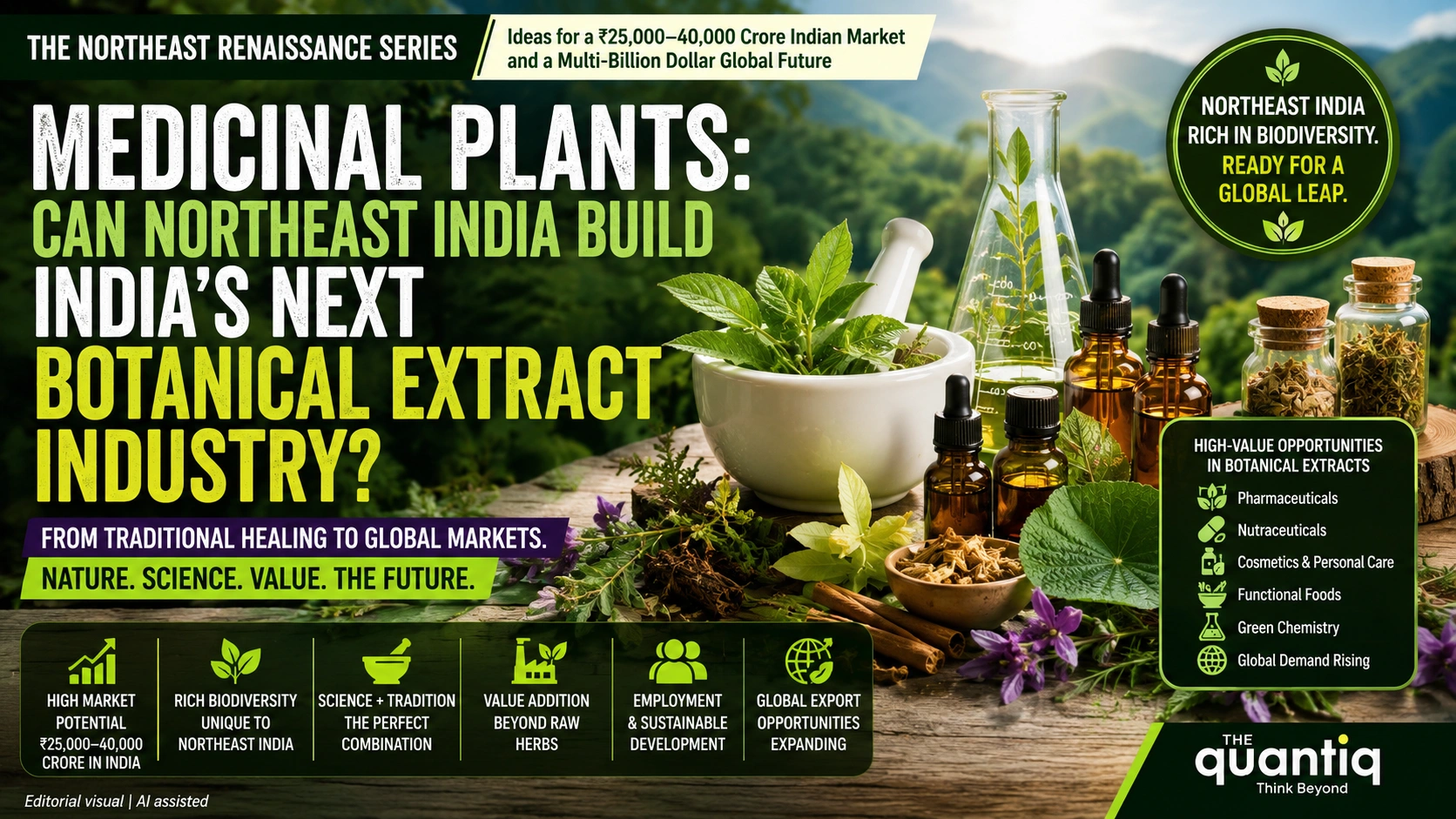
Medicinal Plants: Can Northeast India Build India’s Next Global Botanical Extract Industry?
The Northeast Renaissance Series
Ideas for a ₹25,000–40,000 Crore Indian Market and a Multi-Billion Dollar Global Future
For centuries, medicinal plants have been valued for healing. The twenty-first century may value them even more for the molecules they contain.
For most of human history, medicinal plants have been harvested for their therapeutic properties and used in traditional systems of healing. Today, a quiet industrial revolution is changing that perception. Pharmaceutical companies, cosmetic brands, nutraceutical manufacturers and food innovators are no longer looking at medicinal plants simply as herbs. Increasingly, they are seeking the highly specialized bioactive compounds hidden inside them—molecules capable of delivering consistent performance in modern industrial applications.
This shift represents one of the most significant transitions taking place within the global bioeconomy. Around the world, consumers are moving steadily towards plant-based ingredients supported by scientific validation, while industries are replacing synthetic chemicals with naturally derived alternatives. As a result, medicinal plants are gradually evolving from traditional healthcare resources into strategic industrial feedstocks.
Against this backdrop, Northeast India finds itself in a uniquely advantageous position. The region possesses one of the richest reservoirs of medicinal plant diversity in India, ranging from Centella asiatica (Gotu Kola) and Patchouli to Lemongrass, Citronella, Perilla, Wild Turmeric and numerous indigenous medicinal species that remain commercially underutilized.
The opportunity, however, is no longer about cultivating larger volumes of medicinal plants.
It is about unlocking greater value from every kilogram harvested.
The future bioeconomy will increasingly reward those who understand molecular intelligence rather than biological abundance.https://nmpb.ayush.gov.in/
Why the World Is Turning Towards Botanical Extracts
The global market for botanical extracts has expanded rapidly over the past decade, driven by changing consumer preferences and continuous advances in extraction technologies. Pharmaceutical companies continue exploring plant-derived therapeutic compounds, cosmetic manufacturers increasingly rely on botanical actives for premium skincare formulations, while food and beverage companies are replacing synthetic additives with natural antioxidants, essential oils and herbal extracts.
Meanwhile, consumers themselves are driving much of this transformation. Growing awareness about wellness, preventive healthcare and clean-label products has created unprecedented demand for naturally derived ingredients. At the same time, improvements in extraction technologies now allow manufacturers to isolate highly concentrated plant-based bioactive compounds with exceptional consistency, purity and traceability.
In other words, medicinal plants are no longer competing as agricultural commodities. They are competing as sources of high-value industrial chemistry.https://ayush.gov.in/
From Traditional Herbs to High-Value Industrial Ingredients
Traditional medicine has recognised the therapeutic potential of medicinal plants for centuries. Modern science is now validating many of those traditional observations by identifying the specific molecules responsible for their medicinal properties. Flavonoids, alkaloids, terpenoids, phenolic compounds and essential oils are increasingly becoming the building blocks of pharmaceutical formulations, nutraceutical supplements, cosmetics and functional foods.
Consequently, the economic opportunity extends far beyond cultivation. The real value lies in extracting, purifying and standardizing these bioactive compounds to meet stringent global quality standards. Once processed into concentrated botanical extracts, the same medicinal plant can command significantly higher commercial value than when sold as a raw agricultural product.
The future industry therefore begins not in the field, but in the extraction laboratory.https://www.who.int/
How Botanical Extract Industries Create Value
The industrial journey begins with scientific cultivation practices that ensure consistent plant quality and optimal bioactive compound concentration. Once harvested, the plant material is carefully cleaned, dried and prepared for extraction. Depending on the target compound, manufacturers may use steam distillation, solvent extraction or supercritical CO₂ extraction to isolate valuable botanical molecules.
The extracted compounds are then purified, standardized and subjected to rigorous quality testing. Only after meeting strict quality specifications are they supplied to pharmaceutical manufacturers, cosmetic companies, nutraceutical producers and food processing industries. Each stage of processing improves product consistency, expands commercial applications and adds measurable economic value.
In practical terms, this transforms the entire business model. Instead of exporting dried herbs with relatively limited margins, regions can supply concentrated botanical ingredients to multiple high-value industries around the world. The same medicinal plant that once generated income primarily as a raw commodity can become the foundation of a diversified, knowledge-driven bioeconomy.
The Emerging Botanical Bioeconomy
The botanical extract economy is expanding because it serves several industries at once rather than depending on a single market. Pharmaceutical companies require standardized plant-derived compounds for therapeutic formulations, while nutraceutical manufacturers increasingly rely on botanical ingredients to meet growing demand for preventive healthcare. Cosmetic brands continue replacing synthetic chemicals with plant-based actives, and even the green chemistry sector is exploring botanical molecules as environmentally sustainable alternatives to petroleum-derived ingredients.
Moreover, this transition is creating opportunities far beyond healthcare. Botanical extracts are now finding applications in functional beverages, natural food preservation systems, aromatherapy, premium fragrances and eco-friendly household products. What was once considered a niche herbal sector is rapidly becoming an important pillar of the global bioeconomy.
The future botanical economy will not be built around herbs. It will be built around the high-value molecules they contain.
Opportunity Snapshot
| Indicator | Indicative Estimate |
|---|---|
| Global Botanical Extracts Market | US$ 40–50 Billion |
| India Herbal & Botanical Industry | ₹25,000–40,000 Crores |
| Indicative CapEx | ₹1–5 Crores |
| Potential Margin Range | 30–60% |
| Employment Potential | High |
| Scale Potential | Domestic and Global Export Markets |
Important Note: The above estimates are indicative industry approximations based on prevailing global market trends, comparable processing industries, available sectoral benchmarks and potential business models. Actual investment requirements, margins, ROI timelines and market size may vary depending on technology selection, product portfolio, regulatory approvals and evolving market conditions.
Why Northeast India Has a Strategic Advantage
Few regions in India possess the extraordinary biological wealth found across Northeast India. Its varied altitudes, abundant rainfall, diverse microclimates and centuries-old traditional knowledge have created one of the country’s richest reservoirs of medicinal plant diversity. For generations, indigenous communities have used these plants for healthcare, wellness and everyday living, preserving an invaluable body of knowledge that modern science is only beginning to validate.
However, biodiversity alone does not create prosperity. Many biodiversity-rich regions across the world continue to export raw biological resources while the real economic value is captured elsewhere through extraction, formulation, branding and intellectual property. Northeast India faces a similar challenge today. Large quantities of medicinal plants leave the region as raw materials, while high-value botanical extracts and finished products are often manufactured outside the region.
The opportunity, therefore, is not simply to grow more medicinal plants. It is to build an integrated ecosystem comprising botanical extraction facilities, quality-testing laboratories, biotechnology research partnerships, incubation centres and globally certified processing units. Such an ecosystem would enable Northeast India to participate not merely as a supplier of raw herbs but as a producer of premium botanical ingredients for international markets.
The region already possesses the biological foundation. The next stage is building the industrial architecture around it.https://thequantiq.com/kaji-nemu-citrus-bioeconomy-northeast-india/
Process Intelligence Is the Real Moat
Many entrepreneurs entering the medicinal plant sector instinctively focus on cultivation. While cultivation remains important, it is unlikely to become the defining competitive advantage in the coming decades. Instead, leadership will increasingly depend on process intelligence.
Extraction efficiency, compound standardisation, purity testing, traceability, quality certification and proprietary processing technologies will determine whether a company competes successfully in global markets. Pharmaceutical and nutraceutical manufacturers do not merely purchase herbs; they purchase consistency, reliability and scientifically validated ingredients.
Meanwhile, intellectual property is becoming another powerful differentiator. Companies capable of developing proprietary extraction techniques, standardised formulations and evidence-backed botanical ingredients will enjoy significantly stronger market positions than those competing solely on raw material supply.
In tomorrow’s bioeconomy, the real competitive moat will not be cultivation. It will be scientific processing.
The AI Era and Intelligent Botanical Processing
Artificial intelligence is beginning to reshape every stage of the botanical extract value chain. In the field, AI-powered precision agriculture can monitor crop health, predict disease outbreaks and recommend the optimal harvesting period based on bioactive compound maturity rather than simply plant age.
Inside processing facilities, machine learning algorithms are helping optimise extraction temperatures, solvent utilisation and production efficiency. Meanwhile, AI-assisted spectroscopy and predictive quality analytics are improving compound standardisation, allowing manufacturers to achieve the consistency demanded by pharmaceutical and export markets.
Advanced data platforms are also strengthening traceability by recording the complete journey of botanical ingredients from cultivation to finished extract. Such digital transparency is becoming increasingly important as global buyers seek ethically sourced, scientifically validated and environmentally responsible products.
The botanical industry of the future will therefore combine traditional ecological knowledge with artificial intelligence, creating manufacturing systems that are both technologically advanced and environmentally sustainable
From Biodiversity to Bioeconomy
For decades, biodiversity-rich regions have measured their wealth by the number of species they possess. While biodiversity remains an extraordinary natural asset, the global economy is increasingly rewarding something far more sophisticated.
It rewards the ability to transform biological resources into knowledge, knowledge into technology and technology into globally competitive industries.
Medicinal plants illustrate this transformation more clearly than almost any other biological resource. A medicinal herb undoubtedly possesses value, but the molecule hidden inside that herb may ultimately prove far more valuable than the raw plant itself. That invisible chemistry increasingly determines commercial success across pharmaceuticals, cosmetics, nutraceuticals and functional foods.
Consequently, the future may not belong to the regions that simply possess biodiversity.
It may belong to those capable of converting biodiversity into intellectual property, advanced manufacturing, globally trusted products and sustainable industrial ecosystems.
Northeast India already possesses the biology. The next challenge is building the industry.https://thequantiq.com/bhut-jolokia-industrial-applications-northeast-india/
The Quantiq Assessment
Northeast India stands at an important crossroads in the evolution of India’s bioeconomy. The region possesses extraordinary medicinal plant diversity, yet much of its economic potential remains unrealised because value addition continues to occur outside the region. Raw herbs frequently leave local markets, while the higher-value extraction, formulation, branding and international marketing take place elsewhere.
This imbalance can be corrected, but doing so will require a coordinated industrial strategy rather than isolated entrepreneurial efforts. Investments in extraction technology, scientific validation, quality assurance laboratories, sustainable harvesting systems, regulatory compliance and globally recognised certifications must evolve together. Equally important is building stronger partnerships among farmers, research institutions, biotechnology companies, startups and policymakers to create an integrated botanical innovation ecosystem.
However, commercial success should never come at the cost of ecological sustainability. Northeast India’s biodiversity is not merely an economic resource; it is also a globally significant natural heritage. Responsible cultivation, scientific conservation and community participation must remain central to any future botanical industry.
The opportunity is significant. The responsibility is even greater.
The twenty-first century will not reward regions simply because they possess medicinal plants.
It will reward those capable of transforming biological wealth into globally trusted industrial products while protecting the ecosystems that make that wealth possible.
That is where the real Northeast Renaissance begins.https://thequantiq.com/bamboo-activated-carbon-northeast-india/





6 Comments