
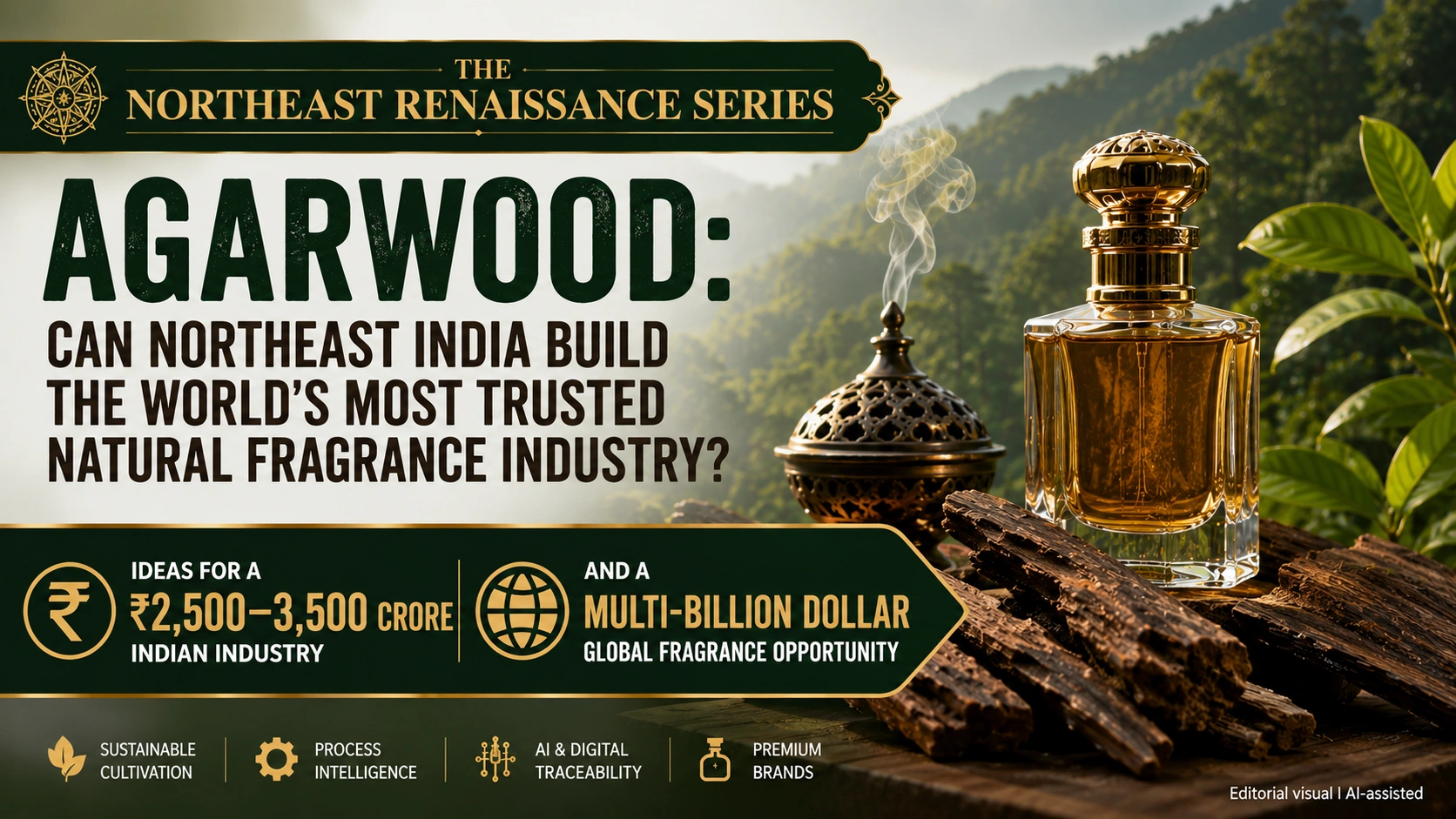
Agarwood: Can Northeast India Build the World’s Most Trusted Natural Fragrance Industry?
Northeast Renaissance Series
From the forests of Assam to the luxury perfume houses of the world, how science, sustainability and trust can transform one of Northeast India’s oldest natural resources into a globally respected premium industry.
For decades, discussions on economic development in Northeast India have revolved around increasing agricultural production, improving infrastructure and attracting industrial investment. Yet history suggests that regions rarely achieve lasting prosperity merely by producing more raw materials. They prosper when they transform those resources into globally recognised products, trusted brands and knowledge-driven industries.
Agarwood presents Northeast India with precisely such an opportunity.
Across the world, the resinous heartwood of the agar tree is revered as one of nature’s rarest aromatic treasures. Distilled into the precious oil known as oud, it has found its way into royal palaces, luxury perfume houses, religious ceremonies and wellness traditions for centuries. A few millilitres of premium-grade agarwood oil can command extraordinary prices in international markets, making it one of the world’s most valuable natural fragrance ingredients.
Yet the real opportunity before Northeast India is not simply to grow more agarwood trees.
The greater opportunity is to become the world’s most trusted source of authentic, sustainably produced and scientifically verified natural fragrances. In an era where consumers increasingly seek transparency, traceability and environmental responsibility, trust itself may become the region’s most valuable export.
This is not merely a story about a forest tree.
It is the story of how biodiversity can become biotechnology, how traditional knowledge can inspire modern innovation, and how a resource that quietly grew around rural homes for generations can evolve into the foundation of a globally competitive knowledge economy.
That journey has already begun.
Born from the Forest
Some of my earliest memories of agarwood take me back to the early 1970s.
Whenever agarwood buyers arrived in our village in Upper Assam, there was a quiet sense of anticipation. They travelled from one household to another searching for naturally growing Sanchi trees. Once they identified a mature tree, it was carefully felled, split open and examined piece by piece. Most of the wood held little commercial value. The buyers were searching for something hidden deep within the trunk—the dark, resin-rich heartwood formed over many years through a natural biological process.
Those fragrant pieces were carefully separated, packed into gunny bags and taken away.
As children, we watched the entire process with curiosity but without understanding its significance. To us, the Sanchi tree was simply another familiar part of the rural landscape. Similar trees stood quietly around homes and villages across districts such as Golaghat and Jorhat, blending effortlessly into everyday life.
Only much later did I realise that those ordinary-looking trees were producing one of the world’s most sought-after natural fragrance ingredients. The resin hidden within them would eventually find its way into luxury perfumes, sacred incense, traditional medicine and premium wellness products across the Middle East, Japan, Europe and other international markets.
Looking back today, I often wonder how many fortunes quietly left our villages in those gunny bags, long before most of us understood what they contained.
That memory is no longer simply a childhood recollection.
It is a reminder that Northeast India has always possessed extraordinary natural wealth. What the region lacked was not resources, but the scientific knowledge, policy support, entrepreneurship and market access required to unlock their full economic potential.
Today, those missing pieces are gradually beginning to come together.
Why This Matters
Natural resources have shaped the fortunes of nations throughout history. Yet the countries that have achieved the greatest prosperity are rarely those with the largest reserves of raw materials. Instead, they are the ones that learned how to add value through research, innovation, branding and world-class manufacturing.
Switzerland built a global reputation for precision rather than simply exporting steel.
Italy became synonymous with luxury design instead of leather alone.
France transformed fragrant flowers into a perfume industry recognised across the world.
Each of these economies demonstrates an important lesson. Sustainable prosperity is created not by extracting resources but by building ecosystems that combine science, skilled human capital, technology and globally respected brands.
The same lesson applies to agarwood.
For centuries, agarwood was valued primarily as a forest product collected from naturally occurring trees. Today, however, the industry is undergoing a profound transformation. Scientific cultivation, improved inoculation techniques, laboratory testing, premium fragrance formulation and digital traceability are redefining how value is created across the global supply chain.
Consumers are also changing.
Luxury buyers no longer ask only whether a fragrance smells exceptional. They increasingly want to know where its ingredients originated, whether forests were sustainably managed, whether farming communities benefited and whether the product they are purchasing is genuinely authentic.
In other words, modern consumers are buying far more than fragrance. They are investing in provenance, sustainability and trust.
That shift creates an extraordinary opportunity for Northeast India.
From Forest Resource to Global Luxury
Agarwood occupies a unique position among the world’s natural products because its value emerges through an extraordinary biological process.
Unlike timber, where healthy wood represents the primary product, agarwood derives its commercial value from a natural defence mechanism. When the tree is injured or exposed to specific microorganisms, it gradually produces a dark aromatic resin that protects the damaged tissue. Over many years, this resin transforms portions of the heartwood into one of the most prized natural fragrance materials known to humanity.
Nature, in effect, converts adversity into rarity.
This remarkable characteristic has fascinated civilisations for thousands of years. Ancient cultures across Asia and the Middle East treasured agarwood for religious ceremonies, meditation, traditional healing practices and royal courts. Its rich, complex aroma eventually became one of the defining ingredients in luxury perfumery, where genuine oud continues to command immense respect among fragrance connoisseurs.
For much of history, however, the industry depended largely on harvesting naturally occurring trees, a practice that placed immense pressure on wild populations.
That model is steadily changing.
Scientific plantation-based cultivation, coupled with improved inoculation techniques, has demonstrated that economic development and environmental stewardship can coexist. Farmers are increasingly viewing agarwood not as a forest resource to be extracted but as a long-term agricultural investment capable of generating sustainable livelihoods while reducing pressure on natural forests.
This transition represents far more than a change in cultivation practices.
It marks the evolution of agarwood from a forest product into a sophisticated bio-based industry.https://thequantiq.com/natural-colours-green-textile-chemistry-northeast-india/
A Global Industry Looking for Trust
The global fragrance industry is evolving at a remarkable pace.
Luxury perfume houses, wellness brands and premium cosmetic companies are increasingly seeking natural ingredients that meet the highest standards of quality, sustainability and authenticity. Regulatory expectations are also becoming more stringent, with international buyers demanding greater transparency throughout the supply chain.
For producers, this represents both a challenge and an opportunity.
The future will not belong solely to those capable of producing the largest volumes of agarwood. It will belong to those capable of demonstrating consistent quality, scientific credibility and complete traceability from plantation to finished product.
That distinction is important. Selling raw wood generates income. Selling authenticated premium ingredients creates significantly greater value. Building globally trusted fragrance brands creates even more.
Northeast India therefore stands at an important crossroads. It can remain primarily a supplier of raw materials, or it can position itself at the centre of a globally respected fragrance ecosystem that combines cultivation, biotechnology, research, premium manufacturing and luxury branding.
The decisions taken over the coming decade will determine which path the region ultimately follows.
Why Northeast India Holds a Strategic Advantage
Every globally respected industry begins with one undeniable advantage. Switzerland became known for precision engineering, Japan for manufacturing excellence and France’s Grasse region for perfumery. However, these regions did not achieve global leadership simply because they possessed valuable natural resources. Instead, they built complete ecosystems that combined research, skilled professionals, innovation, quality standards and internationally recognised brands.
Northeast India possesses a similarly rare advantage. The region enjoys abundant rainfall, a humid subtropical climate and extraordinary biodiversity. Moreover, communities across Assam and neighbouring states have lived alongside agarwood for generations. Together, these factors create conditions that very few regions in the world can replicate.
Today, Assam, along with parts of Tripura, Arunachal Pradesh, Meghalaya and Nagaland, has emerged as one of India’s most important centres for cultivated agarwood. Thousands of farmers have already shown that scientific plantation-based cultivation can generate sustainable livelihoods while reducing pressure on natural forests. As a result, the region has established a strong foundation for future growth.
Nevertheless, natural advantages alone are not enough. The next phase of global competition will not be determined by who grows the largest number of agarwood trees. Instead, it will favour those who produce the highest-quality oils, build internationally trusted brands, invest in scientific research and develop integrated value chains that inspire confidence among buyers.
Consequently, Northeast India has an opportunity to move beyond supplying raw material. The region can position itself as one of the world’s most trusted natural fragrance ecosystems. To achieve that ambition, governments, researchers, entrepreneurs and educational institutions must work together. Only then can Northeast India transform its natural advantage into lasting global leadership.
A New Policy Environment is Creating New Possibilities
For many years, agarwood represented both opportunity and uncertainty.
Although demand for agarwood products continued to grow internationally, regulatory complexities surrounding harvesting, transportation and trade often discouraged farmers and investors. Many landowners hesitated to cultivate agarwood because they were unsure about future legal procedures, while entrepreneurs found it difficult to build long-term business plans around an uncertain policy environment.
Over the past decade, however, Assam has gradually begun creating a more supportive framework for plantation-grown agarwood.
This policy shift reflects an important change in thinking.
Instead of treating agarwood merely as a forest resource requiring regulation, policymakers have increasingly recognised it as a high-value agricultural and bio-economy opportunity capable of generating rural income, exports and employment. Greater policy clarity has encouraged plantation development, private investment and scientific cultivation practices that balance commercial growth with environmental responsibility.
Policy alone, however, cannot build a globally competitive industry.
Successful industries emerge when supportive governance is complemented by research institutions, skilled professionals, innovative entrepreneurs and internationally accepted quality standards. Assam has already begun moving in that direction, but the journey has only just begun.https://thequantiq.com/medicinal-plants-botanical-extract-industry-northeast-india/
Ajmal and Anfar Have Already Proven That Global Brands Can Be Built from Assam
Perhaps the strongest evidence that Northeast India can lead the global fragrance industry already exists.
It exists in brands.
Long before agarwood became a mainstream topic in economic development discussions, fragrance houses such as Ajmal and Anfar, both founded by entrepreneurs from Assam, demonstrated that products rooted in the region’s natural heritage could earn international recognition.
Their achievements carry an important lesson.
The greatest value in the agarwood industry is not created when a tree is harvested.
It is created when science, craftsmanship, formulation, branding and consumer trust transform a natural ingredient into a premium global product.
Every bottle of luxury perfume represents the work of chemists, perfumers, quality specialists, designers, marketers and international distributors. By the time the product reaches a customer, its value has multiplied many times beyond the price of the original raw material.
This is precisely the transition Northeast India must accelerate.
Instead of measuring success primarily through the export of wood chips or crude oil, the region should aspire to create internationally recognised fragrance houses, specialised ingredient manufacturers, premium wellness brands and high-value consumer products carrying the identity of Northeast India into global markets.
Why Process Intelligence is the Real Competitive Moat
One of the defining characteristics of the artificial intelligence era is that information alone no longer creates competitive advantage. Processes do.
Two producers may cultivate agarwood under similar climatic conditions and harvest trees of comparable age. Yet one consistently earns higher prices because every stage of production is carefully documented, scientifically validated and internationally certified.
That difference is not accidental. It is the result of process intelligence.
Process intelligence begins long before harvesting. It includes selecting superior planting material, maintaining healthy plantations, following scientifically validated inoculation techniques, monitoring resin formation, applying standardised distillation methods, conducting laboratory analysis and maintaining complete documentation throughout the supply chain.
Each stage strengthens confidence. Each documented process reduces uncertainty. Each quality assurance step enhances trust.
In today’s premium markets, buyers increasingly ask questions that would have been uncommon only a decade ago. They want to know where the tree was grown, how old it was, whether sustainable practices were followed, how the oil was extracted and whether independent testing confirms its authenticity.
These questions reflect an important transformation in global commerce. Luxury consumers no longer purchase products based solely on appearance or aroma. They purchase confidence.
That is why process intelligence—the systematic ability to collect, analyse, verify and continuously improve every stage of production—will become one of Northeast India’s greatest competitive advantages if developed effectively.
The AI Era: From Plantation to Perfume Bottle
Artificial intelligence is rapidly reshaping industries ranging from agriculture and healthcare to manufacturing and logistics. The agarwood sector is unlikely to remain untouched by this transformation.
Imagine a future plantation where satellite imagery detects crop stress before symptoms become visible to farmers. Ground-based sensors continuously monitor soil moisture, humidity and temperature, allowing AI systems to recommend precise irrigation schedules and identify environmental conditions favourable for resin development.
Computer vision could help estimate tree growth and monitor plantation health, while machine learning models may eventually assist researchers in predicting optimal inoculation timing based on local climatic conditions.
The transformation continues after harvesting.
Laboratories equipped with advanced analytical instruments can use artificial intelligence to evaluate the chemical composition of agarwood oil, improving quality consistency and helping producers meet the demanding specifications of international fragrance houses.
The finished product itself may carry a digital identity.
Blockchain-enabled traceability systems could record every stage of production—from plantation location and cultivation practices to harvesting dates, laboratory testing and export documentation. A simple QR code on a perfume bottle may one day allow consumers anywhere in the world to verify its complete journey.
Such transparency is no longer a futuristic concept.
Across the premium food, coffee, wine and luxury goods sectors, digital traceability is rapidly becoming an expectation rather than a novelty.
The fragrance industry is likely to follow the same path.
For Northeast India, this represents an opportunity to compete not only through biodiversity but also through technological leadership.
From Natural Resource to Global Centre of Excellence
The future of agarwood should never be measured solely by the number of trees planted or tonnes exported.
Those indicators matter, but they tell only part of the story.
The larger ambition should be to build an ecosystem where scientific research, sustainable cultivation, fragrance formulation, premium manufacturing, international branding and advanced technologies reinforce one another.
When the world thinks of Swiss watches, precision comes to mind.
When it thinks of Silicon Valley, innovation follows.
When it thinks of Grasse, it thinks of perfume.
One day, when consumers think of authentic, sustainably produced natural agarwood, there is every reason they should think of Northeast India.
Achieving that vision will require patience, collaboration and sustained investment. Yet history repeatedly shows that industries capable of combining nature with knowledge create far greater prosperity than those that rely on natural resources alone.
That is the opportunity now standing before Northeast India.
Opportunity Snapshot
| Indicator | Indicative Estimate |
|---|---|
| Global Agarwood Market | US$ 35–40 Billion (including perfumes, oud oil, incense and luxury fragrance products) |
| India Agarwood & Oud Industry | ₹2,500–3,500 Crores (rapidly expanding) |
| Indicative Initial CapEx | ₹75 Lakhs–₹3 Crores (distillation, oil extraction, value addition and small-scale manufacturing) |
| Indicative ROI Window | 5–8 Years (depending on plantation maturity and business model) |
| Potential Gross Margin | 35–60% (value-added fragrance products significantly outperform raw material exports) |
| Employment Potential | High (cultivation, distillation, laboratories, perfumery, branding, exports, tourism and AI applications) |
| Export Opportunity | Very Significant (Middle East, Europe, Japan, Southeast Asia and North America) |
Note: Figures are indicative estimates compiled from industry reports, government publications and market analyses. They are intended to provide directional understanding rather than investment advice.
Learn More: Where Your Journey Can Begin
One of the defining characteristics of successful industries is that they invest continuously in human capital. Knowledge transforms natural resources into globally competitive products, and learning is the first step in that transformation.
Students interested in fragrance science and entrepreneurship should explore specialised institutions that combine technical education with practical industry exposure.
The Fragrance & Flavour Development Centre (FFDC), Kannauj, established with the support of the Government of India, has played a pioneering role in promoting essential oils, perfumery, fragrance formulation and aroma-based entrepreneurship. Its programmes are particularly relevant for students seeking an understanding of India’s traditional and modern fragrance industries.https://www.ffdcindia.org/
Internationally, ISIPCA (Institut Supérieur International du Parfum, de la Cosmétique et de l’Aromatique Alimentaire) in Versailles, France, remains one of the world’s most respected institutions dedicated to perfumery, cosmetics and flavour sciences. Several introductory and executive programmes are now accessible online, allowing learners from India to gain exposure to global best practices without immediately relocating overseas.
The digital era has dramatically reduced barriers to learning. A student from a small town in Assam today can access lectures, certification programmes and global industry knowledge that were once available only to professionals working in established perfume capitals.
The journey towards building a fragrance industry therefore begins not in a laboratory or a factory, but in the willingness to learn.https://www.isipca.fr/en/en/home-isipca
The Quantiq Assessment
The conversation surrounding agarwood should no longer be confined to plantations, exports or commodity prices.
The larger question is whether Northeast India can build an internationally respected fragrance economy.
The distinction is important.
Commodity economies generate income by selling natural resources. Knowledge economies generate prosperity by combining science, technology, skilled talent, intellectual property and globally recognised brands. History consistently demonstrates that regions mastering value addition capture significantly greater economic benefits than those exporting raw materials alone.
Northeast India already possesses several critical advantages. It has favourable agro-climatic conditions, a long cultural association with agarwood, experienced entrepreneurs, emerging policy support and growing scientific expertise. These strengths provide a strong foundation, but they are not sufficient on their own.
The next stage of development must focus on institutions.
The region needs advanced testing laboratories capable of certifying quality according to international standards. Universities should introduce specialised programmes in fragrance chemistry, essential oil technology and sensory sciences. Research organisations must continue improving cultivation techniques, inoculation technologies and sustainable plantation management. Entrepreneurs should invest in premium consumer brands rather than limiting themselves to commodity exports, while digital technologies such as artificial intelligence and blockchain can strengthen quality assurance and traceability across the entire value chain.
This integrated approach reflects what The Quantiq has consistently described as process intelligence.
Competitive advantage in the twenty-first century will increasingly belong to those who master processes rather than merely possessing resources. Every carefully documented cultivation practice, every laboratory report, every quality certification and every traceable supply chain contributes to building one invaluable asset—trust.
Ultimately, the greatest export from Northeast India should not simply be agarwood.
It should be confidence in every product that carries the region’s name.





3 Comments