India Leads the World in AI Talent. The Northeast Isn’t Yet in the Data.
What the Stanford AI Index 2026 reveals—and why Northeast India must begin measuring its own AI economy.
Artificial intelligence is no longer a technology waiting for tomorrow. It has quietly become part of everyday life—helping businesses draft reports, farmers monitor crops, entrepreneurs market their products, and students learn in entirely new ways. Across the world, AI adoption is accelerating at a pace few technologies have achieved before.
The latest Stanford AI Index 2026, widely regarded as one of the world’s most authoritative annual assessments of artificial intelligence, captures this transformation with remarkable clarity. Its findings confirm that AI has moved well beyond research laboratories and technology companies. It is becoming an economic infrastructure.
For India, the report carries encouraging news. The country is emerging as one of the world’s leading AI talent hubs, with professionals adopting AI tools faster than almost anywhere else. Yet for Northeast India, the report tells a different story—not because the region lacks potential, but because it remains largely invisible in the datasets that shape the global understanding of India’s AI economy.
That absence is more than a statistical curiosity. In the age of artificial intelligence, what is not measured is rarely recognised, and what is not recognised often struggles to attract investment, policy attention, and opportunity.https://meity.gov.in/
India’s AI Moment
The Stanford AI Index 2026 paints a picture of extraordinary global momentum.
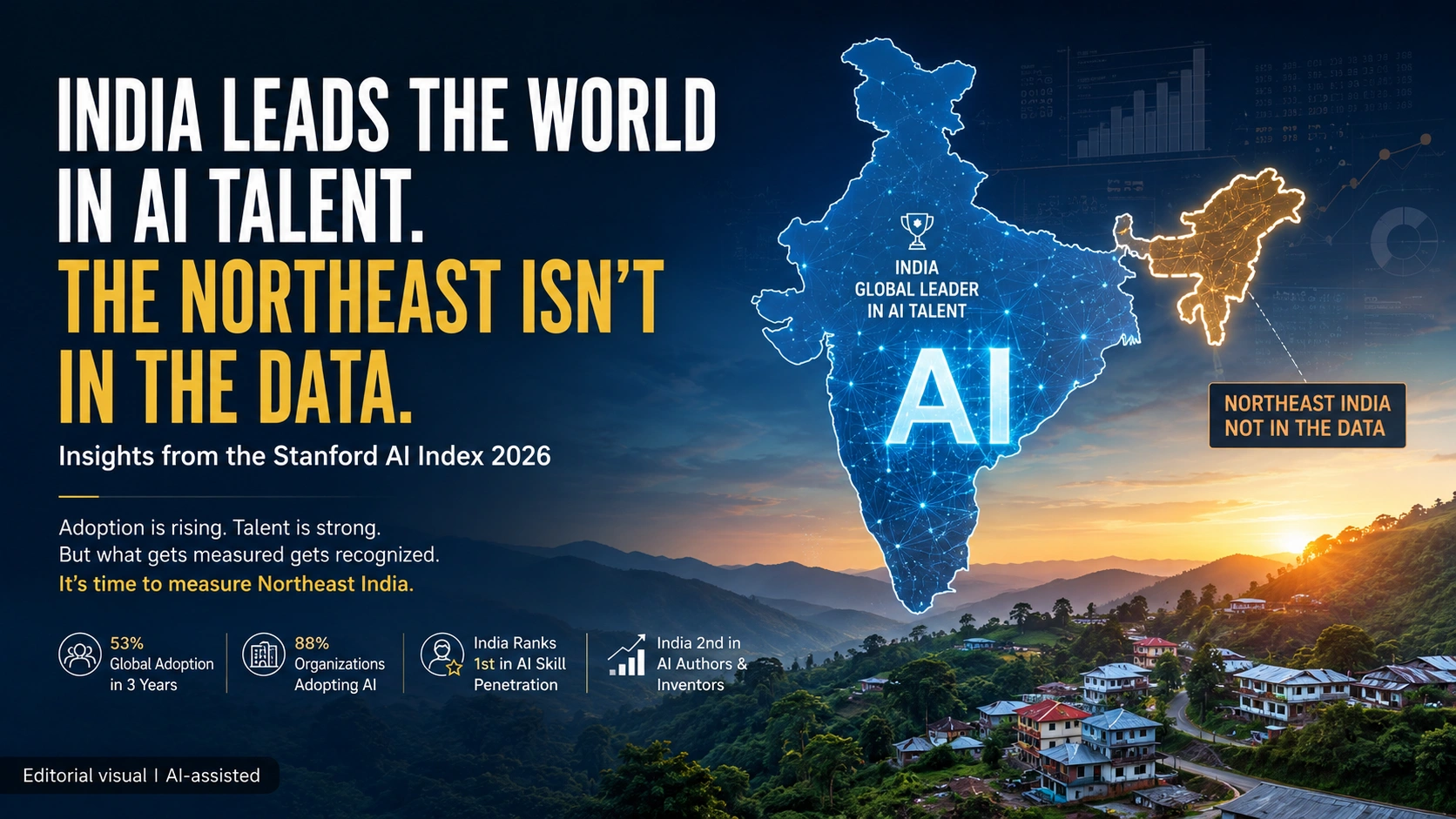
Generative AI has reached 53% of the world’s population within just three years, making it one of the fastest-adopted technologies in modern history. Across industries, organisations are integrating AI into daily operations at unprecedented speed, with 88% of surveyed companies reporting some level of AI adoption. In the United States alone, researchers estimate that generative AI now creates an annual consumer surplus of approximately US$172 billion, reflecting the enormous economic value users derive from these tools.
India’s performance stands out even more.
According to the report, India ranks among the world’s leading AI talent ecosystems, placing second in the combined measure of AI authors and inventors. On LinkedIn’s AI Skill Penetration Index, India holds the top global position, indicating that AI-related skills appear in Indian professionals’ profiles at a significantly higher rate than the global average.
Perhaps the most striking finding is how rapidly AI is becoming part of everyday work. More than 80% of Indian employees report using AI tools regularly in their jobs, placing India among the world’s leading adopters of workplace AI.
The report also offers a useful reminder that technological progress brings mixed emotions. While enthusiasm for AI continues to grow, India recorded the world’s largest increase in AI-related anxiety over the past year. As AI becomes more capable and widespread, excitement and uncertainty are advancing side by side.
Taken together, these findings point to a country that is not merely consuming AI but increasingly shaping its future through talent, skills and adoption.https://indiaai.gov.in/
The Missing Northeast Story
For all its strengths, however, the Stanford AI Index leaves one important question unanswered.
Where does Northeast India fit into this national success story?
The report provides a comprehensive picture of India’s AI ecosystem at the national level, but it does not separately report data for the eight Northeastern states. As a result, it is impossible to determine how much of India’s impressive AI progress is being driven—or shared—by the region.
That does not mean Northeast India is absent from the AI economy.
Across Assam and the neighbouring states, entrepreneurs are already experimenting with AI-powered marketing, content creation, tourism services, agriculture, education and business automation. Tea producers are exploring data-driven cultivation. MSMEs are beginning to use generative AI for documentation and customer engagement. Educational institutions are introducing AI into classrooms, while startups are quietly integrating AI into products and services.
The challenge is not necessarily a lack of activity.
The challenge is a lack of visibility.
Without credible regional datasets, Northeast India’s AI journey remains largely undocumented. National rankings cannot reveal local progress that has never been measured, and global reports cannot showcase achievements that are absent from the underlying data.
In today’s digital economy, data is more than evidence—it is representation. Regions that measure themselves are able to demonstrate progress, influence policy discussions and attract investment. Those that remain statistically invisible risk being overlooked, regardless of their actual potential.
For Northeast India, that may be the most important message hidden within the Stanford AI Index.
From Blind Spot to Opportunity
The absence of Northeast India from global AI datasets should not be seen as a weakness. Instead, it should be viewed as a challenge waiting to be solved.
The first gap is one of measurement.
Despite India’s remarkable AI progress, there is no publicly available regional benchmark that tracks how businesses, educational institutions or entrepreneurs across Northeast India are adopting artificial intelligence. Without such baseline data, it becomes difficult to answer even simple questions. How many MSMEs are using AI? Which industries are adopting it fastest? Where are the skills gaps? Which districts are emerging as innovation clusters?
If these questions cannot be answered, informed policymaking becomes far more difficult.
The second gap is talent visibility.
The Stanford AI Index notes that migration of AI researchers to the United States has declined sharply in recent years, suggesting that more AI talent is choosing to build careers closer to home. For India, this presents an important opportunity. But how much of that talent is contributing to Northeast India’s economy? Are graduates from the region returning to build companies? Are local universities producing AI-ready professionals? At present, there is little publicly available evidence to answer these questions with confidence.
The third gap is governance.
The Stanford report observes that AI adoption is advancing faster than the policies designed to support it. That observation applies nationally, but it is even more relevant for emerging regions like Northeast India. While several states have begun discussing AI within their broader digital and innovation agendas, measurable targets for AI adoption, workforce development or sector-specific implementation remain limited in the public domain.
Bridging these gaps is not simply the responsibility of governments.
Universities, industry associations, chambers of commerce, startup ecosystems and independent research organisations all have a role to play in building the region’s AI knowledge base.
A Strategic Opportunity for Northeast India
Every major economic transformation creates new leaders—not only those who build the technology, but also those who build the intelligence around it.
For Northeast India, that opportunity may lie in becoming one of India’s best-documented regional AI economies.
Imagine an annual Northeast AI Adoption Index that tracks how tea estates are using predictive analytics, how tourism businesses are deploying AI-powered customer services, how handloom enterprises are improving market access through generative AI, or how educational institutions are preparing students for an AI-driven economy.
Such a dataset would do more than inform policymakers. It would provide investors, entrepreneurs, researchers and development agencies with credible evidence about where opportunities exist and where intervention is needed.
For businesses, the benefits are equally significant. Companies adopting AI for export documentation, quality inspection, customer engagement, logistics or financial management are creating practical case studies that deserve wider visibility. These stories can inspire other enterprises while demonstrating that AI adoption is not limited to metropolitan technology firms.
The region already possesses unique strengths in sectors such as tea, agri-business, tourism, bamboo, handloom and food processing. Combining these traditional industries with responsible AI adoption could create a distinctive model of innovation—one rooted not in scale alone, but in regional expertise and sustainable value creation.
Rather than asking whether Northeast India can compete with India’s established technology hubs, the more meaningful question is this:
Can the region become India’s most intelligent producer economy—where AI strengthens traditional industries instead of replacing them?
Answering that question begins with something surprisingly simple.
First, the region must start measuring itself.
The Quantiq Verdict
The Stanford AI Index 2026 confirms that India has firmly established itself as one of the world’s leading AI nations. The country possesses a deep and expanding talent pool, professionals are adopting AI at an exceptional pace, and businesses are integrating artificial intelligence into everyday operations faster than ever before.
What the report cannot tell us is equally important.
It cannot tell us how much of this transformation is taking place in Northeast India because the region is largely absent from the datasets that shape global AI narratives.
That absence should not be mistaken for inactivity.
Across the region, entrepreneurs, educators, MSMEs and professionals are already experimenting with AI in practical ways. Yet without systematic measurement, these efforts remain isolated stories rather than evidence of a regional transformation.
For Northeast India, the next frontier is not merely adopting AI—it is documenting, measuring and understanding its adoption.
A regional AI Adoption Index, periodic enterprise surveys and sector-specific intelligence for industries such as tea, tourism, agriculture, handloom, bamboo and food processing would provide policymakers and investors with something the region currently lacks: credible evidence.
The AI economy will not be built by technology alone. It will also be built by the quality of the data used to understand it.
The Stanford AI Index has shown where India stands today.
The next question is whether Northeast India will become a visible contributor to that story—or remain an invisible one.
At The Quantiq, we believe the answer begins with measurement.
Because in the age of artificial intelligence, what gets measured gets recognised—and what gets recognised creates opportunity.