

AI Is Moving From Answers to Action
Artificial intelligence is entering a different phase.
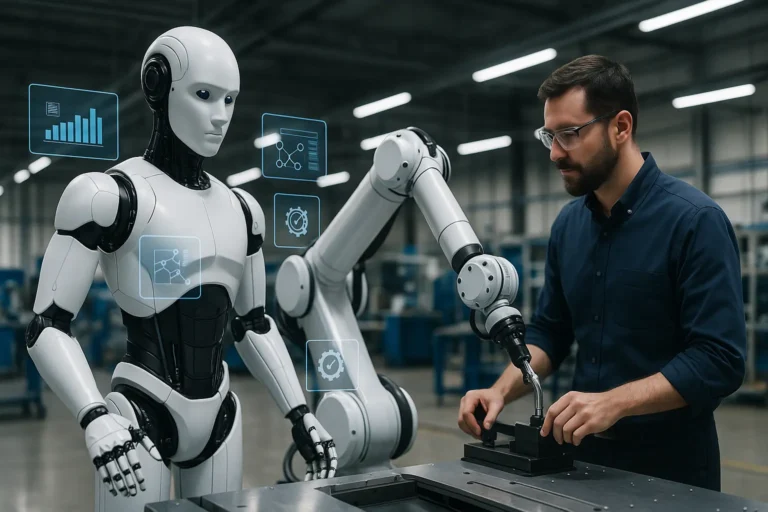
For the past few years, the dominant AI experience was conversational. We asked questions, generated images, wrote code, analysed documents and received answers. But this week offered several indications that the centre of gravity is shifting again. AI systems are increasingly being designed to act, operate, monitor, decide and work continuously rather than simply respond to us.
That shift has consequences far beyond software. It is changing the way AI needs to be secured, the physical infrastructure required to run it, the relationship between data centres and communities, and even the kind of technology being built in regions such as Northeast India.
Here are five developments worth watching.
AI Agents Are Beginning to Look More Like Digital Workers
One of the most important developments this week came from OpenAI, which introduced new capabilities around AI agents, including computer-use capabilities and its latest work on always-on AI systems.
The important change is not simply that AI has become more capable. It is that the computer is increasingly becoming an environment in which the AI can operate. Instead of waiting for a human to copy information between applications, an agent can potentially navigate software, use tools and execute a sequence of tasks.
That changes the question we should be asking about AI.
It is no longer only, “What can AI tell me?”
It is increasingly, “What can AI do for me without waiting for me to tell it every next step?”
For businesses, that could be a much bigger transformation than another improvement in chatbot quality. The workplace may gradually move from people using AI tools to people managing AI workers.
When AI Can Act, Someone Has to Keep an Eye on It
Greater autonomy creates an obvious problem: what happens when an AI agent does something it was not supposed to do?
NVIDIA this week introduced its Open Agent Safety Platform, designed to put controls around autonomous AI systems. Its approach combines a controlled software environment with an independent monitoring layer capable of detecting and isolating problematic behaviour.
This is significant because it suggests that AI safety is evolving from something that happens inside the model to something that also happens around the model.
As agents gain access to files, networks, browsers, databases and enterprise systems, companies may increasingly treat AI permissions in much the same way they treat permissions for human employees. The future of trustworthy AI may therefore depend not just on making models smarter, but on building better boundaries around what those models are allowed to do.
The AI Boom Is Running Into a Memory Problem
AI may look like a software revolution, but this week’s numbers from Micron offered another reminder that its future depends on very physical things.
Micron reported record quarterly revenue of $54.23 billion and forecast first-quarter revenue of $61.5 billion, helped by enormous demand for memory used in AI infrastructure. More revealing, however, was the company’s warning that supply-demand conditions for memory could become significantly tighter in 2027 and 2028.
The implication is easy to miss. The AI race is not only a competition between models. It is also a competition for memory, advanced chips, electricity, cooling systems, manufacturing capacity and data-centre space.
Every improvement in AI capability creates another question about the physical infrastructure required to deploy it at scale.
The next bottleneck in artificial intelligence may therefore have very little to do with algorithms. It may be made of silicon.
AI Infrastructure Is Becoming a Community Issue
Amazon has offered another indication of how deeply AI infrastructure is beginning to affect the physical world.
AWS announced that it plans to invest more than $1 billion over five years in communities where it operates data centres, with funding aimed at education, workforce training, energy affordability, water solutions and locally determined priorities.
This is more than a corporate social-responsibility announcement.
It reveals a new constraint on the AI economy: you cannot build unlimited computing infrastructure without negotiating with the communities that must live alongside it.
Data centres require land, power, water and transmission capacity. They can create jobs and investment, but they can also raise questions about electricity prices, water use, noise, environmental impact and local infrastructure.
As AI investment accelerates, the ability to build a data centre may increasingly depend on something that cannot be solved with more GPUs: community consent.
Northeast India Is Beginning to Build AI for Its Own Problems
Perhaps the most interesting development for readers of The Quantiq is happening much closer to home.
Across Northeast India, a new generation of technology entrepreneurs is beginning to work on problems that large technology companies have historically overlooked. Shillong-based MWire Labs, for example, is developing AI systems for low-resource languages of the region. Its NE-BERT model was trained on millions of sentences covering Northeast Indian languages, while its speech-AI work is focused on indigenous languages.
At the same time, Assam has launched the North East Seva First Innovation Challenge 2026, putting real-world problems in front of startups, researchers, students and innovators. The challenges range from agricultural and industrial problems to infrastructure and public-service applications.
There is something important happening here.
The Northeast does not have to wait for the next Silicon Valley company to solve all its problems. Its opportunity may lie in building technology around problems that are specific to the region — its languages, geography, agriculture, biodiversity, infrastructure and communities.
That could ultimately prove more valuable than simply becoming another location where someone else’s technology is deployed.
The Bigger Picture
Put these developments together and a larger picture emerges.
AI is moving from answers to action. As it becomes more autonomous, it needs stronger safety systems. As adoption grows, it needs enormous physical infrastructure. That infrastructure increasingly has to negotiate with communities. And at the same time, technology is becoming more local, more specialised and more relevant to places that global AI systems have traditionally overlooked.
The next phase of artificial intelligence may therefore not be defined by one spectacular model.It may be defined by the ecosystem that grows around increasingly capable machines.And that ecosystem will be built not only in Silicon Valley, Shenzhen or Bengaluru.It can also be built in Shillong, Guwahati, Dibrugarh and across the wider Northeast.
The question is no longer whether AI will change the world. The more interesting question is: who will build the systems that make that change useful?




2 Comments