Everyone Is Using AI. But Are We Making Better Decisions?
The real test of artificial intelligence is not how much content we can generate, but whether it helps us make better choices. For India’s businesses, that distinction could determine whether AI becomes a competitive advantage or merely another digital habit.
A generation ago, Yahoo Messenger was one of the ways people discovered the pleasures of being constantly connected. Conversations stretched late into the night. Status messages became a form of expression, and the simple act of being online could feel like an activity in itself.
The technology was useful. But its popularity also raised a question that remains relevant today: were we using the tool to accomplish something meaningful, or had using the tool itself become the activity?
Artificial intelligence presents a more consequential version of that question.
Today, people turn to AI to write emails, create presentations, generate images, summarise documents, prepare reports and solve everyday problems. Businesses are experimenting with chatbots, automated customer support and AI-generated marketing content. The technology is becoming easier to access, and the temptation to use it for almost everything is growing.
Yet a crucial distinction often gets lost in the excitement. Producing something faster is not necessarily the same as making a better decision.
A business can generate hundreds of social media posts with AI and still misunderstand its customers. A sales team can produce polished presentations without identifying the right buyers. A company can automate its reporting while continuing to make poor pricing, inventory or investment decisions.
The question, therefore, is not simply whether we are using AI. It is whether we are using it to improve the quality of our decisions.
The difference between generating output and creating value
Much of the public conversation about generative AI focuses on visible outputs: text, images, videos, presentations and code. These applications matter. They can save time, reduce repetitive work and help individuals and small businesses do things that previously required more resources.
But output is only one part of how organisations create value.
Every business also makes a continuous series of decisions. Which customer should receive priority? Which product deserves more investment? What should be manufactured next month? Which supplier offers the best combination of cost, quality and reliability? Which market offers a realistic opportunity for expansion?
These decisions determine what a business produces, where it invests, how it manages risk and whether it grows profitably.
AI can help with these questions, too. It can analyse historical sales, compare alternatives, identify patterns, test assumptions and generate scenarios that a busy manager might not have the time to explore independently.
The difference is significant.
When AI writes a marketing email, it helps a business create content faster. But AI can do more than that. It can identify which customer groups respond best to a product. Businesses can use these insights to allocate their marketing budgets more effectively and improve conversion rates. This makes it easier to measure AI’s real business value.
This is not an argument against content generation. It is an argument for looking beyond it.
The ultimate measure of AI adoption should be the value created, not the volume of material produced.
How India’s MSMEs Can Use AI Better
India’s micro, small and medium enterprises (MSMEs) have much to gain from AI. Many operate with limited working capital and lean teams. Founders often handle sales, procurement, staffing and financial decisions themselves.
AI can improve productivity without requiring every business to build an in-house technology team. The key is to apply it to specific business needs rather than adopt it simply because it is available.
Move Beyond Content Creation
Consider a small manufacturer supplying components to larger companies. AI can help prepare product descriptions and social media posts. It can also analyse sales and inventory records to flag slow-moving stock, anticipate cash-flow pressure and identify changes in demand.
Similarly, an enterprise in Assam seeking customers beyond the Northeast can use AI to research potential export markets. With reliable data, it can compare demand, transport costs, applicable standards, competition and likely profit margins.
Content creation can improve visibility, but decision support can help businesses choose where to focus their resources. Both have value. The right application depends on the business’s immediate needs and priorities.
What MSME Adoption Figures Tell Us
A joint Confederation of Indian Industry–Indian School of Business study, reported by Business Standard on 13 October 2026, offers a useful indication of adoption among surveyed businesses. Of the 2,919 confirmed MSMEs in its analytical sample, 65.8 per cent reported using AI tools, while 21 per cent used enterprise resource planning or customised business software.
Business communication, content creation and training were among the reported AI applications.
However, the study used a voluntary survey that was not probability-weighted to represent all Indian MSMEs. Its findings should therefore be interpreted as evidence about the surveyed businesses, not as a definitive estimate of AI adoption across the sector.
The figures raise an important question: how can businesses move from experimenting with accessible AI tools to integrating them into their core operations?
India’s AI Opportunity Goes Beyond Access
The IndiaAI Mission, approved with an outlay of ₹10,371.92 crore, supports initiatives covering computing capacity, datasets, application development, skills, startup financing and safe and trusted AI.
These efforts can help expand access to AI capabilities. But access alone will not guarantee better business outcomes. MSMEs also need reliable data, relevant skills and sound processes to evaluate AI recommendations and measure results.
The next stage of adoption is not simply about getting more businesses to use AI. It is about helping them apply it where it can make a measurable difference.
The hidden risk: when assistance becomes dependence
There is another side to the discussion.
AI can help people consider alternatives they might otherwise overlook. It can challenge assumptions, summarise complex material and make analysis more accessible. But its fluency can also create an illusion of reliability.
A confident answer is not necessarily a correct answer. An apparently precise recommendation may rest on incomplete information, outdated assumptions or patterns that do not apply to the situation at hand.
Research published in Computers in Human Behavior in 2024 examined over-reliance on AI advice through an interactive behavioural experiment. The researchers found that participants sometimes followed AI-generated advice even when it conflicted with available contextual information and their own assessment.
The finding does not establish that everyone who uses AI becomes less capable of independent judgment. It does, however, highlight a genuine risk: people can give a recommendation undue weight simply because it comes from an AI system.
The US National Institute of Standards and Technology has also identified automation bias—excessive deference to automated systems—as a risk in its Artificial Intelligence Risk Management Framework: Generative Artificial Intelligence Profile.
For business leaders, the implication is straightforward. AI should be capable of explaining its reasoning, identifying uncertainty and presenting evidence that can be checked. Users should be prepared to challenge its conclusions rather than accept them merely because they sound convincing.
This becomes particularly important when decisions affect people’s employment, access to credit, eligibility for services or other consequential interests. In such situations, accuracy is only one consideration. Fairness, transparency, accountability and the ability to question a decision matter as well.
Human oversight should not be a ceremonial final click after an AI system has already determined the outcome. It should be a meaningful part of the decision process.
Introducing the AI Decision Matrix
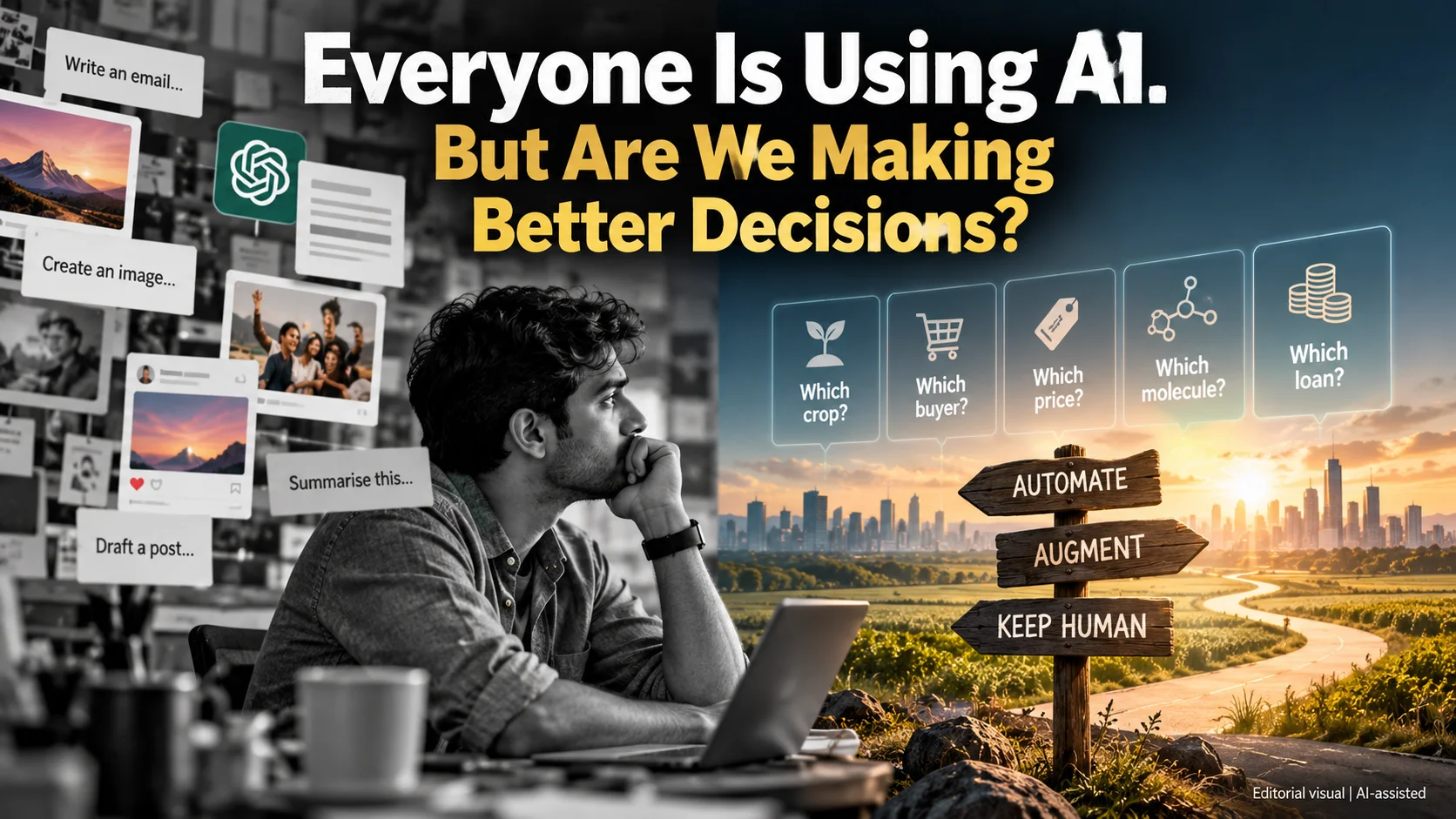
How can a business determine which decisions should be automated, which should be supported by AI and which should remain firmly under human control?
One practical starting point is an AI Decision Matrix: a structured way to assess decisions before deciding how much authority to give an AI system.
The matrix proposed here is an editorial framework, not a validated scientific instrument. Its purpose is to help businesses ask better questions before deploying AI.
Five questions should guide the assessment:
1. What is the potential business impact?
Would a better decision meaningfully improve revenue, productivity, customer satisfaction, quality or resource allocation? Start with a problem that matters rather than searching for a problem to justify an AI tool.
2. What is the risk of getting it wrong?
Could a poor recommendation cause a minor inconvenience, a financial loss, reputational damage or serious harm to a person? The greater the potential consequences, the stronger the safeguards and human involvement should be.
3. Is the necessary data available and reliable?
AI cannot compensate automatically for missing, inaccurate or unrepresentative information. A business with inconsistent sales records may need to improve its data practices before relying on AI to forecast demand.
4. Can the decision be reversed?
An incorrect draft can be edited. An inventory adjustment within an approved limit may be reversible. A major investment, a rejected loan application or a hiring decision may have consequences that are difficult to undo.
5. Who remains accountable?
Someone must be responsible for the decision, its consequences and any corrective action. Using AI does not eliminate the need for ownership.
These questions help determine the appropriate level of AI involvement. Three broad categories offer a useful starting point.
Automate: routine decisions with clear boundaries
Tasks that are repetitive, governed by clear rules and relatively low-risk may be suitable for automation, provided the system is tested and monitored.
For example, a business might use AI to classify customer enquiries, flag invoices that require attention or recommend stock replenishment within predefined limits. Exceptions can be referred to a person rather than handled automatically.
Automation should have clear boundaries, performance checks and a way to intervene when something goes wrong.
Augment: decisions that benefit from analysis
Many commercially important decisions belong in this category.
AI can compare supplier quotations, analyse customer feedback, identify changes in sales patterns or evaluate potential export markets. It can help management examine alternatives and test assumptions, while a human decision-maker considers the wider context.
For instance, an AI system might identify a promising export market based on demand indicators and estimated costs. Management would still need to verify the data, examine regulations, confirm buyer credibility and assess whether the opportunity fits the company’s capabilities.
Here, AI improves the decision-making process without automatically owning the decision.
Keep human-led: decisions with serious consequences
Some decisions require direct human responsibility, especially where the consequences are significant, the evidence is uncertain or fairness and individual circumstances matter.
Hiring, consequential credit decisions, major strategic commitments and decisions affecting people’s rights deserve particular caution. AI may assist with research, analysis or scenario planning, but it should not become an unquestioned substitute for accountable human judgment.
The appropriate safeguards depend on the context, the system and the applicable legal requirements. In some settings, automated decisions may be inappropriate altogether.
The principle is not that humans are infallible and machines are not. Humans make mistakes, too. The objective is to combine the strengths of both while making risks visible and ensuring that responsibility remains clear.
How a business can put the matrix to work
A founder does not need an expensive AI strategy exercise to begin.
Start by listing five to ten recurring decisions that influence the business. These might include purchasing stock, setting prices, choosing suppliers, prioritising leads, managing cash flow or identifying new markets.
For each decision, record its potential impact, the risk of error, the quality of available data, its reversibility and the person accountable for the outcome.
Then ask whether AI should automate the task, augment human judgment or play only a limited supporting role.
Choose one suitable use case and test it on a manageable scale. Establish a baseline before introducing the system. Measure whether it improves a meaningful outcome—such as forecast accuracy, time taken to complete a process, inventory wastage, lead conversion or the quality of a decision.
Compare the results with the existing process. Check for errors, unexpected consequences and cases where the system performs poorly. If the benefits do not justify the cost and risk, change the approach or stop the experiment.
This last step matters. AI adoption should be treated as an ongoing process of evaluation, not a one-time declaration that a business has become technologically advanced.
A company does not need to automate every decision to become an effective AI user. Sometimes the most valuable application is a system that helps a manager see a problem earlier, compare options more systematically or ask a question that would otherwise have gone unasked.
The real competitive advantage is better judgment
The excitement surrounding AI is understandable. Its capabilities are expanding, access is becoming easier, and businesses have good reasons to explore what it can do.
But technology adoption and business transformation are not the same thing.
A company can use AI extensively without changing how it makes decisions. It can produce more content, generate more reports and automate more routine tasks while leaving its underlying problems untouched.
Conversely, a small business that applies AI carefully to a few important decisions may gain a meaningful advantage without making the technology the centre of its identity.
The difference lies in intention, data quality, implementation and the willingness to measure results.
For founders and business leaders, the challenge is to stop asking only, “What can we do with AI?” and begin asking, “Which decisions would benefit from AI, what evidence would make its recommendations trustworthy, and who will be accountable for the outcome?”
That is a more demanding question. It is also a more useful one.
Yahoo Messenger once made being connected feel like an achievement in itself. AI risks creating a similar illusion around being technologically active. But the real value of a tool is not measured by how frequently we use it.
It is measured by what improves because we used it.
Everyone is using AI. The more important question is whether we are becoming better decision-makers because of it.