
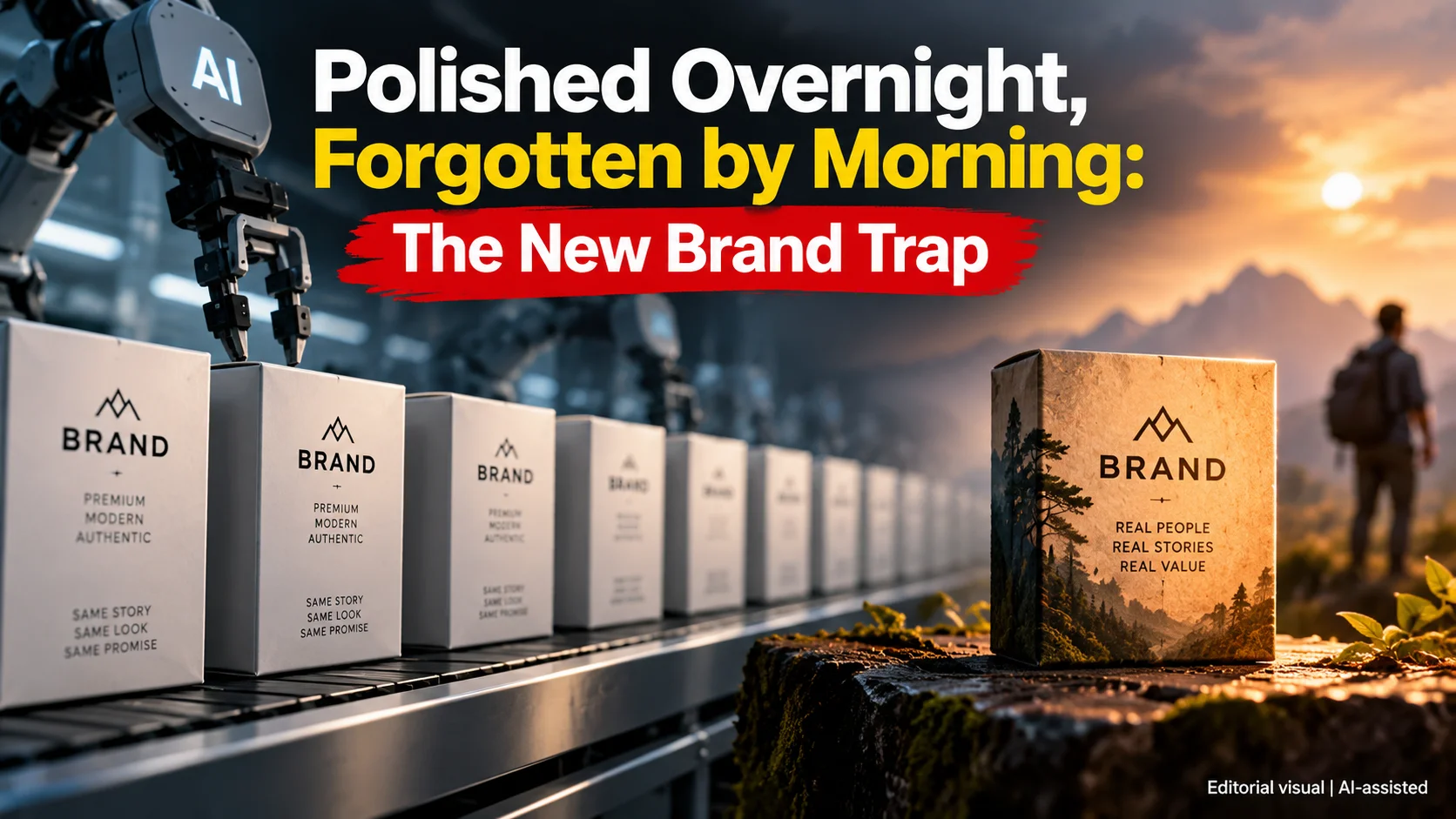
Polished Overnight, Forgotten by Morning: The New Brand Trap
The Quantiq | Brand & Media Intelligence.
How AI is making brands easier to produce—and why differentiation, customer trust and lasting preference are becoming more important than ever.
A founder launches a new business. Within a few days, the brand has a polished logo, a convincing website, professional-looking product images and a month of social media content. The messaging sounds confident. The visual identity looks consistent. Even the brand story feels complete.
A competitor launches around the same time. Its website looks equally good. Its content follows a similar rhythm. Its language is just as persuasive.
A third business enters the market with much the same advantages.
None of these founders has necessarily done anything wrong. They have used accessible tools to get their businesses ready for the market. That is one of the most valuable things artificial intelligence has made possible.
But a difficult question remains. When customers encounter these businesses, what gives them a reason to remember one rather than the others?
This is where a new brand trap begins.
Artificial intelligence can help a business look established long before it has built a reputation. It can make communication faster, improve presentation and help a small team compete with better-resourced rivals. Yet none of those advantages automatically gives customers a compelling reason to choose the business, trust its promises or return after the first purchase.
The danger is not that AI makes branding worthless. It is that founders may confuse the ability to produce brand assets with the ability to build a brand.
In a market where polished presentation is increasingly accessible, the more difficult task is becoming genuinely distinctive.
When looking professional stops being a competitive advantage
Not long ago, a small business seeking a professional brand identity might have needed a designer, a copywriter, a photographer and an agency to coordinate the work. Producing a steady stream of marketing content could be expensive and time-consuming.
AI has changed that equation. A founder can now explore visual identities, draft website copy, develop campaign concepts and produce content with a fraction of the previous effort.
This is progress. Small businesses should not have to spend heavily merely to communicate professionally. Nor should founders feel compelled to avoid useful technology simply because larger companies were the first to benefit from it.
The problem begins when every competitor uses similar capabilities to produce the same familiar signals of credibility.
The minimalist logo. The confident brand statement. The carefully arranged product photograph. The warm, conversational caption. The promise of quality, innovation and customer-first service.
These elements can serve a useful purpose. But none is especially difficult to reproduce.
When several brands look equally professional, presentation alone becomes a weaker basis for choosing between them. Customers must look elsewhere for meaningful differences. They may consider price, convenience, reputation, product performance, recommendations or their previous experience with the business.
The brand that wins is not necessarily the one with the most attractive website. It may be the one that explains its value more clearly, solves a particular problem better or gives customers stronger reasons to believe its promises.
The distinction matters because professional presentation is now easier to obtain. A lasting preference is not.
The quiet economics of becoming interchangeable
Commoditisation rarely announces itself with a dramatic failure. A business may continue publishing regularly, attract website visitors and receive encouraging engagement on social media.
From the founder’s perspective, the marketing operation appears healthy.
Yet customers may struggle to explain what makes the business different. Enquiries may increasingly focus on discounts. Prospects may compare several providers and choose whichever appears cheapest or most convenient. Existing customers may return only when a promotion makes the offer attractive again.
These signals do not prove that a brand has become interchangeable. Price sensitivity and repeat purchasing depend on the category, the buying cycle and the customer’s circumstances. But when several signals appear together, they deserve attention.
The commercial consequences can be significant.
If customers see little meaningful difference between competing offers, the business may have to work harder to win each sale. It may spend more on advertising, offer deeper discounts or keep producing content to maintain attention. The marketing machinery becomes busier without necessarily making the brand more valuable.
This creates an uncomfortable cycle. The founder responds to weak differentiation by increasing output. More content is published, more campaigns are launched and more money is spent seeking visibility.
But the underlying question remains unanswered: why should customers choose this business when credible-looking alternatives are everywhere?
AI can accelerate this cycle because it makes producing more material easier. It cannot, by itself, resolve the strategic problem that the material is supposed to solve.
The risk is not simply wasted content. It is a business investing in the appearance of momentum while failing to strengthen the reasons customers prefer it.
The evidence behind the trust question
This concern is not merely theoretical. Research is beginning to examine how consumers respond when they know brands use generative AI in their marketing.
A 2024 study by Jasper David Brüns and Martin Meißner, published in the Journal of Retailing and Consumer Services, examined consumer reactions to AI-generated social media content across three experimental studies. The researchers found that AI adoption could reduce perceived brand authenticity and negatively affect follower attitudes and behaviour. The negative response was less pronounced when AI assisted human creators rather than replacing them entirely.
The findings offer an important qualification. The issue is not necessarily whether AI was involved. How it was used matters. Human judgement and contribution can change how the resulting content is perceived.
Research from India offers a useful additional perspective. In its 2025 AI Monitor, Ipsos reported that 67% of Indian respondents expected products and services using AI to disclose that use. The study also found mixed preferences regarding AI-generated and human-created content. Indian respondents were more accepting of some AI applications than global respondents, but that did not amount to universal preference for machine-generated communication.
More recently, a Gartner survey of 1,539 US consumers, conducted in October 2025 and published in March 2026, found that 50% preferred to give their business to brands that did not use generative AI in consumer-facing content. This is a US survey, not a measure of Indian consumer sentiment, and should be interpreted in that context.
Taken together, these findings do not establish that customers universally reject AI-assisted marketing. They establish something more useful: the relationship between AI use, perceived authenticity and consumer trust deserves serious attention.
For founders, the practical lesson is to avoid assuming that greater production efficiency automatically creates a better customer relationship.
A brand may use AI extensively behind the scenes and still deliver an excellent experience. Another may rely on AI-generated messaging that sounds polished but feels generic, misleading or disconnected from the people behind the business.
The technology alone does not determine the outcome. The judgement governing its use matters.
A brand is more than what it publishes
A brand’s public identity is often the most visible part of the business. It includes the name, logo, website, packaging, advertisements and social media presence.
But customers do not experience a brand only through its published content.
They experience it when the product arrives. They notice whether the service matches the promise. They remember how a complaint was handled, whether the price was transparent and whether the business took responsibility when something went wrong.
These encounters gradually shape what the brand means to them.
A company can use AI to describe its products as dependable. Dependability becomes credible only when customers repeatedly receive what they were promised. A business can publish warm, reassuring messages. Those messages carry more weight when the company responds constructively to a difficult customer situation.
The same principle applies to differentiation.
A founder might decide to serve a narrowly defined customer group exceptionally well rather than appeal to everyone. Another might build a reputation for transparent pricing, unusually responsive service or deep expertise in a particular problem. Such decisions shape the business itself, not merely its marketing language.
They may also require trade-offs. A company cannot promise the lowest price, the highest level of personal service, the widest range and exceptional speed in every situation without confronting operational realities.
The choices a business makes, and the standards it consistently upholds, can become part of its identity.
AI can help communicate those choices. It can also help a founder investigate customer needs and explore possible positioning. But the business must decide what it stands for, which customers it intends to serve and what it is prepared to deliver.
A brand is not made distinctive simply by describing itself differently. It becomes distinctive when customers have meaningful reasons to experience it differently.
When the content performs but the brand does not
This is where brand strategy and media intelligence need to work together.
Marketing teams have become increasingly skilled at measuring activity. They can track impressions, video views, click-through rates, website traffic and social engagement. These metrics help explain what happened to a piece of content and how audiences interacted with it.
But they do not independently establish whether the brand has become more trusted, more memorable or more likely to be chosen.
A widely viewed video may create awareness without generating serious purchase interest. A high click-through rate may bring visitors who leave without finding what they need. A popular campaign may attract attention because it is entertaining rather than because it communicates a meaningful competitive advantage.
None of these outcomes makes the content useless. Awareness and entertainment can play legitimate roles in marketing. The mistake is treating them as proof of lasting brand strength.
Founders need to connect media performance with customer behaviour and perception.
Are the people responding to the content part of the intended audience? Do qualified enquiries increase? Can customers explain why they chose the business? Are buyers returning when they have another need? Are recommendations growing? Do customers continue to see value when discounts are absent?
The answers require more than a dashboard. They require listening to customers, examining sales patterns and understanding the context behind the numbers.
A business might discover that its most popular content attracts a broad audience but generates few qualified enquiries. Another might find that a less spectacular piece of content consistently brings prospects who understand the offer and are more likely to buy.
The objective is not to abandon reach or engagement. It is to understand their relationship with the outcomes the business actually wants.
Media intelligence should help a brand learn what matters to its audience, which messages influence decisions and where the customer journey breaks down. That knowledge can inform both the next campaign and the underlying business proposition.
The early warning signs founders should watch
A founder does not need an expensive research programme to begin examining whether a brand is becoming interchangeable. A few disciplined questions can reveal where the problem might lie.
Start by asking recent customers why they chose the business. Listen for specific reasons rather than general compliments. If customers repeatedly mention only low prices, attractive packaging or convenient availability, investigate whether the business offers other benefits they recognise and value.
Next, examine the conversations that precede a sale. Are prospects asking informed questions about the product or service? Or are they struggling to see any difference between the business and its competitors? Price comparisons are normal in many categories, but persistent confusion about the value offered deserves attention.
Look beyond the content calendar as well. Is the brand publishing more frequently without generating better enquiries? Are the same messages being repeated across channels without producing new insight? Are customer questions revealing gaps in the product, service or information available on the website?
Finally, examine what happens after a purchase. Do customers return when they have a genuine need? Do they recommend the business? How does the company respond to complaints? Are recurring problems being fixed, or are they being hidden behind reassuring communication?
No single answer delivers a verdict on brand strength. Together, however, these observations can help a founder identify whether marketing is creating meaningful preference or simply maintaining visibility.
The most valuable metric is not always the easiest to automate. Sometimes it begins with a straightforward conversation with a customer.
How to use AI without outsourcing your identity
Rejecting AI would be the wrong response to this challenge. Used thoughtfully, it can give a small team more time to do the work that makes the business stronger.
It can help analyse customer feedback, organise research, explore alternative messages, prepare content variations and improve the consistency of routine communication. It can assist with search engine optimisation and help make useful information easier to discover through conventional search and AI-powered tools.
The founder should lead the work of understanding the customer, defining the value proposition, choosing the audience and making the trade-offs that distinguish the business. AI can help test and express those decisions. It should not replace the evidence, judgement and accountability required to make them.
The same principle applies to content. A useful workflow begins with real customer questions, product knowledge, first-hand experience or original research. AI can help organise the material and improve its presentation. A responsible human reviewer should verify claims, preserve the intended voice and remove language that sounds impressive but says very little.
Transparency also matters. Businesses should consider when disclosure is appropriate or required, especially when AI-generated material could mislead customers about people, products, evidence or real-world events.
There is no universal rule that every AI-assisted sentence must be labelled. Nor should businesses imply that human authorship guarantees accuracy or authenticity. The more important principle is that customers should not be deceived about material facts, and the business should stand behind what it publishes.
For search visibility, the same discipline applies. Search engine optimisation and generative engine optimisation can improve the discoverability of useful, credible information. Neither can substitute for a strong proposition, reliable evidence or an experience worth recommending.
The aim is not to make a business appear more human than it is. It is to use technology in ways that make the business more useful, more consistent and easier to trust.
The real test: would customers still choose you?
Imagine removing the most polished elements of a brand for a moment. Set aside the logo, the advertising, the carefully written captions and the visual identity.
What remains?
Is there a product or service that solves a meaningful problem? Is there a clearly defined group of customers who value what the business does? Is there a reason to prefer it over alternatives? Does the company deliver on its promises? Can customers explain why they would return?
These questions are more demanding than asking whether the brand looks professional. They also lead to more useful decisions.
If the answers are weak, the solution is not necessarily another campaign or a more sophisticated AI workflow. The business may need sharper positioning, a better product, stronger service, more credible proof or a clearer understanding of its customers.
If the answers are strong, AI can help communicate that value more efficiently and consistently.
The distinction is fundamental. Tools can help a business present itself. They cannot, on their own, make its promises worth believing.
As the cost of producing polished marketing continues to fall, the advantage will not belong automatically to the business that publishes the most or adopts the newest technology first. It will increasingly depend on what the business knows about its customers, the choices it makes, the quality it delivers and the trust it earns over time.
A brand can be polished overnight. Being remembered takes longer.
And in a crowded market, the brands worth remembering will be those that give customers a reason to choose them long after the novelty of their presentation has faded.





One Comment