
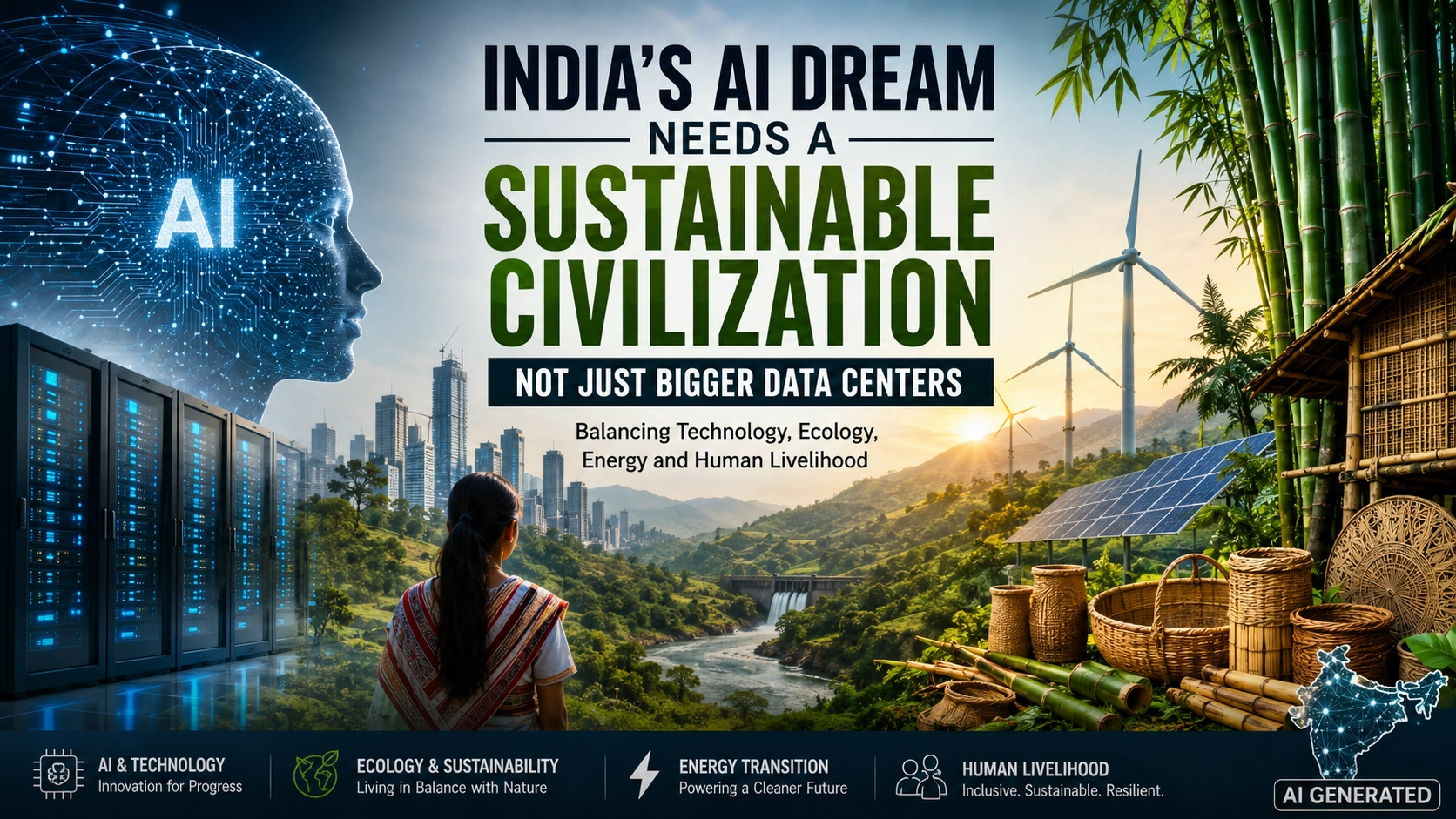
India’s AI Dream Needs a Sustainable Civilization, Not Just Bigger Data Centers
This editorial is part of The Quantiq’s ongoing series exploring the intersection of Artificial Intelligence, sustainability, economic transformation and the future of civilization.
India stands at a fascinating moment in history. Across policy circles, corporate boardrooms, startup ecosystems and global investor forums, the country is increasingly being projected as the next major force in Artificial Intelligence. New announcements around AI infrastructure, semiconductor ambitions, digital public systems and computational capacity have begun to dominate the national economic narrative. The language itself has changed. AI is no longer being discussed as merely another technology sector. It is now being framed as the foundation of India’s next economic era.
Yet beneath the excitement lies a question far more important than valuation, funding cycles or technological prestige.
Can India truly become an AI superpower simply by building more data centers, faster chips and smarter applications? Or does the future demand something deeper — a sustainable civilization model capable of balancing technology, ecology, energy and human livelihood together?
This distinction matters because AI is often misunderstood as a purely digital phenomenon. To most people, AI appears weightless. It arrives through a chatbot window, a recommendation engine, an image generator or an automated workflow. But the physical reality behind AI is immense.
The Invisible Cost of Artificial Intelligence
Artificial Intelligence consumes staggering amounts of energy. It depends upon gigantic computational infrastructure, uninterrupted electricity, cooling systems, water resources, mineral supply chains and vast industrial ecosystems. The more advanced AI becomes, the greater its physical appetite grows.
Around the world, technology companies are already racing not only for computing power, but also for energy security. The future battle for AI dominance is quietly becoming a battle for electricity, sustainability and resilient infrastructure. Nations are beginning to realize that algorithms alone cannot sustain technological leadership. The countries that will dominate the next phase of history may ultimately be those capable of balancing intelligence with ecological stability.
This changes the nature of the AI conversation entirely.
For decades, industrial civilization treated nature largely as a resource to extract from. Economic growth was measured through expansion, consumption and industrial output. Ecological concerns were often treated as secondary, even inconvenient. Sustainability existed at the margins of economic discourse, usually confined to environmental activism or corporate social responsibility reports.
The AI era is beginning to disrupt that mindset.
As artificial intelligence expands, so does the demand for energy, water and physical infrastructure. Suddenly, sustainability is no longer a moral accessory to development. It is becoming central to economic survival itself. The future global economy will increasingly reward nations capable of securing renewable energy, ecological resilience, carbon efficiency and sustainable industrial systems.
According to the International Energy Agency, the rapid expansion of AI and data centers could significantly increase global electricity demand in the coming years, intensifying the importance of sustainable energy systems. International Energy Agency
And this is where India’s path may fundamentally differ from that of both the United States and China.
America built its technological dominance through corporate innovation and financial concentration. China built scale through centralized industrial acceleration. India may need to evolve a third model altogether — one rooted not merely in technological expansion, but in civilizational balance.
Why Sustainability Is Becoming Strategic
That balance may become India’s greatest strategic advantage.
Unlike many industrial economies, India still carries within it deep cultural memories of coexistence between community, ecology and livelihood. Though modernization has often weakened those traditions, they have not disappeared entirely. Across large parts of the country, especially in ecologically rich regions, one still encounters living systems that instinctively understand sustainability not as ideology, but as everyday practice.
This perspective becomes particularly important when viewed through the lens of North East India.
For generations, the North East has largely been discussed within narrow frameworks — as a frontier region, an infrastructural challenge, or a politically sensitive geography. Rarely has it been viewed as a strategic ecological asset for India’s future economy. Yet the emerging global order may force precisely such a re-evaluation.
The region possesses something that may become extraordinarily valuable in the coming decades: ecological capital.
Its forests, biodiversity, water systems, bamboo resources, natural fibres and community-centric traditions represent far more than cultural identity or environmental richness. In a future shaped simultaneously by climate pressure and AI-driven industrialization, these assets may acquire deep strategic importance.
The Untapped Strategic Importance of North East India
Consider bamboo. For decades, bamboo remained trapped within the limited imagination of handicrafts and rural livelihoods. But global sustainability pressures are transforming its significance. Around the world, industries are searching desperately for alternatives to carbon-intensive materials and plastic-dependent manufacturing systems. Bamboo intersects naturally with low-carbon construction, sustainable textiles, biodegradable products and regenerative industrial systems.
What becomes truly fascinating is the possibility of convergence between AI and ecological economies.
Artificial Intelligence could eventually power precision agroforestry, climate analytics, carbon verification systems, predictive cultivation models and intelligent supply chains for sustainable industries. Suddenly, bamboo ceases to be merely a traditional material. It becomes part of a future-oriented bioeconomy.
This is why the conversation around AI cannot remain limited to startups, apps and automation tools alone. The deeper question is whether India can build an intelligence economy without reproducing the ecological destruction that accompanied earlier industrial revolutions elsewhere.
The answer may determine not only India’s economic future, but also the quality of civilization it creates.
A Different Development Model for the AI Age
There is a growing realization across the world that the crises of the twenty-first century are interconnected. Energy insecurity, climate volatility, food systems, migration pressures, technological disruption and social inequality are no longer separate conversations. They are converging into a single global challenge. Artificial Intelligence may accelerate economic productivity, but without ecological balance it could also intensify resource stress, energy consumption and inequality at unprecedented scale.
That is why the future may not belong simply to the nations with the largest computational capacity. It may belong to societies capable of integrating technological advancement with sustainable living systems.
India possesses a rare opportunity in this regard.
The country still has the ability to imagine development differently. It still has regions where ecological wisdom survives alongside modern aspirations. It still has communities that understand restraint, circularity and coexistence in ways hyper-industrial societies are now desperately trying to rediscover.
This does not mean romanticizing poverty or resisting modernization. Nor does it imply rejecting technology. The challenge is far more sophisticated than that. India must modernize rapidly, embrace innovation fearlessly and build globally competitive technological systems. But it must do so without severing the ecological foundations that sustain human life itself.
That may ultimately become India’s defining contribution to the AI age.
The world today is searching for a development model capable of reconciling intelligence with sustainability, growth with resilience, and progress with humanity. If India succeeds in building such a model, it will offer something far more important than technological competition. It will offer a new framework for civilization in the age of Artificial Intelligence.
And perhaps the deepest irony of the future is this: while the world races toward increasingly advanced machines, the societies that endure may ultimately be those that never completely lost their relationship with nature in the first place.https://thequantiq.com/north-east-india-medicinal-plants-bio-economy/



One Comment