
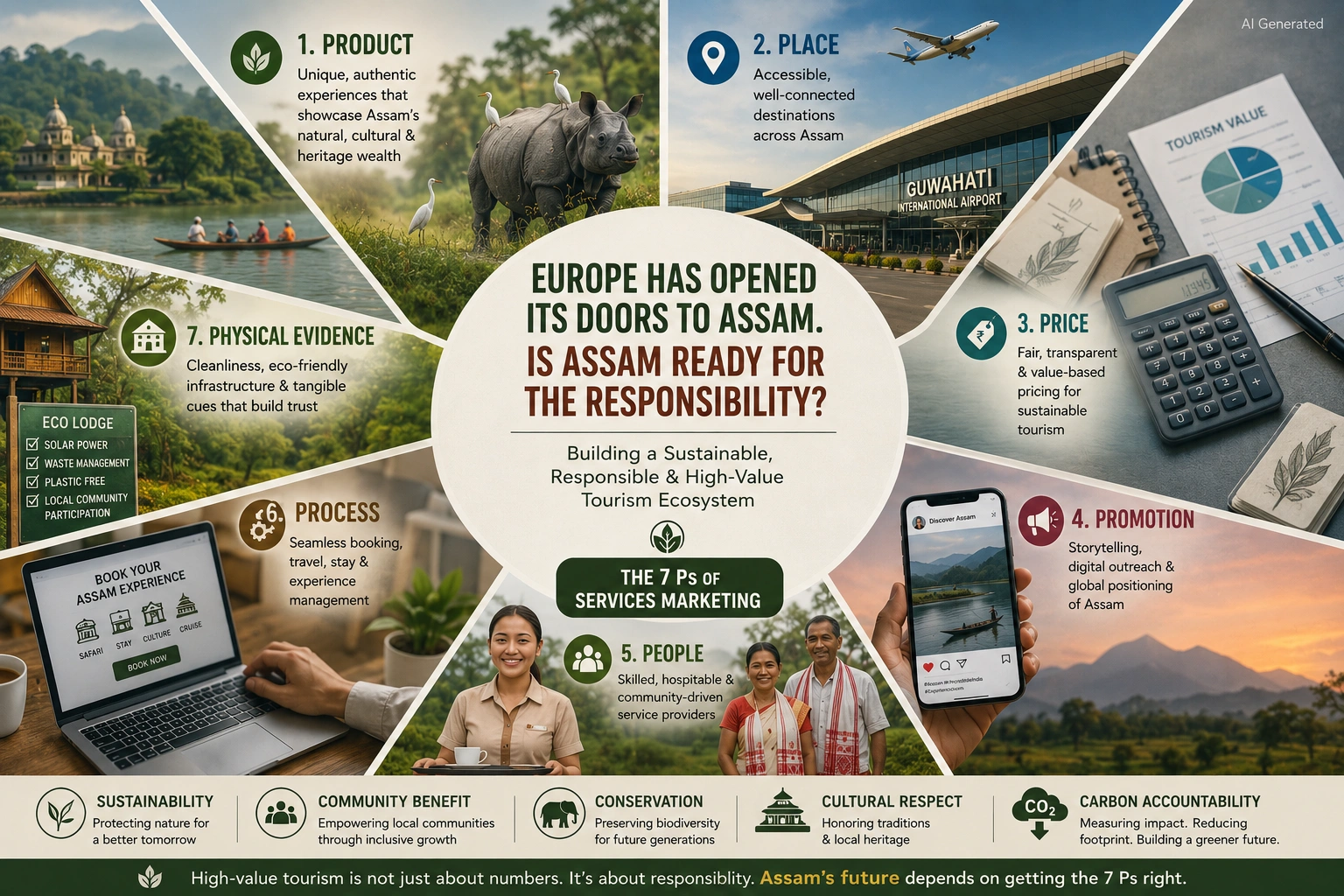
Europe Has Opened Its Doors to Assam. But Is Assam Ready for the Responsibility?
For nearly four decades, Assam carried an invisible burden that had little to do with its breathtaking landscapes, extraordinary biodiversity, or centuries-old cultural heritage. It was a burden created by perception. International travel advisories linked to security concerns quietly kept Assam outside the consideration list of thousands of foreign travelers who otherwise seek destinations rich in nature, culture, and authentic experiences.
That long-standing perception barrier may finally be beginning to change.
The recent announcement by Assam Chief Minister Himanta Biswa Sarma that several European Union nations have revised their travel advisory regarding Assam is undeniably positive news. On the surface, this appears to be a tourism breakthrough. But beneath that positive development lies a far bigger question that deserves serious discussion.
If Europe is finally willing to come to Assam, is Assam institutionally prepared for the responsibility that comes with becoming a globally visible tourism destination?
Because this moment is not simply about attracting more tourists.
It is about rethinking Assam’s entire tourism philosophy.https://assamtourism.gov.in/
Why This Development Matters Far Beyond Tourism Headlines
To be fair, Assam is not new to international tourism.
Over the years, the state has steadily built its reputation among foreign travelers, particularly through globally recognized destinations such as Kaziranga National Park, the cultural heritage of Majuli, Assam’s iconic tea estates, birdwatching circuits, and its growing recognition as one of India’s most biologically diverse regions. International tourist footfall into Assam has shown encouraging growth over time, especially among travelers seeking wildlife experiences, cultural immersion, and nature-based exploration.
But the recent revision in travel advisory by several European Union nations potentially changes the scale of opportunity.
This development does not simply mean Assam may receive a few more foreign tourists.
It means Assam may now become significantly more visible to one of the world’s largest and highest-spending outbound tourism markets.
And that changes the conversation entirely.
Europe collectively accounts for nearly 700 million outbound international trips annually, making it one of the largest tourism markets in the world. Before the pandemic, India was receiving close to 10 million foreign tourists annually, with European travelers representing one of the most economically valuable segments of that market.
What makes this market particularly important is not merely visitor volume.
It is visitor behavior.
European travelers are typically long-haul travelers. Unlike short-duration tourism patterns, they often spend anywhere between ten days and three weeks exploring destinations. Their spending patterns are significantly different. They spend more on accommodation, guided experiences, transport, local handicrafts, ecological tourism, cultural immersion, and premium hospitality.
This changes tourism economics entirely.
The future is no longer about increasing visitor numbers alone.
It is about maximizing value per visitor.
And Assam may now be entering that new phase.https://thequantiq.com/northeast-india-tourism-branding-ai-algorithms/
European Travelers Are Not Conventional Tourists
This distinction is extremely important.
European tourists visiting destinations like Assam are typically long-haul experiential travelers who seek far more than conventional sightseeing experiences. They place high value on authenticity and often prefer slow, immersive travel experiences rather than hurried itineraries designed around quick destination hopping. Many deliberately spend more time in fewer destinations. They want to experience local communities, indigenous cultures, traditional lifestyles, ecological diversity, and real human stories.
Increasingly, they are also conscious travelers.
Before choosing destinations, many European travelers actively evaluate environmental sustainability, community participation, ecological preservation, waste management practices, and the ethical impact of tourism on local ecosystems.
They increasingly ask difficult questions.
Is this destination environmentally responsible?
Are local communities benefiting directly from tourism?
Is biodiversity being protected?
Is overtourism damaging fragile ecosystems?
These questions are no longer secondary considerations.
For many international travelers, these questions directly influence destination choice.
Assam Must Rethink Tourism Through the 7 Ps Framework
Tourism, at its core, is not merely about destinations.
It is fundamentally a service economy.
And service economies are governed by seven critical pillars of services marketing — Product, Place, Price, Promotion, People, Process and Physical Evidence.
Assam already possesses a remarkable tourism product. Its biodiversity, tea heritage, river systems, wildlife ecosystems and indigenous cultures offer experiences very few destinations in Asia can replicate.
But product alone is never enough.
Place demands stronger air connectivity, better road logistics, seamless destination accessibility and integrated tourism circuits capable of supporting long-haul international travelers.
Price requires creating premium tourism experiences without falling into the trap of volume-driven tourism that often damages ecological balance.
Promotion demands repositioning Assam globally not merely as a scenic destination, but as one of India’s most sustainability-conscious tourism ecosystems.
People refers to trained hospitality professionals, local guides, multilingual tourism support, community participation and local entrepreneurship.
Process means frictionless booking systems, digital tourism infrastructure, predictable service delivery standards and intelligent visitor management systems.
Physical Evidence represents what travelers physically experience — cleanliness, eco-friendly accommodation, waste management systems, sustainable hospitality infrastructure and visible environmental responsibility.
If Assam truly wants to compete globally, every one of these seven pillars now needs institutional rethinking.
Assam Has Extraordinary Tourism Assets. But Possessing Assets Is Not Enough
On paper, Assam should be one of India’s most attractive long-haul tourism destinations.
Few places in the world can simultaneously offer the biodiversity of Kaziranga, the river civilization of the Brahmaputra, the spiritual heritage of Majuli, globally recognized tea gardens, rainforests, wetlands, bird habitats, indigenous tribal cultures, and one of Asia’s most ecologically rich landscapes.
But possessing assets and managing assets intelligently are two entirely different capabilities.
This is where difficult questions begin.
Because the uncomfortable truth is that Assam’s tourism architecture may still not be fully aligned with the expectations of high-value global tourism.
And that creates risk.
The Big Question: Is Assam Measuring Tourism Carrying Capacity?
Take Kaziranga as an example.
Kaziranga is globally celebrated for its remarkable conservation success and its one-horned rhinoceros population. Yet very little public discussion happens around one crucial question.
How much tourism is too much tourism?
Every ecological destination has a carrying capacity threshold. Beyond a certain point, tourism itself begins damaging the ecosystem it depends upon.
How many safari vehicles can enter the park every day without disturbing wildlife?
How much human movement begins altering animal behavior?
At what point does repeated tourism activity create invisible ecological stress?
What should be the scientifically defined visitor threshold during peak tourism season?
These are not anti-tourism questions.
These are sustainability questions.
And India still has not institutionalized such discussions at the level they deserve.
Responsible Tourism Must Become Assam’s New Tourism Doctrine
Global tourism is changing rapidly.
The age of measuring tourism success purely through footfall numbers is gradually disappearing. Destinations worldwide are beginning to understand that volume-driven tourism often creates ecological liabilities larger than economic gain.
Assam has a rare opportunity to avoid repeating mistakes many destinations around the world have already made.
The future lies not in mass tourism.
The future lies in responsible tourism.
This means tourism models where economic growth, local community participation, biodiversity protection, and ecological preservation evolve together.
Not separately.
Why Carbon Auditing Should Become Mandatory for Wildlife Tourism Destinations
One of the biggest blind spots in India’s tourism sector is the near absence of environmental accounting.
Tourism creates hidden ecological costs.
Resorts consume large amounts of electricity. Diesel generators operate continuously in remote areas. Tourist vehicles increase carbon emissions. Plastic waste generation rises sharply during peak tourism seasons. Water extraction places pressure on fragile ecosystems.
Yet very few destinations actively measure these costs.
This must change.
Every major ecological tourism destination in Assam should undergo periodic carbon audits.
Such audits should measure transportation emissions, resort energy consumption, waste generation, water extraction pressure, diesel dependency, and total tourism-linked carbon footprint.
Without environmental accounting, tourism growth can quietly destroy the very natural assets tourists originally come to experience.
Assam has an opportunity to become India’s first state to integrate carbon accountability into tourism governance.
Wildlife Zones Cannot Become Entertainment Zones
This is another issue that deserves immediate policy attention.
Increasing commercialization has encouraged resorts and tourism operators near ecological destinations to organize late-night musical events, DJ nights, amplified entertainment programs, and commercial gatherings even in close proximity to wildlife habitats.
This practice needs urgent reconsideration.
Wildlife ecosystems operate according to biological rhythms.
Noise pollution affects feeding patterns, migration behavior, breeding cycles, predator-prey interaction, and overall animal stress levels.
There is no ecological justification for allowing loud recreational events near protected wildlife habitats.
Assam should seriously consider creating protected acoustic zones around all wildlife destinations.
High-decibel entertainment activities near forests, wetlands, and protected wildlife habitats should be completely prohibited.
Tourism cannot come at the cost of ecological disruption.
Premium Tourism Creates Better Economics Than Mass Tourism
One of the biggest misconceptions in tourism economics is the belief that more tourists automatically mean more prosperity.
That is rarely true.
Ten environmentally conscious international travelers staying for two weeks often generate far more sustainable economic value than one hundred low-spending tourists participating in high-volume tourism.
Assam’s tourism entrepreneurs, hospitality operators, and policymakers must understand this transition quickly.
The future lies in premium experiences.
Tea tourism.
Community-owned eco-lodges.
Birding tourism.
River-based slow tourism along the Brahmaputra.
Indigenous cultural immersion experiences.
Wellness retreats.
Conservation tourism.
Sustainability-led hospitality ecosystems.
The world is increasingly willing to pay for authenticity.
The Northeast Must Learn From Global Tourism Mistakes
This lesson extends far beyond Assam.
The entire Northeast now stands at an important crossroads.
States like Meghalaya, Arunachal Pradesh, Nagaland, Mizoram and Tripura must avoid copying the overtourism mistakes that have damaged fragile ecosystems in many destinations across the world.
The Northeast possesses one of Asia’s richest ecological and cultural landscapes.
Destroying it in pursuit of short-term tourism growth would be a strategic failure with irreversible consequences.
Instead of becoming another overcrowded tourism zone, Northeast India can position itself as India’s first sustainability-first tourism ecosystem.
That would create an entirely new development model.https://thequantiq.com/northeast-india-single-tourism-destination/
Assam Has A Rare Opportunity To Lead India
The lifting of European travel restrictions should certainly be celebrated.
But Assam must recognize something far bigger.
The world is not merely opening its doors to Assam.
It is quietly testing whether Assam can evolve from being a beautiful destination into becoming an intelligently managed destination.
Across the world, tourism economies have repeatedly damaged the very ecological assets that originally attracted visitors.
Assam must avoid that mistake.
The state possesses something increasingly rare in the modern world — biodiversity, cultural authenticity, ecological wealth and living heritage systems that cannot be recreated once damaged.
The challenge ahead is no longer attracting tourists.
The challenge is building systems capable of protecting these assets while simultaneously creating long-term prosperity.
Perhaps Assam now has an opportunity to achieve something far bigger than tourism growth.
It can become India’s first sustainability-first tourism economy.
And if Assam succeeds, it will not simply attract the world.
It may begin teaching the world what responsible tourism should actually look like.https://thequantiq.com/the-72-hour-rule-northeast-india-tourism/






3 Comments