
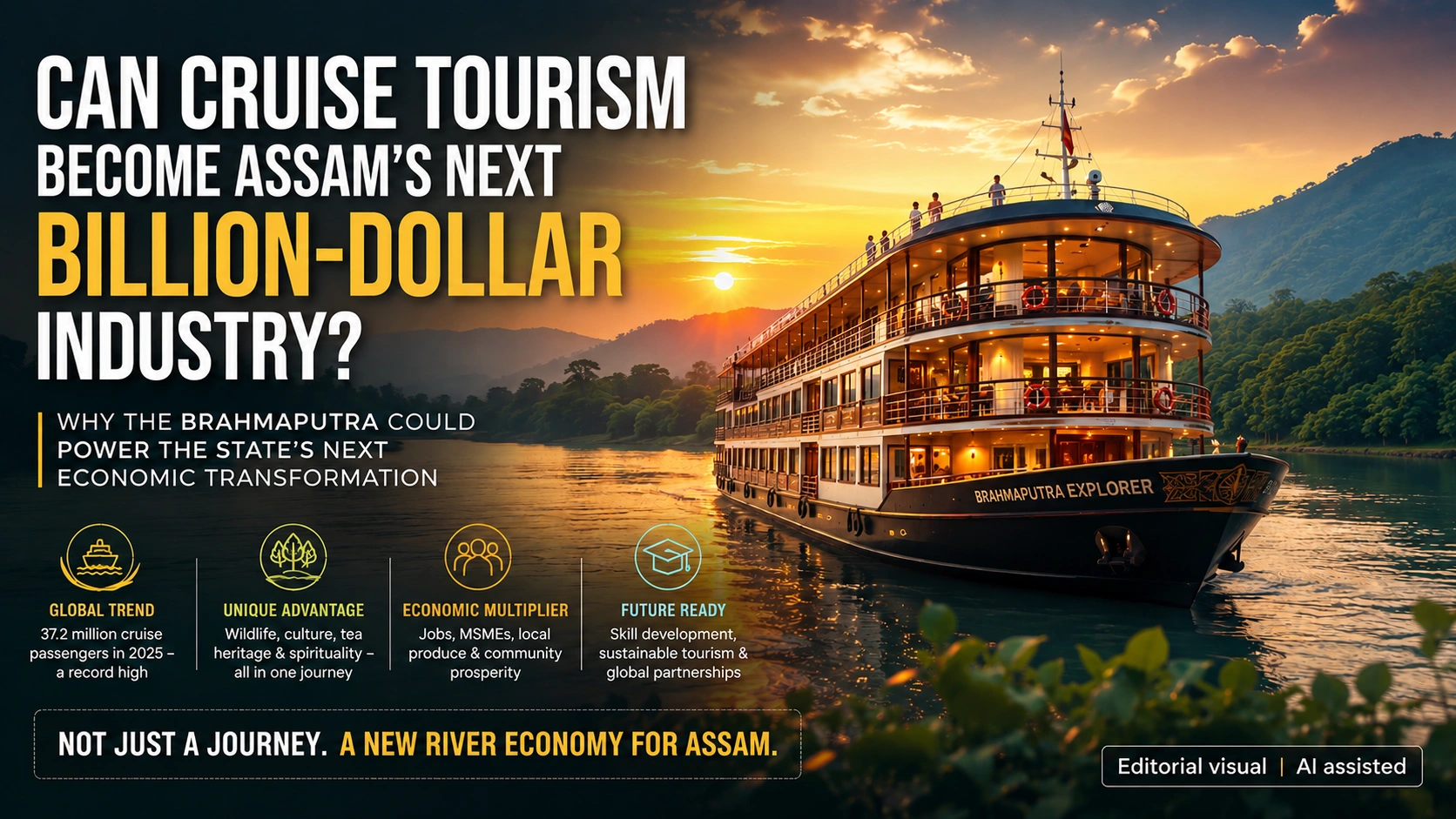
Can Cruise Tourism Become Assam’s Next Billion-Dollar Industry?
Why the Brahmaputra Could Power the State’s Next Economic Transformation
Travel used to be about speed. Railways, highways and airlines competed to shorten the distance between one place and the next. Today, that definition is reversing. Travellers increasingly want to slow down, not speed up.
Cruise tourism captures this shift better than almost any other segment. The ship does not simply carry the visitor to a destination. It becomes the destination.
Assam has just entered this conversation, and quickly. Within days of each other, the Chief Secretary held two separate discussions: one with Germany’s Schulte Group on cruise skilling and workforce development, and another with Antara Luxury River Cruises on a proposed investment of more than ₹500 crore in luxury river cruise vessels and infrastructure along the Brahmaputra.
Together, these conversations suggest something bigger than a new tourism product. They suggest Assam is beginning to treat the Brahmaputra as an economic platform, not just a scenic river.https://thequantiq.com/northeast-india-single-tourism-destination/
Global Data: The World Is Buying the Journey, Not Just the Destination
Cruise tourism is no longer a niche segment of global travel. It is a large and fast-growing industry with its own economics.
- Global cruise passenger numbers reached a record 37.2 million in 2025, per the CLIA 2026 State of the Cruise Industry Report, surpassing pre-pandemic levels.
- Nearly 90 per cent of cruise travellers intend to cruise again, signalling exceptionally high repeat demand.
- The industry generated roughly US$199 billion in total economic impact in 2024, per WTTC, contributing US$98.5 billion to global GDP and supporting 1.8 million jobs.
- More than 60 per cent of cruise passengers later return independently to destinations first discovered on a cruise, per WTTC research.
For a relatively undiscovered destination like Assam, that last statistic matters most. A cruise does not just bring a visitor once. It can convert a first-time visitor into a repeat traveller, an advocate, or even an investor.https://wttc.org/news/wttc-s-cruising-for-impact%E2%80%9D-report-highlights-the-positive-impact-of-cruise-tourism
NE Advantage: Why the Brahmaputra Is Different
Assam has over 1,000 km of navigable waterway, led by the Brahmaputra. Very few rivers anywhere combine what it offers within a single itinerary.
- Kaziranga National Park and its population of the greater one-horned rhinoceros
- Majuli, one of the world’s largest inhabited river islands and the seat of Assam’s Vaishnavite Satra heritage
- Centuries-old tea estates and weaving villages
- Wetlands, river dolphins and rich birdlife
Rivers such as the Rhine, the Nile and the Mekong built entire tourism economies around a single strong identity each. The Brahmaputra’s advantage is that it can offer wildlife, tea, spirituality, craft and cuisine within one voyage. That is a rare combination globally, and it is currently under-monetised.
Gap Analysis: The Enclave Economy Risk
Assam’s long-standing economic problem has not been a shortage of valuable resources. It has been limited local value capture. Tea, fruits, herbs, and bamboo have historically left the state as raw or lightly processed commodities, with branding, packaging, and retail margins captured elsewhere.
Cruise tourism carries the same risk if it is reduced to ships and jetties alone. A vessel crewed by outside labour, stocked by outside suppliers and marketed by outside agencies would replicate the enclave economy pattern the Quantiq has flagged repeatedly across sectors, this time on water instead of land. The real gap is not visitor demand for the Brahmaputra. That demand already exists. The gap is whether Assamese hands staff the vessels, Assamese kitchens supply the food, and Assamese tea, silk and craft are sold as story rather than shipped out as bulk.
Business Opportunity: The Cruise Economy Multiplier
A cruise ship functions as a moving marketplace. It is the customer, not the industry. The real industry begins the moment passengers step ashore.
A single 120-passenger vessel on a seven-day Brahmaputra voyage creates demand for thousands of meals, hundreds of kilometres of local transport, guided excursions, handicrafts, cultural performances and locally grown produce. Every rupee spent moves through several layers of the local economy before it settles.
Because a river cruise moves through multiple districts rather than a single city, this demand spreads geographically. The locations named in the Antara discussion, Chandrapur, Kurua, Silghat, Nimati Ghat and Majuli, span several districts rather than concentrating benefit in Guwahati alone. That structure gives self-help groups, weavers, farmers and artisans along the route a realistic entry point, provided procurement is designed to include them from the outset.
Policy Audit: Where Ambition Meets Ground Reality
The Centre’s Cruise Bharat Mission targets around 100 river cruise terminals nationally and a substantial expansion of river cruise passenger traffic by 2029, spanning more than 5,000 km of navigable waterways. Assam sits inside this larger push, not outside it.
At the state level, two separate conversations are now active at Chief Secretary level: a skilling and workforce discussion with the Schulte Group, and an investment discussion with Antara Cruises. Both are described in official communication as discussions, a proposed investment, and a long-term vision, not as signed agreements or committed capital.
That distinction matters for planning. The Brahmaputra’s seasonal water-level swings, shifting channels and flood cycles are real engineering constraints. Reliable, all-season navigation infrastructure, not policy announcements alone, will determine whether global operators eventually commit capital.
NE Sizing: What Is Actually on the Table
| Partner | Nature of Engagement | Scale/Investment | Focus Areas |
| Schulte Group / BSM (Hamburg) | Skilling and workforce discussion; DG Shipping & MEA-licensed for seafarer deployment | Not yet quantified in ₹ terms | Cruise & hospitality training, overseas employment pipeline for Assamese youth |
| Antara Luxury River Cruises (Raj Singh) | Long-term investment vision discussed with Chief Secretary | Proposed investment of over ₹500 crore | Luxury vessels + infrastructure at Chandrapur (Guwahati), Kurua, Silghat, Nimati Ghat, Majuli; ~5,000 direct and indirect jobs; golf tourism integration |
Neither engagement has yet converted into a binding MoU or committed capital, based on the information available. The scale being discussed, over ₹500 crore in vessels and infrastructure plus a dedicated skilling pipeline, is nonetheless significant relative to Assam’s current cruise tourism base, which today remains a fraction of the state’s overall tourism economy.https://thequantiq.com/assam-europe-tourism-opportunity-sustainable-tourism/
The Quantiq Assessment
If both engagements move from discussion to committed investment, they would mark Assam’s first serious entry into premium river cruise infrastructure, and its first serious attempt to treat cruise-linked skilling as an export-of-labour vertical rather than only an inbound-tourism one.
The caution is equally important. Assam has seen large numbers announced before local employment, sourcing and IP protections were locked in through binding terms, on ADB-funded bamboo lending and elsewhere. “Proposed” and “long-term vision” are the correct words for where this currently stands, and they should stay in the reporting until contracts say otherwise.
Four conditions would convert ambition into a genuine Sovereign Producer Economy outcome for Assam’s cruise sector:
- Local hiring made a contractual quota in any signed MoU, not an aspirational statement
- Local sourcing clauses for tea, silk and cuisine written into vessel operating contracts
- Self-help groups and artisan clusters formally onboarded into the supply chain before terminal construction begins
- Ecological carrying-capacity limits fixed before vessel counts are finalised, not after
The success of this story will not be counted in cabins sold on the Brahmaputra. It will be counted in how many Assamese hands touch the value chain before the ship ever reaches the jetty.https://thequantiq.com/northeast-india-tourism-branding-ai-algorithms/


3 Comments