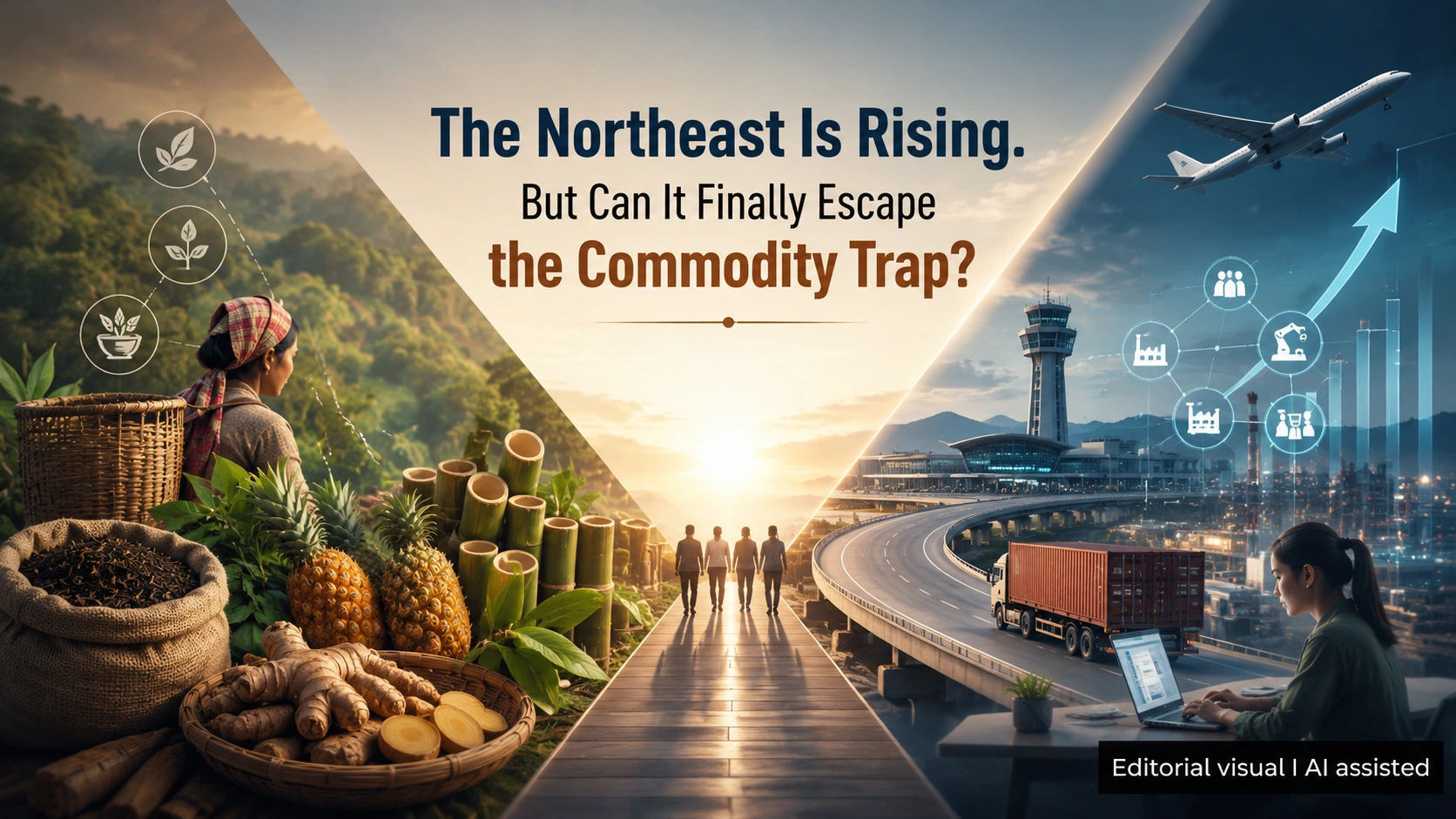
The Northeast Is Rising. But Can It Finally Escape the Commodity Trap?
For decades, Northeast India has been described as a region of immense potential. Blessed with vast natural resources, extraordinary biodiversity, fertile agricultural land and a strategic location connecting India with Southeast Asia, the region has always appeared destined for economic prosperity. Yet despite these advantages, its economic story has often been one of unrealized opportunities rather than sustained industrial growth.
Today, however, that story is beginning to change.
In a recent letter shared on LinkedIn by Jyotiraditya Scindia, the Union Minister for Development of North Eastern Region outlined the remarkable transformation taking place across the eight northeastern states. The figures are impressive. More than ₹1.09 lakh crore has reportedly been invested in road infrastructure between 2014 and 2025, over 10,900 kilometres of roads have been built, operational airports have nearly doubled from nine to seventeen, railway connectivity has expanded, and the regional economy has grown from approximately ₹3.32 lakh crore in 2014-15 to more than ₹10.21 lakh crore in 2024-25.
These achievements deserve recognition. Better roads, improved rail connectivity, expanded airports and stronger healthcare and educational infrastructure create the foundation for long-term economic growth. For a region that struggled with geographical isolation for decades, this transformation is both visible and significant.
Yet these encouraging developments also compel us to ask a question that has received far less attention.
Can Northeast India finally escape the commodity trap that has shaped its economy for generations?https://thequantiq.com/state-branding-economic-self-respect/
Looking Beyond Infrastructure
For many years, discussions about the Northeast’s economic challenges revolved around poor infrastructure. Difficult terrain, high logistics costs and inadequate connectivity were widely considered the principal reasons why industries hesitated to invest in the region. There was considerable truth in that argument. Without roads, railways and airports, no modern economy can flourish.
But infrastructure alone has never guaranteed prosperity.
History offers countless examples of regions that became well connected without becoming economically self-reliant. Roads can move goods more efficiently, but they cannot determine who owns the factories, who builds the brands or who captures the highest share of profits. Infrastructure creates opportunities, but enterprise determines whether those opportunities translate into lasting prosperity.
That distinction is becoming increasingly important for Northeast India.https://thequantiq.com/global-supply-chain-shift-northeast-india-export-opportunity/
A Region Rich in Resources but Poor in Value Addition
The Northeast has never lacked resources. Assam’s tea is recognised across the world. Meghalaya’s Lakadong turmeric commands premium prices because of its high curcumin content. Tripura produces excellent pineapples, Mizoram is known for quality ginger, Arunachal Pradesh possesses remarkable medicinal plant diversity, and bamboo grows abundantly across almost every state in the region.
These are not ordinary commodities. They are products with the potential to create globally competitive industries.
Yet for decades, much of the economic value generated from these resources has been captured elsewhere. Raw or minimally processed products leave the region, while branding, advanced processing, manufacturing and higher-value commercial activities often take place outside the Northeast. Local communities produce the resource, but a significant share of the wealth created from it flows beyond the region.
This is what economists describe as a commodity trap—a situation where resource-rich regions remain dependent on exporting raw materials instead of building industries around those resources.https://thequantiq.com/adb-bamboo-project-northeast-india-industrial-future/
Why This Moment Matters
The significance of the current transformation lies not merely in the number of roads being built or airports becoming operational. It lies in the fact that many of the barriers that historically constrained economic growth are gradually disappearing.
Connectivity is improving. Investor interest is increasing. Digital technologies are reducing geographical disadvantages. Peace and stability have improved across large parts of the region, creating greater confidence among businesses and entrepreneurs.
For perhaps the first time in decades, Northeast India has an opportunity to move beyond being merely a supplier of raw materials.
But opportunities alone do not create economic transformation.
The real challenge now is whether the region can build enterprises capable of processing, innovating, manufacturing and branding products within the Northeast itself. Unless that happens, improved connectivity may simply make it easier for raw materials to leave the region more efficiently than before.
The Next Phase Must Be About Economic Ownership
Infrastructure has rightly dominated public policy discussions over the past decade. The region needed roads, railways, airports and digital connectivity, and significant progress has been made on all these fronts.
The next decade, however, demands a different conversation.
It is no longer enough to celebrate physical infrastructure alone. Equal attention must now be given to industrial infrastructure, entrepreneurship, research, innovation, technology adoption and regional brand building. Economic success will increasingly depend on how much value the Northeast creates from its own resources rather than how much it produces.
Tea should not merely be exported as tea leaves. Bamboo should not remain confined to traditional craft applications. Agricultural products should not leave the region without stronger food-processing industries. Medicinal plants should support pharmaceutical and nutraceutical enterprises. Tourism should create thriving local businesses rather than simply increasing visitor numbers.
Each sector presents an opportunity to move from commodity production to value creation.https://www.investindia.gov.in/
The Role of Technology
Fortunately, the Northeast begins this journey at a time when technology is transforming the global economy.
Artificial intelligence, digital commerce, advanced manufacturing, precision agriculture and modern logistics are lowering barriers that once prevented smaller regions from competing with established industrial centres. A small enterprise in Assam or Meghalaya can now reach customers across India—and increasingly across the world—without the limitations that existed even a decade ago.
Technology alone will not solve the region’s economic challenges, but it provides tools that previous generations never possessed. Combined with improved infrastructure and supportive policies, it offers the Northeast an opportunity to build competitive enterprises rooted in local strengths.
A New Question for a New Northeast
The letter shared by Jyotiraditya Scindia rightly highlights the remarkable progress made across Northeast India. Infrastructure development on this scale deserves appreciation because it lays the foundation for future growth. But perhaps the greatest value of this moment is that it allows us to ask a different question than we have asked for decades.
The question is no longer whether the Northeast will receive roads, airports or railway lines.
The more important question is whether the region will use this new infrastructure to build industries, brands and enterprises that retain wealth within the Northeast.
That is the real measure of economic transformation.
The Northeast has entered a decisive phase in its development journey. The foundations are being laid, connectivity is improving and confidence is returning. Whether this transformation becomes a genuine economic renaissance or simply a more efficient version of the old extractive model will depend on what happens next.
Infrastructure has opened the door.
Now the region must decide how it walks through it.
Perhaps that is the most important economic question facing Northeast India today.https://necouncil.gov.in/