
Infrastructure Builds Industries. Investment Builds Entrepreneurs.
Why Northeast India Must Stop Counting Its Constraints and Start Competing on Its Strengths
For decades, conversations about Northeast India’s development have followed a familiar script. They usually begin with inadequate infrastructure, move to logistical challenges, highlight geographical isolation and eventually end with a long list of constraints that have supposedly prevented the region from realising its full economic potential.
There is no denying that many of these challenges are real. Better highways, railway connectivity, airports, cold chains, industrial parks and logistics infrastructure remain essential for sustained economic growth. However, if every conversation revolves around what the Northeast lacks, an equally important question risks being ignored.
What if the region’s future depends less on overcoming its disadvantages and more on capitalising on its unique strengths?
That question deserves far greater attention than it has received.
The lively discussion that followed The Quantiq’s recent editorial on the Union Ministry of Development of North Eastern Region’s Brand North East initiative offered an interesting insight. Several experienced professionals rightly pointed out the need for better infrastructure, stronger logistics and improved packaging facilities. Those observations are important and deserve serious consideration. Yet they represent only one part of a much larger economic equation.
Infrastructure certainly builds industries.
Investment builds entrepreneurs.
Strong brands create enduring prosperity.
The Northeast cannot afford to ignore any of these pillars.https://thequantiq.com/brand-north-east-doner-value-chain-strategy/
The Missing Link in the Northeast’s Growth Story
Over the past decade, India has emerged as one of the world’s most vibrant startup destinations. Thousands of young entrepreneurs are building companies that are transforming industries ranging from financial technology and healthcare to food processing and consumer products.
The Northeast has no shortage of entrepreneurial talent either.
Across Assam, Meghalaya, Nagaland, Mizoram, Arunachal Pradesh, Manipur, Tripura and Sikkim, young founders are creating businesses around tea, coffee, bamboo, handloom, wellness products, tourism, organic agriculture and technology. Their ideas are innovative, their products are authentic and their ambitions are increasingly global.
What many of them lack, however, is not imagination but access to a mature investment ecosystem.
Successful entrepreneurial regions are rarely built on government schemes alone. They thrive because they develop networks of angel investors, venture capital funds, incubators, accelerators, experienced mentors and industry partnerships that provide not only capital but also confidence. Investors often become the first believers in an entrepreneur’s vision, long before markets recognise its potential.
In much of the Northeast, however, first-generation entrepreneurs continue to depend primarily on bank loans, personal savings or government support. While these remain valuable sources of finance, they seldom provide the patient capital required to build globally competitive businesses.
Consequently, many promising startups eventually may prefer to relocate to Bengaluru, Delhi or Mumbai—not because they wish to leave the Northeast, but because that is where investors, mentors and business networks are concentrated.
The region should aspire to create an environment where entrepreneurs choose to stay because opportunities are available at home.
Packaging Is More Than a Box
Among the many challenges highlighted during discussions on Brand North East, one issue surfaced repeatedly—the absence of a robust packaging ecosystem within the region.
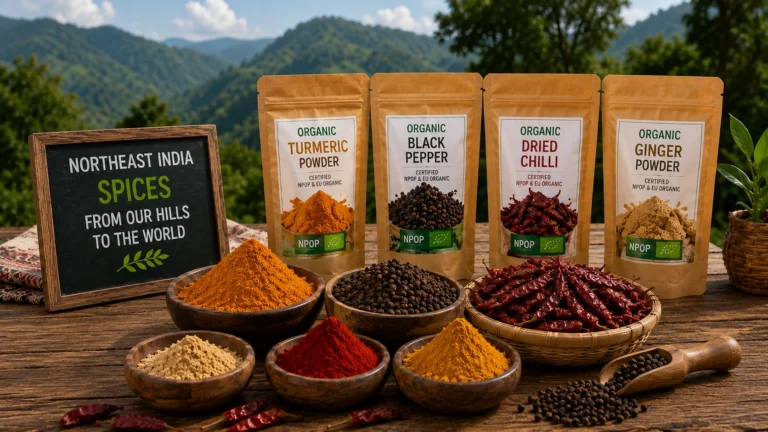
Today, many businesses are compelled to source premium cartons, flexible pouches, labels, glass bottles and specialised packaging materials from mainland India. This increases transportation costs, extends delivery timelines and often reduces competitiveness in national and international markets.
Yet there is another way of looking at this challenge.
Packaging should not be viewed merely as a cost of doing business. It is a sophisticated industry that combines manufacturing, industrial design, branding, material science, engineering and consumer psychology. More importantly, packaging often determines the first impression a product creates in the mind of a customer.
When a consumer picks up a premium tea, artisanal coffee or wellness product, the packaging communicates quality long before the product itself is experienced.
That raises an important question.
Why should premium tea cultivated in Assam travel nearly two thousand kilometres simply to be packed elsewhere?
Why should Lakadong turmeric, specialty coffee or organic products from the Northeast depend almost entirely on packaging materials sourced from outside the region?
Building a globally competitive packaging industry within the Northeast is no longer merely an industrial opportunity. It is becoming an economic necessity.https://dpiit.gov.in/
Changing the Rules Instead of Playing the Same Game
Perhaps the biggest opportunity before the Northeast lies in changing the way it thinks about development itself.
For too long, the region has measured its progress by comparing itself with larger industrial states. While comparisons are inevitable, they can also become limiting because they encourage imitation rather than innovation.
Instead of asking how the Northeast can replicate existing manufacturing hubs, perhaps it should ask a far more strategic question.
What industries can the Northeast lead because of resources that only it possesses?
That shift in thinking changes the conversation completely.
The region possesses abundant bamboo, cane, areca sheath, banana fibre, jute, wood pulp and several other renewable bio-resources. At a time when global businesses are actively searching for sustainable alternatives to plastic packaging, these materials represent a significant competitive advantage rather than merely natural resources.
Imagine Guwahati emerging as India’s centre for premium bamboo-based packaging.
Imagine Agartala becoming a leading hub for areca-based food packaging.
Imagine startups in Meghalaya designing biodegradable packaging solutions for wellness products sold across Europe and North America.
These are not unrealistic dreams. They are commercially viable opportunities supported by changing global consumer preferences.
Instead of trying to compete in yesterday’s industries, the Northeast has an opportunity to build leadership in tomorrow’s sustainable economy.https://www.mdoner.gov.in/
From Local Products to Global Brands
Infrastructure, investment and packaging ultimately serve a larger purpose.
They create brands.
The Northeast has already demonstrated that globally competitive consumer brands can emerge from the region. Companies such as Agapi, Aromica Tea and Woolah Tea have shown that products rooted in local resources, authentic storytelling and innovative thinking can successfully compete in national and international markets.https://thequantiq.com/building-agapi-rinzing-choden-bhutia-global-wellness-brand/
These enterprises are important not simply because they sell products. They demonstrate that the Northeast can move beyond supplying raw materials and begin creating brands that consumers actively seek out.
That distinction matters.
Selling raw tea generates income.
Selling a premium tea brand creates designers, marketers, packaging specialists, logistics companies, distributors, digital marketers and intellectual property. It generates employment across an entire value chain rather than only at the farm.
This is precisely where the region’s greatest economic opportunity lies.
A New Development Narrative
Perhaps the time has come to rethink the way the Northeast speaks about itself.
For decades, development discussions have largely focused on what the region does not have. While recognising these constraints remains important, constantly defining the Northeast by its limitations can unintentionally overshadow its remarkable strengths.
The next phase of economic transformation should begin by asking a different question.
What unique advantages does the Northeast possess that the rest of the world increasingly values?
The answers are compelling.
The region possesses extraordinary biodiversity, globally admired agricultural products, indigenous knowledge systems, sustainable natural resources, a young entrepreneurial population and rapidly improving digital connectivity.
These are not disadvantages waiting to be overcome.
They are competitive advantages waiting to be transformed into globally recognised businesses.https://thequantiq.com/india-handloom-sector-innovation-assam-silk/
The Quantiq Verdict
The future of Northeast India will not be secured by infrastructure alone, important though it remains. Roads, railways and industrial parks are essential foundations, but they cannot, by themselves, create globally competitive enterprises.
Lasting prosperity will emerge when infrastructure enables manufacturing, investment nurtures entrepreneurship and innovation transforms local products into trusted global brands.
The Northeast should certainly continue improving what it lacks. At the same time, it must become equally determined to build upon what it already possesses.
History shows that the world’s most successful economies rarely succeed by copying others. They succeed by discovering their own distinctive strengths and building industries around them.
The Northeast now has the opportunity to do exactly that.
The winners of the next economy will not necessarily be those who play the existing game better. They will be those who redefine the game altogether.