
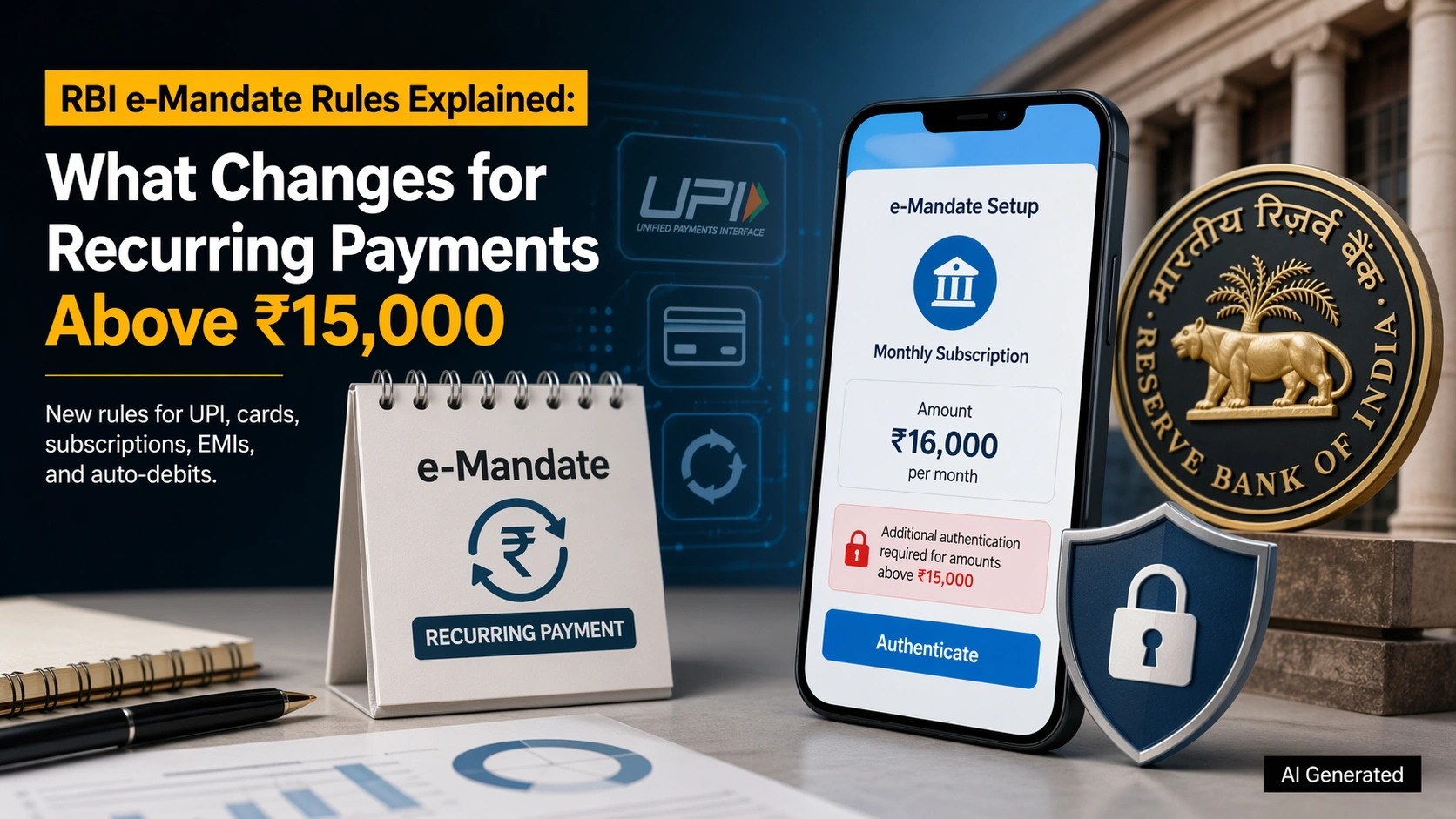
RBI e-Mandate Rules Explained: What Changes for Recurring Payments Above ₹15,000
The Reserve Bank of India updates its e-mandate rules. Here’s what the ₹15,000 limit means for UPI, cards, subscriptions, EMIs, and auto-debits.
A Quiet Shift That Will Shape Everyday Payments
India’s digital payments ecosystem has grown on the promise of speed and ease. Now, the Reserve Bank of India (RBI) is fine-tuning a layer that most users rarely think about—but rely on constantly: recurring payments.
Under the updated e-mandate framework, recurring payments of up to ₹15,000 can now be processed without additional authentication. Anything above that threshold, however, will require an extra step of verification.
At first glance, this may seem like a minor regulatory adjustment. In practice, it reflects a deeper shift—one that tries to preserve convenience while tightening control where it matters most.
What Exactly Has Changed
The RBI has brought greater clarity and uniformity to how recurring payments are handled across digital channels. Whether a payment is routed through UPI, a debit or credit card, or a prepaid instrument, the same underlying logic now applies.
The ₹15,000 threshold sits at the heart of this change. Payments within this limit can move through the system without additional factor authentication, making routine transactions feel almost invisible. But the moment a recurring debit crosses that line, the system slows down just enough to ask for explicit user confirmation.
Even so, some safeguards remain unchanged. The first transaction under any e-mandate must always be authenticated. Any modification to an existing mandate also requires verification. And importantly, users must be notified in advance before each debit is processed. These guardrails ensure that even the most seamless payments do not become opaque.
Understanding the Idea of an e-Mandate
An e-mandate is essentially a digital standing instruction. It allows a business or service provider to automatically debit your account at regular intervals without needing your approval each time.
It powers much of modern digital life—your streaming subscriptions, insurance premiums, systematic investment plans, utility bills, mobile recharges, and even credit card repayments. These transactions often run quietly in the background, forming the backbone of the subscription economy.
The RBI’s updated framework doesn’t change how these payments function at a fundamental level. What it does instead is bring greater predictability and transparency to the process, ensuring that automation does not come at the cost of awareness.
Why the ₹15,000 Threshold Matters
The significance of the ₹15,000 cap lies in how it separates everyday financial behaviour from higher-stakes decisions.
Most recurring payments fall comfortably within this range—monthly subscriptions, utility bills, or routine expenses. By removing additional authentication for these transactions, the RBI is allowing digital payments to remain frictionless where users expect them to be.
But larger debits tell a different story. When the amount rises, so does the need for intent and awareness. By mandating authentication beyond ₹15,000, the RBI is reinforcing a simple principle: convenience should not override control.
This balance is subtle, but it is central to how digital payment systems earn long-term trust.
A Flexible Approach, Not a Rigid Rule
What makes the framework particularly interesting is that it does not impose a one-size-fits-all ceiling. Certain categories—such as insurance premiums, mutual fund investments, and credit card bill payments—are allowed to go up to ₹1 lakh per transaction.
These payments still require authentication, but the higher limit acknowledges the reality that some financial commitments are naturally larger and recurring by design.
In doing so, the RBI signals a more nuanced understanding of user behaviour. Regulation here is not about restriction, but about alignment with how money actually moves.
What This Means for Consumers
For most users, the transition will be almost invisible. Everyday recurring payments are likely to feel smoother, with fewer interruptions and less need for repeated approvals.
At the same time, the system becomes more deliberate when it comes to larger amounts. That extra step of authentication is not an inconvenience—it is a checkpoint. It reduces the chances of fraud, prevents accidental debits, and ensures that users remain consciously involved in higher-value transactions.
In effect, the experience becomes lighter for small payments and more attentive for larger ones.
What This Means for Businesses
For businesses, especially those built on subscription models or recurring billing, the updated framework introduces a new layer of discipline.
Systems must now be fully aligned with RBI guidelines, not just in terms of authentication flows but also in how mandates are created, modified, and communicated. Pre-debit notifications, in particular, become an essential part of the user experience rather than a regulatory formality.
While this may add some operational complexity, it also brings long-term benefits. A clearer and more predictable framework can reduce failed transactions, minimise disputes, and build stronger customer trust.
The Bigger Picture
The RBI’s move reflects a broader transition in India’s digital economy. The early years were about rapid adoption—bringing millions into the fold of digital payments. The next phase is about strengthening the system itself.
This is where speed meets structure, and innovation is balanced with accountability.
Recurring payments, once a background feature, are now being shaped into a more transparent and secure layer of the financial ecosystem.
Bottom Line
The updated e-mandate rules are not designed to slow down digital payments. They are meant to refine them.
For users, the change will barely disrupt daily routines. Subscriptions will continue, bills will be paid, and services will renew as usual. But behind the scenes, the system becomes more robust, more predictable, and more secure.
And in a digital economy built on trust, that quiet strengthening may be the most important upgrade of all.https://thequantiq.com/indias-industrial-moment-a-us-7-trillion-transition-in-motion/
What is the RBI ₹15,000 e-mandate rule?
It allows recurring payments up to ₹15,000 without additional authentication, while higher amounts require extra verification.
Do I need OTP for auto-debits above ₹15,000?
Yes, transactions above ₹15,000 require additional factor authentication such as OTP.
Does this affect UPI auto-pay?
Yes, the rule applies across UPI, cards, and prepaid instruments.
Are there exceptions to the ₹15,000 limit?
Yes, insurance, mutual funds, and credit card payments can go up to ₹1 lakh with authentication.