The Sikkim Pivot: Unleashing the Creative Economy in the Himalayas
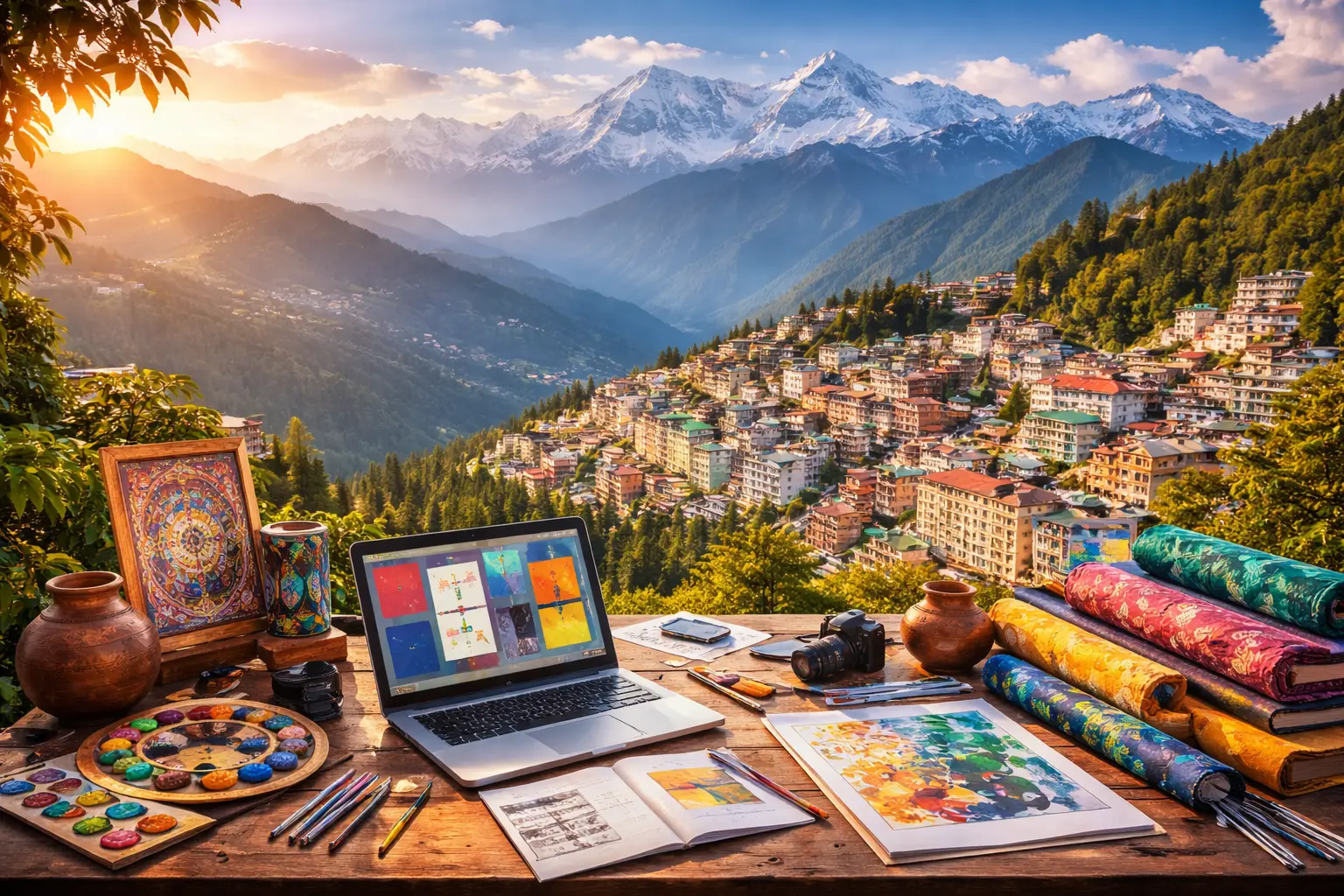
Sikkim has long been recognised for its leadership in organic farming, pharmaceuticals, and ecological stewardship. Now, the Himalayan state appears to be scripting a new economic chapter—one that shifts the focus from land-intensive industries to knowledge-, design-, and creativity-led growth.
Two recent policy signals make this transition unmistakable: the Sikkim Start-up Policy 2025 and a strategic institutional partnership with the National Institute of Design (NID). Together, they point to a deliberate attempt to reposition Sikkim as a creative and digital services hub within the North East.
As the region searches for sustainable growth engines beyond traditional agriculture and extractive industries, Sikkim is betting on the Creative Economy—where culture, technology, and intellectual capital converge.
Skilled Youth Startup Scheme (SYSS) 2025: A Structural Reset
At the heart of this transition is the revamped Skilled Youth Startup Scheme (SYSS) 2025, which marks a clear departure from earlier subsidy-driven entrepreneurship models that often struggled to scale.
Sector Diversification with Clear Policy Intent
SYSS 2025 explicitly supports 18 priority sectors, including IT-enabled services, digital diagnostics, film production, creative media, and adventure tourism. This diversification reflects a policy acknowledgement that future value creation in small states lies increasingly in services, intellectual property, and experience-based industries, rather than heavy manufacturing.
Fiscal Incentives Tailored for Micro-Enterprises
For the first time, Sikkim has introduced operating-cost relief measures that directly impact early-stage viability:
- Fixed power cost reimbursement of ₹1 per unit
- 70% SGST reimbursement for five years for eligible micro-enterprises
For startups operating on thin margins—particularly in digital and creative sectors—these incentives significantly improve survival prospects during the critical early years.
The Creative Clause: Correcting a Policy Blind Spot
One of the most forward-looking provisions is the inclusion of ready-built workshops and long-term rentals (up to two years) as eligible project costs.
This is particularly relevant for creative professionals—UI/UX designers, filmmakers, animators, AR/VR developers—who often lack physical collateral but depend on flexible workspaces. By recognising this structural reality, Sikkim lowers entry barriers for digital nomads and creative startups, a demographic most Indian states still fail to accommodate.
The NID Partnership: Design as an Economic Multiplier
The most analysis-worthy development is Sikkim’s Memorandum of Understanding with NID Ahmedabad, facilitated under the World Bank–supported Sikkim INSPIRES programme.
This collaboration is not about art in isolation. It is about Strategic Design Management—using design thinking to move traditional sectors up the value chain.
Modernising Traditional Crafts for Global Markets
Sikkim’s cultural assets—Thangka painting, wood carving, handloom weaving—carry deep heritage value but limited global market integration. The NID partnership aims to introduce:
- Contemporary design frameworks
- Market-oriented product development
- Branding and packaging aligned with premium and export markets
If implemented effectively, this could transform artisans from local producers into participants in global luxury and lifestyle value chains.
Sikkim Design Week: Building Cultural and Economic Soft Power
The proposed Sikkim Design Week, planned in Gangtok, signals an ambition to position the city as a design and innovation node in the Himalayas.
Beyond visibility, such platforms matter because they:
- Attract national and global design talent
- Expose local youth to international standards
- Build Sikkim’s reputation in UI/UX, product design, and sustainable architecture
For a small state, reputation-building functions as economic infrastructure.
Why the Creative Economy Fits Sikkim’s Geography
Sikkim’s terrain and ecology impose natural limits on industrial expansion. Fragile ecosystems, seismic sensitivity, and land scarcity make large-scale manufacturing neither desirable nor sustainable.
The Creative Economy offers an alternative with a high GSDP-to-land ratio:
- Digital products and services have minimal physical footprint
- Design and IP-led businesses scale globally
- High-value tourism generates revenue without mass ecological stress
This approach aligns economic growth with environmental responsibility.
The Quantiq Analysis: Design Arbitrage in the Himalayas
Sikkim appears to be pursuing a form of design arbitrage—leveraging high literacy, cultural distinctiveness, and digital connectivity to compete in global creative markets despite geographic remoteness.
By skilling local youth in:
- AR/VR and immersive design
- Digital storytelling and content creation
- Experience design for tourism and culture
…the state is effectively building a borderless workforce capable of serving global clients while remaining rooted near Khangchendzonga.
This is not a mass-employment model. It is a high-skill, high-value strategy—and one that may offer a replicable blueprint for other Himalayan and North Eastern states seeking growth without ecological compromise.



One Comment