
Beyond the Resource Economy: The Capital Pivot in Nagaland, Tripura & Manipur
As the first quarter of 2026 closes, something deeper than policy announcements is unfolding across Northeast India. The narrative is no longer about resources alone—bamboo, oil, tea, or handloom. It is about capital. Structured, institutional, and increasingly targeted capital.
From the hills of Nagaland to the plains of Tripura and the complex socio-economic fabric of Manipur, a quiet but decisive pivot is underway—away from subsistence economics toward credit-led, enterprise-driven growth.
This week’s brief tracks three signals that, taken together, point to a region preparing itself for integration into India’s next phase of economic expansion.
Nagaland: The Rise of the Nano-Entrepreneur
In the 2026–27 State Budget presented by Neiphiu Rio, the vision of “Developed Nagaland @ 2047” is not just rhetorical—it is being backed by targeted capital deployment.
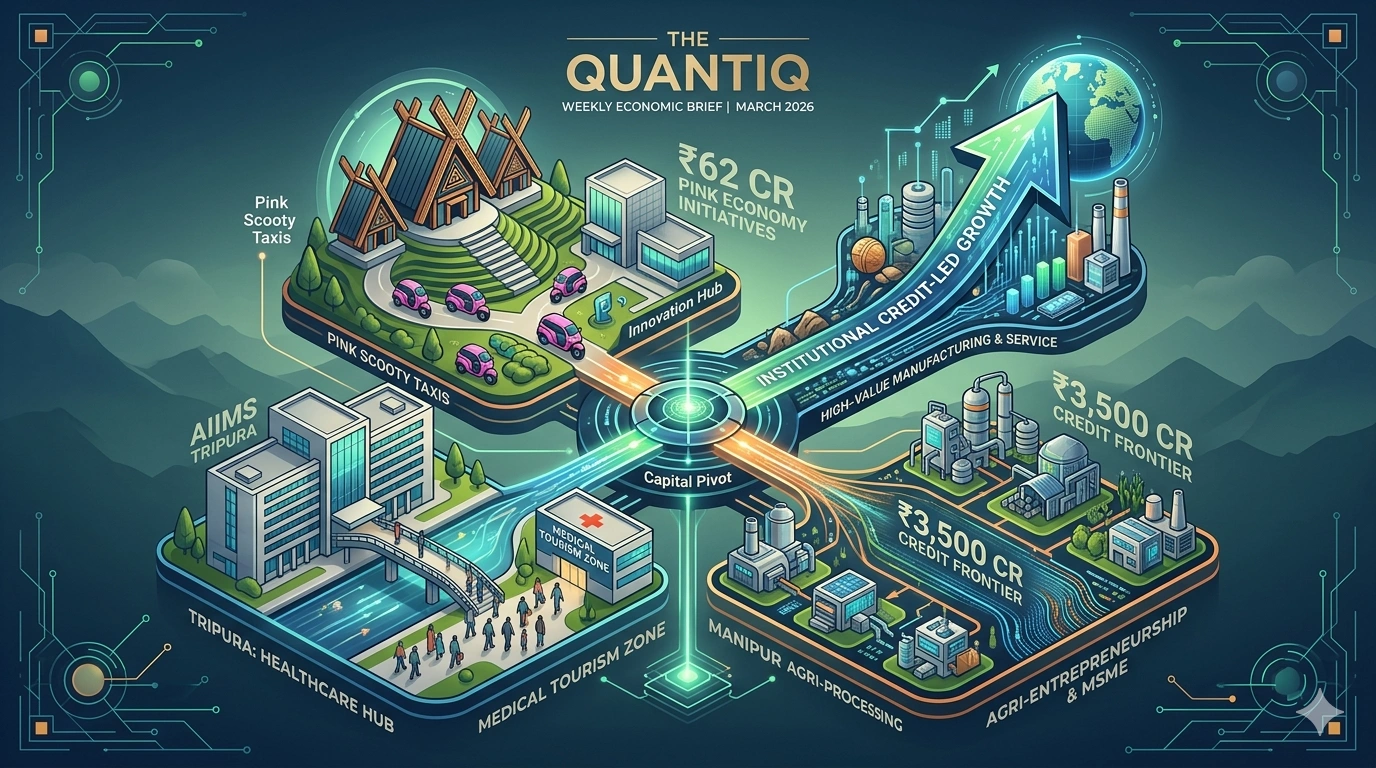
At the center of this shift lies a ₹62 crore strategic investment push.
The most telling component is the operationalization of a ₹2 crore Innovation Seed Fund aimed at nurturing 1,000 nano-women entrepreneurs. These are not large startups chasing venture capital; these are micro, service-led businesses entering the formal economy for the first time.
Complementing this is the rollout of 50 “Pink Scooty Taxis” across Kohima, Mokokchung, and Chümoukedima—an initiative that is as symbolic as it is structural. It signals the formal entry of women into regulated urban mobility services.
What’s really changing here?
Nagaland is moving beyond traditional cottage industries into credit-linked micro-services. The real story is not the size of the fund—it is the design of the intervention. By lowering entry barriers and formalizing nano-enterprises, the state is effectively widening its economic base from the bottom up.
The Quantiq Lens:
This is grassroots capitalism in motion. If sustained, it can transform informal livelihoods into taxable, scalable economic units—something Northeast India has historically struggled with.
Tripura: Building a Cross-Border Medical Economy
Tripura’s economic play is more strategic—and more outward-looking.
Positioned along the Bangladesh border, the state is attempting to capture a steady and growing stream of cross-border healthcare demand. The proposed AIIMS Tripura is expected to act as the anchor institution in this transformation.
Policy inputs emerging from recent Finance Commission-linked studies have emphasized one key idea: healthcare infrastructure as an economic multiplier.
A premier medical institution does not operate in isolation. It triggers an ecosystem—hotels, diagnostics, transport, pharmaceuticals, and specialized services. Early projections suggest a potential 4x expansion in these ancillary sectors once the ecosystem stabilizes.
Why this matters now
Currently, a large volume of patients from Bangladesh and even parts of Northeast India travel to metros like Chennai or Delhi. Tripura is attempting to intercept this flow and localize value creation.
The Quantiq Lens:
This is not just about healthcare—it is about service exports. Tripura is positioning itself as a regional knowledge hub, leveraging geography as a competitive advantage. If executed well, it could become Northeast India’s first true cross-border service economy.
Manipur: The ₹3,500 Crore Credit Inflection Point
In Manipur, the story is not about small pilots—it is about scale.
The State Focus Paper for 2026–27, launched under the leadership of Yumnam Khemchand Singh, estimates the state’s credit potential at ₹3,500 crore.
What stands out is the allocation strategy:
A significant 37% is earmarked for MSMEs, with the rest directed toward agriculture and allied sectors.
On paper, this is transformative. But the real shift lies in intent—the push toward agri-entrepreneurship and rural startups signals a move away from subsistence farming toward value-added production.
But here lies the paradox
Capital is no longer the primary constraint.
The real bottleneck is information asymmetry—a fragmented ecosystem where over 700 MSME units struggle with discovery, market access, and scaling beyond local demand.
The Quantiq Lens:
This is where the next disruption will emerge. AI-driven platforms that can map, aggregate, and connect these enterprises to national and global markets will unlock disproportionate value. In Manipur, the opportunity is not just in funding businesses—it is in making them visible.
The Bigger Picture: A Region Rewriting Its Economic DNA
What connects these three stories is not geography—it is intent.
- Nagaland is formalizing the informal
- Tripura is exporting services, not just goods
- Manipur is scaling credit to unlock enterprise capacity
This is a departure from the long-standing “resource economy” narrative of the Northeast.
Instead, the region is stepping into a capital-first framework, where structured financing, institutional support, and ecosystem thinking are beginning to replace fragmented, subsistence-driven growth.https://thequantiq.com/viksit-bharat-net-zero-22-trillion-india/




3 Comments