
The Economics of Garbage: Why Waste is Now a $400 Billion Industry
The Cost We Don’t See
Waste does not just pile up. It costs.
Every bag of garbage collected, transported, sorted, and buried carries a price. Most of us never see it. It is absorbed quietly into municipal budgets, hidden inside taxes, or deferred into future liabilities.
This is not just spending. It is a growing economic system
Globally, waste management already costs over $250 billion every year. And if current trends continue, that number is expected to rise sharply in the coming decades. These estimates, drawn from the World Bank’s What a Waste 3.0 report, highlight the growing financial burden of managing global waste systems.
From Burden to Industry
For decades, waste was treated as a cost center—a necessary service that cities had to manage, not a system they could build value from.
That thinking is changing.
Waste is no longer just a problem to manage; it is an industry to build. The World Bank’s analysis points to increasing private sector participation and the emergence of new value chains around waste recovery and processing.
Recycling markets are expanding. Waste-to-energy plants are growing. Private companies are entering collection, sorting, and processing. New technologies are emerging to recover materials that were once discarded.
The shift is subtle but powerful. What was once considered useless is now being re-evaluated as a resource.
The Value Hidden in Trash
Look closely at what we throw away—plastics, metals, paper, and organic matter.
Each has value. Yet much of it is lost.
Materials that could be reused are buried in landfills. Organics that could generate energy are left to decompose. Plastics that could be recycled end up polluting oceans.
This is not just environmental damage; it is economic leakage.
The system is not designed to recover value efficiently. It is designed to remove waste quickly—a structural gap also emphasized in global waste assessments by the World Bank.
And that design is expensive.
A System That Spends More, Gains Less
Here lies the contradiction.
The world is spending more on waste management, yet it is recovering less value than it could.
Cities invest heavily in collection and disposal. But recovery systems—recycling, composting, and circular processing—remain underdeveloped in many regions.
The result is a linear economy: take, use, dispose.
That model worked when volumes were low. It breaks down at scale—a concern reflected in global projections outlined in the What a Waste 3.0 report.
And we are now operating at scale.
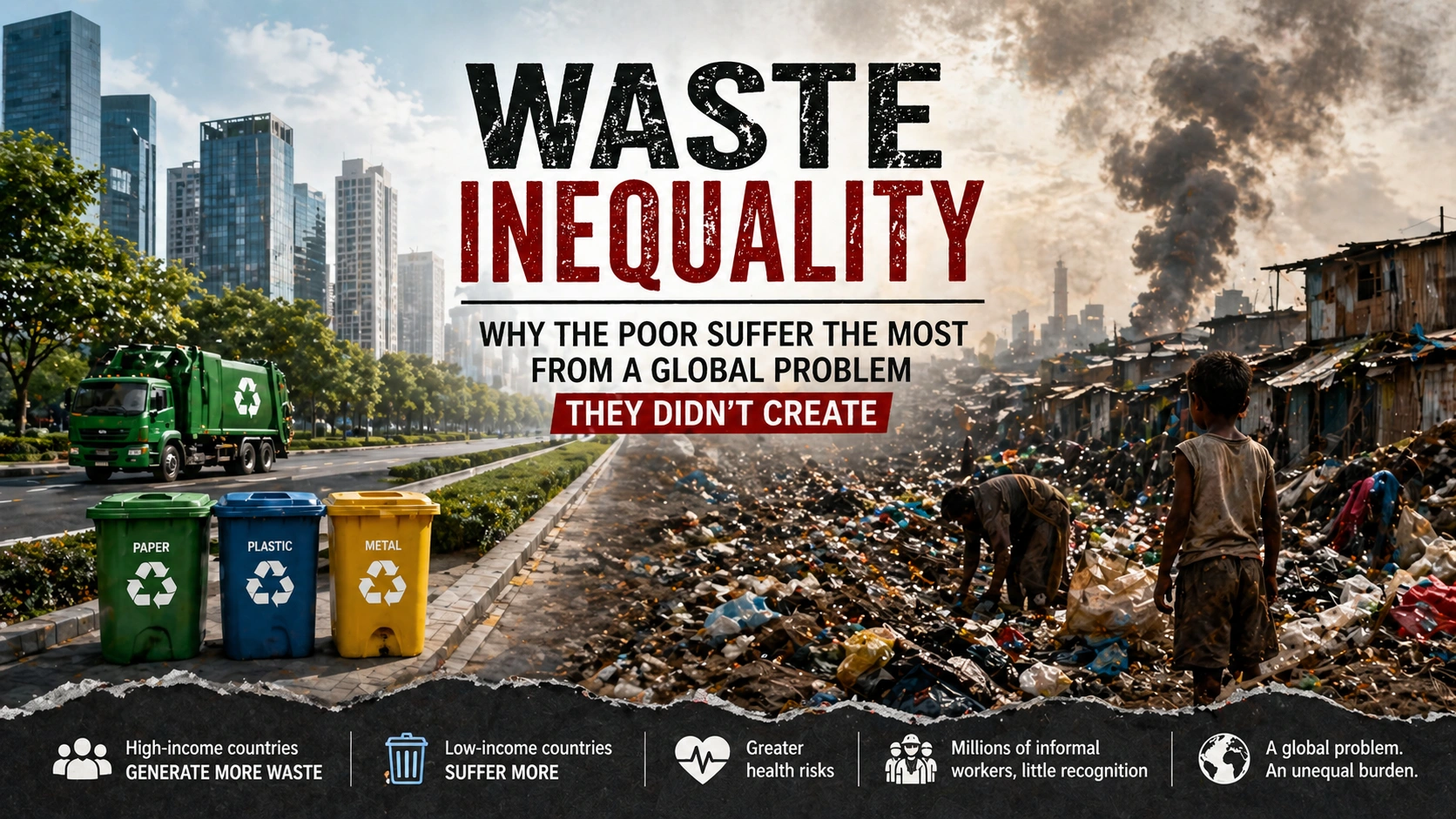
The Inequality of Waste Economics
Not all countries experience this economy in the same way.
High-income nations can afford advanced systems. They invest in recycling infrastructure, energy recovery, and controlled landfills.
Low-income countries struggle with basic collection. In some regions, large portions of waste are never formally managed at all. The World Bank highlights stark disparities in collection rates and infrastructure across income groups.
This creates a paradox.
The places that generate the least waste often face the highest environmental and health costs, while those that generate the most waste have the systems to contain it.
Waste economics, like many systems, reflects inequality.
The Informal Economy No One Talks About
There is another layer to this story.
Millions of people around the world earn a living from waste. They collect, sort, and recycle—often without protection, recognition, or formal inclusion in the system.
Yet they play a critical role.
In many developing countries, informal workers recover a significant share of recyclable materials. They reduce landfill pressure and create value where formal systems fail—a contribution also acknowledged in global waste sector analyses.
This is an economy within an economy—
invisible, but essential.
The Investment Gap
If waste is an industry, it is also an underfunded one.
Many cities cannot afford the infrastructure they need. Collection systems are incomplete. Treatment facilities are limited. Financing models are weak.
Estimates suggest that achieving basic, sustainable waste systems will require a steady share of national income—sometimes up to 0.8% of GDP in low-income countries, according to the World Bank’s projections.
That level of investment is significant.
But the cost of inaction is higher.
Flooding from blocked drains, health crises, environmental damage, and lost economic opportunity—all of these carry a price.
The Rise of the Waste Economy
The next phase is already taking shape.
Waste is entering the language of investment.
Carbon markets are opening new pathways. Recycling industries are attracting capital. Startups are building solutions around sorting, tracking, and recovery.
Governments are introducing policies that push responsibility upstream—toward producers and manufacturers. The World Bank notes growing adoption of such frameworks, including extended producer responsibility.
The idea is simple: if you create waste, you should help manage it.
This is not just regulation. It is market design.
From Linear to Circular
At the heart of this transformation is a shift in thinking—from linear to circular.
In a circular system, waste is not the end of a product’s life; it is the beginning of another.
Materials are reused. Products are redesigned. Systems are optimized for recovery, not disposal.
This is not easy. It requires coordination across industries, governments, and consumers.
But it is necessary.
Because the current model cannot sustain the volumes we are heading toward—a central theme reinforced in the World Bank’s circularity-focused analysis.
The Real Question
Waste is no longer just about cleanliness or civic management.
It is about economics.
It is about how efficiently we use resources, how intelligently we design systems, and how seriously we value what we discard. The numbers are rising. The costs are rising. The pressure is rising.
But so is the opportunity. The real question is no longer whether waste will become an industry. It already is.
The question is who will build it—and who will be left behind.https://thequantiq.com/the-world-is-drowning-in-waste-3-9-billion-tonnes-by-2050/
What is the waste economy?
The waste economy refers to the global system of collecting, processing, recycling, and managing waste, which is now a multi-billion-dollar industry.
How big is the waste management industry?
The global waste management sector already exceeds $250 billion annually and is projected to grow significantly in the coming decades.
Why is waste considered an economic opportunity?
Waste contains valuable materials like plastics, metals, and organic matter that can be recovered, reused, and converted into energy, creating new business opportunities.

One Comment