
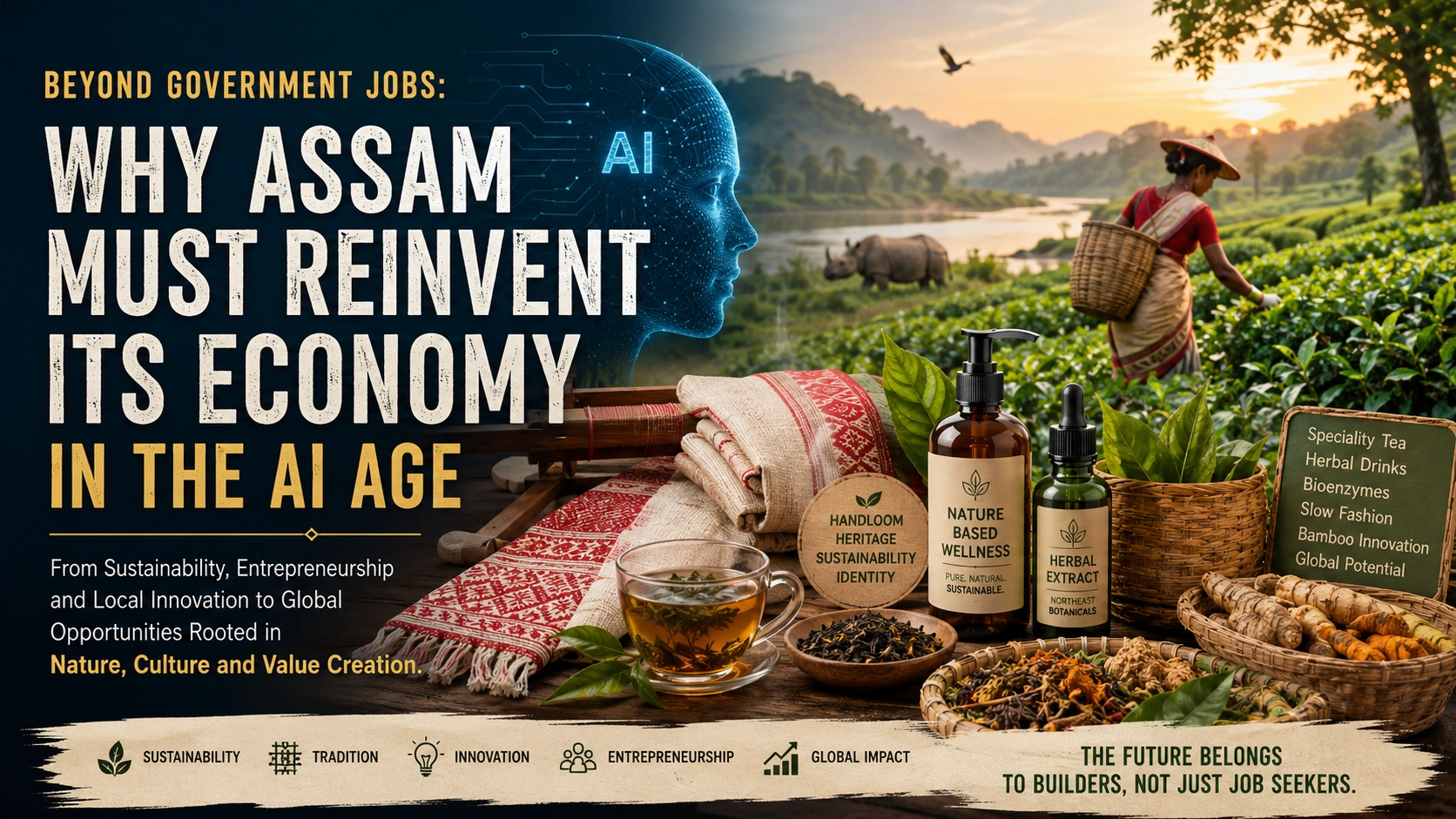
Beyond Government Jobs: Why Assam Must Reinvent Its Economy in the AI Age
For decades, Assam’s economic imagination revolved around one central aspiration — the secure government job.
Families nurtured it with emotional intensity. Society elevated it as status. Educational systems aligned themselves around examinations and recruitment structures. Entire generations grew up believing that stability, dignity, and social mobility ultimately depended on entering government service.
But history has a way of changing silently before it changes dramatically.
And the AI era may be one such turning point.
Across the world, artificial intelligence is no longer a futuristic concept confined to research labs or Silicon Valley conferences. It is rapidly entering workplaces, industries, classrooms, offices, creative sectors, and increasingly, everyday life. The disruption is no longer theoretical. It has begun.
What makes this transformation deeply unsettling is that even industries once considered symbols of long-term security are beginning to feel vulnerable. When IT giants like Infosys and Tata Consultancy Services openly acknowledge the transformative impact of AI on coding, automation, workflow systems, and labour structures, it raises a larger question that societies like Assam can no longer avoid asking:
What exactly does economic security mean in an age where intelligence itself is becoming abundant? This is no longer merely a technological question. It is emotional, social, and civilizational.
For decades, economies rewarded credentials, specialization, institutional prestige, and technical gatekeeping. Degrees became signals of competence. Examinations became gateways to opportunity. Institutions became validators of intelligence.
But AI is beginning to weaken the scarcity on which many of those systems were built. The world may gradually move from a credential-driven economy toward a proof-driven economy.
In such a world, the market may increasingly care less about where somebody studied and more about what they can actually create, solve, build, communicate, or execute. Ivy League degrees may still carry prestige, networks, and exposure, but the monopoly of credentials over opportunity could weaken substantially.
The uncomfortable truth is that the future economy may increasingly reward adaptability, creativity, entrepreneurial thinking, systems understanding, niche expertise, communication, and value creation far more than passive credential accumulation alone.
And this is precisely where Assam faces both danger and opportunity. The danger lies in psychological inertia.
Even today, large sections of society continue to remain trapped within an outdated imagination of economic security. Young people are still being socially conditioned toward examination dependency and employment-seeking identity at a time when the very structure of employment itself is entering turbulence.
The uncomfortable reality is that the future may not have enough “secure jobs” for everyone — not merely because of population pressure, but because AI-assisted productivity, automation, and digital systems are fundamentally changing labour requirements across sectors.
But there is another equally uncomfortable reality Assam must confront honestly.
The state’s entrepreneurial ecosystem too has often evolved as a race to the bottom rather than a race toward innovation.
If one bakery succeeds, dozens suddenly emerge. If restaurants become fashionable, entire neighbourhoods crowd themselves with nearly identical ventures. A few years ago, almost everyone wanted to become a real estate developer. Much of this economic activity is driven not by identifying long-term opportunity gaps or building differentiated value, but by imitation.
The result is hypercompetition without innovation. Margins shrink. Businesses become interchangeable. Quality weakens. Many eventually stagnate or collapse.
In the AI era, this becomes even more dangerous because AI increasingly threatens average-value work and average-value businesses. The real threat of AI may not merely be job destruction. It may be the destruction of mediocrity.
This is why Assam now needs a radically different entrepreneurial philosophy. Not merely more businesses, but smarter businesses. Not merely more shops, but more value creation. Not merely imitation, but differentiation.
And perhaps most importantly, Assam must seriously rethink its economic future through the twin lenses of import substitution and premiumisation of export.
One of the most overlooked realities of Assam’s economy is how heavily dependent it remains on external supply chains even for essential goods connected to food, clothing, lifestyle products, processed items, furniture, and everyday consumption. Wealth continuously flows outward while local productive capacity remains underdeveloped in sectors where Assam naturally possesses deep advantages.
A resilient economy cannot survive merely as a consumption market. It must increasingly become a production ecosystem.
This is where Assam’s greatest opportunity may ironically lie hidden within its oldest sectors.
The world today is moving steadily toward sustainability, ethical sourcing, handcrafted value, traceability, natural materials, slow fashion, artisanal identity, plant-based wellness, eco-conscious consumption, and climate-sensitive production systems. Ironically, many of the sectors that global markets are rediscovering with premium enthusiasm have existed within Assam and the Northeast for generations.https://thequantiq.com/the-green-skin-economy-how-northeast-indias-pineapple-leaves-and-banana-stems-could-clothe-the-world/
Handwoven textiles, natural fibres, bamboo, cane, indigenous craftsmanship, medicinal plants, herbal traditions, speciality tea ecosystems, natural dyes, artisanal food systems, fermented wellness traditions, and nature-based living cultures are not relics of the past. They may become strategic assets of the future.
The problem was never a lack of value. The problem was a lack of positioning. For too long, Assam has often exported raw cultural and ecological value cheaply while importing branded aspiration at premium prices. That equation must change.
The future may not belong to regions that merely produce more. It may belong to regions capable of producing authenticity, sustainability, emotional identity, ecological trust, and differentiated premium value.
A handwoven textile from Assam should not compete merely on price. It should compete on craftsmanship, sustainability, cultural narrative, exclusivity, and emotional connection. Bamboo should not remain merely a low-cost raw material. It should evolve into a design, sustainability, and materials innovation ecosystem.
Similarly, Assam’s speciality tea industry may possess opportunities far beyond conventional commodity thinking.
The future global consumer may not simply buy tea. They may increasingly buy wellness, ritual, mindfulness, heritage, sustainability, emotional experience, and lifestyle identity.
The same applies to nature-based wellness, herbal skincare, haircare, botanical extracts, bioenzymes, plant-based formulations, and functional beverages rooted in the Northeast’s biodiversity.
Across the world, multi-billion-dollar industries are emerging around clean beauty, herbal wellness, functional nutrition, adaptogenic drinks, sustainable cosmetics, low-toxicity lifestyle products, and nature-based consumer ecosystems.
Consumers increasingly seek authenticity, traceability, indigenous ingredients, sustainability, and emotional storytelling. These are not weaknesses for Assam and the Northeast. These are strategic advantages.
Ironically, while many young people dream of building generic AI tools for tiny markets simply because AI currently appears fashionable, the region may actually possess far larger long-term opportunities in combining nature, sustainability, culture, branding, science, and technology into globally differentiated premium products.
This is where another uncomfortable but necessary question emerges. Is it wise to blindly romanticize AI product development without honestly evaluating market size, defensibility, customer depth, and long-term sustainability?
As foundational AI models evolve rapidly, the barrier to building superficial AI products is shrinking dramatically. Replication is becoming easier. Generic AI wrappers may increasingly become difficult to defend economically.
The real opportunity may therefore not lie in merely creating “another AI app.”
It may lie in integrating AI intelligently into sectors where Assam already possesses authentic competitive advantage.
The future may belong to AI-enabled slow fashion, AI-assisted agro ecosystems, smart sustainability products, digitally empowered artisanal exports, nature-based wellness ecosystems, technology-enabled traditional industries, and future-focused media and education platforms.
These are areas where identity, authenticity, ecological richness, and cultural depth create stronger defensibility than generic software imitation.
In many ways, Assam now stands at one of the most important economic crossroads in its modern history.
The future may not belong to societies endlessly waiting for shrinking systems to provide security.
It may belong to those capable of building resilient, differentiated, sustainability-driven value in a rapidly changing world.
And perhaps Assam’s greatest opportunity lies not in copying somebody else’s industrial story, but in finally understanding the extraordinary economic potential hidden within its own natural and cultural ecosystem.https://thequantiq.com/tea-bioeconomy-assam-skincare-haircare-opportunity/


2 Comments