India’s Export Engine Is Accelerating — But Can the Momentum Sustain?
India’s export story is beginning to change character.
For decades, the country’s global trade identity was shaped largely by software services, generic pharmaceuticals, tea, textiles, and back-office operations. Manufacturing exports, despite years of policy ambition, often struggled to achieve the scale and consistency needed to position India as a true industrial heavyweight.
But the numbers emerging in 2026 suggest something deeper may now be unfolding.
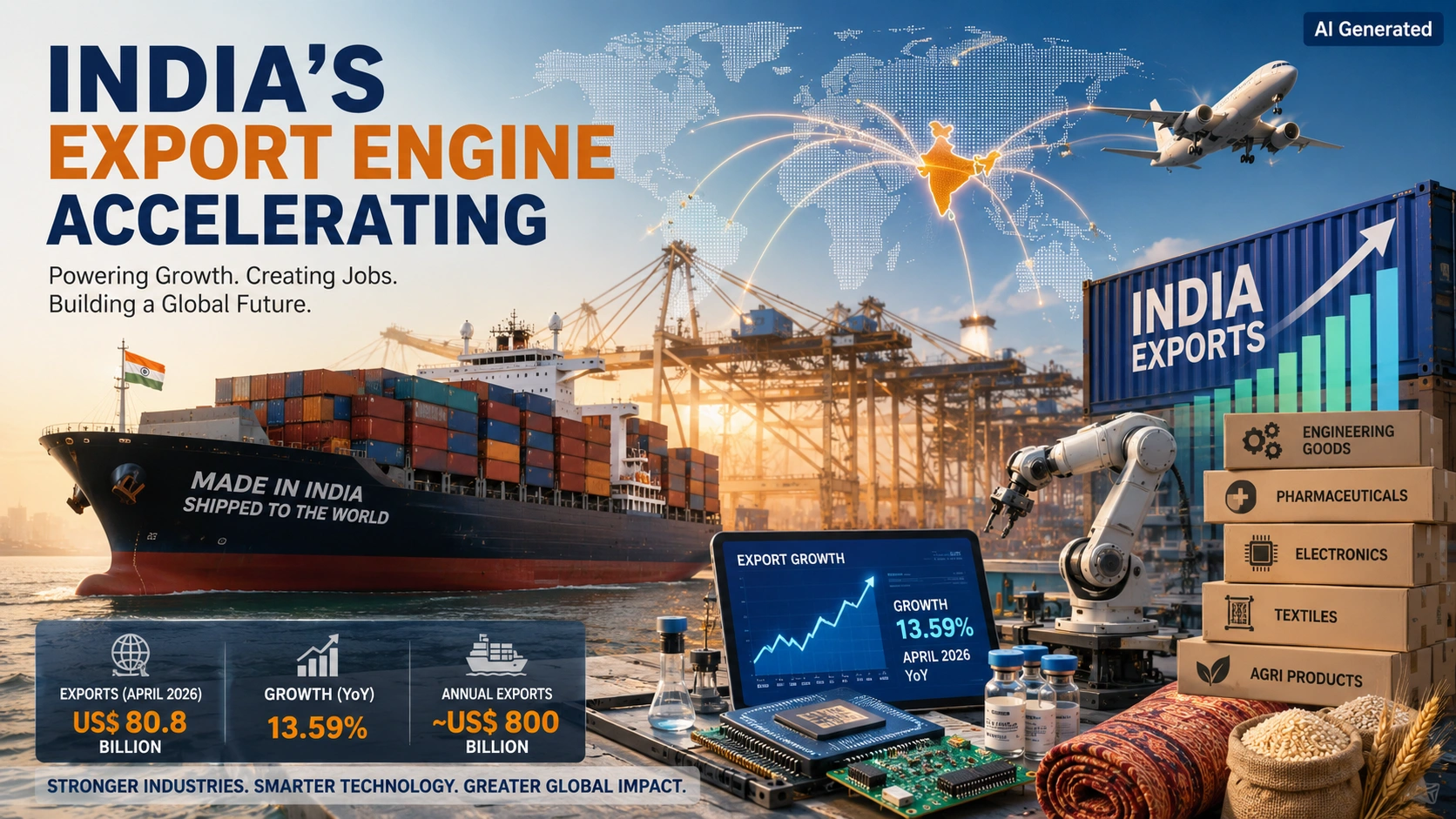
According to recent government and trade estimates, India’s total exports for April 2026 rose to approximately Rs. 7.49 lakh crore (around US$ 80.8 billion), recording a strong 13.59% year-on-year growth over April 2025. Electronics, engineering goods, pharmaceuticals, and petroleum products emerged among the strongest-performing sectors, reflecting an economy that is gradually becoming more integrated into high-value global supply chains.
At first glance, the figures may appear to be just another encouraging economic statistic.
But placed against the backdrop of global geopolitical fragmentation, supply-chain restructuring, artificial intelligence-driven manufacturing, and the global China+1 strategy, the significance becomes much larger.
India is no longer merely trying to participate in global trade.
It is increasingly attempting to position itself as one of the world’s next major industrial ecosystems. India’s combined goods and services exports are now estimated at around US$ 800 billion annually, reflecting the country’s steadily expanding integration into global trade and supply-chain networks.
And for the first time in decades, global conditions may actually favour that ambition.
Across the world, multinational corporations are diversifying manufacturing operations away from excessive dependence on China. Pandemic-era disruptions, rising geopolitical tensions, strategic security concerns, and increasing labour costs have forced companies to rethink supply chains built over nearly three decades of hyper-globalisation.
The result is a historic opening for countries capable of combining scale, political stability, manufacturing depth, and technological adaptability.
India sees this as its moment.
The electronics sector illustrates this transformation most clearly.
A decade ago, India depended heavily on imports for consumer electronics and smartphones. Today, the country is emerging as one of the world’s fastest-growing electronics manufacturing destinations. Government-backed Production Linked Incentive (PLI) schemes, combined with growing investments from global companies such as Apple suppliers Foxconn, Pegatron, and Tata Electronics, are reshaping the sector rapidly.
India’s electronics exports are estimated to have crossed US$ 30 billion in FY2025, with smartphones emerging as one of the country’s fastest-growing export categories.
This is not merely about assembling phones.
It signals the early stages of India’s attempt to integrate itself into advanced global manufacturing networks.
Engineering goods continue to remain another critical pillar of export growth. India is increasingly supplying industrial machinery, transport equipment, steel products, automotive components, and industrial systems to international markets. Pharmaceuticals, meanwhile, continue strengthening India’s position as the “pharmacy of the world,” especially in generic medicines and vaccine production.
Even petroleum exports, despite the global energy transition narrative, continue to generate substantial foreign exchange earnings due to India’s refining capacity and strategic energy infrastructure.
Yet the real question extends beyond monthly export figures.
Can India sustain this momentum long enough to create a structural economic transformation?
The answer depends largely on whether India can overcome three long-standing bottlenecks.
The first is logistics efficiency.
India’s logistics costs remain significantly higher than those of several major export competitors, affecting overall manufacturing competitiveness. Port congestion, fragmented transport systems, warehousing inefficiencies, and bureaucratic friction continue to affect exporters, especially MSMEs trying to integrate into global supply chains.
India has also been aggressively expanding logistics infrastructure through initiatives such as Dedicated Freight Corridors, Bharatmala highways, Sagarmala port modernisation, industrial corridors, and multimodal logistics parks aimed at improving export competitiveness. But despite visible progress, India still has a long journey ahead before matching the efficiency and speed of East Asian manufacturing ecosystems.
The second challenge is technological depth.
Much of India’s manufacturing growth still remains concentrated in assembly-led operations rather than deep ownership of core technologies. True industrial leadership will require India to move aggressively into semiconductors, industrial robotics, advanced materials, battery technologies, AI-integrated manufacturing systems, biotechnology, and precision engineering.
This is where the next industrial battle will likely be fought globally.
Artificial intelligence is already beginning to reshape manufacturing economics worldwide. Smart factories powered by predictive analytics, industrial IoT, machine vision systems, autonomous robotics, and AI-driven quality control are rapidly becoming global standards.
Countries capable of deeply integrating AI into industrial ecosystems may dominate the next phase of manufacturing competitiveness.
India’s success in becoming an AI-native manufacturing economy could determine whether the current export surge becomes temporary momentum or a long-term structural shift.
The third challenge is employment quality and inclusion.
Export growth alone does not automatically guarantee broad-based prosperity. India must ensure that manufacturing expansion creates meaningful jobs, entrepreneurial ecosystems, skill development, and regional industrial participation beyond a few metropolitan clusters.
This becomes especially important for regions like Northeast India, which possess significant untapped potential in sustainable manufacturing, bamboo-based industries, food processing, organic agriculture, handloom textiles, renewable materials, and bio-based exports.
As global consumers increasingly shift toward environmentally responsible products and circular economy systems, India has an opportunity to position sustainability-linked industries as export strengths rather than niche experiments.
The global environment, however, remains uncertain.
The world economy is entering a period marked by protectionism, technological nationalism, geopolitical fragmentation, and strategic trade realignments. Export-led growth strategies may no longer operate under the relatively smooth globalisation models that defined previous decades.
Yet paradoxically, these disruptions may also favour India.
Western economies increasingly view India not merely as a market but as a strategic economic partner capable of supporting resilient supply chains in electronics, semiconductors, pharmaceuticals, renewable energy systems, and advanced manufacturing.
India’s expanding partnerships with countries such as the United States, Japan, the UAE, France, and the Netherlands increasingly indicate that exports are no longer merely an economic subject.
They are becoming instruments of geopolitical influence and strategic positioning.
The coming decade may therefore determine whether India finally achieves the industrial breakthrough it has pursued for generations.
The export numbers from April 2026 are certainly encouraging.
But the larger story lies beyond one month’s data.
It lies in whether India can convert export momentum into technological depth, manufacturing capability, AI-driven productivity, and long-term industrial resilience.
The engine has clearly accelerated.
The real question now is whether India is fully prepared for the road ahead.https://thequantiq.com/india-netherlands-strategic-partnership-semiconductors-trade/