AI Agents: The Digital Workforce That Could Redefine Every Industry
The Quantiq Future Industries Ledger #1
Every Industrial Revolution Begins Quietly
In 1907, a factory owner who wanted to increase production had only one practical option—hire more workers. Nearly a century later, businesses expanded by buying computers, software and internet connectivity. Today, another possibility is emerging. Instead of recruiting another employee or installing another application, a company may soon assign an AI Agent to perform many routine yet critical business tasks.
It may sound like science fiction, but it is rapidly becoming business reality.
Around the world, technology companies are investing billions of dollars in building AI Agents capable of analysing information, planning tasks, communicating with people, using software applications and completing complex workflows with minimal human intervention. While much of the public conversation still revolves around AI chatbots, the real transformation has already begun to move a step further.
The next chapter of artificial intelligence is no longer about systems that simply answer questions. It is about systems that can pursue objectives.
That distinction may prove to be one of the most significant technological shifts of this decade.
Beyond the Chatbot
For most people, artificial intelligence became familiar through conversational tools that could write emails, summarise documents or answer questions. These systems demonstrated the remarkable ability of machines to understand and generate human language, but they generally remained reactive. They waited for instructions before responding.
AI Agents represent a fundamentally different approach.
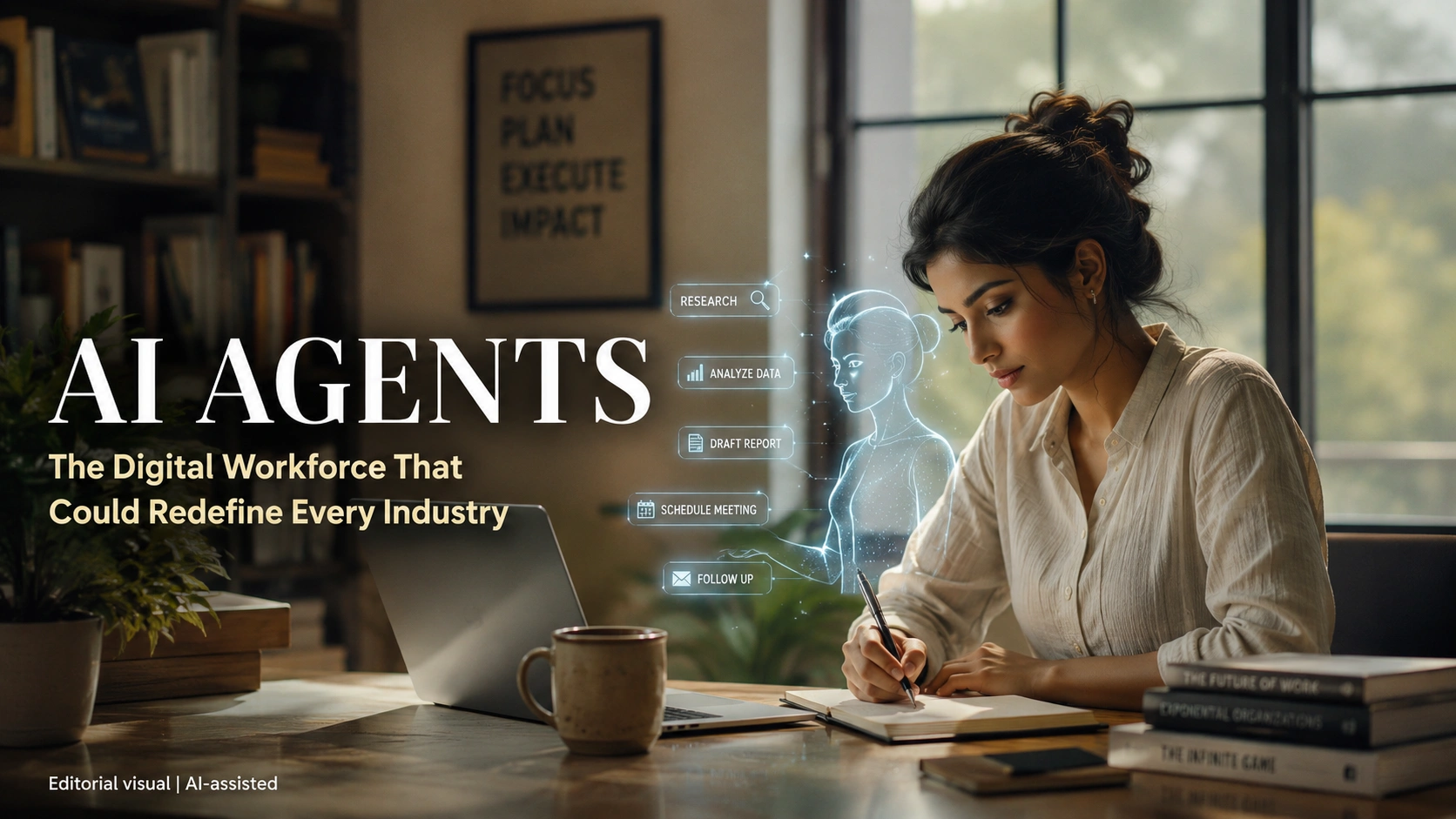
Instead of responding to one prompt at a time, an AI Agent can break down a goal into multiple steps, decide the sequence in which those steps should be completed, interact with different software tools, monitor progress and adapt when circumstances change. In simple terms, it behaves less like a search engine and more like a capable digital colleague.
Imagine asking an AI system to organise an international business conference. Rather than producing a checklist, the agent could identify suitable venues, compare quotations, draft emails to vendors, prepare a preliminary budget, schedule meetings, monitor responses and remind organisers about pending decisions. Human oversight remains essential, but much of the repetitive coordination can be handled autonomously.
The difference is subtle but profound. A chatbot answers. An AI Agent acts.
Why the World Is Paying Attention
Every organisation, regardless of size or industry, runs on thousands of repetitive decisions every single day. Customer enquiries need responses. Purchase orders require verification. Financial reports must be compiled. Compliance documents have to be reviewed. Market trends demand continuous monitoring, while employees spend countless hours coordinating meetings, updating spreadsheets and following up on routine tasks.
These activities are important, but they rarely create competitive advantage.
This is precisely where AI Agents are expected to make their biggest impact. By automating knowledge-based workflows, they can allow professionals to focus on strategy, creativity, innovation and relationship-building instead of administrative repetition.
History suggests that every major technological revolution reshapes work rather than simply eliminating it. Mechanisation transformed agriculture, computers redefined office work and the internet changed global commerce. AI Agents are likely to follow the same pattern. Some routine roles will evolve, entirely new professions will emerge and organisations will increasingly value people who can supervise, guide and collaborate effectively with intelligent systems.
The future workplace may not consist of humans versus machines. It may consist of humans working alongside digital colleagues that never tire, can analyse enormous volumes of information within seconds and continuously improve through learning.
A Global Race Has Already Begun
The race to build capable AI Agents is no longer confined to research laboratories. It has become a strategic priority for some of the world’s largest technology companies and an area of intense competition among startups.
Technology giants are integrating AI Agents into enterprise software, productivity platforms and cloud services. Financial institutions are exploring autonomous systems for compliance and risk analysis. Hospitals are experimenting with AI-assisted patient management, while manufacturers are combining AI Agents with robotics and digital twins to improve efficiency across factories.
Governments are also recognising the strategic implications of this technology. Countries that develop expertise in autonomous AI systems are likely to gain advantages not only in economic productivity but also in healthcare, education, defence, scientific research and public administration.
Investment patterns reflect this growing confidence. Venture capital funding is increasingly flowing towards companies developing specialised AI Agents for legal services, software development, healthcare, logistics, education and cybersecurity. Unlike the first wave of AI, which largely focused on generating text and images, the next wave is focused on completing real work.
That is why many industry observers believe the global AI race is gradually shifting from building better chatbots to creating reliable digital workers.
The winners may not necessarily be those that build the largest language models. They may be those that create the most useful AI Agents for specific industries and real-world business problems.https://hai.stanford.edu/ai-index/2026-ai-index-report
India’s Moment
India enters the AI Agent era with several advantages that many countries would envy. It has one of the world’s largest pools of software professionals, a thriving startup ecosystem and globally recognised digital public infrastructure. Combined with a young entrepreneurial population, these strengths position India not merely as a consumer of AI technologies but as a potential creator of industry-specific AI solutions.
The real opportunity, however, lies beyond developing another general-purpose AI platform. India’s competitive advantage may emerge from building AI Agents that understand the country’s unique business environment. Imagine digital workers trained specifically for agriculture, logistics, manufacturing, healthcare, legal compliance, education or financial inclusion. Such specialised systems could solve problems that global AI platforms often overlook.
For Indian startups, this represents an opportunity to move higher up the value chain. Instead of providing only technology services, they can develop intelligent products capable of serving domestic and international markets.https://indiaai.gov.in/
The Next Competitive Advantage
Every industrial revolution creates new winners. Those winners are rarely the organisations that simply adopt a new technology first. More often, they are the ones that discover new business models around it.
AI Agents are likely to create opportunities across software development, consulting, cybersecurity, enterprise automation, education, digital infrastructure and workflow design. Entirely new professions are also expected to emerge, ranging from AI workflow architects and AI governance specialists to digital workforce managers.
For entrepreneurs, the biggest opportunity may lie in deep domain expertise. An AI Agent designed specifically for tea manufacturing, export documentation, hospital administration or supply-chain management could become far more valuable than another general-purpose chatbot.
Businesses should therefore begin asking a different question. Instead of wondering whether AI will affect their industry, they should ask how AI Agents can eliminate repetitive work, improve decision-making and unlock new sources of value.https://thequantiq.com/mid-week-ai-brief-22-july-2026/
The Northeast Perspective
For Northeast India, AI Agents should not be viewed as another technology trend arriving from distant innovation hubs. They should be seen as tools capable of amplifying the region’s existing strengths.
A tea estate could use AI Agents to analyse weather forecasts, monitor crop conditions, track auction prices and generate production reports. Tourism businesses could deploy multilingual digital assistants to help visitors plan personalised itineraries across the eight Northeastern states. Exporters of bamboo, agarwood, handloom, spices and processed food could use AI Agents to identify overseas buyers, prepare export documentation and monitor changing market demand.
The greatest opportunity may not lie in competing with global AI companies. It lies in building AI solutions that understand the unique industries, languages and business realities of the Northeast.
That journey begins with recognising AI not merely as software, but as a productivity partner.
Questions Every Entrepreneur Should Ask
As AI Agents become increasingly capable, every business owner should begin reflecting on a few strategic questions.
Which repetitive tasks consume the largest share of my team’s time today?
Could an AI Agent perform those tasks faster, more consistently or at lower cost?
Can my business create a specialised AI solution for the industry I understand best?
What new products or services become possible when digital workers are available at scale?
Finally, if my competitors adopt AI Agents before I do, what will that mean for my business five years from now?
The answers to these questions may shape the next generation of successful enterprises.
The Quantiq Insight
History teaches us that industrial revolutions rarely announce themselves with a single dramatic event. They unfold gradually, almost quietly, until one day society realises that the rules of competition have changed.
The arrival of AI Agents may represent one such moment.
Their greatest impact will not come from replacing human intelligence, but from multiplying it. Businesses will still depend on vision, creativity, empathy and leadership. What will change is the amount of routine work required to transform ideas into action.
The companies that thrive in the coming decade may not be those with the largest workforce or the biggest technology budgets. They are more likely to be those that learn how to combine human judgment with intelligent digital workers in ways that create lasting value.
The age of AI Agents has only just begun.
The organisations that begin learning today will be the ones best prepared for tomorrow.https://thequantiq.com/hidden-cost-of-ai-institutional-knowledge/