
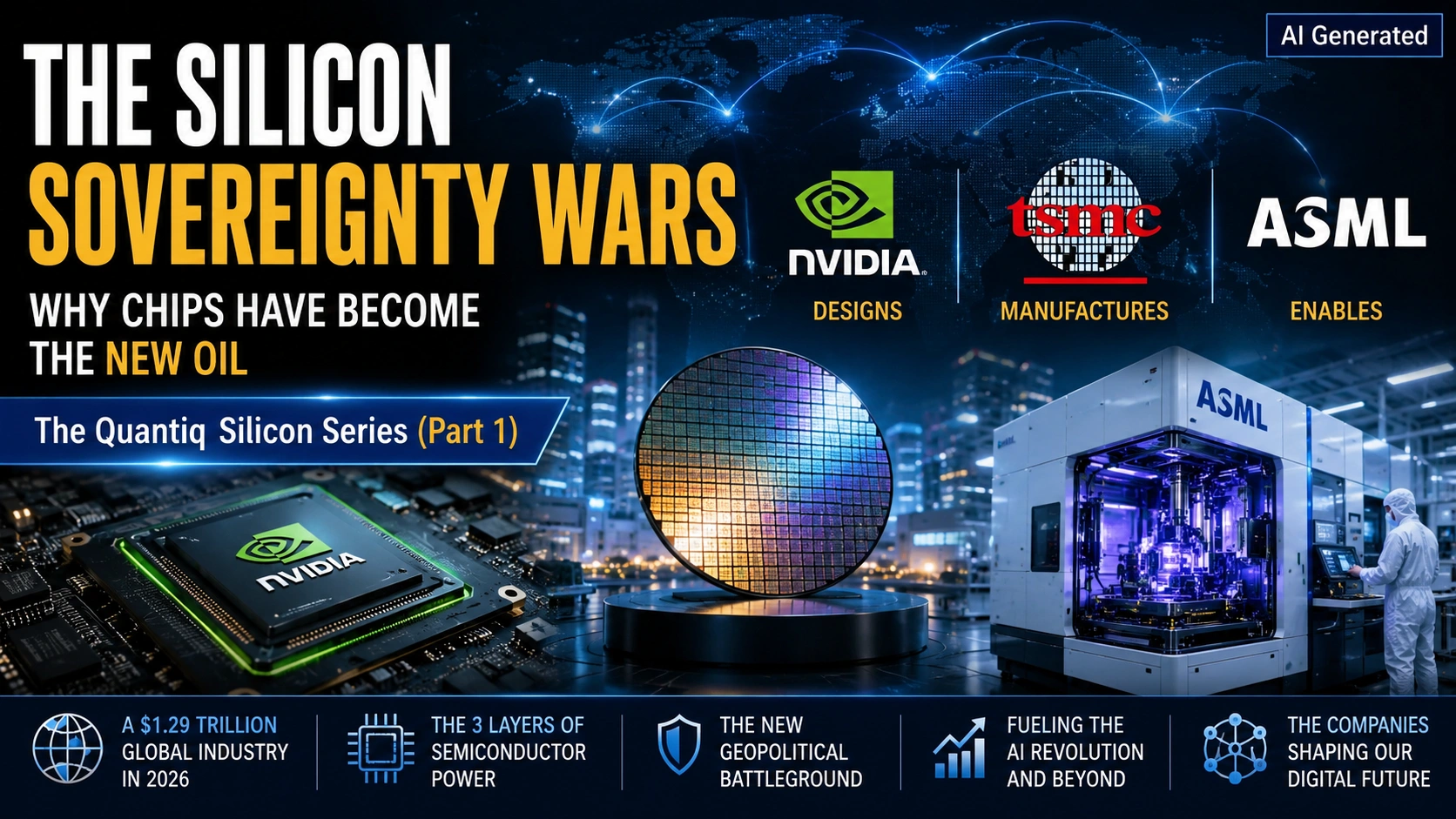
The Silicon Sovereignty Wars: Why Chips Have Become the New Oil
How NVIDIA, TSMC, and ASML Came to Control the World’s Most Strategic Industry
Oil powered the twentieth century.
Semiconductors are powering the twenty-first.
Every AI model, smartphone, electric vehicle, fighter aircraft, satellite, data centre and industrial robot depends on tiny silicon chips that most people never see. Yet these chips have become so strategically important that governments are redesigning industrial policy, corporations are investing hundreds of billions of dollars, and nations are quietly competing for technological supremacy.
The global semiconductor industry is expected to cross US$1.29 trillion in revenue in 2026, driven largely by the explosive growth of Artificial Intelligence. But beneath the headline numbers lies a deeper reality. The industry is controlled by a remarkably small group of companies that dominate critical layers of the value chain.
NVIDIA designs the chips powering the AI revolution.
TSMC manufactures many of those chips.
ASML builds the machines required to produce them.
Together, they form the backbone of the modern digital economy.
This is the story of how a handful of companies came to occupy some of the most strategically important positions in the world—and why the future of economic power may increasingly depend on them.
The Industry Most People Depend On But Rarely Think About
The modern world runs on semiconductors.
A decade ago, many people associated chips primarily with smartphones and personal computers. Today, that perception is badly outdated.
A modern electric vehicle may contain thousands of semiconductor components. Advanced medical equipment depends on them. Telecommunications networks cannot function without them. Defence systems rely on increasingly sophisticated chips for guidance, surveillance and communications.
Artificial Intelligence has accelerated this dependence dramatically.
Every time a user asks ChatGPT a question, generates an image, translates a document or analyses data using AI, vast quantities of computing power are being consumed inside data centres packed with advanced processors.
The AI boom is therefore not merely a software story.
It is fundamentally a semiconductor story.
That reality explains why the global semiconductor market is expected to exceed US$1.29 trillion in 2026, making it one of the largest and most strategically important industries on Earth.
Understanding the Three Layers of Semiconductor Power
Although people often refer to the semiconductor industry as a single sector, it is better understood as three interconnected layers.
Each layer is controlled by different players.
Each layer requires different expertise.
And each layer creates different forms of power.
Layer One: Design — Where Intelligence Is Created
The first layer is chip design.
This is where engineers create the architecture that determines how a chip performs, how efficiently it uses power, and what tasks it can execute.
Design companies typically do not manufacture chips themselves. Instead, they focus on intellectual property, software ecosystems and engineering innovation.
This is also where some of the highest profit margins in the industry are generated.
The undisputed leader of this layer today is NVIDIA.
Why NVIDIA Has Become the Toll Booth of the AI Economy
NVIDIA’s rise is one of the most remarkable corporate stories of the modern era.
Originally known for graphics cards used by gamers, the company gradually built a software ecosystem called CUDA that allowed developers to harness graphics processors for scientific and computational workloads.
That decision proved transformational.
When artificial intelligence entered the mainstream, NVIDIA already possessed the hardware and software ecosystem required to train large AI models.
The result has been extraordinary.
The company reported FY2026 revenue of approximately US$215.9 billion, while generating nearly US$96.6 billion in free cash flow.
More importantly, NVIDIA has become deeply embedded within the global AI ecosystem.
Most frontier AI systems today rely heavily on NVIDIA hardware.
Its chips power everything from large language models to scientific simulations and autonomous systems.
The company’s true advantage, however, extends beyond silicon.
Its greatest strength lies in the software ecosystem surrounding its products.
Thousands of developers, startups, research institutions and corporations have built workflows around CUDA. Switching away from that ecosystem is possible, but often expensive and complex.
This creates a competitive moat that rivals continue to struggle against.
In practical terms, NVIDIA has become one of the most important infrastructure providers of the AI age.
Layer Two: Fabrication — The Manufacturing Chokepoint
Designing a chip is one challenge.
Manufacturing it is another.
Fabrication plants—commonly known as fabs—represent some of the most sophisticated industrial facilities ever built. Constructing a modern semiconductor fabrication plant can cost tens of billions of dollars and require years of development.
This has created a remarkable concentration of manufacturing power.
The company at the centre of this concentration is Taiwan Semiconductor Manufacturing Company, better known as TSMC.
Most consumers have never heard of it.
Yet it manufactures chips for many of the world’s largest technology companies, including NVIDIA, Apple, AMD and Qualcomm.
Without TSMC, much of the modern technology economy would face severe disruption.
The company’s importance has become so great that analysts increasingly describe Taiwan as the world’s semiconductor chokepoint.
Why Taiwan Matters to the Entire World
The strategic significance of Taiwan extends far beyond geography.
It is rooted in manufacturing capability.
For decades, TSMC focused relentlessly on perfecting advanced semiconductor fabrication. That commitment allowed it to build a lead that competitors have struggled to match.
Today, some of the world’s most advanced chips are produced in facilities located only a few hundred kilometres from mainland China.
This concentration creates both efficiency and risk.
Efficiency because the ecosystem has become extraordinarily specialised.
Risk because geopolitical tensions have transformed semiconductor manufacturing into a matter of national security.
Governments in the United States, Europe, Japan and India are now investing heavily to diversify semiconductor supply chains.
Their objective is simple: reduce dependence on a single geographic region for one of the world’s most critical technologies.
The Company Few People Know About—But Everyone Depends On
If TSMC is the manufacturing king of the semiconductor industry, ASML may be its most indispensable supplier.
Headquartered in the Netherlands, ASML produces the Extreme Ultraviolet (EUV) lithography machines required to manufacture leading-edge semiconductors.
There is no meaningful alternative.
Each machine is an engineering marvel containing tens of thousands of components sourced from highly specialised suppliers around the world.
The machines are so complex that they can cost hundreds of millions of dollars each.
Without them, producing the world’s most advanced chips becomes extraordinarily difficult.
This gives ASML a unique position in the global technology ecosystem.
While NVIDIA captures headlines and TSMC dominates manufacturing, ASML quietly controls one of the most critical bottlenecks in modern industry.
The company illustrates an important lesson about technological power.
Sometimes the most valuable position is not building the final product.
It is owning the tool that everyone else needs.https://thequantiq.com/india-315-billion-tech-sector-northeast-ai-economy/
Layer Three: Advanced Packaging — The Next Battlefield
For decades, semiconductor progress was largely defined by shrinking transistor sizes.
That approach is becoming increasingly difficult and expensive.
As a result, the industry is now pursuing another path: advanced packaging.
Rather than relying on a single chip, companies are increasingly combining multiple specialised chips into highly integrated systems.
Technologies such as chiplets, High-Bandwidth Memory (HBM), and advanced packaging platforms are becoming central to AI performance.
This shift is creating new opportunities and new bottlenecks.
The companies that master advanced packaging may become just as important as those leading fabrication.
In many ways, the next chapter of semiconductor competition is already underway.
Why Governments Are Suddenly Paying Attention
Semiconductors are no longer viewed as ordinary industrial products.
They have become strategic assets.
Governments increasingly see chip supply chains through the same lens once reserved for oil, energy infrastructure and defence capabilities.
The United States has launched major initiatives to strengthen domestic semiconductor manufacturing.
Europe is investing heavily in semiconductor resilience.
Japan is rebuilding advanced manufacturing capabilities.
India has launched the India Semiconductor Mission to establish a foothold in the global value chain.
The common theme is clear.
No major economy wants to depend entirely on external suppliers for technologies that underpin national competitiveness.
Semiconductors have become instruments of economic power.
The New Oil of the AI Era
The comparison between oil and semiconductors is not perfect.
Oil is consumed.
Chips are manufactured.
Yet both share a critical characteristic.
They sit at the centre of countless economic activities.
A century ago, nations competed to secure access to energy resources.
Today, they are competing to secure access to advanced computing.
The AI revolution is accelerating this trend.
Every breakthrough in artificial intelligence ultimately depends on physical infrastructure.
Behind every AI model sits a data centre.
Behind every data centre sits a semiconductor supply chain.
And behind that supply chain stands a small group of companies whose influence extends far beyond technology.
NVIDIA designs.
TSMC manufactures.
ASML enables.
Together, they form the foundation of the AI economy.
In Part 2 of The Quantiq Silicon Series, we examine India’s semiconductor ambitions—from the India Semiconductor Mission and Tata’s Dholera fabrication project to TSAT Morigaon in Assam—and ask whether India can secure a meaningful place in the world’s most strategic industry.https://thequantiq.com/india-semiconductor-sovereignty-niti-aayog-2035-blueprint/





2 Comments