Rice to Fabric: Can Northeast India Turn Paddy Straw into a New Textile Industry?
Northeast Renaissance Series
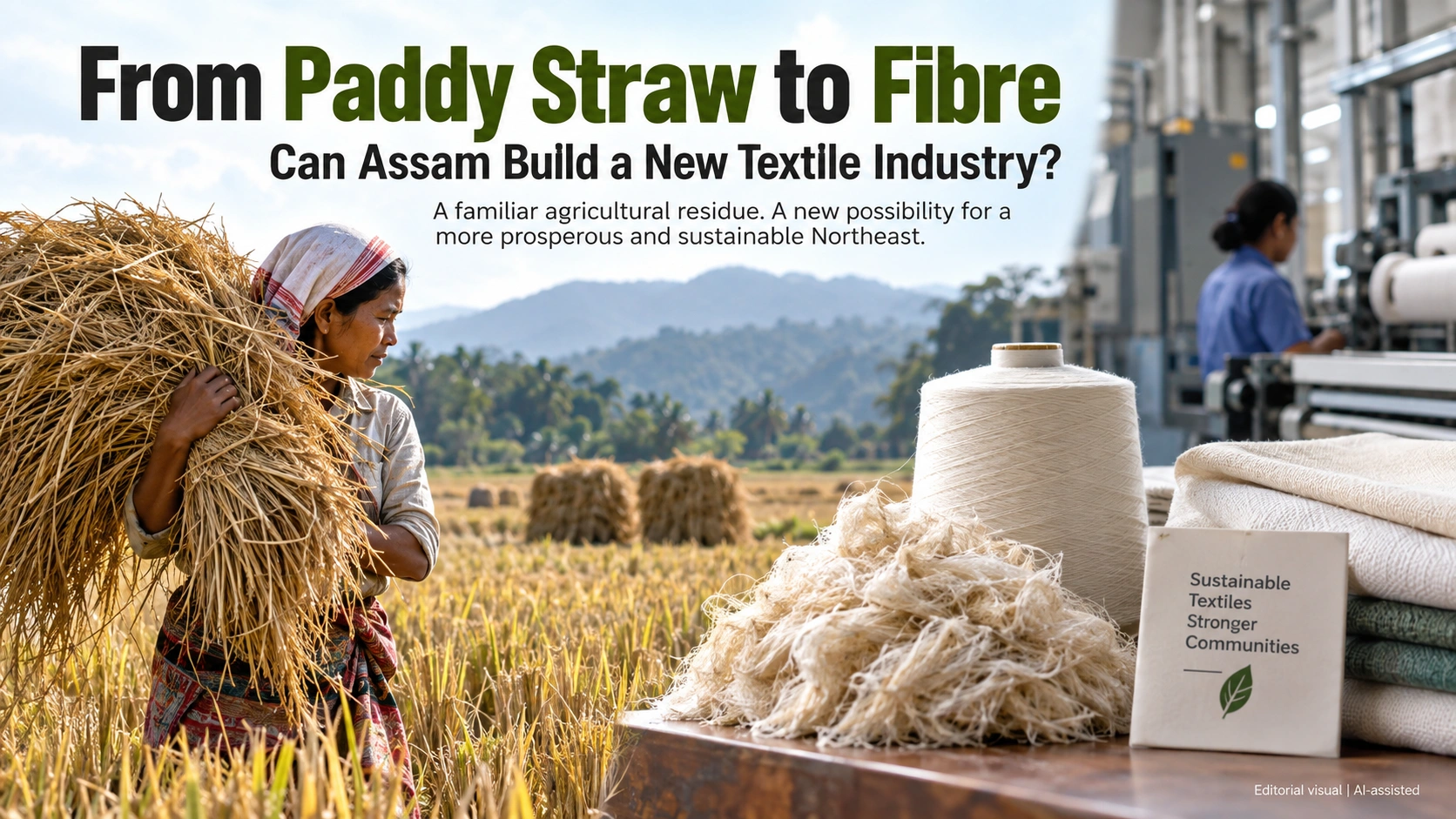
Assam grows rice by the millions of tonnes. What if some of the value of that harvest lies not in the grain, but in what is left behind?
Every harvest leaves something behind.
In Assam’s paddy fields, one of the most abundant of those leftovers is paddy straw. For generations, the grain has been the valuable part of the rice plant. It feeds families, supports farmers and occupies a central place in the culture and economy of the Northeast. The straw, meanwhile, has generally been treated as a by-product of the harvest, with some used as cattle feed, incorporated into the soil or disposed of when there is little practical alternative.
But science is beginning to give this familiar agricultural residue a different identity.
Paddy straw contains cellulose, a natural polymer that is already fundamental to the textile and materials industries. Research in different parts of the world has demonstrated methods for extracting cellulose from rice straw and converting it into fibres and other advanced materials. Regenerated cellulose fibres have also been produced from rice straw through wet spinning, bringing the possibility much closer to the world of textiles.
The question for Northeast India is therefore no longer whether paddy straw contains industrial value. It does. The more interesting question is whether the region can develop the knowledge, processing capability and supply chain required to capture that value.
Why This Matters
Rice is deeply embedded in Assam’s agricultural economy, landscape and culture. According to the Assam Economic Survey 2025–26, rice covered approximately 22.86 lakh hectares in 2024–25, with a production of around 55.21 lakh tonnes. Rice is cultivated across the state’s three principal seasons, making it not merely an important crop but one of the foundations of Assam’s rural economy.
Every tonne of rice, however, comes with a quantity of agricultural residue. The precise amount varies according to rice variety, cultivation system, harvesting method and season, so it would be misleading to present one fixed number as the quantity of straw that Assam can actually supply to industry. Some straw also has legitimate uses within farming systems and should remain available for livestock, soil management and other purposes.
Even with those qualifications, the scale of the resource is substantial. Assam’s rice economy generates several million tonnes of straw each year, creating a potential feedstock for applications that are currently almost entirely undeveloped in the region. That is where the economic question becomes more interesting. Instead of asking only how agricultural residue can be disposed of, Assam could begin asking whether part of it can be converted into a higher-value industrial material.
What Is Actually Inside Paddy Straw?
Paddy straw is a lignocellulosic material, which means that its structure contains cellulose along with hemicellulose and lignin. Cellulose is particularly important because it can be separated, purified and processed into different forms of fibre and advanced materials.
Research has already demonstrated several approaches to extracting cellulose from rice straw. Studies have investigated alkaline treatment, bleaching, ultrasound-assisted extraction and other pretreatment methods. One study using ultrasound-assisted processing reported a higher cellulose-fibre yield than the alkaline process used for comparison, while other researchers have explored alternative extraction routes involving subcritical water and bleaching.
There is also a direct connection with textile manufacturing. Research has demonstrated the production of regenerated cellulose fibres from rice straw using wet spinning, showing that cellulose recovered from agricultural residue can potentially be converted into a textile fibre rather than remaining simply a processed biomass product.
This distinction is important because the opportunity is not about taking pieces of straw and somehow weaving them directly into cloth. The more sophisticated pathway involves separating and purifying the cellulose and then engineering it into a fibre suitable for yarn, nonwoven materials or technical-textile applications. In other words, the journey is not really straw to fabric. It is straw to cellulose, cellulose to fibre, and fibre to products.
From Paddy Field to Fibre
The industrial process would begin well before the textile mill.
Paddy straw would first have to be collected, cleaned, dried and prepared for processing. It would then undergo a pretreatment designed to break down the plant structure and separate cellulose from lignin and hemicellulose. Depending on the technology ultimately selected, this could involve alkaline treatment, bleaching, enzymatic processing, steam-based methods or combinations of these approaches.
The cellulose-rich material would then need further purification before being converted into the required form. Some processing routes can produce cellulose microfibres, while others can move towards nanocellulose or regenerated cellulose fibres.
That means a future Assam facility would not simply be a textile factory. It would sit at the intersection of agriculture, biotechnology, chemical processing, materials science and textile engineering. And that is precisely why the opportunity deserves to be looked at as an emerging industrial ecosystem rather than as another agricultural-waste project.
Opportunity Snapshot
| Indicator | Indicative assessment |
| Assam rice production, 2024–25 | ~55.2 lakh tonnes |
| Potential paddy-straw resource | Several million tonnes annually |
| Primary material of interest | Cellulose |
| Potential textile applications | Fibre, yarn, nonwovens, technical textiles |
| Wider applications | Nanocellulose, composites, packaging, biomaterials |
| Current Northeast industrial maturity | Early-stage / largely unbuilt |
| Employment potential | High |
| Value-addition potential | Very high |
| Export opportunity | Significant, subject to commercial validation |
The straw-resource estimate is indicative rather than a measured recoverable quantity. Actual availability would depend on rice variety, season, harvesting practices, competing agricultural uses, collection efficiency and logistics.
The Northeast Should Not Stop at the Field
Whenever we discuss Northeast India’s natural resources, there is a tendency to stop at the point of abundance. We talk about the bamboo that grows across the region, the forests that support entire ecosystems, the agricultural biomass generated every harvest and the enormous water resources that surround our communities. But having a resource is only the beginning of an economic story. The real transformation starts when that resource is processed, refined and converted into something with greater value.
Paddy straw offers a good illustration of what that transformation could look like. Instead of leaving the material at the farm as agricultural residue, its cellulose can potentially be extracted and processed into fibre, which can then move into yarn, nonwoven materials, technical textiles or finished products. At each stage, the value of the original resource increases, while creating opportunities for researchers, processors, manufacturers, designers, entrepreneurs and skilled workers. The finished product can ultimately travel far beyond the Northeast, allowing a much larger share of the value created from the region’s agricultural resources to remain within the region.
This is the difference between having a resource and building an industry around it. The objective should not simply be to find another use for paddy straw. It should be to build the knowledge and processing capabilities that can take a locally available resource through several stages of value addition and, eventually, turn it into products that can compete in larger markets. That is where the real promise of a paddy-straw economy lies.
Assam May Not Be Starting Entirely From Zero
There is another reason to examine this possibility carefully.
Assam is already seeing work around the extraction and processing of natural fibres, particularly bamboo. The research material prepared for this article points to bioenzyme-based bamboo-fibre processing involving controlled retting, washing, drying and carding to produce textile-grade fibre.
Paddy straw is not bamboo, and its chemistry and fibre structure are different. A bamboo process cannot simply be transferred to rice straw. Nevertheless, the existence of local experience in biological fibre processing creates an adjacent knowledge base from which a dedicated paddy-straw research programme could begin.
That could prove useful because new industries rarely emerge from a single breakthrough. They often develop by combining capabilities that already exist in neighbouring fields.
The Bigger Opportunity May Be a Biorefinery
The textile proposition is compelling, but it should not become a narrow “straw-to-cloth” project.
Paddy straw contains several components that can potentially be separated and directed towards different markets. Cellulose could move towards fibres, regenerated cellulose, nanocellulose and composites, while other fractions could potentially become inputs for chemicals, coatings, binders and other materials.
This is the logic of a biorefinery. Instead of depending on a single product, a biorefinery seeks to extract several valuable outputs from the same biomass.
Rice husk could eventually become part of such a wider model, but it should not be treated as identical to paddy straw. The husk has a different composition, including significant silica, which gives it a different industrial opportunity in areas such as silica extraction and composite materials.
The larger proposition for Northeast India is therefore not simply rice straw fabric. It is the possibility of developing a paddy-residue materials economy, with textiles as one potentially important destination.
The First Investment Should Be Evidence
This may be the most important question in the entire story.
The temptation will be to ask how large a factory Assam could build. That is not the question that should come first.
The first question should be much simpler: Can Assam’s own paddy straw produce commercially useful fibre at a competitive cost?
We do not yet know.
Different rice varieties can have different fibre characteristics, and the straw produced during Ahu, Sali and Boro cultivation may not behave identically. Harvesting conditions, moisture, storage and transportation can also influence the quality and economics of the feedstock.
That is why the first serious investment should probably not be a large industrial plant. It should be a properly designed research-to-pilot programme.
Representative paddy straw from Assam’s principal rice-growing regions and varieties could be tested for cellulose yield, fibre quality, processing requirements, water and energy consumption, chemical or enzyme requirements and cost. The resulting material should then be benchmarked against specifications supplied by actual textile, technical-textile or materials manufacturers.
The research note prepared for this article makes the same fundamental sequencing argument: variety-specific trials should come first, followed by fibre-quality benchmarking and a small pilot, with commercial-scale investment considered only after those stages provide reliable evidence.
That approach may sound modest, but it is precisely what makes the proposition credible.
Process Intelligence Is the Real Moat
Abundant straw by itself will not give Northeast India a competitive advantage.
The advantage will come from knowing how to process it efficiently and consistently.
Researchers will need to determine which rice varieties offer the most useful cellulose characteristics, how the straw should be collected and stored, which pretreatment provides the best balance between fibre quality and processing cost, and whether enzymes or other technologies can reduce chemical and energy requirements.
There is an equally important logistical question. Paddy straw is generated across agricultural landscapes rather than arriving at a factory in neat industrial lots. The economics of baling, aggregation, storage and transportation will therefore matter almost as much as the chemistry.
Finally, the fibre will have to satisfy someone who is willing to buy it.
That is why process intelligence—not merely access to raw material—could become the real competitive moat.
The Policy Question
There is an interesting policy dimension to this opportunity.
India’s crop-residue conversation has historically been dominated by the stubble-burning problem in Punjab, Haryana, Uttar Pradesh and the National Capital Region. The Centre’s Crop Residue Management framework was developed largely around that geography and the machinery required to address it. The uploaded analysis notes that Assam is not currently part of that principal CRM framework.
But Assam does not need to wait for its paddy-straw problem to become an air-pollution crisis before thinking about it economically.
The policy question should instead be framed around resource valorisation.
What would it take to help Assam test paddy straw as an industrial feedstock? Could agricultural universities, ICAR institutions, textile laboratories, biotechnology centres and private manufacturers collaborate on a pilot? Could existing biomass, MSME, agricultural infrastructure or circular-economy programmes support the early stages?
Most importantly, policy should support proof before scale.
The first public intervention need not be a large subsidy for a factory. It could be support for the scientific and commercial evidence required to determine whether such a factory deserves to exist.
For Students & Young Professionals
A paddy-straw materials industry would bring together several disciplines that are usually taught separately.
Textile-technology graduates could work on fibre development, spinning, yarn construction and fabric performance. Chemical and biochemical engineers could focus on pretreatment, cellulose separation, enzymes and process optimisation. Materials scientists could explore nanocellulose, composites and functional materials.
Agricultural engineers could work on collection, baling and logistics, while environmental specialists could address water consumption, chemical recovery, waste management and life-cycle assessment. Data scientists could contribute to feedstock mapping, process optimisation and industrial decision-making.
For entrepreneurs, the opportunity may exist even before a commercial fibre mill is established. Collection and preprocessing, laboratory testing, specialised material development, technical textiles and downstream products could each become separate businesses within a larger ecosystem. That is an important lesson for young professionals in the Northeast. An emerging industry does not necessarily begin with a large company waiting to hire people. It often begins with small specialised capabilities that eventually connect to form an industry.
The Quantiq Assessment
Paddy straw is not Assam’s next textile industry.
Not yet.
And that is precisely why it belongs in the Northeast Renaissance Series.
The scientific evidence has moved far enough to demonstrate that cellulose can be recovered from rice straw and developed into fibres and advanced materials. What has not yet been established is whether the same proposition can work economically with Assam’s own rice varieties, agricultural conditions and supply chains.
That is why the opportunity should begin with evidence rather than a factory.
A properly designed Assam-specific pilot could establish the real cellulose yield, determine the quality of the resulting fibre, identify the most suitable processing route and calculate whether the economics can compete with alternative fibre sources.
If those experiments succeed, the opportunity could extend well beyond textiles. It could create a new value chain from paddy residue to cellulose, cellulose to fibre, fibre to technical materials and other biomass fractions to additional industrial products.
The immediate opportunity is therefore not to promise a new industry.
It is to prove whether one can be built.
That distinction is important.
For Northeast India, the journey from resource to industry has too often stopped at the point where the raw material leaves the region. A paddy-straw economy offers the possibility of doing something different: retaining more of the processing, knowledge and value within the region.
For generations, Assam has grown rice for its grain.
Perhaps the next generation can learn to see value in the straw as well.
The grain feeds us. The straw could help build another industry.




One Comment