
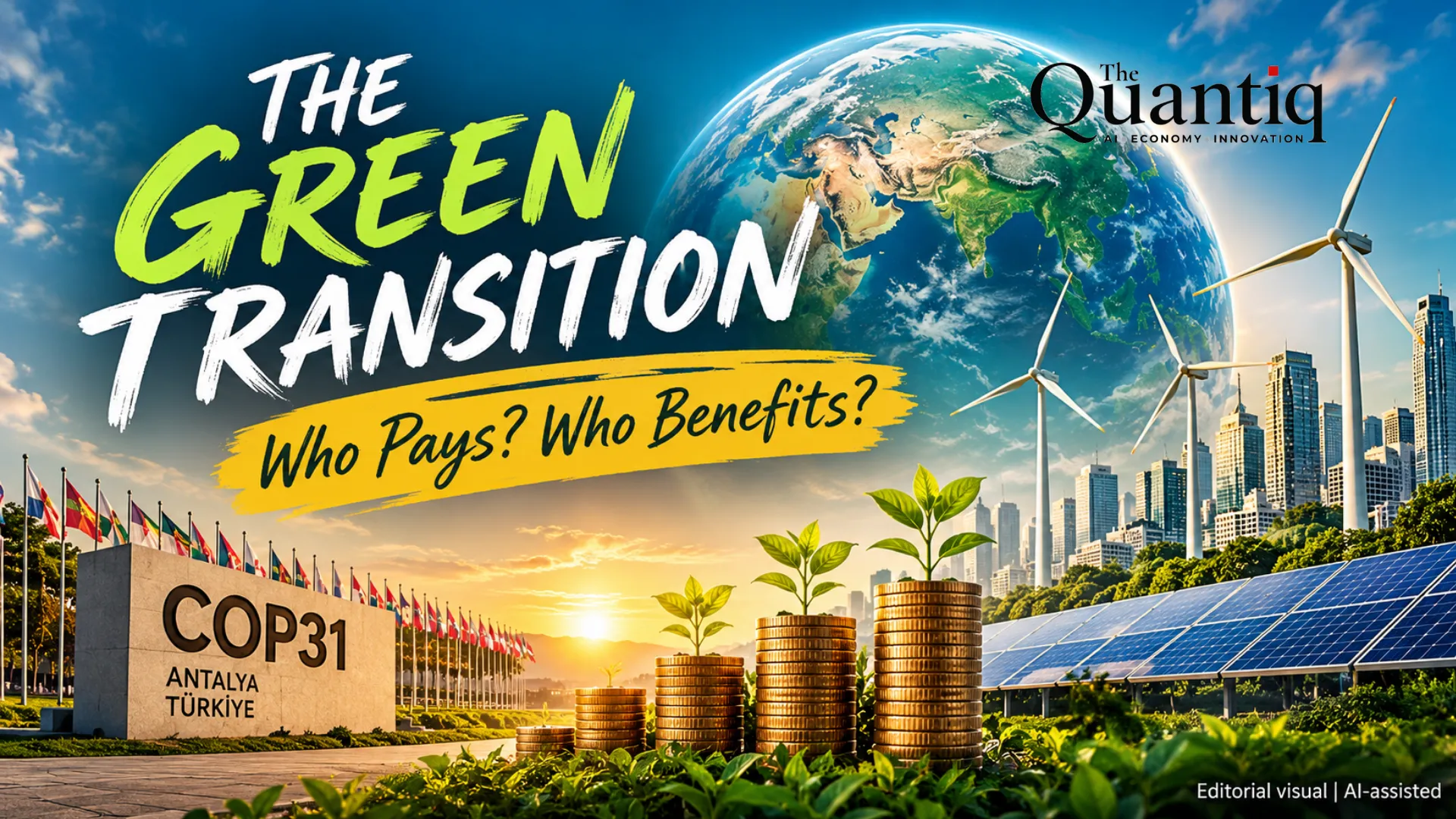
COP31: Beyond Climate Promises — Who Will Pay for the Green Transition?
As climate negotiations enter their final stretch in Antalya, the debate is shifting from emission targets to a more difficult question: who will finance the transition, and how can developing economies pursue cleaner growth without compromising their development priorities?
Climate change is no longer just an environmental concern. It is increasingly influencing investment decisions, industrial policy, energy security, trade and the future competitiveness of economies.
That reality is becoming increasingly evident at COP31, the United Nations climate conference taking place in Antalya, Türkiye.
With negotiations approaching their scheduled conclusion on 20 November, countries are grappling with difficult questions. How quickly can the world move away from fossil fuels? Who will finance the transition in developing economies? And how can countries protect their people and industries from climate risks while continuing to grow?
The COP31 Presidency circulated the first draft of a proposed cover decision on 16 November, bringing several disagreements into sharper focus. The text includes competing proposals on the transition away from fossil fuels, faster electrification and climate finance for developing countries.
The Presidency has made clear that this is an initial negotiating text, not a consensus document. Consultations continued on 17 November, with revised text expected as countries work towards an agreement before the conference concludes.
The debate points to a larger issue: the world may agree on the need for a greener economy, but it has yet to agree on how to pay for it.
The cost of building a greener economy
Moving towards a low-carbon economy involves much more than installing solar panels or replacing conventional vehicles with electric ones.
Countries need modern electricity grids, reliable energy storage, cleaner industrial processes, efficient transport systems and climate-resilient infrastructure. Agriculture, construction and manufacturing must also adapt to changing environmental conditions.
All this requires substantial investment.
Developed economies generally have greater access to capital, established infrastructure and advanced technology. Developing countries face a different set of priorities. They must expand electricity access, create jobs, improve infrastructure and raise living standards while also reducing emissions and preparing for climate-related risks.
For countries such as India, these objectives cannot be separated.
The challenge is not simply to reduce dependence on fossil fuels. It is to ensure that cleaner energy becomes affordable, reliable and capable of supporting a growing economy.
A transition that makes electricity more expensive or weakens industrial competitiveness could create new economic difficulties. Equally, delaying investment in cleaner technologies could leave industries less competitive as global markets increasingly respond to environmental standards.
The transition, therefore, needs to be planned as an economic transformation, not just an environmental exercise.
Climate finance: A gap that cannot be ignored
Finance remains one of the most contentious issues in international climate negotiations.
At COP29 in Baku in 2024, developed countries agreed to take the lead in mobilising at least US$300 billion annually for developing countries by 2035. The wider ambition was to scale up climate finance from all sources to US$1.3 trillion annually by the same year.
Yet the question of whether these amounts will be sufficient, accessible and delivered in a form developing countries can afford remains unresolved.
The latest warning comes from the United Nations Environment Programme (UNEP).
Its Adaptation Gap Report 2026: Ready? Not estimates that developing countries will need around US$305 billion annually by 2035 to meet their climate adaptation requirements. International public adaptation finance from developed to developing countries stood at only US$28.2–31.7 billion in 2024.
Even if the COP30 aspiration to triple international public adaptation finance to developing countries by 2035 is achieved, UNEP estimates that it would cover only 20–29% of their projected needs.
This is a substantial gap.
The distinction between loans and grants also matters. Countries already facing financial constraints cannot be expected to accumulate unsustainable debt to protect their populations from climate impacts.
Climate finance must therefore be judged not just by the amount announced, but by how much reaches vulnerable countries, how easily it can be accessed and whether it produces measurable results.
For developing economies, access to affordable finance and appropriate technology is as important as the commitments made at international conferences.
Energy security and the fossil-fuel debate
Another difficult issue at COP31 is the pace of the transition away from fossil fuels.
The draft contains competing formulations on this subject, reflecting differences between countries over whether to accelerate the transition away from fossil fuels or pursue more explicit phase-out language.
It also includes a proposal to raise electricity’s share of global energy use to 35% by 2035. However, this remains a negotiating proposal, with countries divided over its ambition and implications.
The disagreement is understandable when viewed against the energy requirements of different economies.
Fossil fuels continue to support electricity generation, transport and industrial production in many countries. A rapid transition without affordable and dependable alternatives could disrupt businesses, raise energy costs and affect employment.
However, dependence on fossil fuels also exposes economies to price volatility, supply disruptions and geopolitical uncertainty.
The way forward is to expand cleaner alternatives while strengthening energy security.
Solar and wind power, hydropower, nuclear energy, battery storage, green hydrogen and modern electricity networks will all have roles to play, depending on the circumstances of individual countries.
The opportunity extends beyond energy generation. Countries that develop domestic capabilities in battery manufacturing, advanced materials, energy-efficient equipment and clean industrial technologies could capture a significant share of the emerging green economy.
This makes the climate transition an industrial and investment opportunity, not merely a compliance requirement.
India’s balancing act: Growth and cleaner energy
India’s climate challenge is shaped by its development priorities.
The country needs to expand its industrial base, improve infrastructure, generate employment and meet rising electricity demand. At the same time, it has been investing heavily in renewable energy and other non-fossil sources.
According to the Ministry of New and Renewable Energy, India’s installed non-fossil fuel-based electricity capacity reached 300.50 GW as of 31 July 2026, representing more than 54% of the country’s total installed electricity capacity.
This is an important milestone. But installed capacity should not be confused with actual electricity generation. Solar and wind power are variable sources, making energy storage, grid modernisation and reliable backup essential.
India’s next challenge is to convert its growing clean-energy capacity into a dependable energy system that can support households, agriculture and industry.
It must also strengthen domestic manufacturing capabilities so that the transition creates jobs, builds technical expertise and reduces excessive dependence on imported technologies.
India’s position in the climate negotiations reflects these realities. It has consistently emphasised the importance of climate finance, technology transfer, adaptation and the principle of equitable responsibility.
The country’s development pathway cannot simply replicate that of economies which industrialised over a much longer period using fossil fuels.
The objective should be to pursue cleaner growth while recognising differences in economic capacity and historical responsibility.
What the green transition could mean for Northeast India
For Northeast India, the climate debate has a particularly direct connection with economic development.
The region’s forests, rivers, biodiversity and agricultural resources are valuable natural assets. At the same time, communities and businesses face recurring challenges from floods, erosion, extreme rainfall and changing agricultural conditions.
Climate resilience must therefore become part of the region’s development planning.
There are several areas where technology, enterprise and environmental priorities could come together.
Climate-resilient agriculture: Better seeds, weather intelligence, improved water management and scientific farming practices can help farmers respond to changing climatic conditions. Strengthening storage and processing infrastructure can also reduce post-harvest losses.
Decentralised renewable energy: Solar power, microgrids and suitable energy-storage systems could improve electricity access in remote areas. Such projects need to be designed around local requirements and economic viability.
Sustainable forest-based enterprises: Bamboo, medicinal plants and other non-timber forest products offer opportunities for responsible value addition. Developing processing capabilities and market access could generate local employment while encouraging sustainable resource management.
Climate and disaster intelligence: Satellite monitoring, geospatial technology and improved weather forecasting can support flood preparedness, infrastructure planning and agricultural decision-making.
Cleaner manufacturing: Alternative construction materials, biomass-based industrial inputs and circular-economy businesses could create new opportunities for regional entrepreneurs and MSMEs.
The larger opportunity is to move beyond the traditional model of supplying raw materials and develop businesses that capture more value within the region.
This will require investment, research, appropriate technology and stronger links between local enterprises and wider markets. It will also require environmental safeguards and meaningful participation from communities whose livelihoods depend on natural resources.
Turning climate commitments into economic opportunities
The emerging green economy is creating new markets for businesses and investors.
Battery storage, energy-efficient equipment, electric mobility, recycling, cleaner construction materials and climate-resilient infrastructure are among the areas attracting growing attention.
But investment will not flow simply because a sector is described as green.
Businesses need predictable policies, access to finance, technical expertise and customers willing to pay for cleaner products and services.
Governments and financial institutions have an important role in reducing early-stage risks and supporting technologies that may not immediately generate commercial returns.
Private investment can help scale viable projects, but it cannot replace public funding for essential adaptation, disaster preparedness and community resilience.
The most effective approach will combine public finance, private capital, research institutions and entrepreneurial innovation.
For India, this could also be an opportunity to build domestic capabilities in technologies that will become increasingly important to global industry.
For Northeast India, the focus should be on identifying practical projects that match local resources, market demand and environmental realities rather than pursuing fashionable technologies without a clear business case.
The Quantiq Perspective
The climate negotiations in Antalya reveal a reality that is becoming increasingly difficult to ignore: the transition to a greener economy will be shaped as much by economics and technology as by environmental commitments.
Countries will need to make difficult choices about energy, investment and industrial development. Developing economies will need access to affordable finance and technologies that match their circumstances. Businesses will have to rethink production, resource use and long-term competitiveness.
For India, this is both a responsibility and an opportunity. For Northeast India, it is an opportunity to rethink how natural resources, biodiversity, agricultural potential and technological capabilities can contribute to a more resilient regional economy.
The real test of COP31 will not be the ambition of its final declaration. It will be whether countries can turn commitments into accessible finance, practical technologies, stronger infrastructure and opportunities for people and businesses.
The green transition cannot be built on promises alone. It must be economically viable, technologically achievable and fair to the countries expected to deliver it.





One Comment