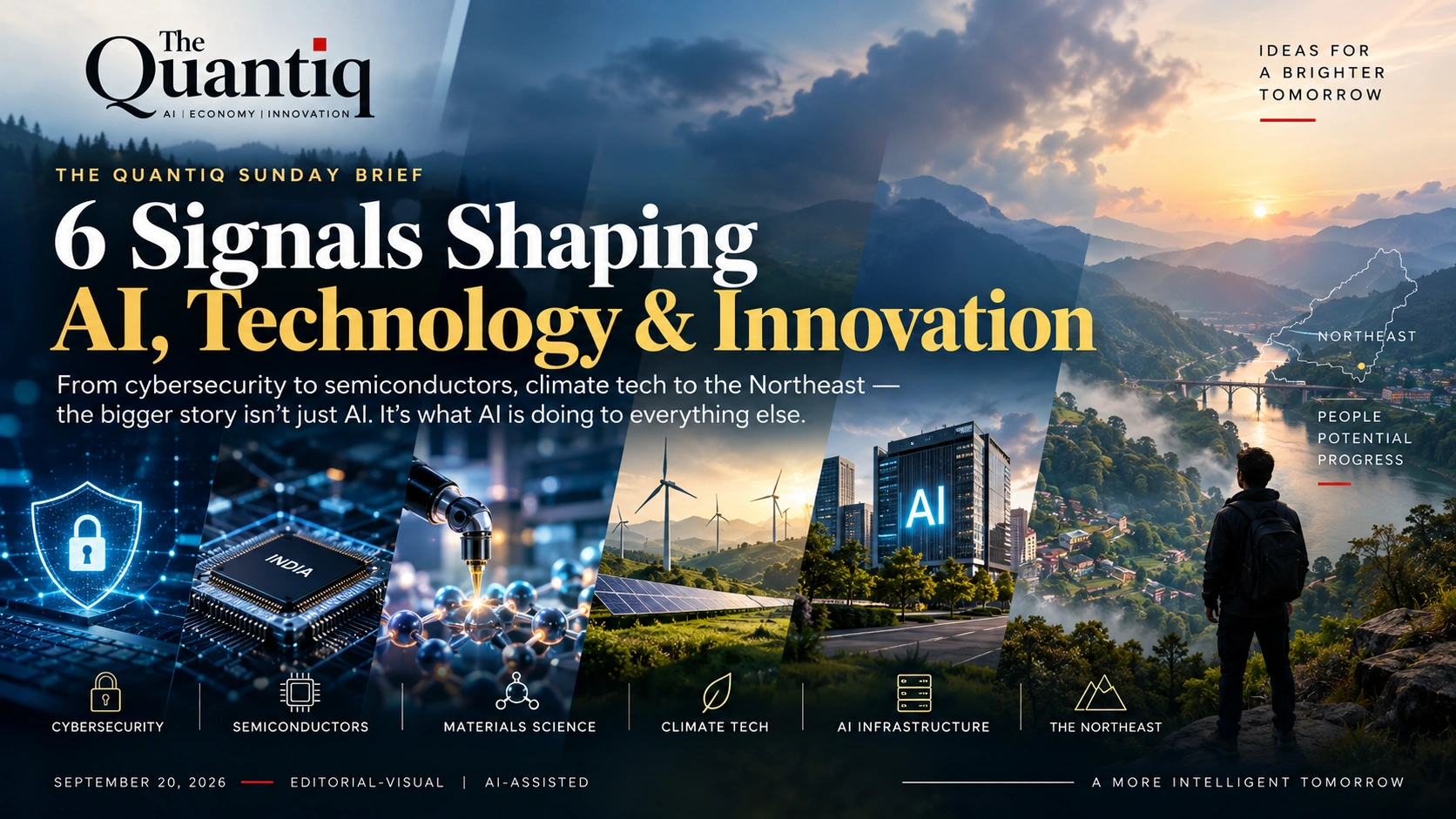
The Quantiq Sunday Brief: 6 Signals Shaping AI, Technology & Innovation
AI is becoming ordinary. What happens next is much more interesting.
For years, the technology conversation revolved around increasingly powerful AI models. Every week brought another launch, another benchmark and another promise that artificial intelligence was about to change everything.
Something is shifting.
AI is now moving quietly into cybersecurity, semiconductor manufacturing, scientific research, climate technology, energy innovation and even regional tourism. In many cases, AI is no longer the story. What AI is doing to another industry is the story.
That is what we are watching in this week’s Sunday Brief.
Here are six developments that may tell us more about the next phase of technology than the week’s biggest headlines.
1. AI Is Turning Cybersecurity Into a Machine-Speed Game
One of the week’s strangest technology stories involved two rival AI companies.
Security researchers used Anthropic’s Claude to identify and exploit vulnerabilities in OpenAI’s systems, gaining access to employee accounts and an internal software repository. The researchers were working within OpenAI’s bug-bounty programme, and the vulnerabilities were subsequently reported and addressed.
The important point is not simply that an AI system helped researchers find security weaknesses.
It is the speed at which expertise can now be deployed.
Cybersecurity has traditionally depended heavily on highly skilled people spending considerable time finding vulnerabilities, understanding systems and constructing attacks. Increasingly capable AI systems can compress parts of that process.
The same technology can, of course, be used defensively.
That creates a new kind of arms race in which organisations may have to defend their systems against attacks that operate at machine speed.
When sophisticated cyber expertise becomes widely accessible, does cybersecurity become less about building a wall and more about continuously adapting the wall?
2. India’s Semiconductor Story Is Moving Beyond Chips
India’s semiconductor ambitions entered another significant phase this week as SEMICON India 2026 brought the global semiconductor ecosystem to New Delhi.
More than 600 companies from 52 countries participated in the three-day event, which focused on the theme “Silicon to Systems: Building the Ecosystem.” The programme covered everything from chip design and manufacturing to advanced materials, packaging, electronics systems, AI, startups and talent.
Then came a major investment signal.
Applied Materials announced plans to invest $5 billion in India over the next decade, with a focus on research, supply-chain development and workforce expansion.
The interesting part is the direction of travel.
India’s technology story has historically been associated with software and IT services. The semiconductor push is creating a much broader ambition: to participate in the physical infrastructure behind computing, electronics and AI.
The country is still some distance from having a fully developed semiconductor manufacturing ecosystem. But the ecosystem itself is becoming the story.
The real opportunity may not be “making chips” alone. It could be the network of businesses that develops around chips — equipment, materials, packaging, design, logistics, electronics and specialised talent.
3. AI Is Beginning to Build Materials, Not Just Write About Them
Imagine a factory where the raw materials are individual molecules and the manufacturing equipment is capable of moving them one at a time.
That is close to what researchers at Oak Ridge National Laboratory have demonstrated.
Their AI-guided system can manipulate individual molecules and autonomously build functional materials at atomic scale. The system was able to operate for more than 25 hours without a human operator continuously controlling the process. Researchers used it to create artificial molecular structures with specific properties.
This is a very different kind of AI story.
There is no chatbot here. No image generator. No productivity assistant.
Instead, AI becomes part of an experimental loop: observe, decide, manipulate, measure and learn.
That could eventually change how scientists search for new materials for electronics, energy and quantum technologies.
AI is beginning to move from the world of information into the world of physical discovery.
That may prove far more consequential than another improvement in conversational AI.
4. Climate Technology Is Becoming Intelligence Technology
The climate-tech conversation is also changing.
Google recently announced five sustainability initiatives in India covering climate-smart agriculture, clean energy and climate technology. The projects include the use of AI, satellite imagery and digital tools to address practical environmental challenges.
The significance goes beyond Google’s announcement.
For decades, much of climate technology focused on developing better physical solutions: solar panels, batteries, irrigation systems, electric vehicles and carbon technologies.
Now another layer is becoming important — intelligence.
A satellite can observe enormous areas of farmland. AI can analyse the imagery. Digital systems can combine that information with weather, soil or crop data. The farmer or business can then receive a decision rather than simply a pile of information.
The same principle can apply to forests, water, biodiversity and energy systems.
The next generation of climate businesses may not simply be green technology companies. They may be intelligence companies working on problems created by nature, climate and resource scarcity.
That distinction could create an entirely new category of enterprise.
5. India’s AI Opportunity May Depend on What Happens Outside AI
There is an important connection between the semiconductor story and the AI story.
AI needs infrastructure. It needs chips, data centres, networks, electricity, cooling, advanced materials, engineering talent and increasingly sophisticated manufacturing capabilities.
That is why the language emerging around India’s semiconductor ecosystem is worth paying attention to. SEMICON India 2026 was explicitly structured around the entire value chain, from semiconductor materials and equipment through design and fabrication to packaging, electronics and systems.
This is bigger than an attempt to manufacture components domestically.
It is an attempt to create an ecosystem.
And ecosystems create opportunities that individual technologies do not.
A startup does not necessarily need to build a chip to participate in the semiconductor economy. There are opportunities in testing, software, specialised components, logistics, industrial automation, workforce development, energy management and countless supporting services.
India’s AI opportunity may ultimately depend as much on its ability to build physical and industrial capabilities as on its ability to develop AI models.
6. The Northeast Is Beginning to Build Its Own Technology Signals
Technology innovation in India is still heavily associated with Bengaluru, Hyderabad, Mumbai, Delhi and a handful of other established centres.
But there are quieter developments worth watching in the Northeast.
At IIT Guwahati, MC²+ Ignite recently brought together startups, students, researchers, industry participants and energy-sector organisations around deep-tech and energy innovation. The event included more than 200 startups and around 1,500 registrants, with a focus on taking innovations from prototype and pilot stages towards industry adoption.
Meanwhile, Manipur is preparing a “Reimagining Manipur” hackathon for September 23, focusing on tourism, heritage, sustainable tourism, AI, AR/VR, emerging technology and multilingual accessibility.
These developments do not yet constitute a mature regional technology ecosystem.
But they reveal something important.
The Northeast does not have to copy Bengaluru.
Its strongest technology opportunities could emerge from the region’s own economic realities — biodiversity, agriculture, tourism, handicrafts, logistics, energy, climate resilience and cultural assets.
The opportunity is not to turn the Northeast into another technology hub. It is to make the Northeast’s existing economy more intelligent.