
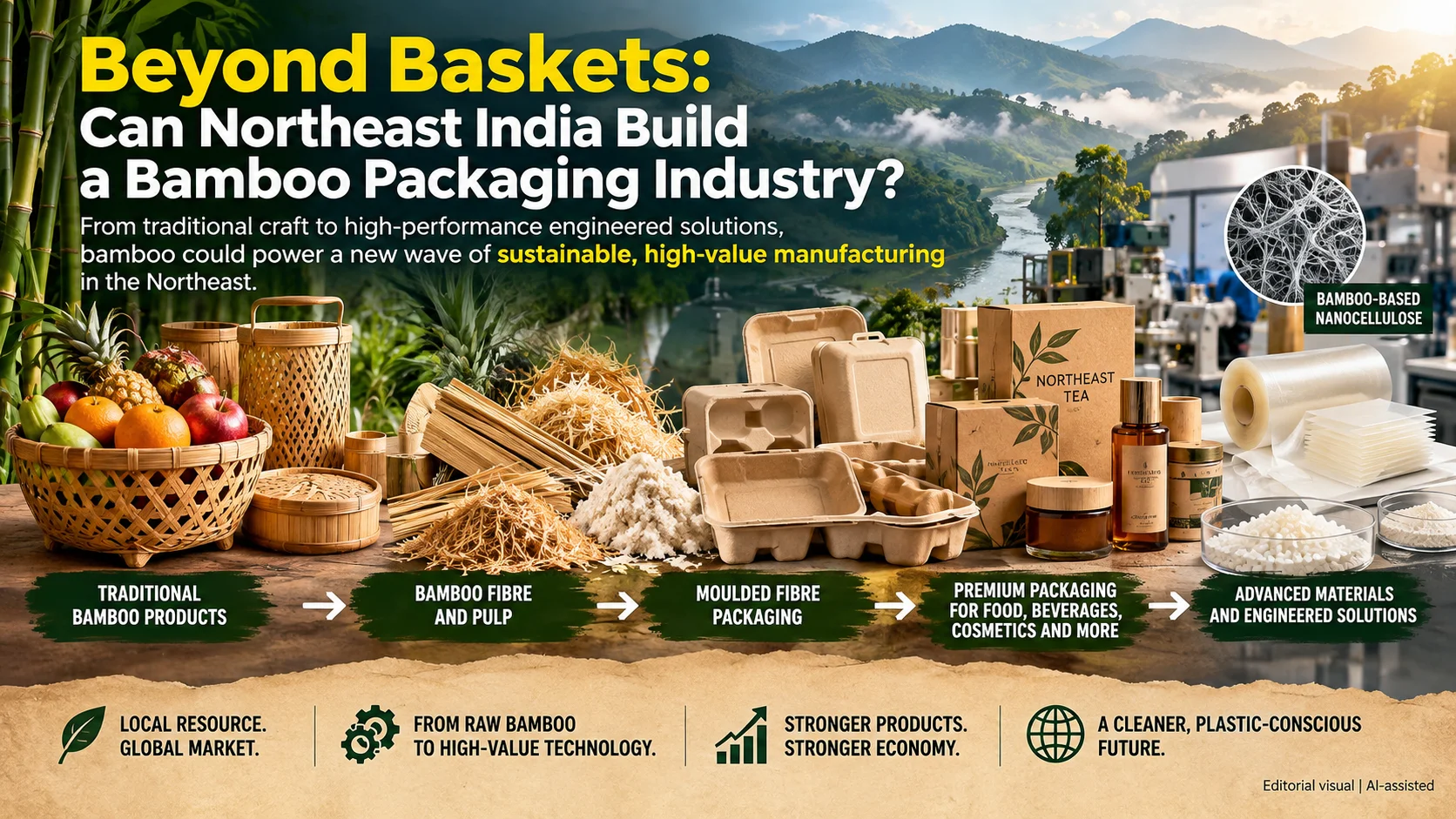
Beyond Baskets: Can Northeast India Build a Bamboo Packaging Industry?
Northeast Renaissance Series
In a plastic-conscious world, the Northeast has an unusual advantage: an abundant local material, a growing packaging market and an opportunity to develop the technology rather than simply import it.
Every product has a journey before it reaches the consumer. For a packet of tea, a box of spices or a bottle of essential oil made in the Northeast, that journey may involve packaging manufactured somewhere else in India. The package travels into the region, the product is packed, and the finished product then travels out again to markets across India and beyond.
There is an economic opportunity hidden inside that journey.
What if some of that packaging could be made here? And what if it were not simply another cheap carton, but a high-value bamboo-based material designed specifically for the product, the market and the Northeast’s own supply chains?
That question becomes particularly interesting as India’s packaging industry expands and manufacturers face growing pressure to rethink plastics, waste and material choices.
India’s packaging industry is projected by Avendus Capital to reach about US$92 billion by FY2030, growing at around 9% annually. Food and beverages, pharmaceuticals, personal care, agriculture, consumer durables and e-commerce are among the major demand drivers.
Meanwhile, a commercial market estimate puts the global bamboo-packaging market at US$1.42 billion in 2025, rising to US$2.31 billion by 2034.
The numbers are interesting, but they are not the whole story.
For Northeast India, the more important question is this:
Can a region that already has the bamboo develop the materials, packaging and technology needed to capture more of the value?
Why This Matters
Plastic succeeded because it solved packaging problems exceptionally well. It is lightweight, strong, mouldable, relatively inexpensive and capable of protecting products from moisture, contamination and physical damage. That is why replacing plastic is much harder than simply finding something that looks more natural.
A credible alternative has to perform. It has to survive transportation, meet applicable safety standards, work with manufacturing systems and make economic sense. Increasingly, it must also have a credible end-of-life pathway.
India’s regulatory environment is changing the economics around plastic packaging as well. The country’s Extended Producer Responsibility framework places obligations on producers, importers and brand owners for managing plastic packaging waste, while recycling obligations for different categories of plastic packaging are also being strengthened.
The Central Pollution Control Board’s plastic EPR system has further formalised the management of plastic packaging waste through its dedicated portal.
None of this means that plastic is about to disappear.
It does mean that packaging companies have increasing reasons to explore materials that can perform specific functions with lower environmental impacts.
That is where bamboo deserves a closer look.
The Northeast Has the Raw Material
The Northeast’s bamboo advantage is not merely cultural. Published analysis using Forest Survey of India data estimated that the region accounted for 45.62% of India’s estimated bamboo culm production in 2021, with approximately 24.33 billion culms. The region represented about 35.79% of India’s bamboo-bearing area in that assessment.
The same analysis estimated around 5.656 billion bamboo culms in Assam, 8.824 billion in Arunachal Pradesh, 2.705 billion in Nagaland and 2.199 billion in Meghalaya.
More importantly, bamboo is now receiving fresh institutional attention.
In 2026, the Asian Development Bank approved a US$42.22 million financing facility for bamboo value-chain development across Assam, Manipur, Meghalaya, Mizoram, Nagaland and Tripura. The programme is designed to strengthen the industry through resource mapping, research, training, technical institutions, private-sector investment and value-chain development.
The significance goes beyond the amount of money involved.
It reflects recognition that the Northeast’s bamboo opportunity cannot be unlocked simply by growing more bamboo. The region needs better processing, technology, market access and industrial capabilities.
That is where packaging could become one part of a much larger value-addition story.
The Hidden Cost of Packaging
There is another reason this opportunity deserves attention in the Northeast.
Packaging is not simply a material. It is part of a supply chain.
When packaging is sourced from outside the region, manufacturers may be paying not only for the package but also for freight, handling, inventory and lead time. The finished product then has to travel to markets outside the Northeast.
This does not automatically mean that locally produced packaging will always be cheaper. Manufacturing scale, technology and processing costs still matter. But it raises an important economic question.
Why should a region with abundant bamboo import the value-added packaging and then export the finished product?
Consider a premium Assam tea. The tea may be grown and processed locally, while parts of its packaging value chain sit elsewhere. The package could involve materials, printing, conversion and specialised manufacturing carried out outside the Northeast before it finally reaches the tea producer.
Now imagine another possibility.
Bamboo is sourced within the region and processed into an engineered fibre or pulp. A local packaging company develops a distinctive container for the tea, manufactures it nearby and supplies it directly to the tea producer. The finished product then leaves the Northeast carrying more locally created value.
The package has moved from being merely a cost to becoming part of the product.
This becomes particularly interesting for products where provenance matters. Tea, coffee, spices, honey, natural cosmetics, essential oils, specialty foods and premium handicrafts all have stories of origin that can be reinforced through thoughtful packaging.
A premium price should never be assumed simply because bamboo is used. But material, performance, design, provenance and brand story can together create a much stronger proposition than a generic package.
From Bamboo Products to Bamboo Materials
This is where the story moves beyond traditional bamboo craft.
For centuries, bamboo has been transformed directly into objects such as baskets, furniture, mats, buildings and household products. An industrial materials economy starts somewhere else. It asks what properties can be extracted, modified and engineered from the material.
Bamboo can be processed into fibres and pulp that can then be formed into different products. Research on moulded pulp has already identified bamboo as a non-wood fibre suitable for packaging applications, alongside materials such as bagasse and wheat fibre.
That distinction is important.
A bamboo package does not have to look like bamboo. It could look like a sophisticated industrial package while retaining a plant-based fibre as one of its principal inputs.
This opens a much larger field of possibilities.
The First Opportunity: Moulded Bamboo Fibre
Moulded fibre may be one of the most practical starting points.
The basic principle is relatively simple. Plant fibres are processed into pulp, formed using a mould and consolidated into a three-dimensional structure. The technology can produce trays, clamshells, protective inserts and other packaging formats.
Research has already investigated bamboo fibre in moulded food packaging, while combinations of different natural fibres have also been studied to modify the properties of finished products.
However, producing a useful package involves much more than forming fibre into a shape. Moisture resistance can matter, particularly for food applications. Grease resistance may also be important, while food-contact products require appropriate safety validation.
The manufacturing process itself also has an environmental footprint. Energy, water, chemicals, coatings and end-of-life systems all need to be considered. Research on moulded-pulp food packaging highlights these issues and stresses the importance of life-cycle assessment rather than relying on the appearance of a product to determine its sustainability.
The opportunity, therefore, is not simply to make a bamboo tray.
It is to develop a better material and a better process.
The Second Opportunity: Bamboo Plus Other Northeast Biomass
Perhaps the future package will not be made entirely from bamboo.
It could be a fibre blend.
Researchers have already investigated combinations such as bamboo and bagasse for moulded food packaging.
That idea becomes particularly interesting in the Northeast because bamboo does not exist in isolation. The region also produces agricultural residues and other natural fibres that could potentially become inputs for engineered materials.
Paddy straw is one obvious example.
Our recent exploration of paddy-straw fibre showed how agricultural residue could potentially become a source of cellulose and other useful materials. The same principle can be extended to packaging, provided the material properties and economics support the application.
The question then becomes much more interesting:
What combination of Northeast biomass can produce the properties required for a particular packaging application?
That is a materials-engineering question rather than a traditional bamboo question.
It also points towards something larger:
A Northeast biomass-materials industry.
The Third Opportunity: Advanced Cellulose Packaging
The technology frontier extends beyond moulded fibre.
Researchers are investigating bamboo-derived nanocellulose for higher-performance packaging applications. A 2025 study, for example, extracted cellulose nanofibres from bamboo-shoot shells and developed composite films with water resistance and antibacterial properties.
The choice of raw material is particularly interesting.
The study did not rely on the mature bamboo culm. It investigated bamboo-shoot shell, turning another part of the plant into an input for advanced material development.
Other research is exploring bamboo-derived nanocellulose for films with barrier properties relevant to food packaging.
This is where the bamboo story begins to change character.
The question is no longer simply whether bamboo can replace a plastic container. It becomes whether bamboo-derived cellulose can be engineered to perform specific functions that conventional packaging materials perform today.
That is a much more ambitious research and business proposition.
What Could the Northeast Make?
The opportunity is not one product, and different packaging problems will require different technologies.
Food and agriculture could use moulded trays and protective structures. Tea and specialty foods could use premium fibre-based boxes and containers. Cosmetics and wellness brands could explore bamboo-based secondary packaging and, where technically feasible and compliant, selected primary packaging applications.
Electronics and consumer products could use moulded fibre inserts for protection during transportation. Premium brands could also use packaging in which the material itself contributes to the identity and provenance of the product.
The important discipline is to begin with the customer problem, rather than the material.
Instead of asking, “What can we make from bamboo?”, an entrepreneur should ask:
“Which packaging problem can bamboo-based material solve competitively?”
That small change in thinking can prevent a great deal of wasted investment.
Opportunity Snapshot
| Indicator | Indicative Assessment |
|---|---|
| Global bamboo packaging market, 2025 | US$1.42 billion |
| Global bamboo packaging market, 2034 | US$2.31 billion |
| Global bamboo packaging CAGR, 2026–34 | 5.61% |
| India packaging industry, FY2030 projection | ~US$92 billion |
| India sustainable packaging market, 2025 | US$10.23 billion |
| India sustainable packaging market, 2034 | US$17.73 billion |
| Northeast share of estimated Indian bamboo culm production, 2021 | 45.62% |
| Estimated Northeast bamboo culms, 2021 | ~24.33 billion |
| ADB bamboo-value-chain facility, six NE states | US$42.22 million |
| Pilot CapEx | Technology and product specific |
| Commercial CapEx | Dependent on process, capacity and product format |
| ROI | Requires product-specific feasibility modelling |
| Employment potential | High |
| Value-addition potential | Very high |
| Export possibility | Significant, subject to quality, certification and cost |
The global bamboo-packaging figures come from commercial market research and should therefore be treated as directional rather than official industry statistics. The Indian packaging projection comes from Avendus Capital, while the sustainable-packaging estimate comes from IMARC. The bamboo-resource figures are based on published analysis of Forest Survey of India data.
One figure is deliberately absent: a universal ROI.
A moulded-fibre packaging unit, a bamboo pulp facility and a company developing bamboo-processing machinery would have very different investment requirements. Their margins and returns would also depend on capacity, utilisation, product mix, selling prices, energy costs and financing.
In this industry, the process has to be defined before the return can be calculated.
The Northeast Should Not Stop at the Factory Gate
The most valuable opportunity may not be a single large bamboo-packaging plant. It could be an ecosystem in which several specialised businesses work around the same material.
One company could process bamboo into fibre. Another could develop material formulations, while an engineering workshop could build specialised equipment. A university laboratory could test material properties, a packaging designer could develop commercial applications and a regional brand could become the first customer.
This kind of ecosystem creates value at several points instead of concentrating everything inside one factory.
There are already some building blocks. Government data show that the National Bamboo Mission supported 208 value-added product and processing units in the Northeast between 2018–19 and 2021–22.
Assam’s industrial strategy also identifies fibre, thermoplastics, industrial products, machinery and equipment among potential bamboo applications.
The challenge is to move from processing capacity towards technology capability.
Why Should We Import the Technology?
When entrepreneurs see a successful bamboo-processing plant elsewhere, the natural response is often to ask which machine was used and how much it costs.
Sometimes, that is exactly the right commercial decision. Proven machinery can reduce risk, imported equipment can provide useful benchmarks and some specialised systems may not make economic sense to reproduce locally.
But buying a machine does not have to mean outsourcing technological imagination.
The Northeast Bamboo Action Plan recognised this issue years ago. It proposed research into indigenous machinery, species-specific processing, a Centre of Excellence for bamboo machinery and stronger links between technology experts and manufacturers.
That points towards a different possibility.
The Northeast can learn to design the machines it needs.
It Is Not Rocket Science. But It Is Engineering.
Developing technology does not mean pretending that science and engineering are unnecessary. They are essential, particularly when a prototype has to become a reliable industrial process.
But the entrepreneur who identifies a problem does not have to know every answer.
An entrepreneur can identify the customer need. An engineer can design the mechanism, while a materials scientist studies the fibre and a chemical engineer works on treatment processes. A designer can make the package useful and attractive, a fabricator can build the prototype, and a laboratory can test whether it performs as intended.
That is how innovation becomes collaborative.
The first prototype may fail. The next version may solve one problem while creating another. With each iteration, however, the team learns more about the material and the process.
That accumulated knowledge can become process intelligence, design capability and eventually intellectual property.
The most valuable asset may therefore not be the machine itself. It may be the knowledge of how to make the machine and process work for our bamboo, our conditions and our market.
Don’t Begin by Asking Which Machine to Import
Begin with the problem.
Suppose the goal is to make a premium fruit tray for Northeast produce. The engineering questions become much more useful once the problem is defined.
How much weight must the tray carry? How much moisture will it encounter? How long must it survive? Can it be stacked? Will it protect the fruit during a long journey? Does it require a coating? Can that coating be safely managed at the end of its useful life?
Then come the commercial questions.
What will the customer pay? Can the mould be manufactured locally? Can the process operate economically? Can production be scaled without losing quality?
Those questions lead naturally to experimentation.
And experimentation leads to technology.
This is why the first investment should not necessarily be a factory.
The first investment should be evidence.
Evidence that the bamboo works. Evidence that the process works. Evidence that the product performs and, most importantly, evidence that a customer will pay for it.
Only then should large-scale capital follow.
The Premium Packaging Opportunity
There is another reason the Northeast should take this opportunity seriously.
Packaging is increasingly part of the brand experience. The Avendus analysis identifies branding, customer experience and supply-chain efficiency among the factors shaping India’s packaging demand.
That creates an opening for premium regional products.
Consider an Assam tea package made from a locally developed bamboo-based material. The value would not lie in bamboo alone. It would come from the combination of material, engineering, design, provenance and brand.
The same principle could apply to Northeast coffee, spices, honey, natural cosmetics, essential oils, specialty foods and premium handicrafts.
A generic package protects the product. A distinctive package can also help sell the product.
That difference is where higher value can potentially be captured.
The Bamboo Trap
There is a temptation to assume that anything made from bamboo is automatically sustainable. That would be a mistake.
A bamboo-plastic composite is fundamentally different from a fibre-based package. A fibre product that depends on a difficult-to-recover coating may also have a very different environmental profile from what its natural appearance suggests.
The same caution applies to compostability. A package may be technically compostable under specific conditions, but that does not mean those conditions exist in the waste-management system where it will eventually be discarded. Food-contact applications also require appropriate testing and regulatory compliance, particularly when new materials, coatings or additives are involved.
Research on moulded-pulp packaging highlights several of these challenges, including chemical and energy use during processing, barrier performance and the need for life-cycle assessment and viable end-of-life systems.
The opportunity, therefore, is not to replace one simplistic claim with another.
The Northeast should not build a bamboo packaging industry simply because bamboo sounds greener than plastic. It should build products whose performance, safety, environmental impact and economics can be demonstrated.
That is a much stronger foundation for a new materials industry.
The AI Era
Artificial intelligence can eventually become useful in this field, but it should serve the materials problem rather than become a decorative addition to the story.
Packaging development involves many variables, including fibre characteristics, moisture, pressure, temperature, binder concentration, drying time, density and strength. Once enough experimental data exist, AI and statistical models could help researchers identify promising combinations and reduce the number of physical trials required.
Computer vision could support quality inspection. Data models could help optimise production parameters, while digital design tools could allow packaging structures to be tested before expensive moulds are produced.
The principle is simple.
AI can accelerate experimentation, but it cannot replace the need to understand the material.
For Students & Young Professionals
The emerging bamboo-materials industry could create careers far beyond traditional bamboo craft.
Mechanical engineers could work on fibre-processing and moulding equipment. Materials scientists could study fibre strength, composites, coatings and cellulose. Chemical engineers could develop pulping and fibre-treatment processes, while packaging technologists could work on structural and barrier performance.
Industrial designers could turn a material into packaging that consumers actually want to hold. Agricultural engineers could work on bamboo harvesting, preprocessing and logistics. Environmental scientists could assess life-cycle impacts, while data professionals could work on process optimisation and quality control.
Entrepreneurs would have the opportunity to connect these capabilities to customers.
The bamboo industry of the future may therefore require as much engineering and design as it does forestry.
Where Can You Learn More?
The scientific literature already provides a substantial starting point for entrepreneurs, researchers and students.
The review of moulded-pulp food packaging provides an overview of bamboo and other non-wood fibres, processing methods, performance challenges and sustainability considerations.
Recent research on bamboo-shoot-shell cellulose nanofibres demonstrates how bamboo residues can become inputs for advanced packaging films with water-resistant and antibacterial properties.
For Northeast-specific technology development, the North Eastern Council’s Action Plan for Promotion of Bamboo in NER is particularly relevant because it discusses indigenous machinery, species-specific processing challenges and a proposed Centre of Excellence for bamboo machinery.
The Asian Development Bank’s 2026 Northeast bamboo programme is also useful for understanding the direction of current institutional investment across six Northeast states.
For Assam, the State Bamboo Development Agency provides information on bamboo resources, characteristics and development initiatives.
The Quantiq Assessment
Bamboo packaging is not the real opportunity. Bamboo technology is.
The Northeast has one of India’s strongest bamboo-resource positions, yet its industrial value chain remains relatively shallow. The ADB’s current programme reflects the need for deeper processing, stronger research, better technology and greater private-sector participation.
Packaging is an unusually interesting entry point because it connects several trends at once. India’s packaging market is large and expanding, plastic-waste regulation is becoming more structured, sustainable materials are receiving greater attention, and Northeast products can potentially capture more value through better packaging and stronger provenance.
But the region should not approach this opportunity simply by asking:
Which bamboo-packaging machine can we buy?
The better question is:
What packaging problem can we solve with our own materials, engineering and ingenuity?
Imported machinery can provide a benchmark. International technologies can provide knowledge. Scientists and engineers can provide specialist expertise, while universities can provide laboratories and testing.
But the region should increasingly aspire to own the process knowledge.
You do not need to be a scientist to begin developing technology. You need a problem worth solving, curiosity and the willingness to experiment. When the problem becomes technically complex, bring in people who understand the science.
That is not a weakness.
That is how technology ecosystems are built.
There is also a potentially powerful economic consequence. If packaging continues to be brought into the Northeast while finished products leave the region, much of the packaging value is created elsewhere. If some of that packaging can instead be designed, engineered and manufactured locally, the region can potentially capture another layer of value before its products reach the market.
The objective is therefore not simply substituting plastic with bamboo.
It is building a higher-value regional manufacturing capability around bamboo.
The Machine We Haven’t Built Yet
The Northeast has spent generations demonstrating what bamboo can do. The next generation can demonstrate what engineering can do with bamboo.
The opportunity may begin with a food tray or a premium tea box. It may then move into protective packaging, agricultural applications, advanced cellulose materials and specialised industrial products.
But the larger opportunity lies underneath those products. It lies in the materials, processes, machinery, designs and intellectual property required to make them possible.
That is where the real value can accumulate.
The Northeast does not have to wait for somebody elsewhere to invent every machine. It can study existing technologies, learn from experienced professionals, collaborate with universities, build prototypes, test them and improve them.
The first prototype may fail, and that is part of the process. The important thing is that the learning stays within the ecosystem.
Over time, that knowledge can become technology suited to the region’s bamboo, its entrepreneurs and its markets.
The future may therefore not be about replacing every plastic package with bamboo. That would be neither realistic nor necessary.
The more interesting possibility is that the Northeast learns to identify where bamboo can perform, where it can add value and where its technology can be owned locally.
Because the package is only the visible part of the opportunity.



One Comment