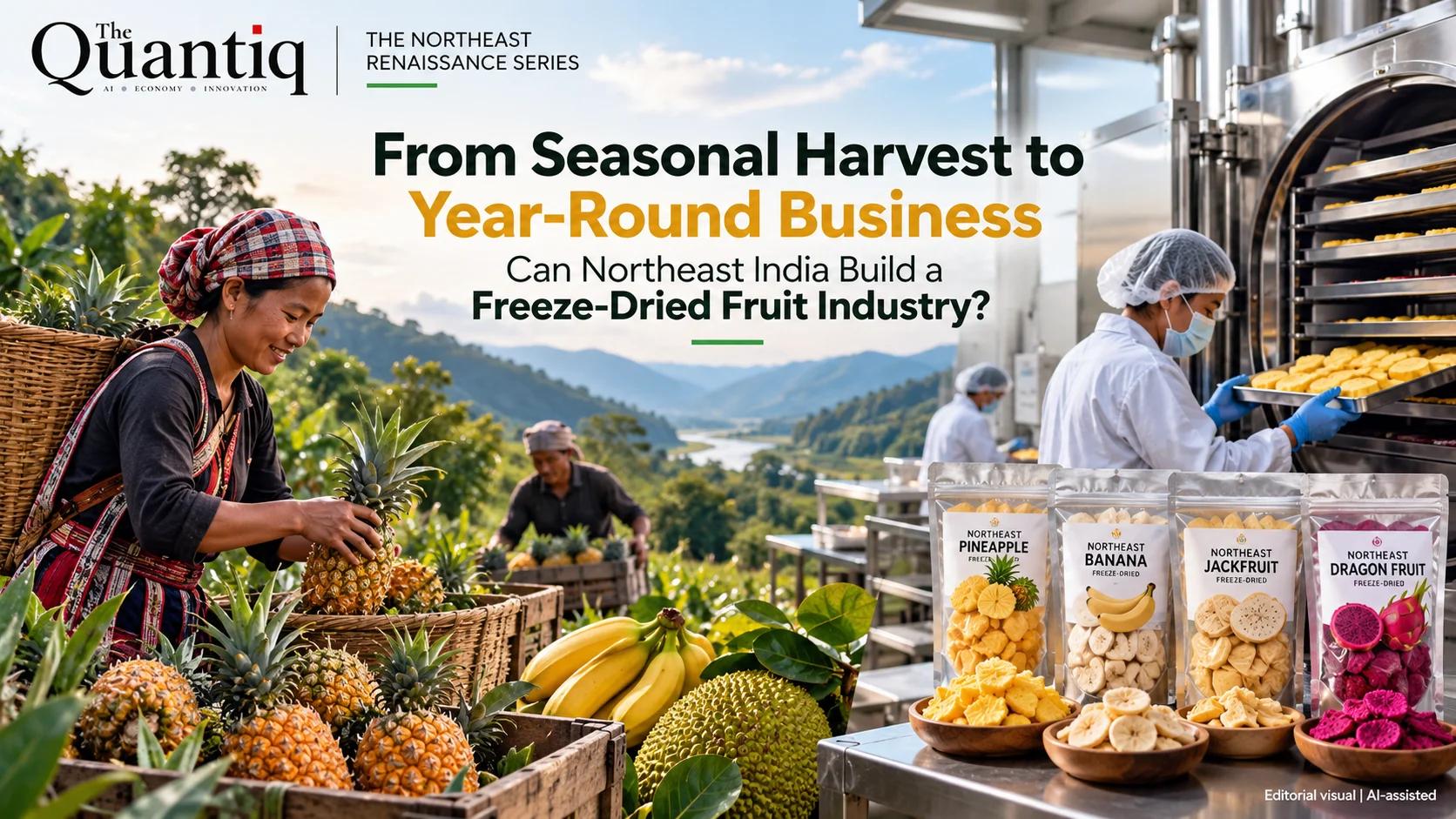
From Seasonal Harvest to Year-Round Business: Can Northeast India Build a Freeze-Dried Fruit Industry?
The Northeast Renaissance Series
Northeast India’s fruit-growing regions could supply premium snacks and specialised food ingredients to domestic and international markets. Turning that potential into a viable industry, however, will require more than buying processing equipment.
Highlights
Northeast India produces a diverse range of fruits, but much of its commercial value depends on how quickly the harvest can reach consumers or processors. Freeze-drying offers a way to create lightweight, shelf-stable products for premium snacks and specialised food applications.
India’s freeze-dried fruit market is attracting attention, while equipment costs remain a significant barrier for new entrepreneurs. The opportunity lies in connecting suitable fruits with the right processing technology, dependable supply chains and customers willing to pay for quality.
The central question is not whether the technology works. It is whether businesses in the Northeast can build a commercially viable value chain around it.
What If the Value of a Fruit Season Could Last All Year?
A fruit harvest can be a moment of abundance for a farming community. It can also become a race against time.
When large quantities of fruit ripen together, farmers and traders must find buyers quickly. Limited cold storage, transport delays and uneven market access can make the problem worse. Even fruit of good quality may fetch disappointing prices when supply exceeds immediate demand.
Now imagine a different possibility. Instead of selling every kilogram of fruit within a short window, a processor could convert part of the harvest into a lightweight product that retains much of its original shape, colour and flavour. Properly packaged, that product could remain marketable for considerably longer than fresh fruit.
This is the commercial proposition behind freeze-drying.
For Northeast India, the idea deserves serious attention. Assam, Meghalaya, Tripura, Arunachal Pradesh, Mizoram, Manipur, Nagaland and Sikkim have different growing conditions and agricultural strengths. Together, they offer a range of fruits that could support specialised food-processing businesses.
Yet the opportunity should not be confused with a guaranteed business success. Freeze-drying is an expensive process, and a technically impressive product is not necessarily a commercially successful one. The challenge is to identify the right fruit, develop a product customers want and build a supply chain that can deliver consistent quality.
That is where the real business opportunity begins.
This Is More Than Conventional Fruit Drying
Freeze-drying, also known as lyophilisation, removes water from a frozen product under reduced pressure. The ice changes directly into vapour through a process called sublimation, rather than melting into liquid water first.
This process can preserve the structure of many fruits better than conventional hot-air drying. The resulting product is often light, porous and crisp. It can also reabsorb moisture quickly, which makes packaging and storage conditions particularly important.
Conventional drying remains useful for products where a chewy texture, lower processing cost or familiar taste is more important than retaining the original structure. Freeze-drying serves a different market. Its appeal lies in products where appearance, texture, weight, flavour and convenience can justify a higher price.
Freeze-dried fruit can be sold as a snack, added to breakfast cereals and confectionery, or supplied as an ingredient for bakery products, desserts and selected food formulations. Depending on the product and buyer, it may also find applications in travel food and specialised nutrition.
The distinction matters because an entrepreneur should not choose freeze-drying simply because it appears more advanced. The process must offer a clear commercial advantage over alternatives such as conventional drying, pulping, freezing or making fruit concentrates.
For some fruits and markets, it will. For others, a simpler processing method may generate better returns with lower investment.
Opportunity Snapshot: What the Numbers Tell Us
The market estimates below indicate the scale of the wider opportunity. They should not be interpreted as a forecast of sales for Northeast India. Global market reports use different definitions, product categories and methodologies, so their figures are not always directly comparable.
| Indicator | Available evidence | What it means for entrepreneurs |
|---|---|---|
| Global market | Global Market Insights estimates that the freeze-dried fruits and vegetables market could grow from about US$5.9 billion in 2026 to US$10.7 billion by 2035. Fortune Business Insights publishes a substantially higher estimate, reflecting differences in market scope and methodology. | Demand is attracting commercial interest, but individual product categories and target markets need separate assessment. |
| Indian market | IMARC estimates India’s freeze-dried fruit market at US$110.5 million in 2025, with a projection of US$210.3 million by 2034. | India offers a potential market, but these estimates do not establish demand for any particular fruit or regional producer. |
| Equipment investment | An Indian equipment supplier’s published guide gives indicative prices of roughly ₹39–44 lakh for pilot systems, ₹76 lakh–₹1.94 crore for commercial systems, and ₹2.37–5.46 crore for larger industrial systems. | Equipment costs can be substantial. These indicative figures require direct supplier quotations and verification of specifications, delivery terms and installation costs. |
| Total project cost | A reliable, standardised project cost for a Northeast-based facility has not been established here. | The investment must also account for premises, utilities, pretreatment, packaging, quality control, freight, installation and working capital. |
| Break-even and returns | No defensible break-even period or return on investment can be stated without a defined product, process, capacity, cost structure and validated selling price. | Entrepreneurs should test the business model before committing to a large facility. |
| Employment | The industry could support work in procurement, processing, quality assurance, packaging, maintenance, logistics and sales. A reliable job estimate is not available. | Employment will depend on capacity, automation, product mix and the extent of local sourcing. |
| Export potential | Freeze-dried fruit can serve premium snack and specialised ingredient markets. Actual export prospects depend on buyer requirements, compliance, consistency and landed cost. | Export demand should be validated with prospective buyers rather than assumed from global market growth. |
| Government support | The Ministry of Food Processing Industries’ PMFME portal provides information on a scheme designed to support micro food-processing enterprises. | Current scheme status, eligibility, assistance and application conditions must be checked before including any subsidy in a project plan. |
Sources: Global Market Insights, Fortune Business Insights, IMARC, equipment price guide and PMFME. Market figures are published estimates, not independently verified forecasts for the region.
The snapshot points to a promising but capital-intensive opportunity. It also highlights an important gap: national and global market estimates cannot tell an entrepreneur how much local fruit can be procured at the right quality, what processing will cost or how much a buyer will pay.
Those questions must be answered at the level of a specific product and business model.
Why Northeast India Deserves a Closer Look
The region’s advantage is not simply that it grows fruit. Many parts of India do. The more interesting question is whether Northeast India can connect its agricultural diversity with better processing, product development and market access.
Pineapple from suitable growing areas, bananas, jackfruit and other locally available fruits could be assessed for freeze-drying. The choice should depend on the fruit’s physical properties, flavour after processing, seasonal availability, purchase price, preparation requirements and demand from potential buyers.
Not every fruit will perform equally well. Sugar content, fibre, acidity, water content and the condition of the raw material can affect the final texture, yield and processing time. Some fruits may be more attractive as whole pieces, while others could work better as slices, flakes, powders or ingredients blended into other foods.
The region also faces practical constraints. Fruit production may be spread across small farms, collection points can be distant from processing locations, and supply may fluctuate with weather and seasonality. A facility that depends on irregular deliveries will struggle to maintain consistent production and control costs.
This makes the design of the supply chain as important as the choice of machinery.
One possible approach is to begin with a defined sourcing cluster rather than attempting to collect fruit across a large geographical area. Farmer groups, cooperatives, producer organisations and local aggregators could help coordinate harvest schedules, sorting and delivery. Processors would need clear standards for maturity, defects, handling and traceability.
Such arrangements could improve the reliability of supply while giving farmers access to an additional market. However, the benefits would depend on transparent procurement terms, realistic quality specifications and a commercial model that works for both growers and processors.
The broader opportunity is to make agricultural value addition a more important part of the regional economy.
The Real Opportunity Is in the Value Chain
A freeze-drying business is often imagined as a factory with a machine at its centre. In practice, the machine is only one part of a longer chain.
The business begins with identifying the customer. A company selling freeze-dried pineapple as a premium snack will have different requirements from a supplier selling fruit pieces to a cereal manufacturer. One may prioritise flavour, appearance and retail packaging. The other may demand consistent particle size, moisture levels, specifications and dependable bulk deliveries.
These differences shape everything that follows, including fruit selection, processing methods, packaging, certification and pricing.
Consider a hypothetical entrepreneur in Assam who wants to develop freeze-dried pineapple. Before purchasing equipment, the entrepreneur could approach food brands, specialty retailers, ingredient distributors and potential institutional buyers. The aim would be to discover whether they would purchase the product, in what form, at what quality and at what indicative price.
The entrepreneur could then work backwards to determine the required raw fruit volume, processing yield, production schedule and cost structure. This is a more disciplined route than building a facility first and searching for customers later.
Product development also deserves attention. A technically sound product may still fail if its taste is unfamiliar, its pack size is inconvenient or its price is too high for the intended customer. A premium snack may require attractive packaging and strong branding. An ingredient business may depend more on technical specifications, consistency and reliable delivery.
The region does not need to compete only on raw material availability. It can build value through processing expertise, product design, quality assurance, traceability and dependable fulfilment.
For entrepreneurs, that is a more meaningful ambition than merely installing advanced machinery.
The Technology Trap: Why Buying a Freeze-Dryer Is Not a Business Plan
Freeze-drying is a sophisticated process, but the presence of sophisticated technology does not guarantee a profitable enterprise.
Equipment prices vary according to capacity, design, configuration and supplier. The indicative figures in the Opportunity Snapshot are useful for understanding the scale of investment, but they are not complete project estimates. Freight, duties where applicable, installation, electrical requirements, refrigeration, premises, pretreatment equipment, packaging and quality-control facilities can add significantly to the initial cost.
Operating expenses matter just as much. Freeze-drying can be energy-intensive, and processing time varies by product, slice thickness, loading pattern and required final moisture level. A machine’s advertised capacity may not translate directly into the volume of saleable product produced during a working day.
The yield from fresh fruit also needs careful measurement. Peels, seeds, cores and other rejected material may be removed before processing. Water loss during drying further reduces product weight. As a result, the cost of the fresh fruit cannot be compared directly with the selling price of the dried product without calculating the actual usable yield and processing expenses.
Before committing to a commercial facility, an entrepreneur should arrange pilot trials using locally sourced fruit. The trials should examine product quality, drying time, usable yield, energy consumption, packaging performance and customer acceptance.
Independent food-processing institutions, technical experts and equipment suppliers may help with these trials, but the results should be documented and tested against commercial requirements. A sample that looks attractive is not enough. It must also meet food-safety standards, remain stable in its intended packaging and satisfy the buyer’s specifications.
Starting with contract processing or access to a shared facility may be worth exploring where suitable services are available. This can help validate demand without immediately taking on the full cost of a dedicated plant. Availability, minimum order quantities, product ownership, quality controls and processing charges would need to be checked directly.
The principle is straightforward: validate the product and the market before scaling the technology.
Can Freeze-Dried Fruit Become an Export Business?
Export markets offer a possible route to higher-value customers, but they should not be treated as an automatic consequence of adopting advanced processing.
International buyers may look for products that meet specific standards for moisture, texture, microbiological quality, ingredient declarations, packaging and traceability. Depending on the destination and intended use, additional regulatory and certification requirements may apply. Buyers may also expect consistent volumes and delivery schedules that a new enterprise cannot immediately guarantee.
Freight and distribution costs must be considered alongside the selling price. Freeze-dried fruit is light, but its packaging must protect it from moisture and physical damage. A product that performs well in a laboratory can deteriorate if it is packed poorly or exposed to unsuitable storage conditions.
A sensible export strategy would begin with a defined product and a small group of prospective buyers. The business could develop samples, obtain feedback, understand the required specifications and calculate the cost of delivering the product to the buyer’s location. Only then should it consider the investment needed to meet larger orders.
Domestic markets can provide an equally important starting point. Premium food brands, specialist retailers, bakeries, confectionery manufacturers and ingredient distributors may offer opportunities to test products and establish repeat business before entering unfamiliar export markets.
For enterprises in the Northeast, the strongest route may be to develop reliable processing and quality systems first, then pursue export customers as the business becomes capable of meeting their requirements.
Government assistance may help eligible businesses with parts of the food-processing journey, but no subsidy should be assumed in advance. Entrepreneurs should verify the current status and conditions of relevant schemes through official channels, including the PMFME portal, and seek guidance on applicable food-safety requirements from the Food Safety and Standards Authority of India.
Process Intelligence Is the Real Competitive Advantage
The long-term advantage in food processing will not come from machinery alone. It will come from understanding how the entire operation behaves and using that knowledge to make better decisions.
For a freeze-dried fruit enterprise, this means collecting reliable information on fruit availability, seasonal prices, supplier performance, processing time, energy consumption, product yield, rejected batches, packaging quality and customer demand. Over time, these records can help identify which fruits are most suitable for processing, when procurement is most economical and which products deliver the best commercial results.
Artificial intelligence could support parts of this process. Forecasting tools may help estimate seasonal availability or demand when sufficient reliable data exists. Computer vision could assist with sorting and quality inspection in suitable applications. Analytics could identify unusual energy consumption, variations in yield or recurring production problems.
These are potential applications, not guaranteed outcomes. Their usefulness depends on data quality, equipment compatibility, the cost of implementation and the value of the decision being improved. A small enterprise may initially gain more from disciplined record-keeping and simple spreadsheets than from an expensive AI system.
As operations mature, better data can connect procurement, production and sales. A processor could compare the economics of different fruits, track the performance of suppliers and plan production around confirmed orders rather than relying entirely on seasonal expectations.
This is where the Northeast Renaissance argument becomes relevant. Regional development requires more than moving from agriculture to processing. It requires businesses that learn, improve and build repeatable systems.
In the age of AI, process intelligence is the real moat. For a regional food-processing industry, that means using technology to improve decisions across the value chain, not adopting it simply because it is new.
For Students and Young Professionals
The freeze-dried fruit opportunity is not limited to entrepreneurs who can finance a processing plant. It also creates questions and potential career paths for people interested in food technology, agriculture, engineering, business, logistics, marketing and data analysis.
Students could begin by studying the availability and seasonal pricing of selected fruits in a specific district. They could map potential suppliers, interview growers and retailers, examine competing products and estimate the cost of moving fresh fruit to a processing location. Food technology students could investigate how different varieties and preparation methods affect the final product.
Business and marketing students could test consumer interest through small, carefully designed product studies. Engineering students could explore energy efficiency, process monitoring and packaging performance. Those interested in AI and analytics could examine how seasonal price data, procurement records and production logs might support better decisions.
The first objective should be evidence, not a grand business plan. A focused study of one fruit, one sourcing cluster and one potential customer segment can reveal more than a broad proposal covering the entire Northeast.
For young professionals, this is an opportunity to work at the intersection of agriculture, manufacturing, technology and enterprise. The region needs people who can connect these disciplines and translate ideas into practical, commercially grounded solutions.
Learn More
The following resources provide a starting point for understanding market estimates, processing technology and the regulatory environment. Market reports are useful for context, but entrepreneurs should verify assumptions against their own products and customers.
Market research: IMARC — India Freeze-Dried Fruits Market provides an estimate of the Indian market and its projected growth. Global Market Insights and Fortune Business Insights offer wider market perspectives. Their estimates should be read with attention to differences in scope and methodology.
Technology and equipment: A review of freeze-drying research is available through PubMed Central. For initial equipment-cost context, see this published Indian freeze-dryer price guide. Actual procurement decisions require quotations and technical evaluation.
Food processing and compliance: The Ministry of Food Processing Industries provides information on food-processing initiatives through its official website. The PMFME portal is a starting point for checking the scheme’s current provisions. Food businesses should consult the FSSAI website for applicable requirements.
The Quantiq Assessment
Northeast India’s fruit economy could benefit from moving beyond the sale of fresh produce into carefully selected, higher-value products. Freeze-drying is one possible route, particularly where buyers value the product’s texture, appearance, low weight and suitability for specialised food applications.
But the opportunity is narrower than a simple reading of global market forecasts might suggest. The technology requires significant capital, and the economics depend on raw material quality, usable yield, energy costs, production utilisation, packaging and the price customers are prepared to pay. A market that is growing nationally does not guarantee demand for a new regional brand.
The most credible starting point is therefore not a large factory announcement. It is a disciplined commercial experiment: select a suitable fruit, test the processing method, speak to prospective buyers and establish the full cost of delivering a consistent product. Build evidence before committing major capital.
If that process identifies a viable product, Northeast India could develop a new link between its agricultural strengths and modern food manufacturing. The broader ambition should be to create businesses that retain more value in the region, develop technical capabilities and connect local producers with dependable markets.
That is how a seasonal harvest can begin to support a year-round enterprise.
The Northeast Renaissance Series is an initiative of The Quantiq to examine how technology, enterprise, innovation and better decision-making can create new economic opportunities across Northeast India.
How Well Do You Know Northeast India?
Test your knowledge of Northeast India’s fruit economy. These three questions reveal a few interesting facts about the region’s agricultural strengths and market connections.
Which Northeast Indian state is famous for its GI-tagged Queen Pineapple?
A. Assam
B. Tripura
C. Meghalaya
D. Nagaland
Reveal answer
Tripura. Its Queen Pineapple has a registered Geographical Indication (GI).
According to Assam’s Statistical Handbook 2024, approximately how much jackfruit did Assam produce in 2023–24?
A. 24,000 metric tonnesv
B. 124,000 metric tonnes
C. 242,000 metric tonnes
D. 424,000 metric tonnes
Reveal answer
Approximately 242,000 metric tonnes.
Which market in Assam is widely recognised as a major banana trading hub for Northeast India?
A. Darrangiri, Goalpara
B. Jorhat
C. Silchar
D. Tinsukia
Reveal answer
Darrangiri in Goalpara district is known for its banana trade, including supplies from Meghalaya’s Garo Hills.
How many did you get right? The Northeast Renaissance Series explores the region’s resources, enterprises and emerging opportunities through facts, ideas and informed analysis.