
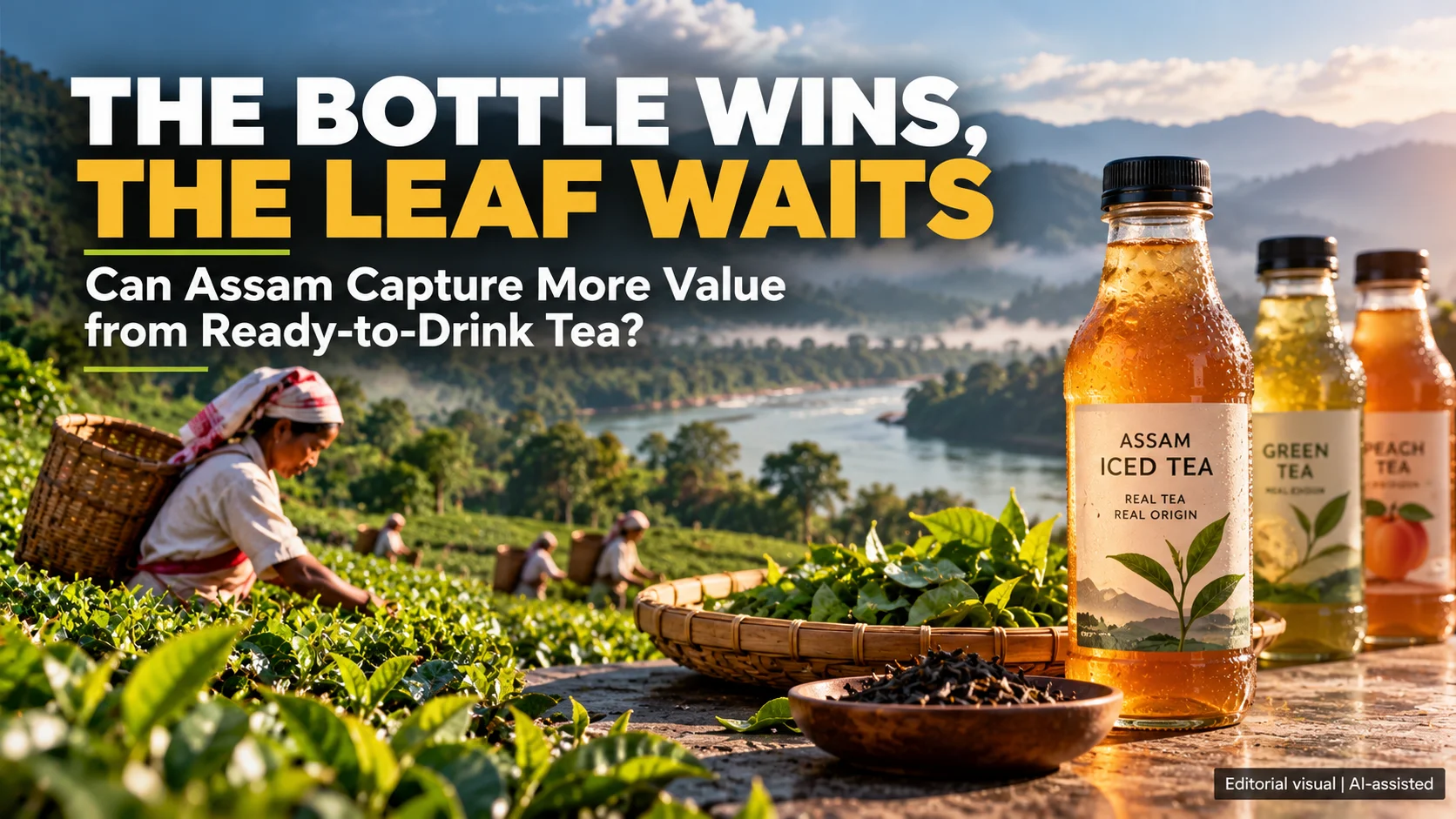
The Bottle Wins, the Leaf Waits: Can Assam Capture More Value from Ready-to-Drink Tea?
The Northeast Renaissance Series
The global ready-to-drink tea market is evolving beyond conventional iced tea. For Assam, the question is not simply whether the category will grow, but whether the region can participate in the processing, product development, branding and intelligence that create value beyond the leaf.
A bottle of tea in a supermarket tells a different commercial story from a packet of tea on an auction floor.
The packet represents an agricultural product that has passed through cultivation, plucking, processing and trading. The bottle represents something more. It combines a beverage formulation, processing technology, packaging, branding, distribution and a carefully designed consumption experience.
Both may contain tea. Yet they operate in different commercial worlds.
This distinction matters to Assam, one of the world’s best-known tea-growing regions. The state has the production base, processing experience and origin recognition to participate in a changing beverage economy. What remains less certain is how much of the value created by ready-to-drink tea can realistically be captured by regional growers, processors and entrepreneurs.
The opportunity deserves attention, but not uncritical optimism. A growing global market does not guarantee a profitable local business. The economics depend on the product, manufacturing model, distribution costs, consumer demand and the ability to compete with established beverage companies.
Opportunity Snapshot: What the Numbers Tell Us
| Commercial indicator | Available evidence | What it means for Assam |
|---|---|---|
| Global RTD tea market | Future Market Insights estimates US$34 billion for 2026, while Fortune Business Insights estimates US$85.69 billion. | The category is substantial, but estimates are not directly comparable because research firms use different definitions and methodologies. |
| Global growth outlook | Forecast compound annual growth rates range from approximately 4.8% to 5.8% across these two reports. | Growth is plausible, but the forecast should not be treated as a guarantee for individual brands or regional producers. |
| India’s RTD tea market | Euromonitor publishes category data covering sales, company shares and forecasts, although detailed tables require paid access. | There is a credible research route, but publicly available information is not sufficient to establish a precise Northeast market size. |
| Assam’s tea production | Assam produced 687.76 million kilograms of tea in 2025, representing 50.2% of India’s total production. | The region has a substantial production base. Converting that advantage into finished-product value requires additional capabilities. |
| Northeast RTD market size | No defensible regional estimate has been established for this article. | A structured retail survey and discussions with manufacturers would provide a stronger starting point than an assumed market figure. |
Market estimates: Future Market Insights and Fortune Business Insights. Assam production: the figure used in The Quantiq’s earlier article, Tea Beyond Beverage. The global figures are commercial research estimates, not audited sales totals.
A Global Market Without One Agreed Number
Ready-to-drink, or RTD, tea refers to packaged tea-based beverages that consumers can drink without brewing or preparing them. The category includes bottled and canned iced tea, unsweetened tea, flavoured varieties and several premium formats.
It sits at the intersection of the traditional tea industry and the modern packaged-beverage business.
The scale of this market is difficult to summarise with a single number. Future Market Insights estimates the global RTD tea market at US$34 billion in 2026, with a forecast of US$59.7 billion by 2036. Fortune Business Insights puts the 2026 market at US$85.69 billion and projects US$124.76 billion by 2034. Both forecast continued growth, but their estimates differ considerably.
For entrepreneurs, the disagreement is a useful reminder. Market size is not enough to establish a business case. A company must understand the specific segment it wants to serve, the consumers it can reach and the costs involved in getting a product to market.
The more useful question is what consumers are buying, and why.
China: When Tea Becomes an Alternative to Sugary Drinks
China offers an important lesson in product positioning. The market has seen strong interest in unsweetened and sugar-free tea beverages, creating room for products that compete not only with other teas but also with conventional soft drinks.
Nongfu Spring’s Oriental Leaf has become a prominent example. Daxue Consulting reported that the brand held about 79% of China’s sugar-free RTD tea segment by mid-2025. That figure refers to the specific segment, not the entire Chinese tea beverage market.
The distinction is important because the wider market contains many products, price points and consumer preferences. A strong position in one segment does not mean that every new tea brand will find similar success.
The commercial lesson is more useful than the headline share. Consumers can be attracted to tea because of its taste, convenience and place in a daily routine. For some, reduced sugar is an additional reason to choose it over a conventional soft drink.
An Assam-origin beverage could explore this space, but it would need more than a regional identity. It would require a consistent flavour, a clearly defined customer, a suitable price and a credible product proposition. Whether consumers will pay a premium for Assam origin is a question to test, not an assumption to build a business around.
The United States and Japan: Mature Markets Still Need Innovation
The United States illustrates the difference between a large category and a uniformly growing one. According to figures reported by Beverage Industry from Circana, US canned and bottled tea sales reached US$4.8 billion in the 52 weeks to 19 April 2026, down 1.5% in dollar terms. Refrigerated tea performed better in a separate reporting period, demonstrating that individual formats can move differently within the same broad category.
This is not a market where simply putting familiar tea into a bottle guarantees success. Established brands already compete for shelf space, consumer attention and distribution. New entrants need a reason for shoppers to choose their products.
Matcha, sparkling tea, reduced-sugar formulations and more specialised beverages provide examples of how brands are seeking differentiation. These are not automatic opportunities for every producer. Each requires formulation work, product testing and an understanding of the consumers being targeted.
Japan offers another perspective. Packaged tea is already part of everyday consumption, supported by convenience stores, vending machines and established beverage companies. Yet a mature market can still face pressure on domestic volumes and changing consumption patterns. Japanese companies have also looked towards overseas demand for green tea and matcha.
For Assam, the lesson is not to copy another country’s product range. It is to recognise that successful RTD businesses must keep responding to changes in taste, format and occasion. A regional brand would need to find its own defensible place in that competitive landscape.
India: A Tea-Drinking Nation, but a Distinct RTD Business
India’s familiarity with tea provides a cultural foundation for the category. It does not, by itself, establish how large the market for bottled or canned tea can become.
The distinction between tea premixes and liquid RTD tea is particularly important. A premix still requires preparation, while a bottled or canned beverage is ready for immediate consumption. They may share ingredients or consumer associations, but they operate through different product and distribution systems.
Tata Consumer Products’ experiments with iced-tea and matcha premixes in 2026 are relevant to the broader movement towards new tea formats. They should not, however, be presented as evidence of growth in liquid RTD tea sales.
India’s category data is also more accessible through specialist research than through a single, freely available market total. Euromonitor’s RTD Tea in India report includes historical retail sales, company and brand shares, and forecasts. Its public summary points to health, convenience, product innovation and quick-commerce expansion as relevant trends. The detailed data tables are paid content.
This leaves an important gap for regional decision-makers. Without reliable local information on products, prices, pack sizes, availability and consumer response, it is difficult to judge whether an Assam-origin RTD product has a viable market or which customers it should target first.
Assam’s Advantage Begins with the Leaf. It Cannot End There.
Assam’s tea production gives the region a substantial foundation. In 2025, the state produced 687.76 million kilograms of tea, accounting for 50.2% of India’s total production.
That scale supports an established network of growers, factories, traders and skilled workers. Assam also has recognised origin identity, including the established geographical indication for Assam orthodox tea. These assets can support product development, but they do not automatically confer an advantage in the packaged-beverage market.
An RTD manufacturer must solve a different set of problems. The tea needs to deliver a consistent flavour after extraction, blending, storage and distribution. The formulation must remain stable under the chosen processing conditions. Packaging must suit the product, and the final price must work for both the business and the consumer.
Origin can still matter. A premium beverage made with carefully selected Assam orthodox or single-estate tea could offer a distinctive flavour and a traceable story. Hotels, cafés, speciality retailers and direct-to-consumer channels may provide places to test such a proposition before a brand attempts wider distribution.
But the business case depends on consumer response. If customers value convenience and price above origin, the producer will need to compete on those terms. If origin and flavour command a premium, the brand must demonstrate that difference consistently.
The first task, therefore, is not to assume that Assam needs a large bottling plant. It is to identify which part of the value chain offers a realistic entry point.
Where Does the Value in a Bottle Actually Come From?
The retail price of a bottled beverage cannot be treated as the value of its tea content. Between the tea factory and the consumer sit several activities that carry costs and commercial risk.
The manufacturer must develop a recipe and ensure consistency. Depending on the formulation and process, the business may need extraction equipment, specialised treatment, quality testing and suitable packaging. The product then has to be transported, distributed, displayed and sold. Retailers and distributors need their own commercial returns, while marketing and product development add further costs.
The brand owner may capture value by coordinating these activities successfully. Yet the retail price is not the brand owner’s profit. Manufacturing, packaging, logistics, trade margins, promotions, overheads and unsold inventory all affect the final result.
This distinction matters for tea-growing regions. A rise in RTD sales does not necessarily increase the price paid for raw leaf. The benefit to growers depends on whether the new demand creates additional demand for their tea, whether that tea meets the buyer’s specifications and whether suppliers have enough bargaining power to secure better terms.
Assam can participate in this value chain in more than one way. It can supply suitable tea to established beverage manufacturers, help develop premium origin-led products or explore ownership of a brand. These routes involve different levels of investment, risk and control.
Three Gaps That Assam Must Address
1. Consistent supply and product specifications
A beverage manufacturer needs tea that performs predictably. Variations in flavour, colour, extraction and supply can affect the finished product. Buyers may also require traceability and compliance with applicable food-safety standards.
Assam producers interested in this market would need to understand the specifications required by beverage blenders and extract manufacturers. That means talking to potential buyers before investing in new processing capacity.
A supply partnership based on clear quality standards and repeat orders may be a more practical first step than building an entirely new beverage business.
2. Processing, branding and distribution
A distinctive tea origin can attract attention, but the bottle must deliver a consistent product at a price consumers will accept. The business also needs a route to market.
Contract manufacturing or shared production facilities could allow a small brand to test demand without immediately building its own bottling line. The feasibility of this approach depends on the availability of suitable facilities, minimum production quantities, formulation requirements and the cost of distribution.
Owning a brand offers greater control over product positioning, but also places more responsibility on the entrepreneur. Investment in packaging and manufacturing alone cannot substitute for a clear customer proposition and reliable sales channels.
3. Reliable market intelligence
The region also needs better information. Which RTD tea products are already available in Guwahati? How do prices vary by pack size? Which flavours dominate? Are products positioned as premium, functional, low-sugar or everyday refreshment? How prominently do brands communicate tea origin?
These questions can be investigated through structured retail research. The results would help regional businesses distinguish a genuine market opportunity from an attractive idea that lacks sufficient demand.
Four Business Opportunities Worth Testing
The following opportunities are hypotheses for validation, not forecasts of guaranteed demand or profitability.
Premium Assam-origin cold brew
A small business could test an unsweetened or lightly flavoured cold-brew tea made with selected Assam leaf. The initial market could include cafés, hotels, speciality stores and direct sales rather than a costly nationwide launch.
The objective would be to learn whether consumers value the flavour, convenience and origin enough to support a viable price. Small-batch trials could help refine the formulation and identify repeat customers before the business commits to larger production.
Specification-led tea supply
Growers, estates or processors could explore supplying tea to RTD manufacturers and extract makers. This route would focus on consistent quality, traceability, dependable volumes and clear commercial specifications.
It may require less consumer-facing investment than building a retail brand. However, it would depend on identifying buyers and meeting their technical requirements. Discussions with blenders and extract manufacturers should precede any major investment.
Contract manufacturing and shared production
A regional entrepreneur may not need to own a bottling facility to test a beverage concept. Contract manufacturing could provide access to suitable production infrastructure, subject to the availability of compatible facilities and commercially viable order sizes.
Shared manufacturing could also become relevant if several brands can use the same facility without compromising product quality or scheduling. Before treating it as an opportunity, entrepreneurs must establish production costs, minimum orders, food-safety requirements, shelf-life needs and distribution economics.
A Tea Intelligence retail tracker
There is also an opportunity to build knowledge before building a factory.
A recurring RTD tea tracker could record product availability, price per 100 millilitres, pack type, declared sugar content, flavour, origin claims and retail channel. A carefully designed survey of Guwahati outlets could establish a baseline, with subsequent rounds showing how the category changes over time.
The resulting dataset could support manufacturers, retailers, investors and regional policymakers. It would not immediately reveal total market size, but it could create a credible local evidence base where one is currently lacking.
What Should Policymakers and Industry Associations Examine?
Public support should follow a verified business case rather than precede it. The relevant questions include whether existing food-processing incentives apply to a proposed beverage unit, what support is available for product testing and quality assurance, and whether current Tea Board programmes cover the intended form of value addition.
Food businesses must also comply with the applicable Food Safety and Standards Authority of India requirements, including relevant rules for product standards, labelling and claims. Entrepreneurs should confirm the current requirements for their specific formulation and manufacturing process before committing capital.
A regional initiative could bring together tea producers, beverage manufacturers, packaging suppliers, research institutions and potential buyers. Its first task would be to establish demand and technical feasibility. Only then should it consider shared infrastructure or a larger investment programme.
How to Estimate the Northeast Opportunity Without Guesswork
A defensible regional market estimate should begin with primary research.
A Guwahati retail audit could cover a defined sample of supermarkets, convenience stores and general-trade outlets. Researchers would record the RTD tea products available, their prices, pack sizes, stated ingredients, sugar claims and distribution presence. The method and sample would need to be documented so that later surveys could be compared with the first.
Interviews with retailers could add information about product movement and consumer response, although these observations should not be confused with audited sales data. Conversations with tea blenders and beverage manufacturers would help establish the technical specifications and supply conditions required for commercial participation.
Repeating the exercise quarterly would create a useful time series. The data could then be combined with relevant official tea production statistics and any available sales information to improve the regional assessment.
Until that work is completed, publishing a precise Northeast RTD tea market value would create a misleading impression of certainty.
For Students and Young Professionals: Where Could the Careers Emerge?
The RTD tea business is not limited to plantation management or conventional tea tasting. It brings together food science, product development, packaging, quality assurance, supply-chain management, retail analytics and marketing.
Food technology graduates could explore beverage formulation, shelf-life testing and quality control. Data and business graduates could study pricing, distribution and consumer behaviour. Designers and marketers could work on packaging, product positioning and digital commerce, while supply-chain professionals could focus on procurement, production planning and retail availability.
For young entrepreneurs, the most useful starting point may be a small research or product-testing project rather than an immediate manufacturing investment. Understanding what consumers buy, why they buy it and what it costs to serve them is a valuable foundation for any future venture.
The Quantiq Assessment: Assam Must Decide Where It Wants to Compete
Ready-to-drink tea offers Assam a reason to examine the relationship between agricultural strength and consumer-product value. It does not offer a shortcut from tea production to higher profits.
The immediate opportunity may lie in understanding the market, supplying tea to manufacturers or testing a premium regional product through limited channels. A larger branded beverage business could follow if demand, production economics and distribution support it.
The order matters. Investing in bottling capacity before validating demand could create a costly asset with insufficient utilisation. Conversely, refusing to explore new formats may leave regional producers dependent on established markets and conventional supply relationships.
Assam does not need to capture every part of the RTD value chain. It needs to identify the parts where its tea, skills, identity and entrepreneurial capabilities provide a credible advantage.
The leaf remains essential. But in the RTD business, success also depends on what happens after the leaf leaves the factory.
Learn More
- Future Market Insights: Ready-to-Drink Tea Market — global market estimate and long-term forecast.
- Fortune Business Insights: RTD Tea Market — an alternative market estimate and category analysis.
- Euromonitor: RTD Tea in India — Indian market trends, competitive landscape and category data.
- Food Safety and Standards Authority of India — official information on food safety, product standards and labelling requirements.
- Tea Board India — official tea-sector information, statistics and scheme details.


One Comment