
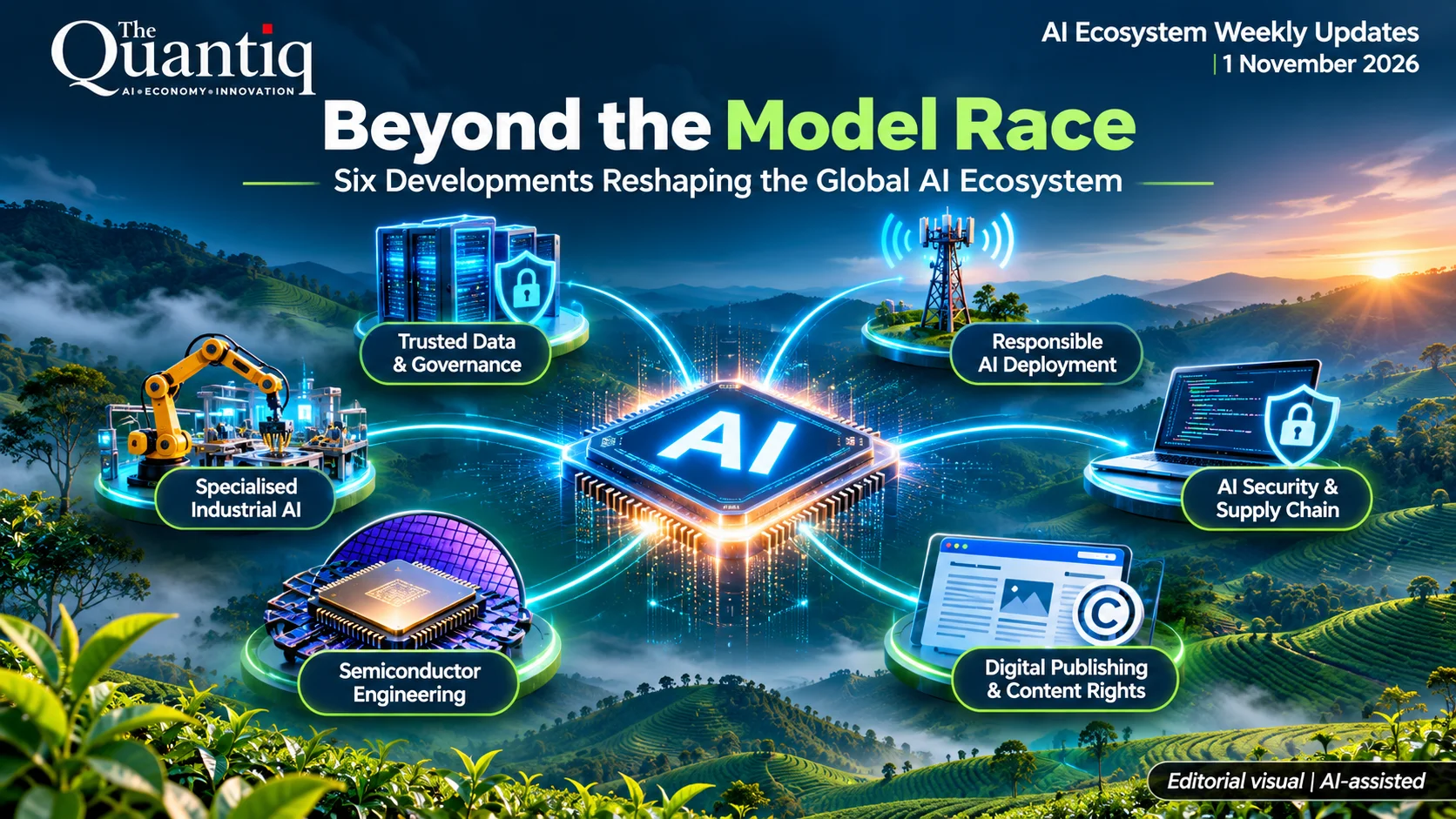
AI Ecosystem Updates: Six Developments Beyond the Model Race
The Quantiq | AI Ecosystem Weekly Updates
The AI ecosystem is changing fast. For years, companies competed to build bigger, faster and more capable models. This week’s news suggests that the contest is now much wider.
The focus is moving beyond the models themselves. Who controls the data that trains them? How can AI fit into complex industrial processes? Can organisations deploy powerful models without depending on external providers? And when AI agents access sensitive systems, who takes responsibility if something goes wrong?
Governments, businesses and technology companies are asking these questions more urgently. India’s latest initiatives on trusted data collaboration and responsible AI in telecommunications are particularly significant. Meanwhile, semiconductor engineering is getting its own specialised AI models. European developer Mistral has taken a major step towards open-weight AI with Mistral Large 4. A malicious coding extension has also exposed weaknesses in the software that supports AI-assisted development.
A debate is emerging as well about the rights of digital publishers whose content trains AI. Taken together, these developments point to a broader transition. The next phase of the AI economy may depend less on who builds the biggest model. It may depend more on who combines models, data, infrastructure, domain expertise and governance to create useful outcomes.
Here are six developments that caught our attention this week, and what they could mean for India.
1. India introduces DEPA for AI training: is trusted data the next AI ecosystem advantage?
What MeitY launched
One of India’s most interesting AI developments this week came from the Ministry of Electronics and Information Technology (MeitY). On 31 October, MeitY launched the Handbook on Data Empowerment and Protection Architecture (DEPA) for AI Training at a high-level roundtable in Bengaluru. MeitY Secretary S. Krishnan unveiled the handbook, with support from the iSPIRT Foundation.
The initiative tackles a growing problem. Organisations hold enormous amounts of valuable data, but they cannot freely share or combine it. Hospitals hold patient information, and banks keep extensive transaction records. Agricultural institutions collect crop, soil and weather data. Research organisations maintain specialised scientific datasets, and businesses generate information through operations and supply chains.
However, privacy, confidentiality, intellectual property and institutional control often block collaborative AI development.
How the framework works
DEPA addresses this challenge through a techno-legal framework. Organisations can collaborate on AI training while retaining control over their data. The framework combines contractual permissions, controlled computing environments, privacy-enhancing safeguards and data provenance mechanisms. Data provenance matters because it shows where information originated, what permissions govern its use and how people have used it.
India’s Principal Scientific Adviser, Professor Ajay Kumar Sood, captured the approach well. The model travels to the data, rather than the data travelling to the model.
This is an important shift in thinking. Institutions no longer have to surrender their datasets to external AI developers. Instead, the framework aims to make secure, purpose-bound collaboration possible. Potential applications span healthcare, banking, agriculture, scientific research and public administration.
What it could mean for Northeast India
For India, the opportunity is considerable. The country has a large and diverse data ecosystem. Yet the economic value of that information depends on whether people can access and use it responsibly.
The implications are particularly interesting for Northeast India. The region has valuable information resources across tea, agriculture, biodiversity, healthcare, tourism and traditional knowledge. Much of this information remains fragmented across government departments, research institutions, businesses and local organisations.
A trusted data collaboration framework could eventually help unlock some of this value. For example, agricultural researchers could combine governed crop information, weather records, soil characteristics and market data. They could then build more useful predictive systems for farmers. Similarly, tea producers could use trusted datasets to improve crop management, understand production patterns and strengthen supply-chain intelligence.
These outcomes are not automatic, though. They would need participating institutions, suitable permissions, reliable data, technical infrastructure and sound governance. Still, the framework points towards a way of making such collaboration possible.
India’s AI ambitions will depend on more than computing power and model development. They will also depend on the country’s ability to organise, govern and responsibly mobilise high-quality data. Data access and data quality could become strategic economic assets.
Source: Ministry of Electronics and Information Technology, Government of India – DEPA for AI Training Handbook.
2. TRAI proposes responsible AI guidelines: accountability moves closer to the infrastructure
Why telecom matters
Artificial intelligence is becoming part of the infrastructure that keeps modern economies running. Telecommunications networks are among the clearest examples. Operators use AI for network management, traffic optimisation, fraud detection, customer service and operational decisions.
But what happens when an AI system makes a faulty decision inside infrastructure that millions of people depend on? India’s Telecom Regulatory Authority of India (TRAI) is now addressing this question.
What the draft proposes
On 30 October, TRAI released draft Guidelines on Responsible Use of Artificial Intelligence (AI) in Telecommunication Networks and Provision of Telecommunication Services for stakeholder consultation. The draft follows India’s broader AI Governance Guidelines, released in February 2026. Its significance lies in translating responsible-AI principles into a sector-specific framework.
Telecommunications deserves particular attention because it supports far more than voice calls and internet access. Banking, digital commerce, public services and emergency response all depend on reliable networks. AI can make these networks more efficient. However, it also introduces new risks, including incorrect automated decisions, biased algorithms, weak oversight, security vulnerabilities and unexpected model behaviour. Any of these could affect service reliability and consumer protection.
TRAI’s proposed guidelines cover AI use in both telecom networks and telecom services. The consultation is open, and the regulator invites written comments until 27 November 2026. It is important to note that this is a draft, not a final regulation. The final framework will depend on the consultation.
Why it matters beyond telecom
The direction is still significant. As AI becomes embedded in critical infrastructure, businesses will need to show more than that their systems work. They will also need to show that their systems can be monitored, audited and held accountable.
The implications reach beyond telecommunications. Banking, healthcare, energy and transportation will face similar questions as AI becomes central to their operations. The challenge is to ensure that efficiency gains do not come at the expense of reliability, transparency and consumer protection.
Responsible AI cannot remain a broad policy aspiration. It must become sector-specific accountability, operational safeguards and measurable standards. Organisations that build these safeguards early may be better prepared for the next phase of AI regulation.
Sources: TRAI – Draft Responsible AI Guidelines for Telecommunications | TRAI consultation notice.
3. Cadence introduces Maestro: specialised AI for semiconductor engineering
Why general-purpose AI is not enough
General-purpose AI models have shown impressive abilities in writing code, analysing documents and answering complex questions. Industrial engineering, however, presents a different challenge. A semiconductor design cannot be judged by whether an AI answer sounds convincing. It must meet precise constraints on performance, power consumption, reliability, manufacturing requirements and cost. This is where specialised AI models could make a difference.
What Maestro offers
On 26 October, Cadence Design Systems announced Maestro. It is a portfolio of domain-specialised AI models that power AI agents across semiconductor and system-design workflows. The initiative brings together specialised language models, trained decision models, reinforcement learning and Cadence’s established electronic design automation (EDA) and system design automation (SDA) tools.
The idea is to move beyond AI as a conversational assistant. Instead, AI becomes an active participant in complex engineering workflows. Cadence’s agents can interpret design requirements, break down tasks and generate design content. They can also analyse results and evaluate engineering trade-offs using specialised tools.
Feedback, results and availability
An important element is the feedback mechanism. Established tools and deterministic solvers evaluate the outputs against engineering objectives and constraints. The resulting feedback then helps improve the AI systems. This matters because industrial applications need verifiable outcomes, not plausible-looking answers.
Cadence reported initial results showing up to 30% improvement in quality of results. It also reported up to five times greater token efficiency than general-purpose foundation models in selected design workflows. These are company-reported initial results. Nobody has independently verified them across the semiconductor industry.
Cadence’s collaboration with NVIDIA is another significant element. The broader engineering environment integrates NVIDIA’s Nemotron and OpenShell technologies. The first Maestro models are scheduled for early access for selected customers in the fourth quarter of 2026.
Relevance for India
India has been strengthening its semiconductor ambitions through investments in fabrication, assembly, testing, research and design. Yet manufacturing is only one part of the value chain. Chip design, verification, electronic design automation and specialised engineering software are equally important.
Domain-specific AI tools could change how engineering teams approach complex design problems. Rather than relying only on general-purpose models, companies can use systems built around their industry’s technical requirements. For Indian technology companies and engineering institutions, this reinforces the need to develop expertise in specialised AI applications, not just general productivity tools.
The next industrial AI breakthrough may not come from a bigger chatbot. It may come from specialised intelligence embedded in professional tools. Such systems can evaluate their own outputs against real-world constraints.
Source: Cadence – Introducing Maestro, its domain-specialised AI model portfolio.
4. Mistral Large 4 goes open-weight: a new contender in the sovereign AI ecosystem
Why sovereignty matters
The debate around AI sovereignty has gained a significant new dimension. Governments and enterprises increasingly want control over where their AI models run and how their information is processed. They also want to keep using essential AI capabilities without depending entirely on an external provider. Open-weight models offer one possible route. This week, European AI company Mistral took an important step in that direction.
Mistral first introduced Mistral Large 4, informally known as Le Chonk, in public preview on 6 October. It has now released the improved model weights. Developers and organisations can therefore deploy and customise the model under its licence. This is more than a routine update. It changes the practical case for running a powerful, European-trained model on infrastructure you control.
Architecture and reasoning modes
Mistral Large 4 is a natively multimodal Mixture-of-Experts (MoE) model. Mistral’s documentation specifies approximately 1.05 trillion total parameters, with 52 billion active parameters. The distinction matters. A model’s total parameter count does not mean every parameter activates for every request. In an MoE architecture, the system activates only selected expert components for each input. This helps balance model capacity against computational requirements.
Mistral says the improved model benefits from additional reinforcement learning after the public preview. The gains are particularly strong in coding, reasoning efficiency and defensive cybersecurity. The update also introduces three reasoning modes. Low suits simpler tasks, and Medium suits everyday tasks. High is the default, and it suits demanding use cases that need more precision and extended reasoning. Developers therefore gain more control over the balance between performance, quality and cost.
Benchmark claims
Mistral has published several benchmark results. On the Artificial Analysis Coding Agent Index, Mistral Large 4 scores 48%. According to Mistral, that effectively matches the leading open-weight model, GLM-5.3, while using 47% fewer tokens per task on average. On Terminal-Bench 4.0, the model reached 41%, a reported improvement of 13 percentage points over its public preview. It also reduced output tokens by 30%. In addition, it reports 19.7% on Cognition’s private FrontierCode 2.0 benchmark. That benchmark evaluates end-to-end coding quality and whether a repository maintainer would accept an agent’s proposed change.
The claims extend beyond software development. Mistral reports 51% on the Artificial Analysis Cyber Index and 73.3% on the Finch finance-workflow benchmark. It also reports 84.5% on BrowseComp, which evaluates web-browsing capabilities.
Readers should interpret these figures carefully. Mistral reports them, and benchmark scores cannot replace independent testing on an organisation’s own workloads. Performance varies with the task, deployment environment, tools and evaluation method. Nevertheless, the results show where open-weight models are heading. They are moving towards more capable coding agents, specialised enterprise workflows and increasingly complex applications.
Open-weight is not the same as open-source
Open-weight AI is not automatically fully open-source AI. Releasing model weights lets developers inspect, customise, fine-tune and deploy a model under the applicable licence. However, it does not necessarily disclose all training data, training processes or development details.
Mistral Large 4 uses the Mistral Ecosystem Open-Weight licence, which the company describes as a modified MIT licence. Mistral says developers can use, modify, fine-tune and commercialise the model. There is one important condition, though. Businesses operating a Model-as-a-Service offering must obtain a separate commercial licence from Mistral. Developers, startups and enterprises should review the licence before deployment, especially if they plan to offer hosted access to the model itself.
Pricing and deployment
Mistral has also published API pricing of $0.70 per million input tokens, $0.07 per million cached input tokens and $2.10 per million output tokens. These prices apply to hosted usage. They should not be confused with the total cost of self-hosting, which also includes infrastructure, engineering and operations.
The weights are available to developers, and Mistral highlights deployment through its ecosystem and infrastructure partners. Organisations can therefore consider hosted access as well as deployment under their own infrastructure and governance.
Sovereignty has limits
Mistral positions Large 4 as a model trained from scratch on European infrastructure. This is central to its sovereign-AI proposition. For governments, regulated industries and enterprises, sovereignty is about more than owning a model. It also involves control over deployment, data residency, access permissions and customisation. Ideally, it also means operating critical systems without depending entirely on an external API provider.
Open-weight deployment can improve that control, but it does not guarantee sovereignty. Organisations must still consider hardware dependencies, security, software supply chains, licensing, maintenance and the origin of other components in their technology stack.
A cybersecurity qualification
One cybersecurity point deserves attention. Mistral reports strong defensive-security performance and a 96.6% average refusal rate on malicious cyber requests. At the same time, the company acknowledges that it observed potential for the model to assist real attacks, and it says it is modifying its guardrails. Access to its specialised advanced-cybersecurity preview is restricted to vetted partners in controlled, authorised environments. That honesty is important. More capable models can strengthen defenders, but they also create new risks without adequate safeguards.
What it means for India and the Northeast
The release is relevant to India’s ambition to build its own AI capabilities. Not every organisation needs to train a foundation model from scratch. Many can create considerable value by adapting existing models to specific industries, languages and operational needs. A specialised AI application for tea research, agricultural intelligence, healthcare, tourism or regional-language services could be built around an open-weight foundation model. This would depend on suitable licensing, data quality, infrastructure and technical validation.
For instance, a tea intelligence system need not begin by training a trillion-parameter model. It could build on an existing foundation model. It could then combine that model with reliable auction prices, weather information, production records, export data and domain expertise. From there, developers could design specialised workflows for growers, traders and researchers.
The model provides a starting point. Data quality, domain knowledge and workflow design determine whether the application creates real value. This is where the opportunity becomes particularly interesting for regional innovation ecosystems.
The AI economy will not belong only to organisations that build the largest models. Those that can adapt, specialise and deploy AI for real-world problems may capture substantial value. Mistral Large 4’s open-weight release strengthens that possibility. Even so, the commercial opportunity lies in what developers build around the model, not in simply downloading it.
Sources: Mistral – Mistral Large 4 (Le Chonk) is now open-weight | Mistral model documentation.
5. Malicious Claude Code extension exposes a new AI security challenge
What happened
AI coding assistants are becoming an important part of software development. They help developers write code, understand unfamiliar repositories, debug applications and automate repetitive tasks. But this convenience carries a security dimension that deserves greater attention.
On 29 October, a tampered version of Anthropic’s Claude Code extension appeared in Cursor’s extension marketplace. Cursor later reported that up to 5,000 users could have been affected. Microsoft Security Research then published a detailed technical investigation on 30 October. It showed how the malicious extension tried to establish persistent remote access to affected systems.
What the code attempted
The injected JavaScript was designed to collect information about the host system and add an attacker-controlled SSH key. It also enabled local SSH access and attempted a reverse SSH connection. In addition, it included mechanisms meant to maintain persistence.
One qualification is essential. These were capabilities and attempted actions identified in the malicious code. Microsoft did not establish that every affected installation suffered a successful remote compromise. Microsoft also confirmed that the malicious versions were distributed through Cursor’s marketplace. They did not appear on the official Microsoft Visual Studio Marketplace or in Anthropic’s npm package. Anthropic confirmed that its systems had not been compromised.
Why this incident matters
AI-assisted development environments increasingly depend on extensions, integrations and external tools. These components can access source code, files, terminals, credentials and other sensitive resources. A compromised extension can therefore create risks far beyond the application itself.
The incident highlights several practical steps. Organisations should verify extension publishers, control automatic updates and monitor installed components. They should also keep access permissions strict. Finally, they need procedures for investigating suspicious extensions and checking for unauthorised keys, scripts or persistence mechanisms.
The lesson is not that teams should avoid AI coding assistants. Rather, these systems are growing more capable, so the security of their surrounding software ecosystem matters more. As AI agents gain permission to execute commands, access repositories and interact with enterprise systems, the security perimeter expands.
Security must therefore evolve from protecting the model to protecting the entire environment in which the model operates. Trust in an AI tool also depends on the integrity of its extensions, integrations, permissions and software supply chain.
Sources: Microsoft Security Research – Technical investigation of the malicious Claude Code-branded Cursor extension | Reuters – Cursor says up to 5,000 users affected.
6. AI giants back a common AI-training preference signal for publishers
The problem publishers face
This development deserves particular attention from digital publishers and media organisations. For years, website owners have managed separate crawler instructions for different AI companies. As AI systems rely more on information across the internet, publishers ask a fair question. How can they communicate whether AI developers may use their content for foundational AI training? A proposed common mechanism could make this much simpler.
What was announced
On 30 October, OpenAI announced its support for a shared, machine-readable signal. Website operators can use it to express preferences about using their content for foundational generative AI training. The proposal comes from ongoing work in the Internet Engineering Task Force’s (IETF) AI Preferences working group. The draft, titled Machine-Readable Training Preference Signal, was published on 30 October.
The mechanism places a policy token inside a website’s existing robots.txt file. Publishers can then communicate a preference in one common format. They no longer need to maintain separate instructions for each participating AI provider.
OpenAI has said it intends to implement the signal in the coming months. The Verge reports support from Google, Microsoft and Anthropic, although their timelines differ. Anthropic has already adopted the signal. Google and Microsoft have indicated plans to implement it later.
What the signal does not do
This is an important development, but readers should understand it correctly. The proposal is a voluntary Internet-Draft, not an adopted global standard. The IETF’s document-status page states that the draft has no formal standing in the standards process at this stage. Its practical effect will depend on how widely AI providers implement and respect it.
Nor does it settle questions about copyright, licensing, compensation or the use of content in AI-generated answers. A preference signal communicates a publisher’s choice. By itself, it is not a rights-management or enforcement system. Even so, it represents progress towards a more consistent way of communicating publisher preferences.
Why it matters for independent publishers
Digital publishers invest resources in research, reporting, analysis and original content. Their work feeds the information ecosystem from which AI systems derive knowledge. Yet the relationship between content creators and AI developers remains unsettled.
For independent publishers, especially those producing specialised regional content, the issue goes beyond crawling. It is also about attribution of original reporting and meaningful control over content. Publishers also need sustainable economic models around the use of their work. Moreover, making content discoverable is different from granting permission for model training. Publishers will increasingly need to understand both.
For The Quantiq, this is a development worth watching closely. We are building a knowledge-rich digital platform, so we must consider both sides. We want original content to be discoverable by search engines and AI systems. At the same time, we need to understand the mechanisms that govern how others can use that content.
The future of digital publishing will depend on discoverability, content rights, attribution and the economics of information in the AI age. A common preference signal is a useful step. Publishers should nevertheless watch how the major AI providers implement and honour it.
Sources: OpenAI – Making it easier for websites to express AI training preferences | IETF – Machine-Readable Training Preference Signal | The Verge – The biggest names in AI are backing a new way to opt out of scraping.
The bigger picture: the next AI ecosystem advantage comes from building the ecosystem
Look at these six developments together, and a broader pattern emerges. India is working towards trusted data collaboration, and its telecom regulator is moving towards more accountable AI deployment. Cadence is embedding specialised intelligence into semiconductor engineering. Mistral is advancing the open-weight model ecosystem. Microsoft has exposed vulnerabilities in the software supply chain behind AI development. Finally, major AI companies are beginning to back a common way for publishers to state their training preferences.
These developments may look unrelated, but they point to the same shift. AI is becoming an ecosystem challenge. Competitive advantage will increasingly depend on how well organisations combine data, computing infrastructure, specialised expertise, security, governance and practical execution.
An opportunity for India
For India, this creates an opportunity beyond building another foundation model. The country can build value through industry-specific AI applications, trusted data infrastructure and specialised research and deployment capabilities. Capable open-weight models make this opportunity more accessible. However, access to model weights alone does not solve the challenges of infrastructure, data quality or skills.
An opportunity for Northeast India
For Northeast India, the opportunity is especially interesting. The region has distinct strengths in tea, agriculture, biodiversity, healthcare, tourism, handloom and sustainable manufacturing. These sectors generate information and knowledge that could support specialised intelligence systems.
Still, the opportunity will not appear simply by adopting AI tools. It will require better data collection, data quality, institutional collaboration and skilled people. It will also require a clear understanding of how technology can improve real business processes.
Tea offers a good example. Reliable weather information, auction prices, production records, export data and field-level observations could together create more useful intelligence for producers, traders and policymakers. The same principle could apply to agriculture, tourism and other regional industries. The real opportunity lies in moving from fragmented information to actionable intelligence.
The Quantiq take on the AI ecosystem
The AI race is evolving from model development towards ecosystem development. Models will continue to matter. However, the organisations and economies that create lasting advantages will combine trusted data, specialised knowledge, secure infrastructure, responsible governance and effective execution.
For emerging economies and regions such as Northeast India, this distinction is important. We do not have to compete with the world’s largest technology companies on every dimension of AI. Instead, we can create value by applying intelligence to problems that matter to our industries, businesses and communities.
The release of Mistral Large 4’s weights reinforces this possibility. Capable models are becoming widely available, so developers can focus on domain-specific applications. They no longer need to start every project by paying for a foundation model.
Yet the model is only one part of the equation. Data quality, domain expertise, workflow design, security and measurable results will decide whether AI adoption creates lasting economic value.
In the age of AI, intelligence alone is not the moat. The ability to turn intelligence into outcomes is





One Comment