
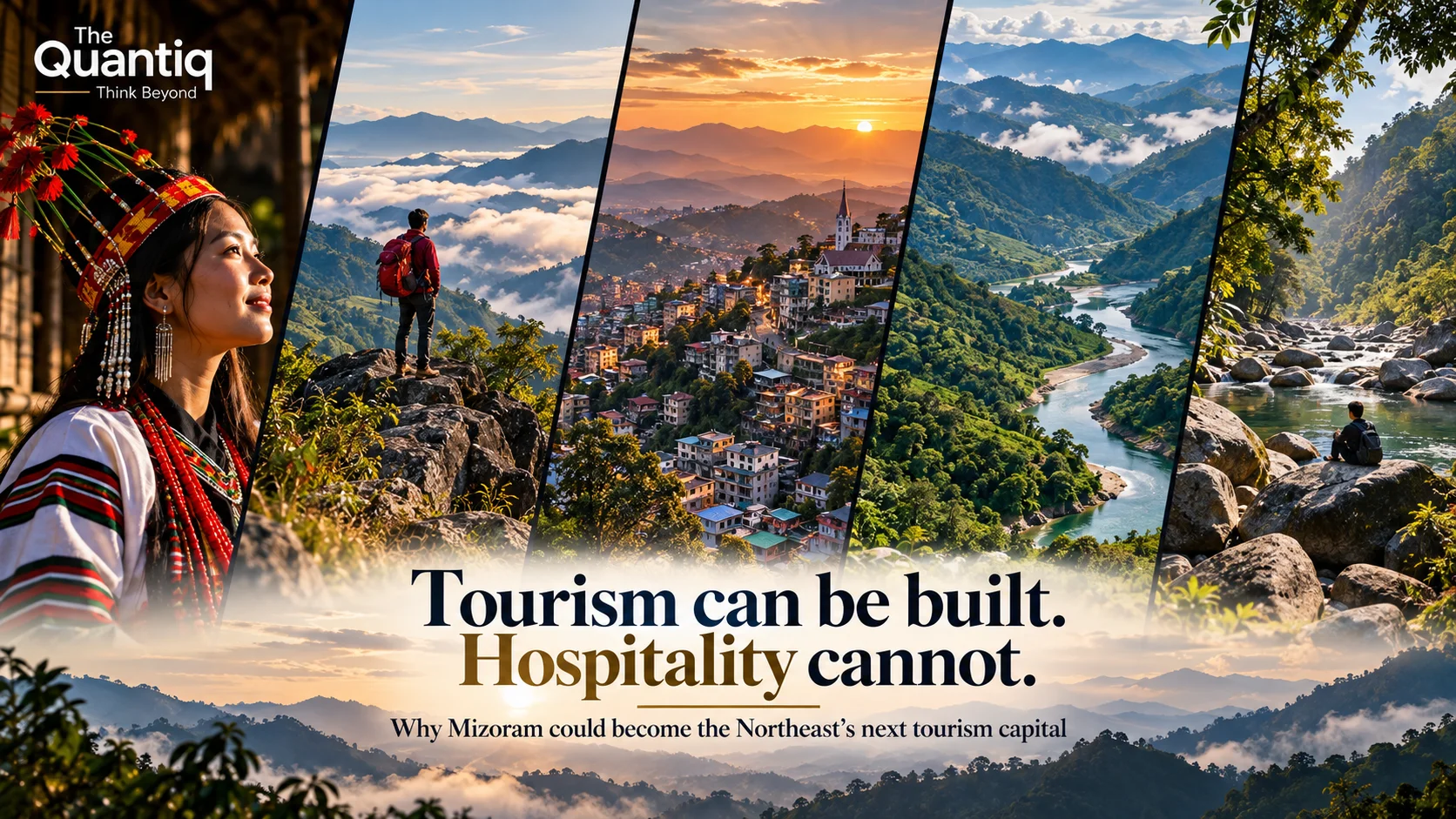
Why Mizoram Could Become the Northeast’s Next Tourism Capital — And Why I’m Not Surprised
Forty years ago, within three hours of landing in Aizawl, I bought a small book from a roadside stall called Learn Mizo from Hindi. It cost next to nothing, but it changed the way I experienced Mizoram.
By evening, I was greeting shopkeepers in halting Mizo tawng. Within a few days, doors were opening for me, and sometimes kitchens too. What began with a tiny language book became a habit that continued for four decades of travelling across the state.
I travelled through Lunglei, Lawngtlai, Saiha, Ngopa, Phuldungsei, Champhai and Thenzawl, the state’s textile hub, moving from town to town and eventually from village to village. My early journeys were connected with concurrent evaluation of the Integrated Rural Development Programme and Rural Water Supply schemes at the block level. Later, my work brought me into rural tourism development. What stayed with me,however, was not simply the landscape.
Mizoram’s hills are spectacular, and its landscapes can stand alongside some of the best in Northeast India. But landscapes alone do not create a tourism destination that people remember. What stayed with me was something much harder to capture in a tourism report or data table.
I never once encountered a beggar.
In some of the remotest villages, even a poor household would ask a stranger, “Thingpui in i duh em, ka pu?” — would you like to have a cup of tea sir? Government guest houses in inaccessible corners were often maintained more carefully than many private hotels I had encountered in larger cities.
That experience is why the latest tourism numbers coming out of Mizoram do not surprise me.
The Numbers Behind Mizoram’s Tourism Growth
Official figures tabled in the Mizoram Legislative Assembly show tourist arrivals almost doubling, from 4,27,302 in 2024 to 8,41,322 in 2025.
The Tourism Department has also reported 6,79,607 tourist arrivals between April and December 2025, including 6,70,001 domestic visitors and 9,606 foreign visitors. That figure alone was already 29.5% higher than the total recorded during the previous financial year.
December 2025 produced another significant milestone. The state recorded 1,33,520 visitors in a single month, representing a 122% increase over December 2024.
Based on these figures, tourism officials have described Mizoram as the fastest-growing tourist destination among the Northeast’s eight states.
The numbers are impressive. But numbers by themselves do not explain why a destination grows.
Something else has to happen underneath the statistics.
Tourism Infrastructure Is Beginning to Catch Up
There is also evidence that tourism infrastructure in Mizoram is expanding alongside visitor numbers.
The Union Tourism Ministry has sanctioned ₹9.97 crore for a Convention Centre at Thingsulthliah. The Northeast Council has supported heritage preservation and skilling at Vangchhia village in Champhai district under the Our Heritage, Our Treasure project.
Meanwhile, the Live Museum showcasing traditional Mizo life at Zokhua, Falkawn, has proved sufficiently popular to be extended through March 2026.
These investments matter because tourism cannot grow indefinitely on scenery and goodwill alone. Visitors need places to stay, experiences to discover, infrastructure to support their journeys and stories worth taking home.
Yet there is another development that, to me, is even more interesting than the headline investment figures.
It is happening much closer to the soil.
Pluck & Pay: A Small Idea With a Bigger Meaning
On September 23, the Tourism Department, together with the Deputy Commissioner’s office in Khawzawl district, launched Mizoram’s first “Pluck & Pay” Festival in Tualte and Chawngtlai villages.
The concept is remarkably simple.
Visitors walk into working farms, harvest produce with their own hands and pay the farmer directly for what they pick.
There is no need to construct an elaborate attraction. There is no need to create an artificial version of rural life for tourists. The farm is already there. The farmer is already producing. The visitor is simply invited to participate.
That simplicity is precisely what makes the model interesting.
Tourism revenue often passes through several layers before it reaches the community that actually produces the underlying value. Hotels, travel agents, intermediaries and curated experiences can all play legitimate roles, but the producer can sometimes become the least visible participant in the tourism economy.
Pluck & Pay reverses that relationship.
The visitor experiences agriculture directly, while the farmer receives money directly for something already being produced.
In other words, tourism and agriculture begin to operate as one local economic system.
From Tourism Inventory to a Producer Economy
This is where Mizoram’s experiment becomes particularly relevant to the wider Northeast.
For years, much of the conversation around Northeast tourism has focused on destinations, circuits, infrastructure and visitor numbers. Those things matter, but they do not answer a more fundamental question:
Who actually captures the economic value created by tourism?
For a region with thousands of villages, farms, craftspeople, weavers, food producers and community-owned natural assets, that question is critical.
The Pluck & Pay model offers one possible answer.
It puts the producer at the centre rather than building a tourism economy around the producer.
That is very close to what I have been calling the Sovereign Producer Economy — the idea that Northeast India’s future growth should run through its producers, rather than around them.
A farmer should not have to become a hotelier to participate meaningfully in tourism. A weaver should not have to build a showroom. A village should not have to transform itself into a theme park.
Sometimes the most powerful tourism experience is simply an invitation to enter an existing way of life respectfully.
If the model works, there is considerable scope to replicate it across villages where agriculture, food, crafts and culture already form part of everyday life.
And importantly, it does not necessarily require large amounts of new capital.
Mizoram’s Tourism Calendar Is Expanding Too
The Pluck & Pay initiative also comes as Mizoram prepares for a wider festival calendar in 2026.
The calendar includes the Anthurium Festival at Reiek, Hnahsin Kût in Champhai and Travel Fest in Aizawl, alongside events such as the Leitlangpui Music Festival, Winter Festival, Tlaizawng Paradise Festival and Sakawrhmuituai Sunset Event.
Festivals can create visitor spikes, but their deeper value comes when they connect visitors with local communities, products, landscapes and stories.
That connection will determine whether tourism becomes merely a numbers game or develops into a broader local economic opportunity.
Why I Think Mizoram’s Growth Could Continue
The numbers explain what is happening.
My years on the ground offer one possible explanation for why it may continue.
Tourism infrastructure can be built by any state that has the resources and political will to invest in it. Roads can be improved. Convention centres can be constructed. Museums can be created. Festivals can be promoted.
But some of the things that make visitors return cannot simply be manufactured through a government scheme.
Hospitality is one of them.
So is cleanliness when it becomes part of everyday civic behaviour rather than something created specifically for tourists. So is the instinct to offer a stranger a cup of tea before asking who they are.
I have travelled through much of the interior of Northeast India over more than four decades. Few places have consistently given me the same combination of hospitality, cleanliness and community warmth that I have experienced in Mizoram, including in some of its poorest and most remote villages.
That is not a statistic.
But tourism ultimately depends on human memory, and human memory is often shaped by precisely these things.
Mizoram’s Real Tourism Advantage May Be Its People
Mizoram has hills, forests, villages, textiles, food, festivals and landscapes. Other parts of Northeast India have those assets too.
What could distinguish Mizoram is the way these assets are increasingly being connected with the people who live among them.
That distinction matters.
A destination can attract a visitor once because of a beautiful landscape. It can bring that visitor back because of an experience. And it can turn a visitor into an advocate because of the way people made them feel.
The next phase of Mizoram’s tourism story should therefore not be measured only by how many people arrive.
It should also be measured by how much value remains in the villages they visit, how many local producers participate in the economy and how much of Mizoram’s everyday character survives as tourism expands.
If the state can continue to build tourism infrastructure while protecting the very qualities that make visitors feel welcome, its growth story could become considerably more important than a rise in tourist arrivals.
It could become a model for how a Northeast Indian state builds a tourism economy without losing ownership of the experience to outsiders.
And if Mizoram continues growing at anything close to the pace recorded in 2025, I would not be surprised to see it challenge the region’s more established tourism destinations within the next few years.
Not because Mizoram suddenly discovered tourism.
Perhaps because tourism is finally beginning to discover what Mizoram has had all along.




3 Comments