What Mattered This Week: Five Developments Shaping Business, Technology and Northeast India’s Growth
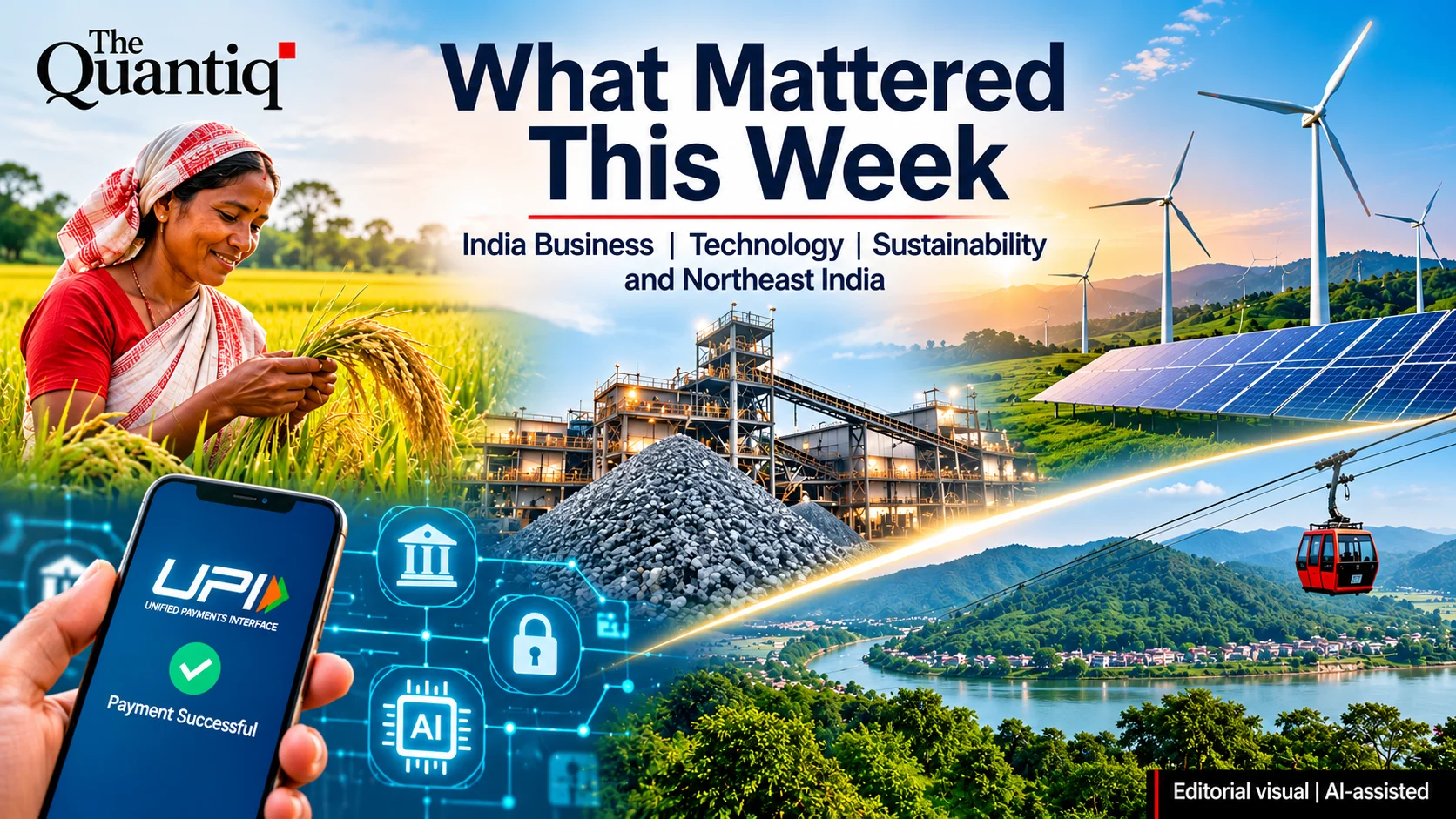
From Assam’s paddy procurement strategy to India’s critical-minerals ambitions, digital financial infrastructure and renewable energy investments, this week brought developments with implications extending well beyond the immediate announcements.
For businesses and entrepreneurs, the important question is not simply what happened, but what these developments could mean for investment, innovation and economic opportunity. Here are five developments worth watching.
1. Assam’s Paddy Procurement: Infrastructure in Place, Focus Shifts to Farmer Prosperity
Assam’s paddy procurement season for 2026–27 began on November 1, with the state targeting 8.49 lakh metric tonnes through 181 procurement centres. The Minimum Support Price (MSP) for common paddy is ₹2,441 per quintal, while Grade A paddy commands ₹2,461.
A conversation with the Assam State Food & Civil Supplies Corporation has added an important dimension to the story. The corporation confirmed that Assam has adequate milling and storage infrastructure to handle the targeted procurement. The state’s paddy milling capacity stands at approximately 24 lakh metric tonnes.
The state government’s additional incentive over and above MSP is another important component of farmer support.
With procurement infrastructure reportedly adequate, the next opportunity lies in strengthening the agricultural value chain through better market access, processing, branding and utilisation of rice by-products.
For Assam, the challenge is increasingly about ensuring that more value from its agricultural production reaches farmers and local enterprises.
2. Critical Minerals: India’s ₹2,814-Crore Push Towards Domestic Processing
India is stepping up its efforts to reduce dependence on imported critical minerals. The Union Cabinet has approved a ₹2,814-crore capital expenditure support scheme to establish domestic lithium and nickel processing facilities over five years, from 2026–27 to 2030–31.
The scheme offers a 30% capital subsidy for four proposed plants—two for lithium and two for nickel. The government expects the initiative to attract approximately ₹10,000 crore in investment.
These minerals are essential for electric vehicle batteries, energy storage, electronics, defence and speciality steel. Their processing is currently concentrated in a limited number of countries, creating supply-chain vulnerabilities.
The significance extends beyond mining. Processing technology, material recovery and downstream manufacturing will determine how much economic value India can retain.
For Northeast India, the development offers a wider lesson: natural resources alone do not create industrial strength. Technology, processing capabilities and competitive value chains do.
3. NPCI’s New Technology Arm: AI and Blockchain Enter India’s Digital Payments Ambition
The National Payments Corporation of India (NPCI), the institution behind UPI and several other retail payment systems, has established a wholly owned technology subsidiary, NPCI Tech Solutions Limited.
Announced on November 4, the new entity will focus on artificial intelligence, blockchain, digital financial infrastructure and global capability centre services.
The move signals an ambition to extend NPCI’s technology capabilities beyond its traditional payments mandate and contribute to India’s wider digital public infrastructure.
For fintech companies, startups and enterprises, the implications could be significant. AI-enabled financial services, secure digital transactions, automated compliance and more sophisticated financial infrastructure are emerging areas of opportunity.
India’s digital journey is gradually moving from enabling transactions to building intelligent systems around them.
The next generation of enterprise innovation may come from businesses that can turn this infrastructure into practical, scalable solutions.
4. Renewable Energy: India’s Global Ambitions Gain Momentum
The Bharat Renewable Energy Summit & Expo 2026 concluded in New Delhi on November 5, bringing together policymakers, investors, technology companies and industry leaders from across the world.
The four-day event recorded participation from more than 135 countries, over 75,000 visitors, 400-plus exhibitors and more than 627 speakers across 113 sessions.
The scale of participation underlines the growing importance of India’s renewable energy ambitions and its position as a potential destination for clean-energy investment and technology partnerships.
But the energy transition is about more than installing solar panels and wind turbines. Energy storage, grid modernisation, transmission infrastructure, green hydrogen, bioenergy and domestic manufacturing will shape the next phase of growth.
For Northeast India, opportunities could emerge in decentralised renewable energy, biomass utilisation, sustainable infrastructure and energy access for remote communities.
The real test will be translating clean-energy potential into commercially viable projects and local employment.
5. Assam’s Five Proposed Ropeways: Tourism Infrastructure with Wider Economic Potential
The Assam Cabinet has approved the formation of a joint Ropeway Development Authority with the Centre to take forward five proposed ropeway projects across the state.
The proposed corridors include Kamakhya Railway Station–Kamakhya Temple, Khanapara–Guwahati Railway Station, Ganganagar–Bhuban Pahar, Jatinga Bird Watching Point–Hempeupet Peak and Agnigarh–Bhairabi Temple.
The proposed authority will have 51% central government and 49% state government participation. The projects are expected to improve connectivity to important religious and tourism destinations.
However, the economic value of these investments will depend on what develops around them.
Better connectivity can create opportunities for homestays, local transport operators, guides, food businesses, artisans and destination-management enterprises. It can also encourage visitors to explore places beyond established tourist circuits.
For Assam, the opportunity is to build complete tourism ecosystems around infrastructure investments, ensuring that local communities and enterprises participate in the economic benefits.
The Bigger Picture
This week’s developments point towards a common economic theme: the growing importance of infrastructure, technology and value addition.
Whether it is agricultural procurement in Assam, critical-mineral processing, digital financial infrastructure or renewable energy, long-term competitiveness will depend on the ability to convert resources and investments into productive capabilities.
For Northeast India, the challenge is to participate in these emerging value chains rather than remain merely a source of raw materials or a destination for infrastructure investment.
The opportunity is not simply to grow. It is to create more value, closer to where resources, people and enterprise already exist.
The Quantiq tracks the developments shaping business, technology, investment and economic transformation, with a particular focus on Northeast India.




One Comment