Capital for Capability: Why India’s Next Growth Story Needs Smarter Investment
The Founder Series | The Quantiq
India has no shortage of ambitious entrepreneurs, promising business ideas or investment opportunities. Yet, there is a question that deserves greater attention as the country prepares for its next phase of economic growth: are we investing enough in building the capabilities that will make Indian businesses globally competitive?
Investment is often discussed in terms of money raised, funding rounds, valuations and new projects. These are important indicators, but they do not tell the entire story. A business may raise substantial capital and expand rapidly without necessarily becoming more competitive. Another may invest patiently in technology, people, research and better production processes, creating capabilities that deliver value for years.
The distinction matters.
India’s next growth story will depend not just on how much capital its businesses attract, but on what that capital helps them build.
Capital should not merely finance growth. It should finance capability creation.
India’s investment momentum: An encouraging picture
There are encouraging signs in India’s private investment landscape.
According to the Reserve Bank of India’s September 2026 assessment, the aggregate cost of projects sanctioned by select banks and financial institutions reached approximately ₹4.35 lakh crore during 2025–26, compared with ₹3.68 lakh crore in the previous financial year. The number of projects also increased from 907 to 1,032.
When investment intentions through bank and financial institution financing, external commercial borrowings and equity issuances are considered together, the RBI identified 1,839 projects worth approximately ₹5.6 lakh crore.
These figures suggest that private corporate investment intentions remain resilient despite global economic uncertainties. Infrastructure, particularly the power sector, continues to attract significant investment. Manufacturing and other industries are also part of the broader investment landscape.
However, there is an important distinction between an investment proposal, a sanctioned project and money actually spent. A project may receive financial approval but still face implementation delays, cost escalations or market challenges.
The real test is whether investment translates into operational capacity, better productivity, employment and sustainable business returns.
That is what ultimately strengthens an economy.
Where does India’s investment money come from?
An interesting picture emerges when we examine how Indian companies finance their capital expenditure.
The National Statistics Office (NSO), under the Ministry of Statistics and Programme Implementation, reported that internal accruals accounted for 65.35% of private corporate capital expenditure during 2025–26. Domestic debt contributed 23.25%, while equity raised within India accounted for 3.78%. Foreign debt and foreign direct investment contributed smaller shares.
These findings from the NSO’s Forward-Looking Survey on Private Corporate Sector CAPEX Investment Intentions highlight the importance of internally generated funds in financing business expansion.
There is nothing wrong with companies reinvesting their profits. In fact, a business capable of funding its own expansion demonstrates financial strength.
But the numbers also raise a question: what happens to businesses that have growth potential but lack sufficient internal resources?
This is particularly relevant for smaller enterprises, emerging manufacturers and businesses developing new products or technologies.
A promising entrepreneur may have a commercially viable idea, a market opportunity and the ability to execute, but lack the collateral required for conventional bank finance. Another business may need patient equity investment because developing a new technology or manufacturing process takes several years.
Different businesses need different forms of capital. Bank credit, venture capital, private equity, development finance and strategic partnerships each have a role to play.
A mature investment ecosystem must recognise these differences.
Beyond funding startups: India’s larger entrepreneurial opportunity
India’s startup ecosystem has attracted considerable attention and investment. It has encouraged innovation, created new business models and demonstrated that Indian entrepreneurs can compete in emerging technology markets.
But the investment conversation must go beyond startups.
India also needs to finance thousands of existing businesses that are ready to modernise, manufacturing enterprises seeking to move up the value chain, family-owned companies preparing for professional expansion and small businesses with the potential to become significant regional or national players.
Many of these businesses may never be described as startups. Yet, they can create substantial economic value.
Consider a small food-processing enterprise that wants to move from selling raw agricultural produce to manufacturing packaged products for national markets. It may need investment in processing equipment, quality control, packaging technology, product development, certification and distribution.
The opportunity is not simply to increase production. It is to build a business with better margins, stronger market access and a defensible competitive position.
The same principle applies to manufacturing, healthcare, tourism, traditional industries and technology-led services.
The challenge is to make such businesses investment-ready.
That requires professional financial management, transparent accounts, credible business plans, reliable market data and founders who understand both their industries and their numbers.
Capital is more likely to follow businesses that can demonstrate these qualities.
Technology is changing what investment should achieve
The nature of business investment is also changing.
Artificial intelligence, automation, advanced manufacturing, data analytics and new materials are reshaping industries. But simply purchasing technology does not guarantee a competitive advantage.
A company can install sophisticated machinery and still remain inefficient if its processes are poorly designed. It can adopt AI tools without improving decision-making or customer outcomes.
The real advantage comes from combining technology with domain knowledge, skilled people and intelligent processes.
In the age of AI, process intelligence is becoming a critical business differentiator.
This has implications for investment decisions. Businesses must increasingly invest in research and development, process engineering, workforce capabilities, data infrastructure and intellectual property.
Such investments may not produce immediate returns, but they can improve productivity, product quality and long-term competitiveness.
For India, this is an opportunity to move beyond being a large consumer of imported technologies and become a stronger creator of products, processes and intellectual property.
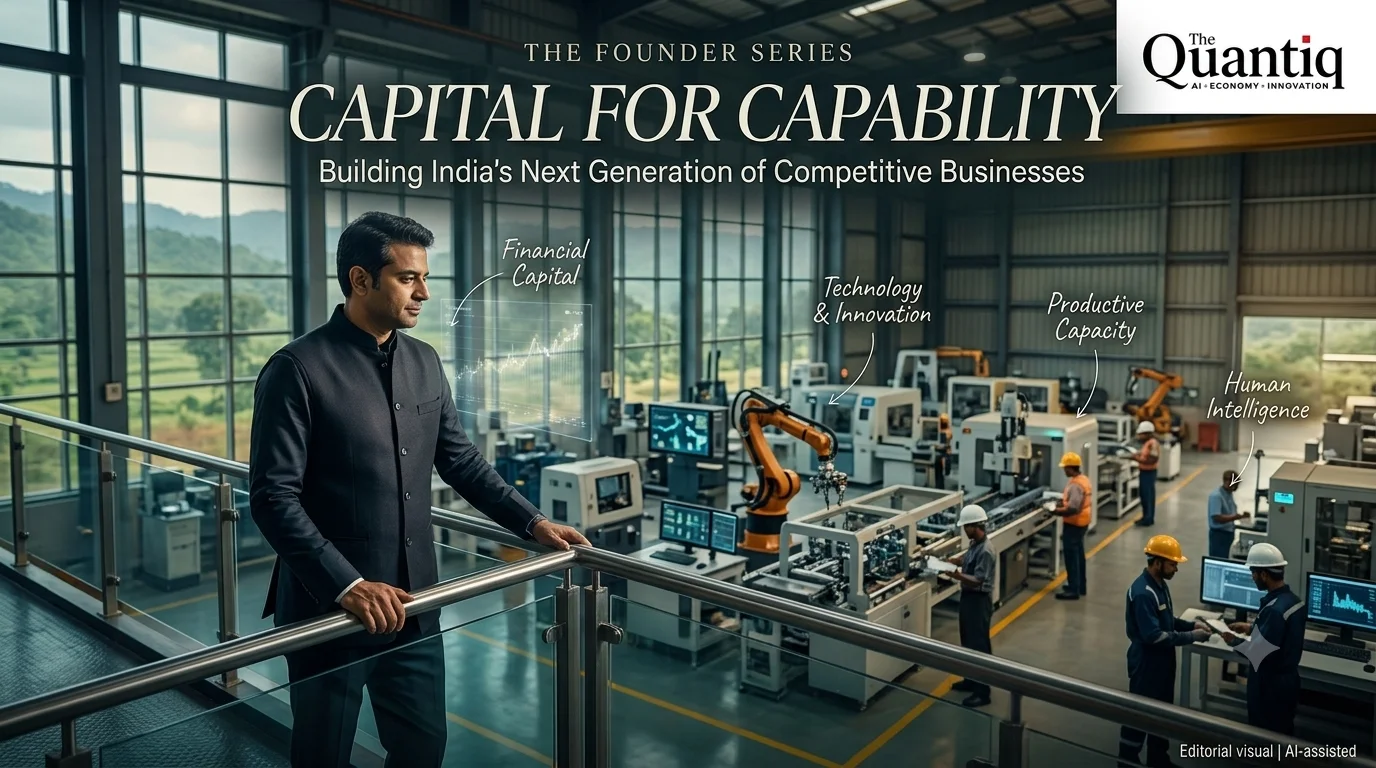
The next generation of competitive businesses will combine financial capital with knowledge, technology and human intelligence.
Northeast India: From investment potential to investable businesses
The investment conversation has particular significance for Northeast India.
Assam and the other northeastern states have considerable economic opportunities in agriculture, food processing, tea, bamboo, tourism, healthcare, sustainable materials and specialised manufacturing.
The region also has geographical advantages, distinctive natural resources and access to markets across India’s eastern neighbourhood.
Yet, potential alone does not attract investment.
Investors need commercially viable projects, dependable infrastructure, skilled manpower, reliable supply chains, market access and predictable operating conditions. They also need entrepreneurs who can demonstrate the ability to execute.
This is where the Northeast needs to make a transition: from presenting opportunities to developing investment-ready enterprises.
Take the region’s agricultural and forest-based resources. Selling raw materials may generate income, but processing, product development, quality certification, branding and market development can create substantially greater value.
The same applies to tea, bamboo and other traditional industries. The opportunity is not merely to produce more, but to develop differentiated products, improve production processes and reach premium domestic and international markets.
This will require investment in technology, research, skilled manpower and business development.
It will also require stronger connections between entrepreneurs, financial institutions, research organisations, government agencies and potential investors.
For the Northeast, attracting investment should not become an exercise in competing for attention. It should be about building businesses that make commercial sense.
The founder’s responsibility: Capital is not a business strategy
There is another side to this discussion that entrepreneurs must confront.
Raising investment is often celebrated as a major milestone. Funding announcements and valuations can create the impression that a business has already achieved something substantial.
But raising capital and building a successful enterprise are two different achievements.
A founder must know what the business intends to build, what problem it solves, who its customers are and how it will generate sustainable returns. More importantly, the founder must understand what additional capabilities the business needs to develop.
Capital should have a clear purpose.
Will it improve productivity? Develop a new product? Strengthen technology? Expand market access? Build a more capable workforce? Create intellectual property?
These are more meaningful questions than simply asking how much funding can be raised.
Investors, too, must look beyond short-term growth indicators. A business with strong fundamentals, disciplined management and a clear competitive advantage may create more enduring value than one pursuing expansion without a sustainable operating model.
The relationship between founders and investors must therefore be built on a shared understanding of long-term value creation.
The investment India needs
India’s next phase of economic growth will require more than an increase in available capital. It will require better alignment between investment, entrepreneurship, technology and productive capacity.
We need investment that strengthens manufacturing, supports research and innovation, improves productivity, develops skilled human resources and helps businesses compete in global markets.
For emerging regions such as the Northeast, this alignment could be transformative. But governments cannot create successful businesses on their own. Investors cannot manufacture entrepreneurial capability, and founders cannot build competitive enterprises without the right ecosystem.
Each has a role to play.
The real measure of investment should not be how much money enters a business, but what that business becomes capable of doing because the money was invested.
India’s next growth story will not be written by capital alone. It will be written by the capabilities that capital helps create.