
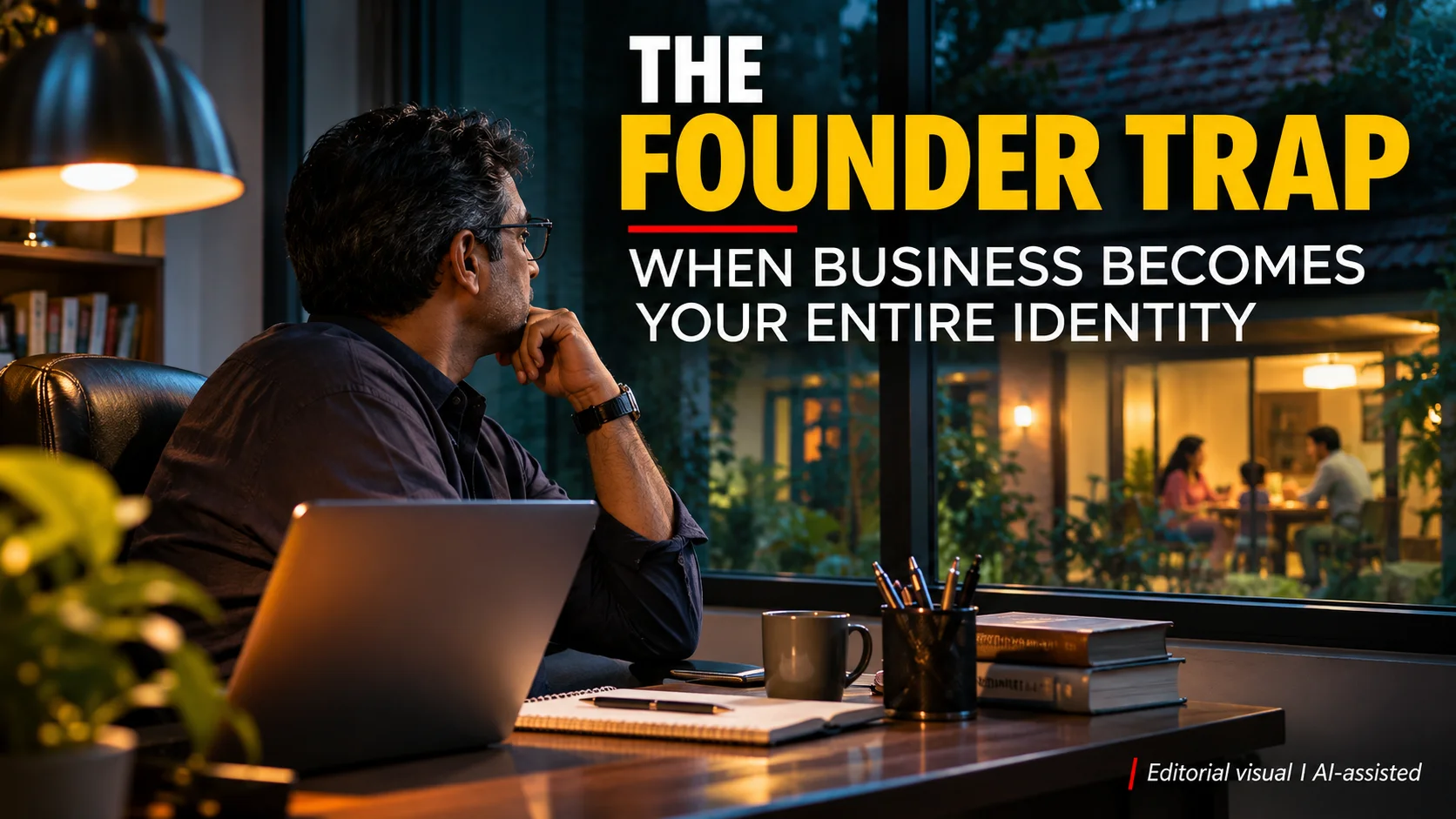
The Founder Trap: When Your Business Becomes Your Entire Identity
Entrepreneurship can give life purpose, independence and a sense of achievement. But when a founder’s identity becomes inseparable from the business, success can come at a cost that rarely appears on the balance sheet.
Ask an entrepreneur what they do, and the answer usually comes without hesitation. They will tell you the name of their company, the industry they operate in, the products they manufacture or the services they offer. Some might even tell you how many years they have spent building the business.
Now ask the same person who they are beyond their business. The answer may take a little longer.
There is a reason for that. Building a business is rarely just a commercial exercise. It is an intensely personal journey, particularly for someone starting from scratch. For a first-generation entrepreneur, it may represent years of financial uncertainty, personal sacrifice and the determination to prove that an idea can become something real.
The business might have started in a small rented room, a modest workshop, a home office or even at the dining table. The founder remembers the first customer, the first major order, the first employee and the first time the business managed to meet all its financial commitments. Every milestone becomes part of a personal story.
Over time, however, something interesting happens. The distinction between the individual and the enterprise begins to blur. The founder no longer simply runs the business. The business becomes an extension of their personality, ambitions and self-worth.
When sales rise, the founder feels successful. When an important customer walks away, it feels personal. When the business struggles financially, the setback can feel like a judgement on their own abilities.
This emotional investment is often what keeps an enterprise alive through difficult times. But it can also become a trap.
What happens when the business becomes so much a part of you that you can no longer imagine who you are without it?
When success becomes a personal identity
In the early days, there is often little distinction between working hours and personal time. A customer may call late at night. A supplier might need an urgent decision. An unexpected problem can disrupt an entire weekend.
The founder accepts this because the business needs attention. There may be nobody else to take responsibility, and the consequences of a wrong decision can be significant.
Initially, this level of involvement is understandable. The business is young, resources are limited and the founder may be responsible for everything from sales and procurement to managing employees and collecting payments.
But what happens when the business grows?
Even after hiring employees and managers, some founders continue to remain involved in almost every decision. They check messages during family gatherings, answer calls while travelling and find it difficult to switch off during holidays. A day without business activity can feel strangely unproductive.
A family outing may be accompanied by thoughts about an overdue payment. A dinner with friends can be interrupted by a customer complaint. Even a holiday becomes an opportunity to explore a new market or meet a potential business partner.
There is a difference between being committed to an enterprise and allowing it to occupy every part of one’s identity.
The difficulty is recognising when that line has been crossed. What begins as dedication can gradually become an inability to disengage.
Arianna Huffington’s wake-up call
One of the most widely discussed examples of the personal cost of relentless ambition is the experience of Arianna Huffington, co-founder of The Huffington Post.
In April 2007, while building the digital news organisation and raising her two daughters, Huffington was pushing herself through long working hours and chronic exhaustion. She had accepted the familiar idea that professional success required constant availability and personal sacrifice.
Then came a moment she would later describe as a turning point.
She collapsed from exhaustion and lack of sleep, struck her head on her desk and broke her cheekbone. What followed was a period of questioning the way she was living and the definition of success she had accepted.
In subsequent interviews, Huffington described how she had bought into the belief that she needed to sacrifice sleep and personal well-being to be a successful founder and mother. Her experience eventually influenced her writing, including her book Thrive, and the creation of Thrive Global, a company focused on well-being and changing workplace behaviour.
The incident was not simply about working too many hours. It exposed a deeper problem: the belief that constant exhaustion was evidence of commitment.
Huffington’s experience is a reminder that professional achievement and personal well-being need not be competing measures of success. Being permanently available does not necessarily make someone a better entrepreneur, a better leader or a better parent.
For founders who wear overwork as a badge of honour, her story offers a reason to reconsider what they are actually trying to achieve.
When the business becomes the only conversation
The consequences of this identity trap are not always visible in the workplace. Sometimes they emerge at home.
Imagine a founder sitting at the dinner table with family. The conversation turns to a child’s school admission, a holiday plan or a relative’s health. The founder participates, but their attention keeps returning to an unanswered customer message or a financial decision waiting to be made the next morning.
The family may be physically together, but the business occupies the founder’s mind.
Friends may notice something similar. Conversations increasingly revolve around the enterprise. A meeting with an old friend becomes an opportunity to discuss a possible business collaboration. A social gathering turns into networking. Even hobbies begin to be evaluated for their commercial potential.
This is not necessarily deliberate. Entrepreneurs are trained by experience to notice problems, identify gaps and look for opportunities. It is part of what makes them effective at building businesses.
But not every relationship needs to produce a business opportunity.
A friend should be able to remain a friend without becoming a prospective customer. A family conversation should not have to compete with a business meeting. A holiday should be allowed to remain a holiday.
The people closest to a founder may understand the pressures of entrepreneurship, but they also need the person behind the business to be present.
And perhaps this is one of the most overlooked costs of building a business: the possibility of being surrounded by people while gradually becoming unavailable to them.
The fear of becoming irrelevant
For some founders, stepping away is not simply a question of workload. It is a question of control, relevance and identity.
The business may have been built through personal relationships and years of individual effort. The founder knows the customers, understands the suppliers and remembers every important decision. They may genuinely believe that nobody else can protect the organisation with the same commitment.
But there may be another, less comfortable reason.
What happens when a capable manager takes over operations? What happens when employees begin making decisions independently? What happens when customers start dealing directly with the organisation rather than calling the founder?
These should be signs of organisational maturity. Yet some founders experience them as a loss of importance.
The business needs to evolve, but the person who built it may unconsciously resist the very changes that would make it stronger. Delegation becomes difficult. Succession is postponed. New leadership is viewed with suspicion. The founder remains at the centre of every decision, even when the organisation has grown beyond the need for such dependence.
There is a paradox here. The founder wants the business to grow, but may find it difficult to accept the changes that growth demands.
A business should benefit from its founder’s experience. It should not remain permanently dependent on the founder’s presence.
Yvon Chouinard: When the purpose becomes bigger than ownership
A very different perspective comes from Yvon Chouinard, founder of Patagonia, the American outdoor clothing company.
Chouinard began as a craftsman making climbing equipment for himself and his friends. Over nearly five decades, he built Patagonia into a globally recognised business, while developing a strong commitment to environmental responsibility.
In September 2022, he and his family announced an unusual change in the company’s ownership structure.
Rather than sell Patagonia or take it public, they transferred all its voting stock to the Patagonia Purpose Trust, created to protect the company’s values and mission. All non-voting stock went to the Holdfast Collective, a nonprofit organisation dedicated to addressing the environmental crisis and protecting nature.
The arrangement meant that the trust would safeguard the company’s purpose and governance, while the Holdfast Collective would receive the economic value associated with the non-voting shares. Profits not reinvested in the business would be distributed to support environmental causes.
Chouinard explained the thinking behind the decision in his September 2022 letter, titled Earth Is Now Our Only Shareholder.
The significance of this move goes beyond philanthropy. It raises an important question about what founders ultimately want to build.
For Chouinard, the business did not have to remain a vehicle for personal ownership or wealth accumulation. Its purpose could continue even as its ownership structure changed.
Not every entrepreneur will make a decision on this scale, nor should every business be expected to follow the same model. Patagonia is an unusual case, with its own history, financial position and ownership circumstances.
But the underlying idea is relevant to businesses of every size: a founder’s legacy need not depend on remaining in control forever. It can also be reflected in the values, people and institutions that continue the work.
Sometimes, the greatest achievement is not holding on to everything one has built, but creating something capable of enduring beyond one’s personal involvement.
The founder needs a life beyond the business
There is no universal formula for separating personal identity from professional ambition. Entrepreneurship demands commitment, and there will be periods when a business requires extraordinary attention. A new venture, a difficult financial year or a major expansion may leave little room for anything else.
The objective is not to reduce ambition or pretend that running a business is a nine-to-five activity. It is to ensure that the enterprise does not consume every other dimension of life.
That may begin with relatively simple decisions. Protecting time for family. Maintaining friendships that have nothing to do with business. Returning to an old hobby. Taking an occasional break without constantly checking the phone. Making space for interests that have no commercial purpose.
Founders also need to build organisations that do not require their involvement in every routine decision. Developing capable managers, delegating responsibility and planning for succession are not merely operational exercises. They allow the founder to reclaim time and create room for the next stage of personal and professional growth.
For first-generation entrepreneurs, this transition can be particularly meaningful. Many have spent years creating opportunities without an established family business or institutional support to fall back on. They have had to learn through experience, absorb setbacks and build credibility one customer at a time.
But the next milestone need not always be another branch, another product or another revenue target. It could be creating an organisation that functions well without constant intervention, developing people who can lead it and making time to pursue interests beyond the business.
Learning to step back is not necessarily a loss of ambition. It may be evidence that the business has matured.
Who are you when you are not the founder?
Entrepreneurship gives people an opportunity to build something that may outlast them. It can create employment, transform communities, support families and introduce products or services that make everyday life better.
But a business is something we build and nurture. It should not become the only thing that gives our lives meaning.
A founder is also a parent, a partner, a friend, a citizen and an individual with interests, relationships and aspirations beyond the balance sheet. Those identities deserve attention too.
A company can have a difficult year without its founder being a failure. A business can change ownership without erasing the founder’s contribution. A founder can step away from daily operations without losing relevance.
Perhaps one of the most important lessons of entrepreneurial maturity is learning to take pride in what the business has become without allowing its performance to determine the value of the person who built it.
The real achievement may be to reach a point where the business is strong enough to run without you, your relationships are strong enough to survive your professional demands, and you still have a sense of purpose when the working day ends.
After all, the business is a part of your life. It should not have to become your entire life.
So, here is a question every founder should occasionally ask: If your business disappeared tomorrow, what would remain of the person you are?





2 Comments