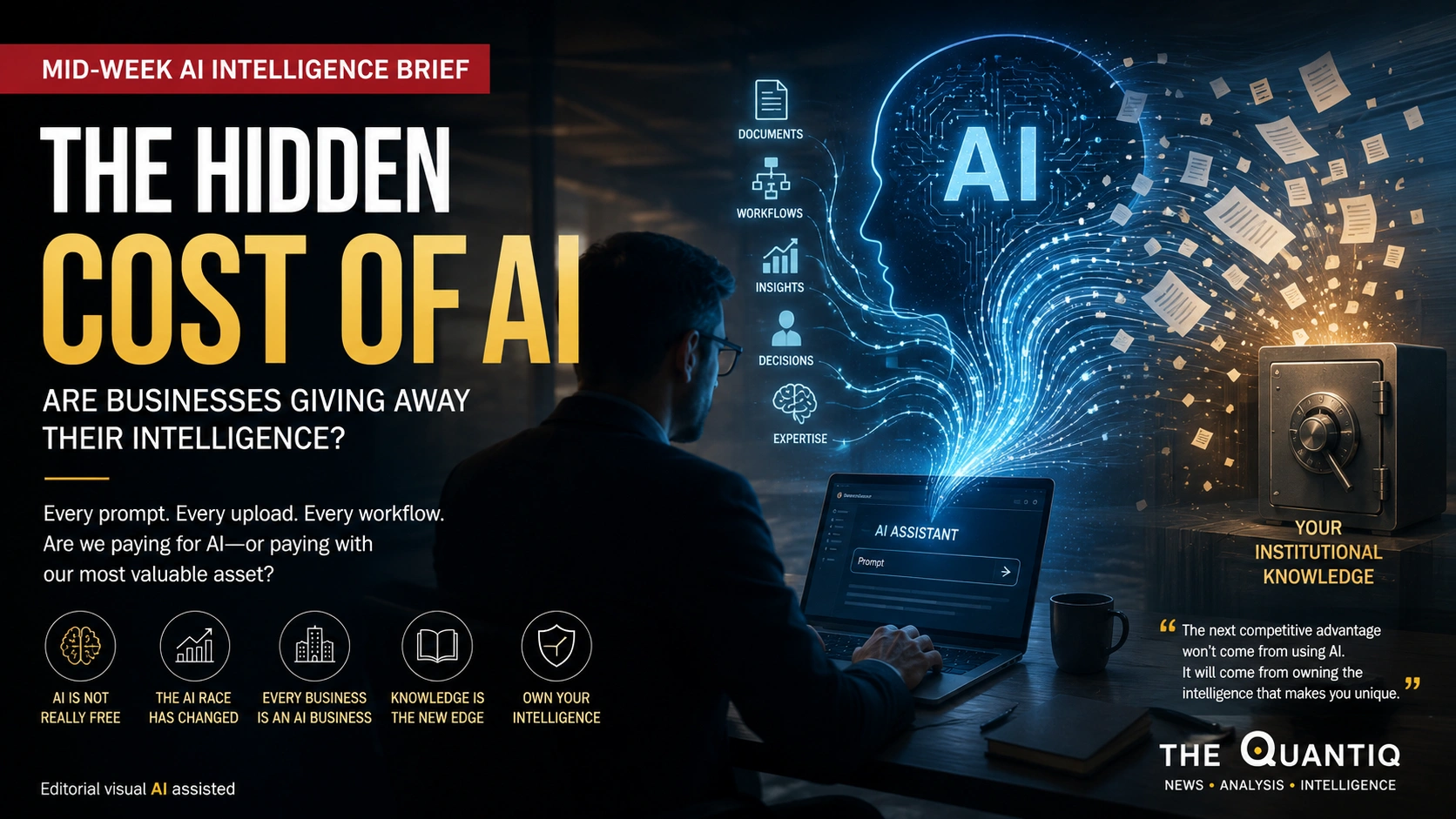
Mid-Week AI Intelligence Brief: Are We Quietly Giving Away Our Most Valuable Asset ?
Artificial intelligence has made our work faster than ever before. We draft emails in seconds, summarize lengthy reports, brainstorm ideas, generate code, and even conduct research with remarkable ease. Every new AI tool promises to save time and boost productivity, making it tempting to integrate them into almost every aspect of our professional lives.
Yet, as businesses enthusiastically embrace this new era, a different question is beginning to surface. While we celebrate what AI gives us, are we paying enough attention to what we may be giving back?
That question gained fresh relevance a few days ago when Microsoft Chairman and CEO Satya Nadella shared an intriguing observation on X. He described what he called the “Reverse Information Paradox”—the possibility that organizations may not only be paying for AI through subscriptions but could also be contributing valuable institutional knowledge through their prompts, workflows, corrections, and everyday interactions. Whether one agrees entirely with the premise or not, the idea has sparked an important conversation about the future economics of artificial intelligence.
Against this backdrop, this week’s Mid-Week AI Intelligence Brief explores five emerging realities that every business leader, entrepreneur, policymaker, and knowledge professional should begin thinking about.https://thequantiq.com/un-warns-ai-risks-india-ai-semiconductor-push/
AI Is Not Really Free
Most organizations adopted AI because the benefits were obvious. Teams could write faster, analyse information more efficiently, improve customer support, and automate repetitive tasks without making large investments in new infrastructure.
However, every interaction with AI carries context. Prompts reveal how an organization thinks. Corrections demonstrate expertise. Workflows reflect internal processes, while uploaded documents often contain years of accumulated experience. Enterprise AI platforms generally provide contractual privacy protections and, in many cases, do not use customer content to train their public models by default. Even so, organizations should remain thoughtful about what information they share and where their most valuable knowledge ultimately resides.
The real question is no longer how much AI costs. Increasingly, it is about understanding the true value of the knowledge that organizations contribute while using it.https://thequantiq.com/40-percent-jobs-ai-disruption-india/
The AI Race Has Quietly Changed
Only a year ago, the technology industry was obsessed with one question: which company had built the smartest AI model?
Today, that discussion feels increasingly incomplete. The competition is shifting towards something much bigger than benchmark scores.
Technology companies are investing heavily in secure cloud infrastructure, specialised AI chips, enterprise integration, developer ecosystems, governance, and trusted deployment. In other words, the race is moving from building impressive demonstrations to creating reliable AI infrastructure that businesses can depend upon every day.
History offers a familiar parallel. During the early years of the internet, attention centred on websites. Eventually, the real value shifted to the infrastructure, platforms, and ecosystems that powered the digital economy. AI now appears to be entering a similar phase.https://thequantiq.com/global-ai-race-infrastructure-not-chatbots/
Every Business Is Becoming an AI Business
Artificial intelligence is gradually becoming invisible.
Banks use it to detect fraud before customers notice anything unusual. Manufacturers optimise production schedules. Hospitals support clinicians with diagnostic insights. Farmers increasingly rely on AI for weather forecasts and crop management, while media organisations employ it to accelerate research, translation, and audience engagement.
Before long, calling a company an “AI company” may sound as outdated as calling it an “internet company.” AI is steadily becoming another layer of business infrastructure rather than a separate industry.
Consequently, competitive advantage will depend less on whether organisations use AI and more on how effectively they combine it with human judgement and domain expertise.
Knowledge Is Becoming More Valuable Than Data
For years, the technology industry repeated the phrase that “data is the new oil.”
While data remains enormously valuable, another asset is quietly becoming even more important: institutional knowledge.
Institutional knowledge is far more than information stored in databases. It includes editorial judgement, customer relationships, operating procedures, research methods, business intuition, and countless decisions shaped by years of experience. These are the qualities that distinguish one organisation from another and are often impossible to recreate simply by collecting more data.
As AI becomes increasingly capable of processing publicly available information, proprietary knowledge may become the defining competitive advantage for businesses across every sector.https://indiaai.gov.in/
The Next AI Winners Will Own Their Intelligence
Many organisations still view AI primarily as a productivity tool. That mindset, while understandable, may also be limiting.
The next generation of successful businesses is unlikely to depend entirely on external AI platforms. Instead, they will build their own knowledge infrastructure by preserving research, maintaining institutional memory, organising proprietary datasets, and continuously learning from their own operations.
Public AI can undoubtedly accelerate thinking, writing, coding, and analysis. However, an organisation’s accumulated knowledge should remain an asset that it deliberately protects and strengthens over time.
The distinction may appear subtle today, but it could become one of the defining strategic advantages of the AI economy.
The Quantiq Perspective
Satya Nadella’s observation is significant not because it introduces a new technology but because it highlights a new way of thinking about artificial intelligence.
The first phase of the AI revolution focused on creating increasingly capable models. The next phase will revolve around ownership, governance, trust, and the economic value of institutional knowledge. In that world, intelligence is no longer measured solely by what an AI system can generate. It is also measured by what an organisation chooses to preserve as uniquely its own.
For media organisations, research institutions, startups, and governments, this shift carries profound implications. Every article, interview, research project, customer interaction, and business decision contributes to an organisation’s collective memory. Over time, that memory becomes a strategic asset that cannot easily be replicated.
At The Quantiq, we believe AI should strengthen human intelligence rather than replace it. Public AI can help us research faster, analyse deeper, and communicate more effectively. However, our editorial judgement, regional expertise, research archives, and institutional understanding remain our most valuable assets.
The companies that merely consume AI will almost certainly become more productive. The organisations that combine AI with their own carefully cultivated knowledge ecosystems, however, are likely to build something far more enduring.
As the AI revolution enters its next chapter, the biggest competitive advantage may not belong to those who simply use the smartest AI. It may belong to those who continue to own the intelligence that truly makes them different.






3 Comments