

India’s Auto Industry in July 2026: Beyond the Sales Boom
July delivered record vehicle sales across India. But beneath the numbers, the automobile industry is undergoing a deeper transformation—from petrol dominance and mass motorisation towards multiple powertrains, premiumisation, electrification and a more globally connected manufacturing ecosystem.
India’s automobile industry had an extraordinary July. The country retailed 25.91 lakh vehicles, a 25.89% year-on-year increase, according to the Federation of Automobile Dealers Associations (FADA). For the first time, every major vehicle category recorded its best-ever July, while passenger-vehicle registrations crossed four lakh units.
Manufacturers saw an equally strong month. The Society of Indian Automobile Manufacturers (SIAM) reported domestic passenger-vehicle dispatches of 4,57,810 units, up 34.3% from July 2025 and the highest July wholesale volume on record.https://www.siam.in/hrspsubmit.aspx
The easy conclusion is that India’s auto market is booming.
The more interesting conclusion is that India’s mobility market is changing shape.
July was not just a record month
The breadth of July’s growth is significant. FADA reported record July retail volumes across two-wheelers, three-wheelers, passenger vehicles, commercial vehicles, tractors and wheeled construction equipment. That suggests the momentum was not confined to urban car buyers but reflected a broader improvement in mobility demand across consumers, businesses and rural markets.
Yet volume alone does not tell the full story.
Passenger vehicles are increasingly being driven by SUVs and higher-value models, while consumers are simultaneously experimenting with CNG, hybrids and electric vehicles. The result is an automobile market that is becoming more valuable, but also more fragmented by technology.
That may be the more important story emerging from July.
The petrol car is losing its old dominance
Perhaps the most revealing number came from the passenger-vehicle powertrain mix.
FADA data showed that CNG, hybrid and electric vehicles together accounted for 40.59% of passenger-vehicle retail sales in July, compared with 41.68% for petrol-powered vehicles. A year earlier, petrol’s share was 47.6%.
This is not simply an EV story.
The Indian consumer is choosing among several alternatives. CNG continues to appeal because of running costs, hybrids offer efficiency without charging dependence, while EVs are becoming increasingly viable as products and infrastructure improve.
India’s transition, therefore, may not follow a simple petrol-to-EV path. It is more likely to be a multi-powertrain transition, with consumers making choices based on price, running costs, infrastructure, reliability and geography.
That makes India’s mobility transformation considerably more complex—and potentially more interesting—than the conventional electric-vehicle narrative suggests.
E20 has introduced an unexpected fault line
July also brought a controversy that could influence consumer behaviour well beyond fuel policy.
The industry’s concerns over E20 petrol moved from a technical discussion into a national debate after SIAM submitted, and subsequently withdrew, a communication concerning possible fuel contamination and its impact on vehicle components. The issue intensified this month after Reuters reported internal communications involving major automakers, including Maruti Suzuki, Tata Motors and Mahindra, concerning chloride and moisture levels found in fuel samples.
The issue needs careful handling because fuel compatibility and fuel contamination are not the same thing. The central question is whether fuel quality, storage practices, vehicle technology and the country’s ethanol-blending ambitions are evolving at the same pace.
There is also a consumer-confidence dimension.
At a time when CNG, hybrids and EVs are already gaining ground, uncertainty surrounding E20 could encourage some buyers to reconsider their powertrain choices. Whether that becomes a lasting market effect remains to be seen, but July has made the question impossible to ignore.
EVs are moving beyond the niche
Electric mobility is simultaneously gaining momentum.
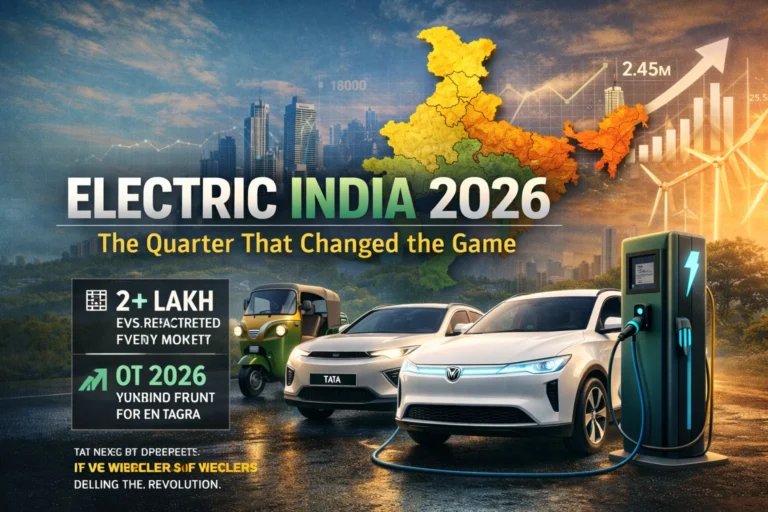
FADA’s July data put total electric-vehicle retail sales at 3,27,901 units, an all-time monthly high. Electric two-wheelers alone crossed 1.73 lakh registrations, with TVS Motor, Bajaj Auto and Ather among the leading players.https://fada.in/
What matters now is not whether EVs will grow. They almost certainly will.
The bigger question is whether the industry can move from early adoption to mass-market economics, supported by better products, charging infrastructure, batteries, financing and domestic component manufacturing.https://thequantiq.com/india-electric-vehicle-revolution-energy-security/
The competitive landscape is already changing. Established manufacturers are expanding electric portfolios while new-age companies continue to challenge traditional market structures.
India’s EV story has therefore entered a second phase: from proving demand to building scale.
The hidden vulnerability is under the bonnet
There is, however, a less visible side to India’s automobile success.
The country’s auto-component industry grew strongly in FY2026, but imports grew faster than exports. ACMA data reported in July showed component imports rising 13%, with China accounting for around 36% of India’s auto-component imports, while overall exports grew only about 5%. This creates an important contradiction.
India is producing and selling more vehicles, but a significant part of the value embedded in those vehicles still depends on global supply chains.
The challenge becomes even more important as vehicles become increasingly electronic and software-defined. Batteries, power electronics, semiconductors, sensors and other advanced components will determine how much value India ultimately captures from the mobility transition.
Manufacturing more vehicles is one ambition. Building the technology stack behind those vehicles is another.
From domestic market to global mobility hub
India’s growing automobile market also has an increasingly international dimension.
Indian two-wheeler manufacturers are already major exporters, while the country is seeking new trade opportunities for automobiles and components. The revival of India-SACU trade negotiations in August is particularly relevant, as automobiles and machinery are among India’s key exports to the five-member Southern African Customs Union.
This creates an opportunity to combine India’s enormous domestic market with export scale.
If India can simultaneously strengthen its component ecosystem, develop advanced automotive technologies and expand access to global markets, the automobile industry could become one of the country’s most important bridges between consumption and manufacturing.
What July really tells us
The Indian automobile story is no longer simply about getting more vehicles onto the road.
It is becoming a story about what kind of vehicles Indians choose, what technology powers them, where their components come from and whether the country can turn domestic demand into global manufacturing strength.
July brought record sales. But the more consequential development was the simultaneous movement in several directions: SUVs and premium vehicles are gaining ground, alternative powertrains are approaching petrol’s share, EVs are scaling, E20 is creating new questions, and component imports remain a structural vulnerability.
That makes July more than another record month.
The Quantiq view
India may be entering a new phase of mobility.
The first phase was motorisation. The second was premiumisation and SUVisation. The next could be mobility diversification, where petrol, CNG, hybrid, diesel and electric technologies coexist while manufacturers compete not only for Indian consumers but also for global markets.
The real test for FY2027 will therefore not be whether India sells more vehicles.
It will be whether India can capture more of the technology, components, intellectual property and export value created by those vehicles.
The sales boom is visible. The transformation underneath it is the story worth watching.https://thequantiq.com/india-small-cars-comeback-auto-industry-june-2026/


One Comment