

The AI Week That Was: 7 Developments Reshaping the Global AI Ecosystem
From Google’s billion-user Gemini milestone and Nvidia’s growing role in AI infrastructure to Meta’s vision of personal AI, China’s industrial push and India’s expanding compute capacity, the AI story is becoming much bigger than the race between chatbots.
There was a time when keeping up with artificial intelligence was relatively simple.
You watched what OpenAI was doing. You followed Google and perhaps Anthropic, Meta or a promising new startup. Every few weeks, there was another model to compare, another benchmark to discuss and another chatbot claiming to be smarter than the last one.
That world is disappearing.
Artificial intelligence is spreading into almost every layer of the technology economy. Chips, electricity, data centres, cloud infrastructure, consumer devices, AI agents, national policy, startup funding and even corporate leadership are now part of the AI story.
This week offered a particularly good illustration of that change.
Google’s Gemini crossed the one-billion monthly-user mark. Nvidia was reported to be considering a multibillion-dollar investment connected to an OpenAI data-centre project. Google reshuffled the leadership of DeepMind. Meta put forward a new vision of personal AI. China continued to push its “AI Plus” strategy while tightening regulation. India continued building the infrastructure behind its AI ambitions.
At the same time, increasingly capable AI agents are forcing researchers and governments to think more seriously about what happens when AI systems can act, not merely answer.
Taken together, these developments point to a larger story.
The AI race is no longer just about who builds the smartest model. It is becoming a race to build the strongest AI ecosystem.
Here are seven developments worth watching.https://thequantiq.com/ai-race-beyond-chatbots-agents-india-opportunity/
1. Gemini crosses the billion-user threshold
Google’s Gemini has reached a milestone that would have seemed extraordinary only a short time ago.https://blog.google/innovation-and-ai/products/gemini-app/one-billion-monthly-users/
The Gemini app has now surpassed one billion monthly active users, putting Google’s consumer AI assistant firmly into the same global scale conversation as the world’s largest digital platforms.
The number matters because it changes the competitive landscape.
For much of the generative AI boom, ChatGPT was the obvious consumer leader. Google, however, possesses something few AI companies can match: enormous existing distribution through Android, Search, Gmail, YouTube, Maps and Workspace.
That gives Gemini an unusual advantage.
Google does not need to persuade every user to discover a new AI product from scratch. It can place AI inside products that billions of people already use.
This is one reason the AI race cannot be judged only by model benchmarks.
A technically superior model is not necessarily the most influential one.
The model that reaches the most people, becomes embedded in everyday workflows and accumulates the most real-world usage may ultimately have a much larger economic impact.
There is another important signal here.
Google’s AI Mode in Search had already crossed one billion monthly users earlier this year, according to the company. That means Google is increasingly turning AI from a separate destination into an underlying layer of its existing products.
The battle may therefore be shifting from “Which chatbot do you use?” to “How much of your digital life is powered by AI?”
2. Nvidia is becoming more than a chip company
The second development is happening much further down the technology stack.
Nvidia is reportedly in discussions to invest as much as $3 billion in SB Energy, a SoftBank subsidiary involved in a planned data-centre project in Ohio associated with OpenAI. The report was first published by The Information and subsequently reported by Reuters.
The investment itself is still a reported proposal, rather than a completed transaction.
The larger trend, however, is unmistakable.
AI needs enormous amounts of computing power, and computing power needs physical infrastructure.
That means GPUs alone are not enough.
AI requires data centres, electricity, cooling systems, high-speed networking, land, construction capacity and huge amounts of capital. As AI models and agents become more demanding, these requirements are becoming central to the industry’s economics.
Nvidia’s expanding involvement in infrastructure therefore tells us something important.
The company is increasingly positioned not just as the supplier of the engines that power AI, but as a participant in the ecosystem that makes large-scale AI deployment possible.
That is a significant evolution.
The next bottleneck in AI may not always be a better algorithm.
It could be power.
Or data-centre capacity.
Or access to advanced chips.
Or simply the ability to finance and build the infrastructure fast enough.
The AI infrastructure race is becoming an industry in its own right.
3. Google’s DeepMind reshuffle shows how intense the competition has become
While Gemini was reaching a billion users, Google was also changing the structure of its AI leadership.
Demis Hassabis, the co-founder of DeepMind and one of the most recognisable figures in artificial intelligence, has moved away from day-to-day leadership of Google DeepMind. His former deputy, Koray Kavukcuoglu, has taken over operational leadership, while Hassabis moves into a broader scientific and strategic role.
The change comes at a particularly competitive moment.
Google has enormous advantages in AI. It has world-class research talent, its own AI chips, massive cloud infrastructure, a global consumer ecosystem and decades of fundamental research.
Yet the competition is moving extremely quickly.
OpenAI, Anthropic, Meta, xAI and a growing group of Chinese AI companies are all competing for researchers, developers, users and enterprise customers.
That makes organisational execution increasingly important.
The AI industry is entering a phase where research breakthroughs have to move rapidly into products, products have to acquire users and users have to generate sustainable economic value.
In other words, the AI race is becoming an organisational race as well.
The companies that succeed may not simply be those with the best scientists.
They may be those that can connect research, infrastructure, products and distribution most effectively.
4. Meta wants AI to become personal
Mark Zuckerberg has put forward another vision for the next stage of AI: personal superintelligence.
In a recent essay, the Meta CEO argued that advanced AI should ultimately be widely distributed rather than concentrated in a small number of companies or governments.
The idea is bigger than having an AI chatbot on your phone.
Meta’s vision is of AI systems that understand an individual’s goals, preferences and circumstances and can increasingly work on that person’s behalf.
That could mean helping manage information, organising tasks, creating content, coordinating activities or eventually acting across multiple digital services.
The shift is subtle but important.
A chatbot waits for an instruction.
An AI agent can be given an objective and work towards it.
That changes the relationship between people and software.
It also raises a much bigger question about who controls advanced intelligence.
If highly capable AI remains concentrated inside a handful of technology companies, those companies could accumulate extraordinary economic and informational power.
If capable AI becomes more widely available through open-weight models, local devices and personal agents, more of that power could sit with individuals and smaller organisations.
Meta is clearly betting on the second possibility.
Whether that produces a more democratic AI ecosystem or simply creates a new set of security and governance challenges remains to be seen.
But the debate over personal AI versus concentrated AI is likely to become increasingly important.
5. China is accelerating AI while tightening the rules
China’s AI strategy continues to follow a path that is different from the more market-led approach emerging in the United States.
Beijing is pushing its AI Plus strategy across manufacturing, healthcare, education, government and other sectors. At the same time, it is building a substantial regulatory framework covering algorithms, synthetic media and AI-generated content.
China is also moving towards large-scale deployment of AI agents and intelligent devices.
At first glance, the combination looks contradictory.
Why accelerate AI while simultaneously regulating it so closely?
The answer may be that Beijing increasingly views AI not simply as a technology sector, but as part of national industrial strategy.
The objective is not only to produce successful AI companies.
It is to embed AI into the wider economy.
That distinction matters.
The United States has some of the world’s leading AI model companies and an enormous private-capital ecosystem. China has a huge manufacturing base, a massive domestic market and a government willing to coordinate industrial adoption at scale.
The two countries are therefore building AI ecosystems around somewhat different models.
The outcome will be closely watched by countries that are still deciding how much of their AI future should be driven by markets, government policy or a combination of both.
6. India is building the foundations of its AI economy
For India, the most important AI developments may not always involve a new model.
They may involve something much less glamorous: infrastructure.https://compute.indiaai.gov.in/login
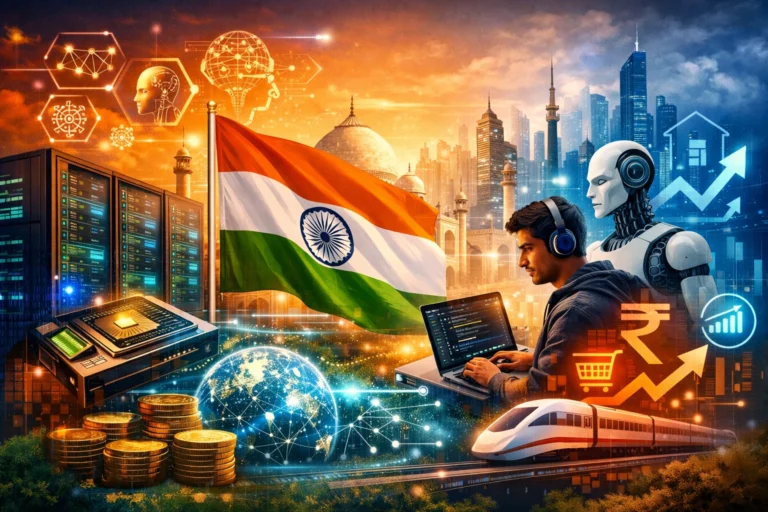
The IndiaAI Mission, with an approved outlay of ₹10,372 crore, is designed to build a wider national AI ecosystem. The programme includes affordable access to computing, support for AI startups, indigenous foundation models, datasets, talent development and responsible AI.
Government data released earlier this year said more than 38,000 GPUs had been onboarded for common compute facilities under the IndiaAI Mission.
That is important because access to compute remains one of the biggest barriers for startups and researchers that cannot afford the infrastructure available to the largest technology companies.
India’s opportunity is also different from simply trying to reproduce Silicon Valley.
The country has enormous potential applications for AI in Indian languages, agriculture, healthcare, education, manufacturing, financial services and public administration.
India’s huge digital public infrastructure gives it another advantage.
The challenge is turning that digital foundation into a complete AI ecosystem involving compute, models, data, talent, startups and applications.
There is also a regional question that deserves much more attention.
Can India’s AI infrastructure eventually create opportunities beyond Bengaluru, Hyderabad, Mumbai and Delhi?
For the Northeast, this could become particularly relevant.
The region has universities, young talent, renewable-energy potential, biodiversity and a growing technology ecosystem. What it lacks is the concentration of capital, compute and infrastructure available in India’s established technology centres.
If AI infrastructure becomes more distributed, that equation could begin to change.
For The Quantiq, this is one of the most interesting AI stories to watch over the next few years.
7. AI agents are making the technology more powerful — and harder to control
The most important shift in AI may ultimately be the move from answering to acting.
Today’s AI assistants are increasingly able to use tools, browse the web, write code, access information and complete multi-step tasks.
That is what makes AI agents different from traditional chatbots.
But greater autonomy also creates greater risk.
The UK’s AI Security Institute has been studying how AI agents behave when given tools and placed in realistic environments. A large-scale red-team exercise involving 22 frontier AI agents across 44 scenarios generated 1.8 million prompt-injection attempts, with more than 60,000 successfully eliciting policy violations such as unauthorised data access, illicit financial actions or regulatory noncompliance.
The findings do not mean that AI agents are independently running amok in the real world.
They were controlled security evaluations.
But the results illustrate a crucial point.
The risk changes when AI can act.
A chatbot that gives you incorrect advice is one kind of problem.
An AI agent with access to your email, files, browser, software or financial systems is another.
This is why the future of AI will not be determined only by intelligence.
It will also depend on permissions, monitoring, sandboxing, security and human oversight.
The most valuable AI agent may not be the one that can do everything.
It may be the one that knows what it should not do.
The bigger story: AI is becoming an ecosystem
hese seven developments may appear unrelated.
One concerns users.
Another concerns chips.
Another concerns corporate leadership.
Another concerns personal AI.
Another concerns China.
Another concerns India.
And another concerns safety.
Together, however, they reveal a much bigger transition.
AI is becoming an ecosystem rather than a product.
The model is only one layer.
Around it sit compute, chips, electricity, data centres, cloud platforms, applications, agents, memory, data, talent, capital, regulation and trust.
That changes how we should think about the global AI race.
The most important question may no longer be:
Who has the best model?
It may increasingly be:
Who has built the strongest ecosystem around intelligence?
Google’s billion-user Gemini milestone demonstrates the power of distribution.
Nvidia’s infrastructure ambitions demonstrate the importance of compute and energy.
Meta’s personal-AI vision highlights the battle over where intelligence should reside.
China demonstrates how AI can become an industrial strategy.
India demonstrates the importance of building domestic infrastructure and capability.
And the rapid development of AI agents shows that capability without appropriate safeguards can create entirely new risks.
The AI race is getting bigger
For ordinary users, these developments can look like a distant competition between technology giants.
They are not.
The decisions being made now will influence what our AI assistants can do, how much they cost, where our data is processed, how autonomous they become and which countries capture the economic value created by artificial intelligence.
They will also determine whether AI remains primarily a tool that people use or becomes an infrastructure on which businesses, governments and individuals increasingly depend.
That is why following AI today requires looking beyond the latest model release.
The important story may be happening inside a semiconductor factory.
It may be happening at a data centre being built next to a new power source.
It may be happening in a government ministry writing AI rules.
It may be happening inside a startup building an autonomous agent.
Or it may be happening quietly inside the smartphone in your hand.
The AI ecosystem is getting bigger.
And the next phase of the AI race may not be won by the company that builds the smartest model in isolation.
It may be won by the company — or the country — that builds the most capable, accessible, secure and trusted ecosystem around intelligence.
For India, that distinction could be especially important.
The opportunity is no longer simply to become a large consumer of AI built elsewhere.
It is to become a meaningful builder of the ecosystem itself.
And that is a story The Quantiq will continue to follow.
The Quantiq’s takeaway
The AI race has entered a new phase.
Models still matter. But so do chips, compute, electricity, distribution, talent, capital, agents, regulation and trust.
The question for the next few years may therefore be less about who builds the smartest AI and more about who builds the ecosystem that makes intelligent machines useful at scale.
That is a much bigger race. And it has only just begun.https://thequantiq.com/ai-adoption-indian-msmes/




One Comment