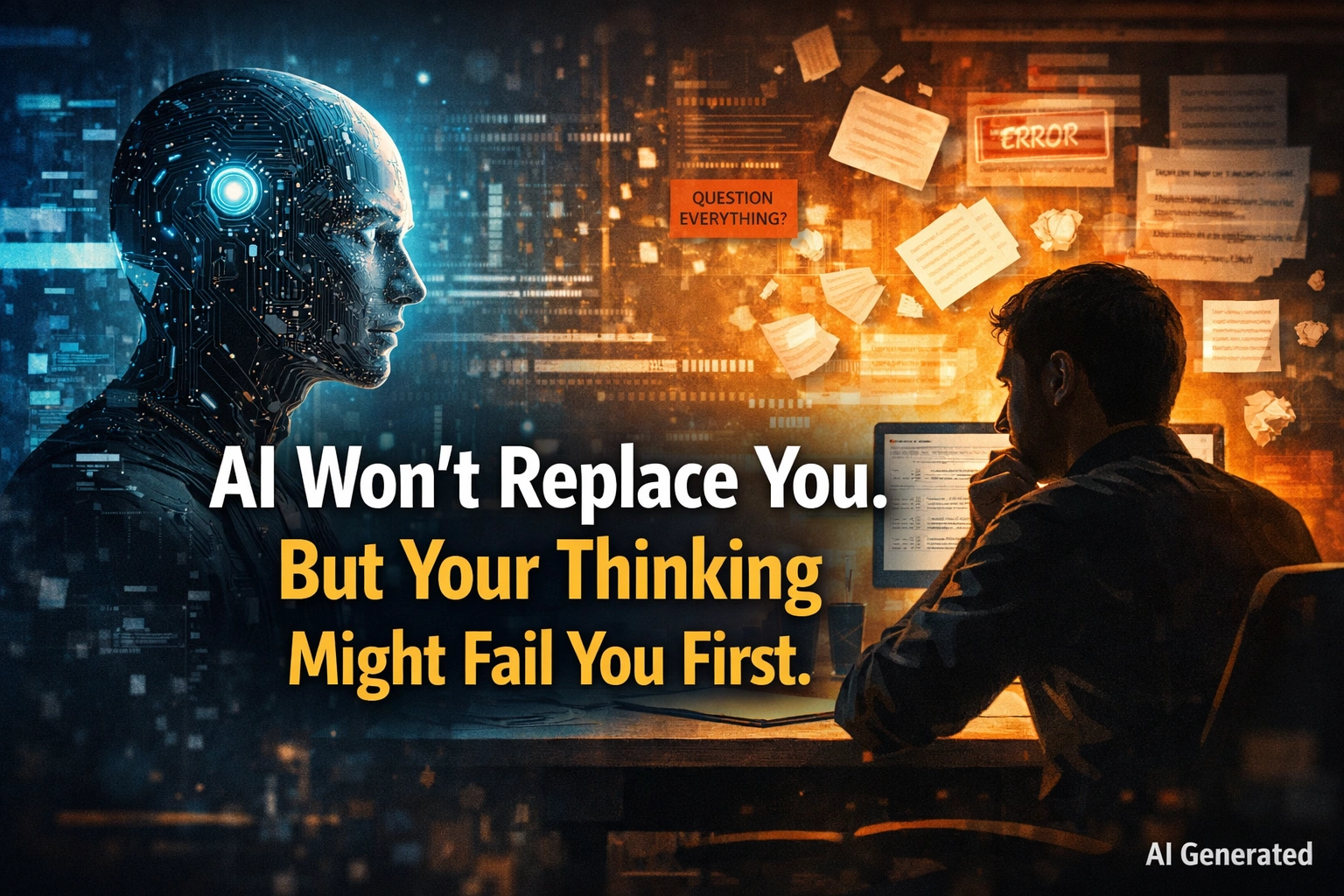
AI Won’t Replace You. But Your Thinking Might Fail You First.
There is a growing illusion in the AI era—one that is spreading faster than the technology itself.
That illusion is this: learning AI tools is enough. It isn’t.
In fact, it may be the most dangerous half-truth of our time.
Across industries, people are rushing to master prompts, explore platforms like ChatGPT, Gemini, and Claude, and build stacks of tools that promise speed, automation, and scale. Courses are being sold. Templates are being shared. “Top 50 AI tools” lists are everywhere.
But beneath all this activity lies a quieter, more uncomfortable truth:
AI does not reward tool knowledge.
AI rewards thinking.
The Amplifier Effect
Artificial Intelligence is not intelligence in the human sense. It does not understand; it predicts. It does not know; it generates. AI is an amplifier.
If your thinking is shallow, AI will scale that shallowness. If your thinking is sharp, AI will multiply your effectiveness. This is why two people using the same tool can produce radically different outcomes. The difference is not the tool. The difference is the mind behind it.
The Collapse of Blind Trust
One of the most overlooked risks of AI adoption is not job loss. It is judgment erosion.
When users begin to accept outputs without questioning, errors stop looking like errors. Assumptions slip through unnoticed. Mediocrity starts wearing the mask of insight. AI hallucinations are not just technical flaws; they are tests of human awareness. Without critical thinking, AI does not just make mistakes—it makes convincing ones.
Why Domain Expertise Still Matters
There is a growing narrative that AI will make expertise irrelevant. That a beginner with the right prompts can outperform a seasoned professional.
It is a seductive idea, and it travels fast. But it is dangerously incomplete.
AI can simulate expertise, but it cannot replace lived understanding. A domain expert sees what AI often misses. Context. Subtlety. Consequence. The invisible edges where real-world decisions live. Without that lens, users often do not even realize when AI is wrong.
And that is the real risk—not bad answers, but undetected bad answers.
The New Divide: Not Access, But Awareness
In the coming years, access to AI will not be the differentiator. These tools will become cheap, embedded, and everywhere.
The real divide will not be technological. It will be cognitive.
It will separate those who question from those who accept, those who think from those who merely prompt, those who understand from those who simply generate.
The Real Formula
The winners in the AI era will not be those who know the most tools. They will be those who understand how to think with tools.
Because the equation is simple, even if its implications are not:
AI multiplied by thinking creates leverage.
AI without thinking creates noise at scale.
A Quiet Warning
There is a temptation to move faster simply because AI allows it. To publish more, produce more, automate more.
But speed without judgment is not progress. It is acceleration without direction.
And in a world where everyone can generate, the rarest skill will not be creation.
It will be discernment.
Closing Thought
AI will not replace you. But it will expose you. It will reveal whether you are thinking—or merely operating. And in that revelation lies the real disruption.https://thequantiq.com/ai-digital-communication-brand-visibility-aeo-geo/