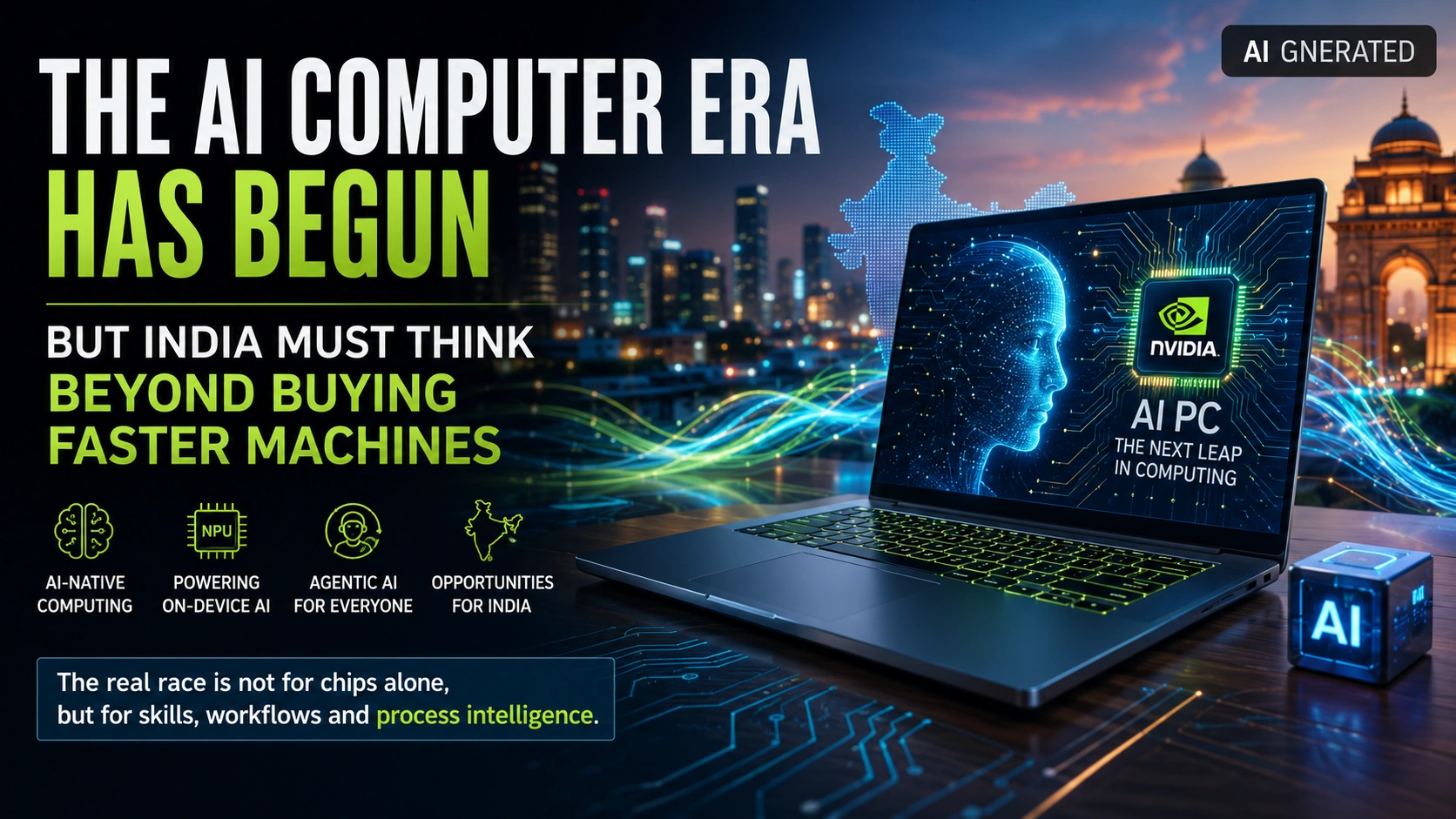
The AI Computer Era Has Begun — But India Must Think Beyond Buying Faster Machines
The personal computer has reinvented itself many times. From bulky desktop machines built for word processing and spreadsheets, PCs evolved into multimedia devices, gaming powerhouses, and gateways to the internet age. Yet for much of the last decade, the industry struggled to rediscover its original sense of excitement. Smartphones captured attention, cloud platforms absorbed workloads, and the PC became a utility rather than a frontier.
That changed on June 1, 2026. At the Computex trade show in Taipei, Nvidia CEO Jensen Huang unveiled the RTX Spark Superchip — a new class of AI-native processor that the company co-developed with Microsoft and MediaTek. His opening declaration left little room for ambiguity: “Microsoft and Nvidia are going to reinvent the PC.”
The statement sounds bold. However, beneath the corporate language lies a development that deserves attention far beyond technology circles. What Nvidia and its partners are pursuing is not merely a faster computer. They are attempting to redefine what a personal computer actually does.
What Exactly Is the RTX Spark — and Why Does It Matter
The RTX Spark Superchip is Nvidia’s first serious entry into the personal computer processor market, a space long dominated by Intel, AMD, Qualcomm, and Apple. However, it is not simply another competitor chip. Its architecture represents a fundamental departure from how personal computers have been designed for the past four decades.
The chip combines three components on a single platform: a 20-core Nvidia Grace CPU based on the Arm architecture, a Blackwell RTX GPU with 6,144 CUDA cores and fifth-generation Tensor Cores, and up to 128GB of unified LPDDR5X memory shared across both processors. These components are connected through Nvidia’s NVLink chip-to-chip interconnect, which eliminates the memory bottleneck that has historically slowed AI workloads on personal devices.
The result is a chip capable of 1 petaflop of FP4 AI compute — enough to run large language models, generate images, process voice, and execute multi-agent AI workflows entirely on the local device, without cloud dependency.https://thequantiq.com/india-315-billion-tech-sector-northeast-ai-economy/
RTX Spark Superchip: Key Specifications
| Specification | Detail |
| Chip Name | Nvidia RTX Spark Superchip (code name: N1X) |
| CPU | 20-core Nvidia Grace (Arm Cortex-X925 + A725) |
| GPU | Blackwell RTX — 6,144 CUDA cores, 5th-gen Tensor Cores |
| AI Performance | 1 petaflop (FP4 precision) |
| Unified Memory | Up to 128GB LPDDR5X at 300 GB/s bandwidth |
| NPU | 40 TOPS — Microsoft Copilot+ compliant |
| Co-developed with | Microsoft and MediaTek |
| Launch Partners | Microsoft, Dell, HP, ASUS, Lenovo, MSI (Fall 2026) |
| Announced | Computex 2026, Taipei — June 1, 2026 |
| Architecture | TSMC 3nm, Windows on Arm platform |
From Cloud AI to Personal AI: Why the Shift Is Real
Until recently, artificial intelligence largely lived in the cloud. When users interacted with systems like ChatGPT, image generators, or AI-powered productivity tools, the heavy computation happened in distant data centres. The user’s device served merely as a window into these systems.
That model is now evolving, and the RTX Spark is a hardware expression of that evolution. AI processing is moving closer to the user — a transition described as edge AI or on-device AI. Instead of depending on remote servers, devices built on the RTX Spark can process large portions of AI tasks locally. This shift matters for three specific reasons.
Speed and responsiveness: Tasks such as image generation, voice processing, translation, and document analysis can happen with lower latency when the computation occurs on the device itself rather than travelling to a server and back.
Privacy and data control: Sensitive data — medical records, financial information, personal communications — remains on the personal device rather than being transmitted continuously across cloud networks. This matters both for individuals and for regulated industries.
Offline capability: AI tools that depend entirely on internet connectivity struggle in bandwidth-constrained environments. The RTX Spark’s 1 petaflop of local compute means AI capability does not require a reliable connection — a point of direct relevance to large parts of India and the Northeast.
Nvidia is not alone in this direction. However, the RTX Spark’s co-development with Microsoft gives it a structural advantage — Microsoft has specifically optimised Windows 11 for the RTX Spark’s workload scheduling, creating deep operating system integration that competing chips will find difficult to replicate quickly.
The Rise of Agentic AI: When the Computer Becomes a Colleague
The RTX Spark is positioned specifically for what Nvidia calls the era of personal AI agents. Understanding what this means in practice is more important than understanding the chip’s specifications.
Agentic AI refers to systems capable of taking initiative, managing multi-step tasks, and acting as intelligent assistants rather than passive tools that wait for instructions. The distinction from conventional AI is significant. A conventional AI answers a question. An agentic AI understands a goal, breaks it into sub-tasks, executes them using available tools, evaluates its own output, and refines it — repeatedly, autonomously, and locally.
Jensen Huang framed this at Computex with a specific observation: for roughly 40 years, the way humans interact with computers has looked the same — keyboard, mouse, screen, repeat. The RTX Spark is built for a different model. Instead of clicking through menus or memorising commands, users state what they want. The AI agent handles the doing.
Consider the practical implications. A creator editing video could have AI automatically manage timelines, generate captions, and optimise distribution workflows. A researcher could ask an AI system to compare reports, extract insights, and prepare structured summaries. A small business owner might rely on AI to draft communications, analyse accounts, and monitor customer interactions. The computer transforms from a machine we operate into a collaborative system that participates in work.
Nvidia Is Not Alone — and That Is Good News
Microsoft is a co-development partner on the RTX Spark itself, not merely a customer. Microsoft has optimised Windows 11 specifically for the chip’s architecture and has announced the Surface Laptop Ultra as a launch device. This level of operating system integration is unprecedented for a non-Intel or non-Apple processor in the Windows ecosystem.
However, Nvidia enters a competitive field. Intel and AMD are advancing their own AI PC chip architectures simultaneously. Qualcomm’s Snapdragon X2 and AMD’s Ryzen AI Max are direct competitors to the RTX Spark in the AI PC segment. Apple’s M-series chips on macOS have already demonstrated that local AI processing at this scale is commercially viable and consumer-ready.
The competition is consequently healthy for consumers and for the broader AI PC transition. Multiple credible players competing on AI PC performance accelerates the hardware cycle, drives down prices, and creates a diverse ecosystem of AI-native devices at different price points. The RTX Spark’s RTX 5070-level graphics performance at significantly lower power consumption may give it a distinctive position in the premium laptop segment specifically.
India and Northeast India: The Real Race Is Not for Machines
For India, the AI PC transition raises both opportunities and uncomfortable questions. The country possesses extraordinary digital energy, a growing startup ecosystem, and a youthful population increasingly familiar with technology. Yet AI preparedness remains uneven, and the gap between device ownership and genuine capability is widening.
Much of the public conversation around artificial intelligence still oscillates between excitement and anxiety — fears of job loss, fascination with viral tools, or confusion about what AI genuinely means in practical work. Owning an AI-enabled device does not create meaningful advantage. Capability does. The arrival of the RTX Spark and the AI PC category makes this distinction more urgent, not less.
The challenge is especially sharp for Northeast India. Infrastructure constraints, digital access gaps, and limited AI-focused skilling ecosystems risk creating a new layer of inequality if preparedness does not keep pace with technological change. However, the RTX Spark’s offline capability is specifically relevant here. A student in Guwahati, Tezpur, or Kohima with an AI-native device does not require a consistently reliable connection to access AI capability. The intelligence is local. The opportunity is therefore real in a way that cloud-dependent AI tools are not.
The Northeast’s growing pool of creative professionals, first-generation entrepreneurs, educators, and digitally adaptive youth are consequently well-positioned to benefit — provided AI literacy and practical adoption become institutional priorities rather than individual choices.
Building Capability Ecosystems, Not Just Buying Hardware
Technology announcements often create an illusion that progress belongs to those who buy the latest devices first. History tells a different story. Countries and businesses rarely succeed merely by importing hardware. They succeed by building systems, workflows, and intelligence around technology.
This is where India’s conversation about AI must mature. The future will not be decided solely by who owns the fastest chips. It will be determined by who develops the strongest capability ecosystems — who trains people effectively, who builds local innovation, who integrates AI into education, governance, entrepreneurship, and productivity.
The arrival of AI-native computing should therefore be viewed not as a consumer electronics story but as a societal preparedness challenge. Nvidia’s RTX Spark announcement is a hardware milestone. However, for India, the more important question is not whether AI computers are coming. They are, this fall, from six major manufacturers simultaneously. The real question is whether we are preparing people — and institutions — to use them intelligently. Because in the age of artificial intelligence, hardware opens the door. Process intelligence, skill, and institutional readiness remain the real moat.
The Quantiq’s Assesment
Nvidia’s RTX Spark is a genuine architectural milestone — not a marketing exercise. The 1 petaflop of local AI compute, 128GB unified memory, and deep Microsoft co-development create a hardware platform that meaningfully changes what a personal computer can do without cloud dependency. For Northeast India, the offline capability is the most commercially and socially significant dimension: AI literacy built around local-compute devices is a practical path to equitable AI access in bandwidth-constrained geographies. The urgency, however, is not in the hardware. It is in building skilling ecosystems, institutional frameworks, and entrepreneurial imagination that the question of whether this technology wave creates opportunity or widens the gap is determined. The Quantiq recommends that Assam’s education and technology institutions begin integrating AI-native device literacy into their curricula before the first RTX Spark devices reach Indian retail shelves this fall.https://thequantiq.com/india-semiconductor-sovereignty-niti-aayog-2035-blueprint/