The $5 Trillion Question: Why the World Needs an Investment Reset
When Numbers Start Sending Signals
There are moments in history when numbers stop behaving like statistics and begin to feel like signals. This is one of those moments.
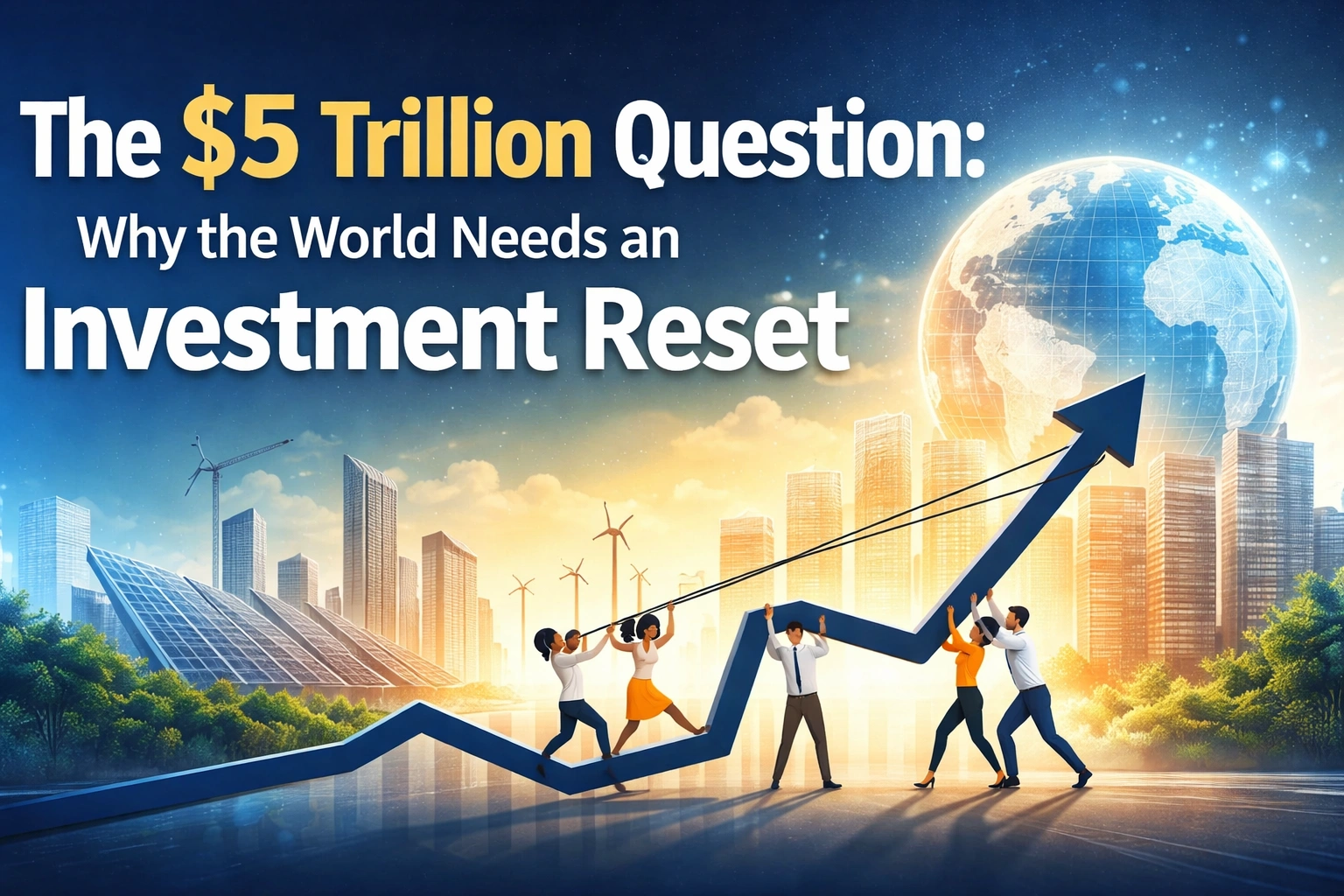
In its latest report, Accelerating Investment: Challenges and Policies, the World Bank Group lays out a striking proposition: to stay on course with development goals and climate commitments, the global economy must channel nearly five percent of its total output into investment every year until the end of this decade. It is a figure vast enough to seem abstract, yet urgent enough to demand attention.
The Slowdown No One Noticed
For decades, investment has been the invisible force behind visible progress. Highways stretching across difficult terrain, ports opening economies to the world, digital networks powering new-age enterprises—none of these emerge without sustained capital and conviction.
And yet, in the years following the global financial crisis, something began to shift.
As the World Bank Group analysis underscores, investment flows did not collapse dramatically; they slowed quietly, particularly across developing economies. Over time, that subtle deceleration has turned into a defining constraint. What makes it more unsettling is that this slowdown is unfolding at a time when global demands are expanding rapidly—climate pressures intensifying, cities growing denser, and economies racing toward a digital future.
The imbalance is no longer theoretical. It is structural.
Why Investment Still Defines the Future
Investment is often reduced to a financial metric, but in reality, it is a measure of possibility. It shapes whether opportunity travels beyond economic centers, whether innovation finds scale, and whether regions long considered peripheral can finally participate in growth.
In its report, the World Bank Group frames investment not merely as an economic input, but as the cornerstone of sustainable development and long-term growth.
In its absence, progress does not merely slow—it becomes uneven.
A Developing World Under Pressure
Nowhere is this tension more visible than in emerging economies.
These nations are expected to build infrastructure, generate employment for expanding populations, transition toward cleaner energy systems, and remain competitive in a fast-evolving global landscape. Yet they attempt this transformation while navigating limited fiscal space, rising debt burdens, and increasingly cautious global capital.
The report from the World Bank Group highlights how these overlapping pressures are widening the gap between economic ambition and actual execution.
The Real Issue: A Crisis of Confidence
Capital, by its very nature, seeks certainty.
It moves toward stability, predictability, and trust. In recent years, however, these very foundations have come under strain. Investors are no longer guided solely by growth potential; they are looking deeper, questioning policy consistency, institutional strength, and long-term clarity.
As reflected in the findings of the World Bank Group, the challenge is not just about mobilizing capital, but restoring the confidence that enables it to flow.
In a world shaped by geopolitical shifts and fragmented trade dynamics, capital has not disappeared—it has become selective. More cautious. More discerning.
The 5% Imperative
Against this backdrop, the call to invest five percent of global GDP each year is not simply ambitious—it is necessary.
The Accelerating Investment report positions this as essential to meeting intertwined goals of development, climate transition, and economic resilience. It reflects the scale of transformation required to build resilient infrastructure, enable clean energy systems, and create inclusive economic opportunities.
The path forward is not about spending more indiscriminately, but about designing systems that can attract, absorb, and sustain investment with clarity and confidence.
India at the Crossroads
India’s position within this evolving landscape is both promising and complex.
It carries the momentum of rapid economic growth and has demonstrated an ability to build and innovate at scale. Its infrastructure push, digital ecosystem, and entrepreneurial energy position it as a key player in the global investment narrative.
Yet beneath this momentum lie familiar challenges—uneven private investment cycles, constrained access to capital for smaller enterprises, and persistent regional imbalances that continue to shape outcomes.
It is within these imbalances that a more nuanced story begins to unfold.
Rethinking the Northeast Narrative
For decades, Northeast India has been viewed through the lens of distance.
But in an investment-driven world, distance is no longer merely geographical. It is defined by connectivity, policy clarity, and perception. It is about how a region is positioned in the minds of investors.
Seen differently, the Northeast begins to reveal a compelling proposition. Its bamboo-based industries, agroforestry potential, and proximity to Southeast Asian markets align closely with the evolving priorities highlighted in the World Bank Group report—particularly the growing importance of sustainable and climate-aligned investment.
The limitation has never been potential. It has been the absence of structured, sustained investment flows that can convert that potential into momentum.
From Global Reset to Regional Opportunity
The idea of an investment reset, therefore, is not confined to global institutions or national governments. It carries profound implications for regions that have long remained outside mainstream investment narratives.
If capital is becoming more selective, then regions must become more intentional. They must articulate their strengths with clarity, align with emerging global priorities, and create conditions that inspire confidence.
In that sense, the global investment reset—framed so clearly by the World Bank Group—is also an invitation to rethink positioning and reclaim relevance.
The Quantiq Perspective
At The Quantiq, this moment is seen not as a crisis, but as a turning point.
It is an opportunity to shift the conversation from where investment has traditionally gone to where it can go next. It is a chance to bring regions like Northeast India into sharper focus, not as outliers, but as emerging contributors to a more balanced and sustainable global economy.
Because ultimately, investment is not just about capital flows. It is about belief—belief in systems, in regions, and in the future they can create.
The Question That Defines the Decade
The numbers are clear. The urgency is real.
But beyond the data lies a more defining question—one that will shape the trajectory of economies, regions, and industries in the years ahead.
When capital begins to move at the scale the world now demands, who will be ready to receive it?https://thequantiq.com/the-silent-crisis-why-human-capital-is-declining-despite-economic-growth/
Editorial Note
This article is part of The Quantiq’s “Investment Reset” series, interpreting key insights from the World Bank Group’s report “Accelerating Investment: Challenges and Policies.”


One Comment