The Great Curriculum Purge: When a Nation Deletes Its Past to Write the AI Future
There is something unsettling about the idea of knowledge being erased.
Not debated. Not revised. Not slowly phased out through academic committees and cautious reforms.
But deleted.
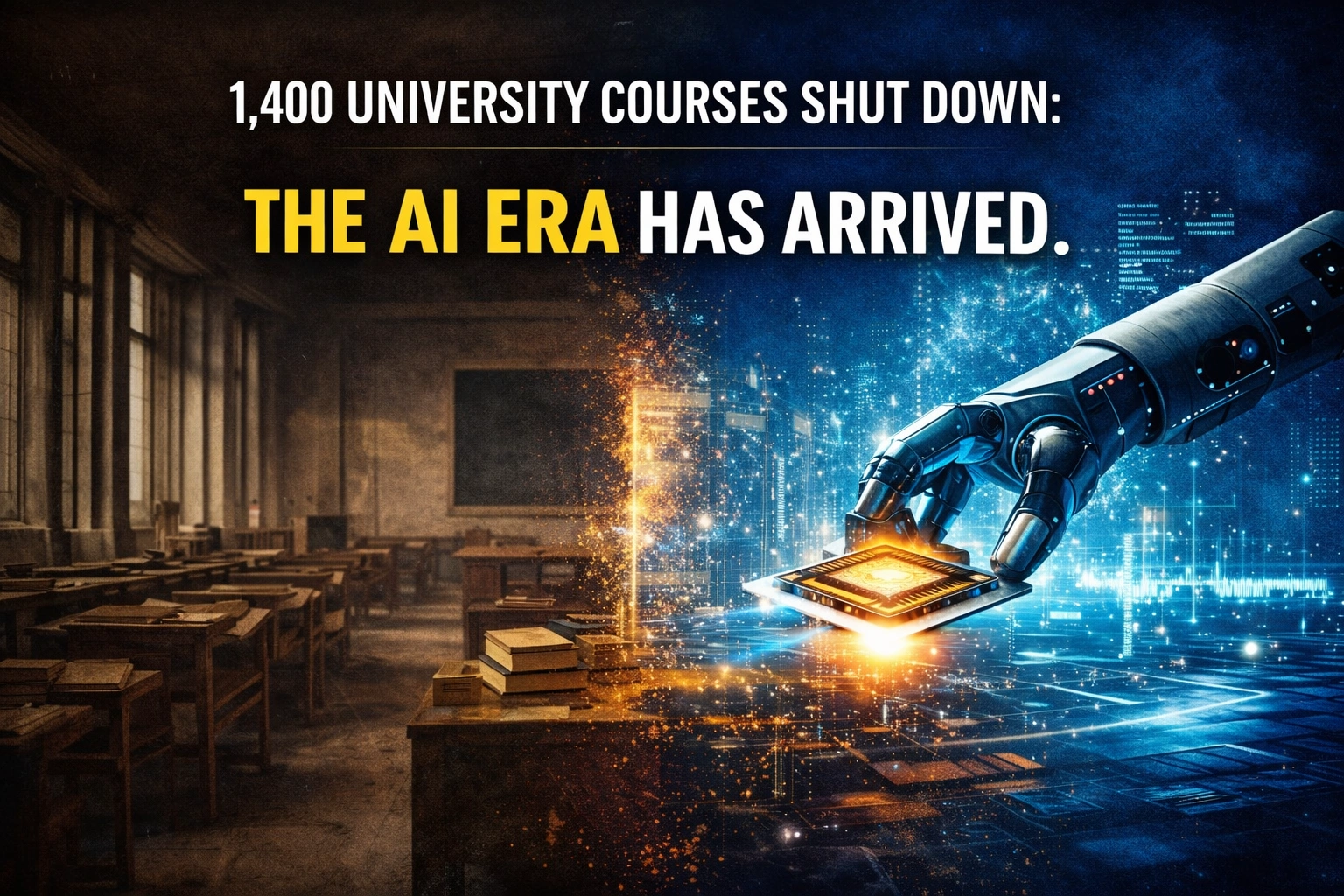
In recent months, multiple credible reports have pointed to a sweeping move in China — the discontinuation of nearly 1,400 university courses deemed misaligned with the demands of the AI-driven economy. The story surfaced across international and regional media, including coverage and summaries by platforms such as South China Morning Post, Global Times, and aggregated academic policy discussions reported by Reuters and The Economic Times.
The exact number may evolve with official clarifications. The intent does not. And the intent is what matters.
A Silent, Ruthless Reset
Imagine walking through a university corridor where courses that existed for decades, some even shaping generations, simply no longer exist. There is no ceremony attached to their disappearance, no institutional nostalgia, no intellectual mourning. There is only absence.
China’s education authorities and universities are reportedly undertaking a structural recalibration, aligning academic offerings with strategic sectors such as artificial intelligence, semiconductor technologies, advanced manufacturing, and data science. In doing so, they are asking a question most countries are still avoiding, perhaps even fearing:
What if a large part of what we teach has already lost its future?
This is not reform in the traditional sense. It is something far more decisive, far more unsettling. It is selection pressure applied not to industries or companies, but to knowledge itself.
When Intelligence Becomes a Filter
For decades, education systems evolved through accumulation. New disciplines were added while older ones lingered, rarely questioned with urgency. The academic universe expanded continuously, without ever truly contracting.
But the rise of Artificial Intelligence has altered that trajectory in a profound way.
AI is not merely creating new domains of opportunity. It is quietly, systematically exposing redundancy. Tasks that once justified entire degrees are now being automated, augmented, or rendered economically insignificant. Entire skill sets, once valuable, are beginning to lose their market relevance faster than institutions can redesign curricula.
And when that happens, the uncomfortable truth emerges with clarity.
Some knowledge domains do not decline gradually. They collapse, often without warning.
China, it appears, is choosing to act before that collapse becomes visible at scale.
A World Divided by Speed
What makes this moment globally significant is not just what China is doing, but how differently the rest of the world is responding to the same disruption.
In many parts of the world, the response remains cautious and procedural. Institutions discuss updates, committees deliberate over syllabus changes, and artificial intelligence is introduced as an optional addition rather than a foundational shift. There is movement, certainly, but it is measured, incremental, and often constrained by legacy structures.
China’s approach, in contrast, appears far more decisive. Instead of adapting around the edges, it is reshaping the core. Instead of debating relevance, it is enforcing it.
This divergence reveals something deeper than policy differences. It reveals a difference in tempo.
And in the age of AI, tempo is not a secondary factor. It is destiny.
The Risk Beneath the Boldness
Yet, such a sweeping move is not without its shadows.
When academic direction is aggressively realigned, there is always the risk of over-centralization. Intellectual diversity may shrink. Fields that seem irrelevant today may hold the seeds of tomorrow’s breakthroughs. History has repeatedly shown that innovation often emerges from unexpected intersections, from disciplines once dismissed as peripheral.
The danger of rapid pruning is that one might eliminate possibilities that have not yet revealed their value.
But there is an equally dangerous alternative, one that feels more familiar to many societies: holding on to legacy knowledge systems long after their relevance has faded, continuing to produce graduates equipped for a world that no longer exists.
Between these two risks lies a difficult choice, and China seems to have chosen decisiveness over hesitation.
India’s Quiet Crossroads
For India, this moment is not distant. It is immediate, intimate, and deeply consequential.
The country stands on the strength of its demographic advantage, its expanding digital ecosystem, and its growing global aspirations. Regions like the North East, which you have long argued require economic and intellectual re-engineering, represent both the urgency and the opportunity of this transition.
Yet the question remains whether India is willing to confront its own educational realities with honesty.
Are institutions prepared to question the economic relevance of the degrees they offer? Are they willing to acknowledge that certain skill pathways may no longer lead to meaningful livelihoods? Or will the system continue, quietly and persistently, to produce graduates whose qualifications do not translate into opportunity?
The challenge is not a lack of talent. It is a reluctance to redefine relevance.
A Signal Larger Than a Statistic
Whether the number is precisely 1,400 or subject to revision is, in many ways, secondary. Numbers capture attention, but they do not define transformation.
What matters is the signal.
We are entering an era where education will no longer be a static asset but a continuously revalidated process. Degrees may not carry lifelong assurance. Their relevance may shrink to shorter cycles, shaped by technological shifts and economic demands.
In such a world, tradition alone cannot sustain value. Adaptability becomes the new foundation of knowledge.
The Uncomfortable Ending
If 1,400 courses can disappear in a single strategic sweep, then the story is no longer about China.
It is about all of us.
It is about the fragility of the systems we have built, the assumptions we have trusted, and the futures we believe are secure.
What happens when entire careers, built on those very courses, begin to face the same fate? What happens when relevance itself becomes temporary?
These are not distant questions. They are already unfolding, quietly, across institutions and industries.
The AI age is not arriving in the future.
It is already here.
And somewhere, in lecture halls and policy rooms, entire futures are being erased to make space for it.https://thequantiq.com/the-silent-crisis-why-human-capital-is-declining-despite-economic-growth/