The Silent Crisis: Why Human Capital Is Declining Despite Economic Growth
There is a quiet contradiction unfolding across the world—one that rarely makes headlines but will shape the destiny of nations.
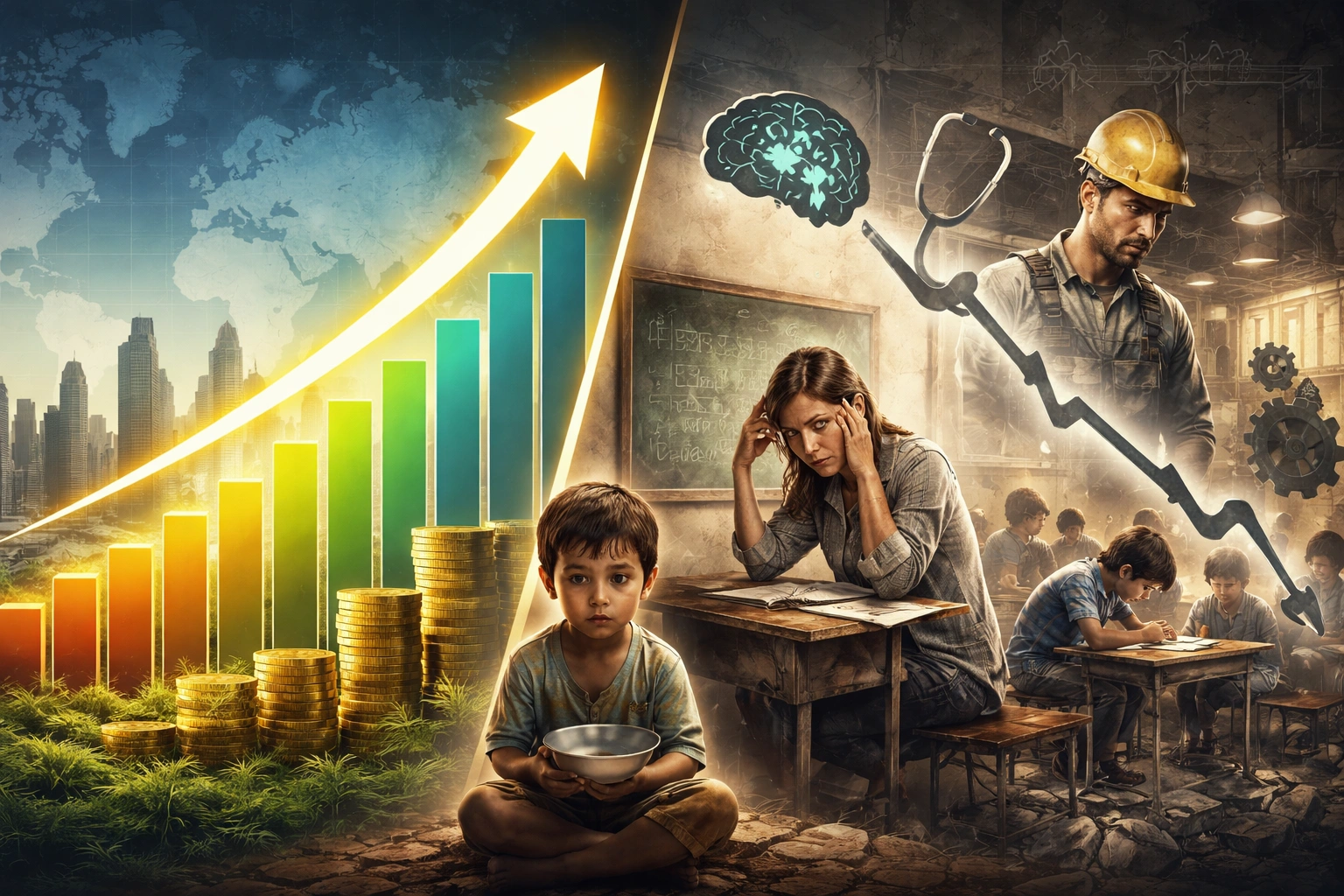
Economies are growing. GDP charts are climbing. Startup ecosystems are booming. Digital transformation is accelerating at an unprecedented pace.
And yet, beneath this surface of progress, something far more fundamental is weakening.
Human capital—the true engine of economic prosperity—is declining.
A Disturbing Reality Hidden Behind Growth Numbers
The latest insights from the World Bank reveal a sobering truth:
86 out of 129 low- and middle-income countries have witnessed deterioration in at least one key dimension of human capital between 2010 and 2025.
This includes:
- Rising learning poverty
- Persistent child malnutrition
- Growing skills mismatch in the workforce
The implications are profound.
Because while GDP measures output, human capital determines potential—the ability of a nation to sustain and multiply that output over time.
What Is Human Capital—and Why It Matters More Than Ever
Human capital is not an abstract academic concept. It is the sum of health, education, skills, and the overall productivity of people.
It determines how efficiently economies function, how innovation scales, and how societies adapt to disruption.
A country may build highways, ports, and digital infrastructure—but without strong human capital, these remain underutilized assets.
The HCI+ Revolution: Measuring What Truly Matters
In a significant shift, the World Bank has introduced the Human Capital Index Plus (HCI+)—an expanded framework that tracks human capital across an individual’s entire lifecycle, from birth to age 65.
Unlike earlier models, HCI+ links human capital deficits directly to lifetime earnings loss, captures long-term productivity gaps, and expands the lens beyond schools and hospitals.
The message is clear: human capital is not built in classrooms alone—it is built in homes, neighborhoods, and workplaces.
The Growth Illusion: When GDP Rises but Capability Falls
This is where the contradiction becomes dangerous.
Economic growth, particularly in emerging economies, is increasingly driven by capital inflows, technology adoption, and consumption expansion.
But these drivers can create a temporary illusion of progress.
If children are not learning effectively, youth are not employable, and workers are not reskilling, then growth becomes fragile, unequal, and unsustainable.
In essence, economies begin to run ahead of their people.
India’s Moment of Reckoning
For India, this narrative carries both urgency and opportunity.
On one hand, India is one of the fastest-growing major economies, it has a demographic advantage with a young population, and it is emerging as a global digital powerhouse.
On the other hand, learning outcomes remain inconsistent, workforce participation—especially among women—lags, and a large section of the workforce remains in informal, low-productivity jobs.
This creates a paradox: a nation rich in human potential but constrained by human capital gaps.
The Real Cost: Lost Productivity, Lost Prosperity
Human capital deficits are not just social challenges—they are economic liabilities.
When a child fails to acquire foundational skills, a worker lacks relevant training, and a population suffers from poor health, the result is measurable in the form of lower productivity, reduced income potential, and slower economic mobility.
In macro terms, this translates into billions—if not trillions—of dollars in lost economic output over time.
Beyond Policy: Where Human Capital Is Actually Built
One of the most powerful insights from the new framework is the shift in focus: human capital is shaped not just by policy, but by ecosystems.
It begins in homes, through early childhood nutrition, parental awareness, and cognitive stimulation. It is shaped further in neighborhoods through access to clean environments, safety and infrastructure, and digital connectivity. It ultimately evolves in workplaces through skill utilization, continuous learning, and adaptation to technology.
This decentralization of responsibility changes everything.
It means human capital is not just the job of governments—it is the outcome of society as a whole.
The Road Ahead: From Awareness to Action
Addressing this silent crisis requires a shift in mindset from education to learning outcomes, from employment to employability, and from growth to inclusive productivity.
It also demands the integration of AI and digital tools in skilling, stronger public-private partnerships, and hyperlocal interventions tailored to community needs.
A Defining Question for the Future
As economies race toward a future shaped by AI, automation, and climate transitions, one question will define success:
Will nations be able to upgrade their human capital at the pace of their ambitions?
Because in the end, it is not technology, capital, or policy that determines the trajectory of a nation.
It is people.
And right now, the world is at risk of leaving them behind.
The Crisis We Cannot Afford to Ignore
The human capital crisis is silent—but its consequences will be loud.
It will show up in slower growth, rising inequality, and increasing social instability.
For countries like India, this is not just a challenge—it is a turning point.
The opportunity is immense, but so is the risk.
And the time to act is now.https://thequantiq.com/india-ai-talent-boom-global-powerhouse/




2 Comments