
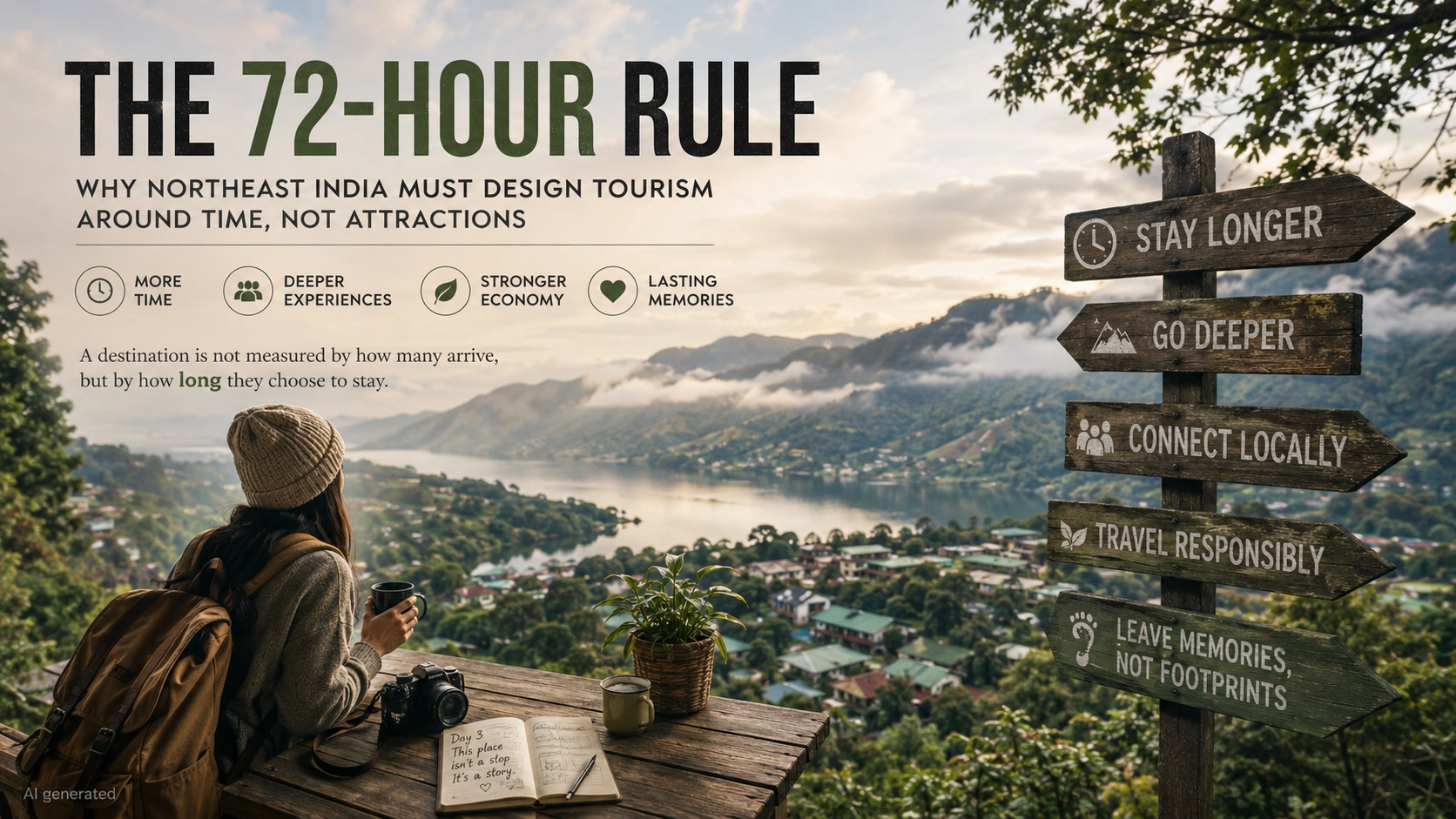
The 72-Hour Rule: Why Northeast India Must Design Tourism Around Time, Not Attractions
There is a revealing difference between a tourist who says, “We covered the place,” and one who says, “We stayed.”
The first describes movement. The second describes experience.
And hidden inside that difference is one of the most important economic questions facing Northeast India’s tourism future.
How long does a visitor actually remain?
Not physically in a hotel room. Not technically within state borders. But emotionally, economically, psychologically engaged with a destination.
Because tourism economies are not built on arrivals. They are built on duration.
A destination that attracts ten lakh visitors who leave within hours often generates less meaningful economic impact than a destination that quietly holds fewer people for four meaningful days. One produces traffic. The other produces circulation.
Across Northeast India, policymakers still celebrate footfalls as though sheer volume alone defines tourism success. Yet the more consequential variable—the one that determines local employment, business sustainability, repeat visitation, and destination depth—is dwell time.
How long tourists stay. How deeply they engage. How much of the local ecosystem they enter before they leave.
And increasingly, one benchmark matters more than most others:
Seventy-two hours.
Three days.
The psychological threshold at which a tourist stops merely seeing a destination and begins inhabiting it
Why Three Days Matter More Than Three Million Footfalls
The tourism industry rarely speaks about time with the seriousness it deserves.
Airports count arrivals. Hotels count occupancy. Governments count visitor numbers. Social media counts visibility.
But local economies survive on something else entirely: the compounding value of an additional night.
The first day of tourism is usually logistical. The second day becomes exploratory. The third day becomes immersive.
That transition changes everything.
A traveller who stays beyond seventy-two hours behaves differently from a transient visitor. Spending patterns widen. Curiosity deepens. Mobility expands. Emotional attachment begins forming. The tourist moves beyond “must-see attractions” into cafés, local conversations, side roads, cultural experiences, hidden markets, evening walks, and unplanned discoveries.
The tourist stops consuming a destination like content and begins experiencing it like a place.
That distinction is not poetic. It is economic.
Every additional night multiplies accommodation demand, restaurant revenues, local transport usage, guide employment, cultural participation, handicraft purchases, and repeat-visit probability.
In fragile regional economies like Northeast India, that multiplier effect matters enormously.
A one-night tourist supports transactions. A four-night tourist supports ecosystems.
The Great Tourism Miscalculation
For decades, much of Indian tourism planning has focused on attraction-building rather than experience architecture.
Governments build viewpoints. Install signboards. Construct gateways. Organise festivals. Launch campaigns.
Then they wait for tourists.
But destinations do not become economically powerful because they possess attractions. They become powerful because they create continuity between experiences.
This is where much of Northeast India still struggles.
The region possesses extraordinary tourism assets: the river landscapes of Assam, the living root bridges of Meghalaya, the monasteries of Arunachal Pradesh, the tribal cultural ecosystems of Nagaland, the ecological diversity of Sikkim, the floating worlds of Loktak, and some of the most visually dramatic geography in Asia.
Yet many destinations continue functioning as isolated spectacles rather than interconnected tourism ecosystems.
Visitors arrive. Photographs happen. Vehicles depart.
The economy barely expands beyond the immediate attraction zone.
This is the difference between a “view” and a “place.”
A view is consumed quickly. A place unfolds slowly.
And tourism economies built entirely around views eventually exhaust themselves.
The Psychology of the Third Morning
There is something psychologically transformative about waking up in a destination for the third consecutive morning.
The first morning belongs to novelty. The second belongs to orientation. The third belongs to familiarity.
By then, the tourist has developed rhythm.
The café owner recognises them. The roads begin making sense. The landscape stops feeling external. The destination begins generating memory instead of impression.
This is the point at which emotional tourism begins.
And emotional tourism is vastly more valuable than transactional tourism.
A traveller who emotionally connects with a destination returns, recommends, stays longer next time, spends more deeply, and becomes part of the destination’s long-term brand network.
This is precisely why some places around the world command extraordinary tourism loyalty despite not necessarily possessing the “best attractions.”
People return to places where they felt immersed.
Not merely entertained.
Why Meghalaya Performs Differently
Among Northeast Indian states, Meghalaya offers perhaps the clearest example of why layered tourism ecosystems outperform isolated attractions.
The state does not depend on a single iconic destination.
Instead, it functions as a connected experiential corridor: Shillong, Cherrapunji, Nongriat, Dawki, Mawlynnong, Jowai, Krang Suri, living root bridge systems, village ecosystems, music culture, café culture, and monsoon landscapes.
Every location naturally extends into another.
One experience unlocks curiosity for the next.
This is intelligent tourism geography.
The tourist rarely asks, “What now?”
Because the destination itself keeps generating narrative momentum.
That momentum increases dwell time almost organically.
Importantly, Meghalaya’s strongest tourism asset may not even be a landmark.
It may be atmosphere.
The slow weather. The music culture. The café ecosystem. The roadside conversations. The layered road journeys. The unpredictability of rain and fog.
These intangible elements quietly encourage staying.
And tourism economies are often built more powerfully by atmosphere than by infrastructure alone.
The Problem With Isolated Attractions
Many destinations across the Northeast remain trapped in what may be called “single-frame tourism.”
The destination exists primarily as an image: a waterfall, a monastery, a lake, a festival, a viewpoint, or a heritage structure.
Visitors arrive primarily to reproduce the image they already saw online.
Once the image is captured, the economic cycle ends.
This creates structurally shallow tourism economies.
The local ecosystem receives limited overnight demand, low off-season resilience, weak repeat visitation, and highly concentrated tourist movement.
Over time, these destinations become vulnerable to overtourism during peak periods and economic emptiness during lean periods.
Ironically, many of the region’s most photographed destinations remain economically under-leveraged because they were never designed to hold people.
They were designed to attract them.
These are not the same thing.
The Infrastructure of Staying
Tourism planners often misunderstand infrastructure.
Infrastructure is not merely roads, airports, and hotels.
In a high-value tourism economy, infrastructure includes walkability, storytelling systems, weather-adaptive public spaces, evening economies, cultural programming, cafés, local food ecosystems, trails, cycling routes, music venues, interpretation centres, and emotionally memorable public experiences.
People stay longer where staying feels natural.
This is why some small European towns hold tourists effortlessly despite lacking globally famous landmarks. The experience ecosystem is complete.
Northeast India possesses a major advantage here.
Unlike over-urbanised tourism regions, much of the Northeast still retains ecological intimacy, cultural authenticity, low-density landscapes, and emotional quietness.
These are increasingly premium global tourism assets.
But they require careful design.
If unmanaged, they can quickly collapse into either chaotic commercialisation or extractive volume tourism.https://thequantiq.com/the-trans-himalayan-surge-how-the-north-east-bhutan-corridor-is-rewriting-asias-tourism-map-2022-2025/
Why Northeast India Must Reject the Mass Tourism Model
This may be the most important strategic question of all.
Should Northeast India pursue high-volume tourism?
The instinctive answer is yes. More tourists appear to mean more revenue.
But ecologically and structurally, the region may actually be far better suited to a different model:
Low-volume. High-yield. Long-duration tourism.
The geography itself supports this logic.
Mountain ecosystems, fragile biodiversity zones, indigenous cultural landscapes, narrow mobility corridors, and environmentally sensitive regions are not naturally compatible with uncontrolled mass tourism.
Trying to imitate high-density tourism economies elsewhere could become deeply destructive.
The wiser path is selective premiumisation: slower tourism, deeper tourism, experience-rich tourism, ecologically regulated tourism, and emotionally immersive tourism.
This is not elitism.
It is sustainability.
And increasingly, it is also where global tourism demand is moving.
Many modern travellers are exhausted by overcrowded destinations and algorithm-driven tourism. They seek silence, authenticity, ecological intimacy, meaningful slowness, and layered local experiences.
Northeast India can become globally competitive precisely because it still possesses these qualities.
But only if it protects them before volume erodes them.https://thequantiq.com/from-hidden-valleys-to-hospitality-capital-the-dirang-signal-that-redraws-northeast-indias-tourism-mapdirang-tourism-ihcl-northeast-india-growth/
Designing the 72-Hour Northeast
If the region wishes to build serious tourism economies, every destination must eventually confront a simple planning question:
What keeps the tourist here tomorrow?
And then:
What keeps them the day after that?
The answers cannot depend on one attraction alone.
Destinations must begin designing around continuity.
That means linking attractions into corridors, integrating culture with ecology, extending activity ecosystems, improving mobility between experiences, encouraging homestay ecosystems, building local storytelling economies, creating weather-resilient tourism models, and investing in emotional atmosphere rather than superficial beautification.
Tourism is not merely movement through geography.
It is movement through emotion, memory, curiosity, and time.
The destinations that understand this become economically resilient.
The ones that do not remain trapped in the exhausting cycle of endlessly chasing more arrivals.
Beyond Tourism
Ultimately, the seventy-two-hour rule is not only about tourism.
It is about how a region sees itself.
A place confident in its depth does not desperately seek attention. It invites immersion.
Northeast India does not lack beauty. It does not lack uniqueness. It does not lack stories.
What it still lacks, in many places, is deliberate experience architecture.
The future of the region’s tourism economy will not be decided by how many people arrive at its airports.
It will be decided by how many decide not to leave too quickly.
Because the true measure of a destination is not whether it can attract attention.
It is whether it can hold time.https://thequantiq.com/tezpur-kaziranga-nameri-corridor-assam-tourism/






7 Comments