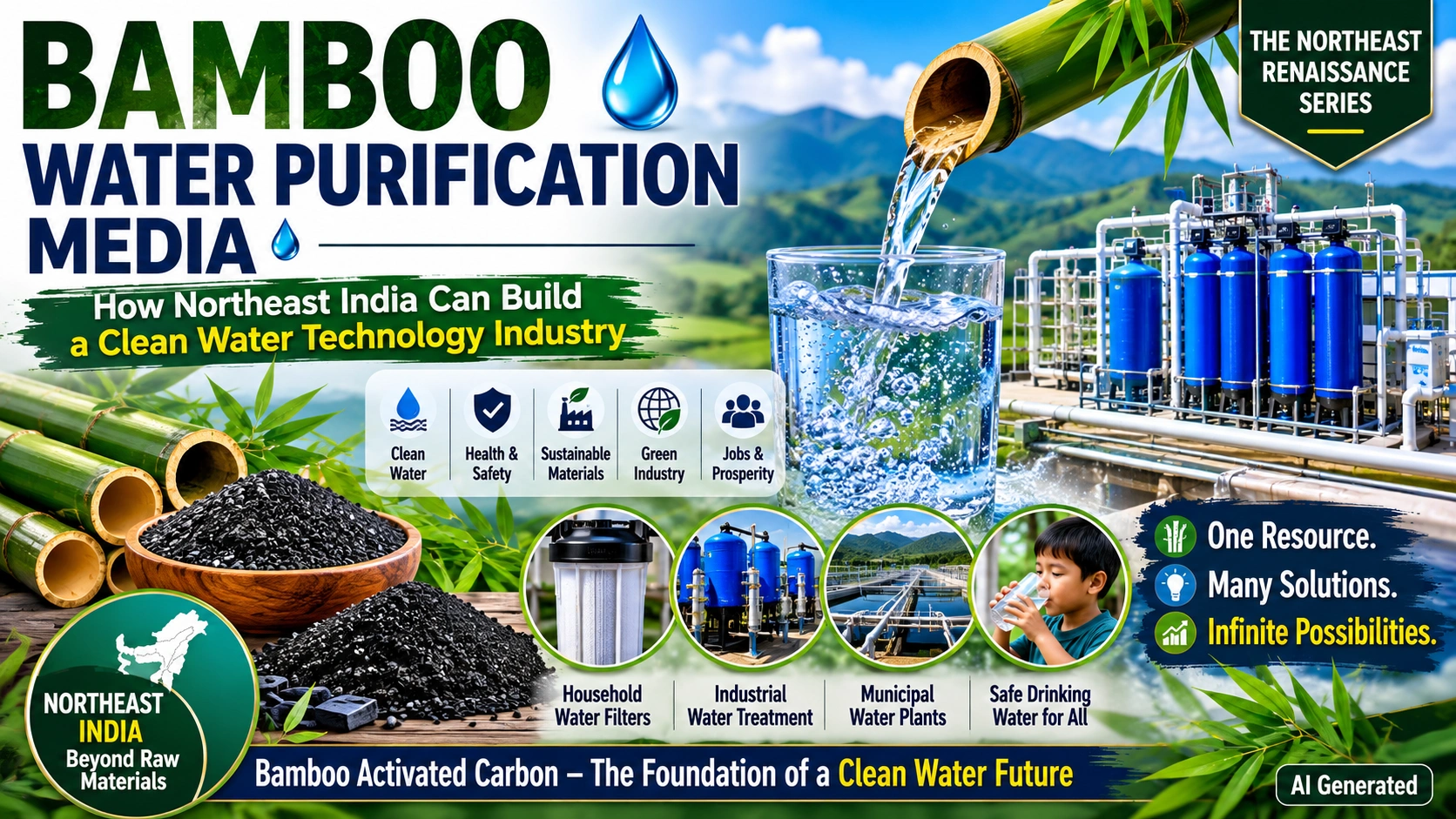
Bamboo Water Purification Media: How Northeast India Can Build a Clean Water Technology Industry
The Northeast Renaissance Series
Ideas for a ₹67,000 Crore Indian Market and a Multi-Billion Dollar Global Future
Every morning, millions of Indians fill a glass of water without thinking about what happened before that water reached them.
A tap opens.
A filter works.
A bottle is purchased.
And life goes on.
Yet hidden behind this everyday convenience lies one of humanity’s most important technologies: water purification.
Without it, modern cities cannot function. Hospitals cannot operate safely. Food processing industries cannot meet quality standards. Hotels cannot serve guests. Pharmaceutical companies cannot manufacture medicines. Even households increasingly depend upon purification systems to ensure the water they consume is safe.
Clean water is so fundamental that people rarely stop to think about the technologies that make it possible.
One of those technologies is activated carbon.
And one of the most sustainable sources of activated carbon may be bamboo.
This creates an intriguing question for Northeast India.
Can a region known primarily for producing bamboo evolve into a supplier of water purification media, filtration systems and clean-water technologies?
The answer deserves serious attention.
Because the future opportunity may not lie only in producing activated carbon.
The larger opportunity may lie in producing solutions.https://thequantiq.com/bamboo-activated-carbon-northeast-india/
Why Water Matters More Than Ever
The twenty-first century is increasingly becoming a century defined by water.
Growing populations, rapid urbanisation, industrial expansion and climate change are placing unprecedented pressure on freshwater resources. At the same time, consumers are becoming more conscious of water quality than ever before.
People now worry about:
- heavy metals
- pesticides
- industrial pollutants
- unpleasant odours
- organic contaminants
- microbial contamination
Governments, industries and households are investing heavily in purification technologies designed to address these concerns.
As a result, water treatment has evolved into a massive global industry.
Yet every purification system ultimately depends on materials capable of removing impurities.
This is where activated carbon enters the story.
And this is where bamboo begins to matter.https://thequantiq.com/bamboo-biochar-carbon-economy-northeast-india/
From Bamboo Grove to Water Filter
In the previous article of this series, we explored how bamboo can be transformed into activated carbon through controlled carbonisation and activation processes.
Activated carbon itself, however, is not the final destination.
It is an enabling material.
Its true value emerges when it becomes part of products that solve real-world problems.
Water purification is one of the most important examples.
The remarkable effectiveness of activated carbon comes from its internal structure.
A single gram of high-quality activated carbon can contain hundreds of square metres of internal surface area.
This enormous surface acts like a microscopic sponge.
As water passes through the material, undesirable compounds become trapped within its pores.
The result is cleaner, safer and more pleasant-tasting water.
What appears to be a simple black material is actually a sophisticated filtration medium created through careful engineering.
And bamboo-derived activated carbon can perform this role exceptionally well.https://thequantiq.com/northeast-india-green-industrialisation-bamboo-manufacturing/
How Bamboo-Based Water Purification Media Is Made
The journey begins with bamboo biomass.
Bamboo culms, residues and processing waste are first converted into charcoal through controlled carbonisation.
The carbonised material then undergoes activation, creating an extensive network of microscopic pores.
This activated carbon is subsequently processed into different forms depending on its intended application.
Stage 1: Carbonisation
Bamboo biomass is heated in oxygen-limited conditions.
Volatile compounds are removed.
Carbon concentration increases.
The result is bamboo charcoal.
Stage 2: Activation
The charcoal undergoes physical or chemical activation.
Millions of microscopic pores develop within the material.
Surface area expands dramatically.
This is what transforms ordinary charcoal into activated carbon.
Stage 3: Processing and Grading
The activated carbon is crushed, screened and graded into different particle sizes.
Different industries require different specifications.
Water treatment systems often demand precise performance characteristics.
Stage 4: Integration Into Filtration Systems
The material becomes part of:
- household water filters
- commercial purification systems
- municipal treatment facilities
- industrial water treatment units
- packaged drinking water plants
At this stage, the value addition increases significantly.
The business is no longer selling carbon.
It is selling purification capability.
The Opportunity Is Larger Than Activated Carbon
Many regions can sell raw materials.
Fewer regions can manufacture activated carbon.
Even fewer can build filtration products and purification systems.
This distinction matters enormously.
A tonne of bamboo has one value.
A tonne of activated carbon has a higher value.
A water filtration system containing activated carbon creates even greater value.
This is precisely the type of economic transition Northeast India must pursue.
The objective should not simply be producing more bamboo.
The objective should be embedding more intelligence into bamboo before it reaches the market.
In an age when artificial intelligence is reducing barriers to innovation, the regions that create solutions will capture more value than those that merely supply inputs.
The machine is not the moat.
The process is.
The material is not the moat.
The application is.
And the application is where the next opportunity begins.
The Three Revenue Streams Behind the Opportunity
The commercial attractiveness of bamboo water purification media lies in the fact that it can generate multiple revenue streams.
Revenue Stream 1: Activated Carbon Sales
Manufacturers can supply activated carbon directly to water-treatment companies.
This remains the most straightforward entry point.
Demand exists from both domestic and export markets.
Revenue Stream 2: Filter Media Manufacturing
The next layer of value addition involves producing cartridges, filter blocks and filtration components.
Margins typically improve because customers are purchasing functionality rather than raw material.
Revenue Stream 3: Water Purification Solutions
The highest value may eventually come from complete solutions.
These may include:
- rural drinking-water systems
- community purification plants
- industrial treatment systems
- hospitality-sector solutions
- disaster-relief purification units
At this level, companies are no longer competing on commodity pricing.
They are competing on technology, performance and trust.
Why Northeast India Possesses a Strategic Advantage
Few regions possess the combination of resources available to Northeast India.
The region already has:
- abundant bamboo resources
- growing industrial ambitions
- increasing focus on sustainability
- expanding entrepreneurial ecosystems
- proximity to South and Southeast Asian markets
Water security is also becoming a priority across Asia.
Countries are investing heavily in purification and treatment infrastructure.
This creates opportunities not only within India but also in neighbouring international markets.
The Northeast therefore has the potential to position itself as a supplier of sustainable filtration materials and water-treatment components.
However, success will depend upon value addition.
Exporting bamboo alone will not achieve this goal.
Exporting technology-enabled products might.
Opportunity Snapshot
| Indicator | Indicative Estimate |
| Indian Water Treatment Opportunity | ₹6,000–8,500 Crores |
| Global Water Treatment Market | Multi-Billion US$ Industry |
| Indicative CapEx | ₹2–5 Crores |
| Estimated ROI Window | 30–48 Months |
| Potential Margin Range | 25–45% |
| Employment Potential | High |
| Scale Potential | Domestic & Export Markets |
Credibility Note
The financial indicators presented are directional estimates based on prevailing industry trends, water-treatment sector growth, activated carbon demand patterns and emerging sustainable-material opportunities. Actual commercial outcomes may vary depending upon technology, certifications, product quality, market access, regulatory compliance and operational efficiency. Readers are encouraged to undertake independent technical and financial due diligence before investment decisions.
Why Process Intelligence Is the Real Moat
In the age of AI, simply importing machinery is no longer enough.
If a machine can be purchased, it can also be replicated.
The true competitive advantage lies elsewhere.
It lies in:
- process optimisation
- filtration science
- material engineering
- quality control
- product design
- intellectual property
This is particularly relevant for water-treatment technologies.
Customers do not buy activated carbon merely because it is activated carbon.
They buy performance.
They buy reliability.
They buy trust.
Companies that understand filtration systems deeply will possess advantages that competitors cannot easily replicate.
This is why process intelligence increasingly matters more than machinery.
From Resource Economy to Solution Economy
For decades, economic discussions in Northeast India have focused heavily on resources.
Tea.
Coal.
Bamboo.
Agriculture.
Yet the future may belong to regions that move beyond resource extraction and toward problem solving.
Clean water represents one of humanity’s most important challenges.
Any region capable of contributing solutions to that challenge will participate in a growing global industry.
This is the larger lesson behind bamboo water purification media.
The opportunity is not really about bamboo.
The opportunity is about applying intelligence to bamboo.
It is about moving from material to technology.
From commodity to solution.
From resource economy to solution economy. https://www.who.int/teams/environment-climate-change-and-health/water-sanitation-and-health/water-safety-and-quality/drinking-water-quality-guidelines