
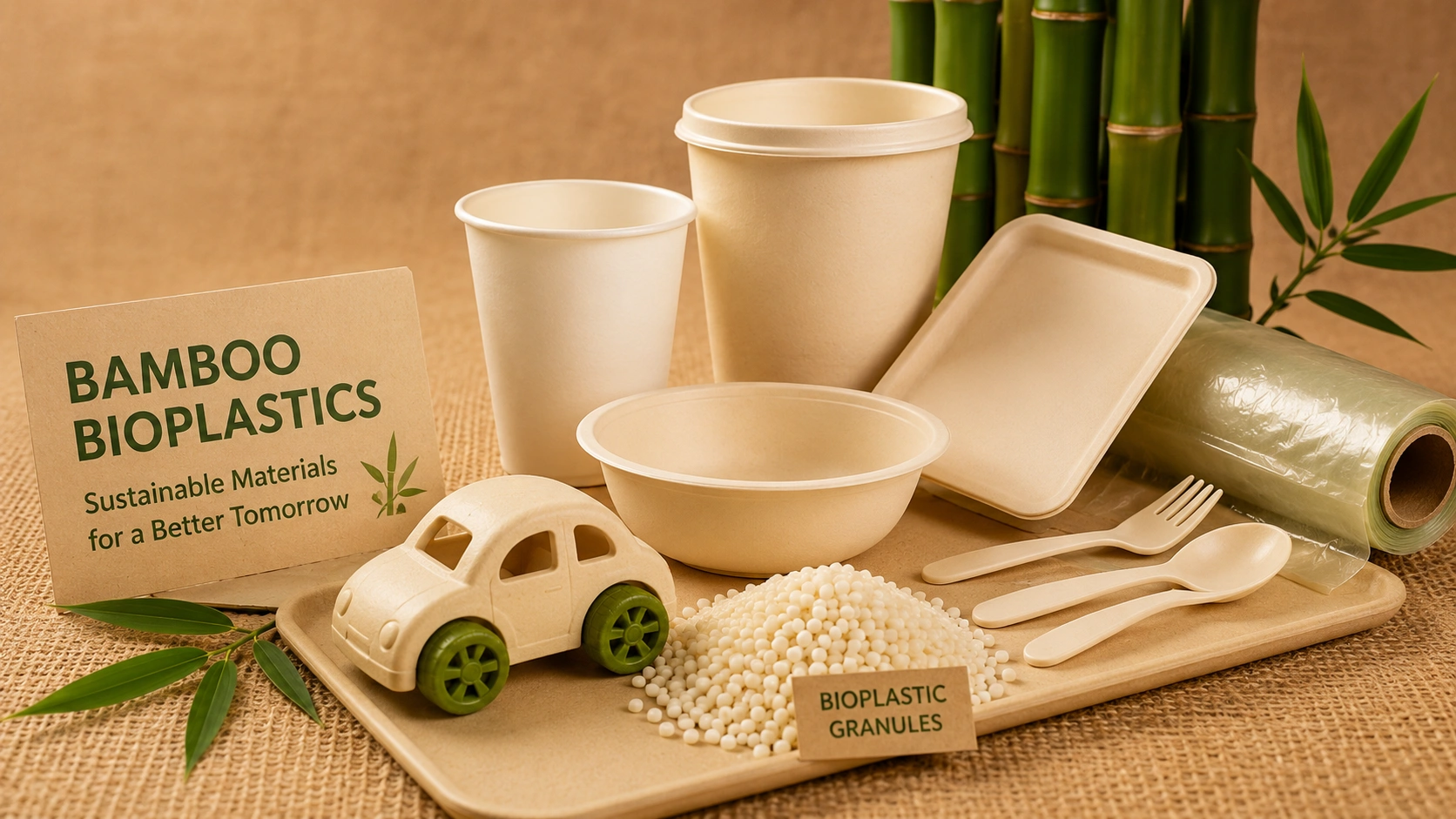
Bamboo Bioplastics: Can Northeast India Build a Future Beyond Single-Use Plastics?
The Northeast Renaissance Series
Ideas for a ₹35,000–50,000 Crore Indian Market and a Multi-Billion Dollar Global Future
Plastic has become so deeply embedded in modern life that most people rarely stop to think about its presence. From food packaging and carry bags to disposable cutlery, retail packaging, and countless household products, plastic has quietly become one of the defining materials of modern industrial civilization. The problem, however, is becoming increasingly impossible to ignore.
For more than a century, the global plastics industry has been built almost entirely on petroleum chemistry. The convenience of plastic transformed manufacturing, logistics and consumer behavior worldwide, but it also created one of the biggest environmental crises humanity now confronts. Oceans continue absorbing millions of tonnes of plastic waste every year, landfills keep expanding and governments across the world are under growing pressure to find sustainable alternatives.
This global transition raises an important question for Northeast India.
If the future increasingly belongs to materials that replace conventional plastics, can a region blessed with abundant bamboo resources begin building industries around bamboo-derived bioplastics and sustainable packaging materials?
The question deserves serious attention.
Because the future plastics industry may increasingly reward those who control biological chemistry rather than petroleum chemistry.
Understanding What Bamboo Bioplastics Actually Are
The term bioplastics often creates confusion because many people assume it simply means plastic that decomposes naturally. The reality is slightly more complex.
Bioplastics refer broadly to materials derived either partially or entirely from renewable biological resources rather than fossil fuels. Unlike conventional plastics manufactured through petroleum-based chemical processes, bioplastics rely on plant-derived compounds such as starch, cellulose, polylactic acid and other bio-polymers capable of reducing environmental impact.
Bamboo has quietly emerged as an attractive candidate in this sector because of one important reason.
It contains high cellulose content.
Cellulose forms one of the most important building blocks in developing biodegradable polymer systems and composite materials designed to replace conventional plastic applications. Scientists and material engineers are increasingly experimenting with bamboo fiber, bamboo cellulose and bamboo-based polymer blends capable of producing packaging materials, disposable food containers and molded industrial components.
What appears to most people as a simple forest resource may eventually support an entirely new materials economy.
How Bamboo Bioplastics Are Manufactured
The manufacturing process begins with bamboo feedstock, although bamboo itself is merely the starting point. The real value emerges through process engineering, formulation science and polymer technology.
The first stage involves preparing bamboo biomass by cleaning, drying and mechanically reducing the raw material into smaller particles suitable for further processing. Once prepared, cellulose extraction begins through mechanical, chemical or enzyme-assisted processing systems capable of separating usable cellulose from the bamboo fiber matrix.
This extracted cellulose then enters polymer conversion systems where it is blended with bio-based polymers such as PLA, PHA or starch-based compounds depending upon the final application being targeted. Additional natural plasticizers and reinforcing agents are often introduced to improve flexibility, durability and heat resistance.
The material then moves into extrusion and molding systems where the compounded material is shaped into trays, packaging sheets, disposable containers, consumer products or industrial molded components.
At this stage, the process begins resembling conventional plastics manufacturing.
The difference lies in the chemistry behind the material itself.
Why Industries Are Searching Aggressively for Plastic Alternatives
The world is no longer treating plastic pollution as a distant environmental concern. Governments, global brands and manufacturing companies increasingly recognize that future consumers will demand products designed around sustainability.
This transition is creating entirely new industrial demand.
The packaging industry is already experimenting aggressively with biodegradable food containers, compostable carry bags and sustainable FMCG packaging solutions. E-commerce companies are exploring alternatives capable of reducing plastic waste generated during retail packaging and product shipping.
The hospitality industry increasingly seeks eco-friendly disposable products while consumer goods manufacturers face growing pressure to redesign packaging systems around environmentally responsible materials.
Even the automobile industry is beginning to experiment with sustainable composite materials for interior applications.
The future demand for plastic alternatives is unlikely to slow.
And this is where bamboo enters the conversation.https://nbm.da.gov.in/
A Market Opportunity Too Large to Ignore
The future bioplastics economy is no longer a niche sustainability conversation. It is quietly becoming one of the fastest emerging industrial opportunities globally.
The numbers deserve attention.
Opportunity Snapshot
| Indicator | Indicative Estimate |
| Indian Sustainable Packaging Market | ₹35,000–50,000 Crores |
| Global Bioplastics Market | US$ 25–35 Billion Industry |
| Indicative CapEx | ₹1–4 Crores |
| Estimated ROI Window | 24–42 Months |
| Potential Margin Range | 25–45% |
| Employment Potential | High |
| Scale Potential | Domestic and Export Markets |
These estimates are indicative and based on sectoral benchmarks. Actual commercial outcomes may vary depending on technology selection, production scale, regulatory approvals, product quality, certification requirements, downstream product development and market access. Readers should undertake independent technical and financial due diligence before making investment decisions.
The future plastics industry may increasingly become a future biomaterials industry.
That shift creates enormous industrial opportunity.
Why Northeast India Has a Strategic Advantage
Northeast India possesses one obvious advantage that much of India lacks.
Abundant bamboo resources.
However, bamboo itself is not the real opportunity. Several Asian countries possess similar bamboo ecosystems.
The actual advantage lies in combining raw material availability with future-focused manufacturing systems capable of transforming bamboo into advanced industrial materials.
The region also possesses another overlooked advantage.
Its proximity to Southeast Asia.
Countries such as Thailand, Vietnam, Indonesia and Malaysia are already moving aggressively toward sustainable materials manufacturing. Northeast India sits geographically closer to these emerging markets than most industrial centers located elsewhere in India.
The region therefore has a rare opportunity to build decentralized manufacturing clusters capable of serving both domestic and export markets.
The question is whether the region will recognize this opportunity early enough.https://thequantiq.com/how-bamboo-fiber-is-made-northeast-sustainable-textile-future/
Why Process Intelligence and Intellectual Property Matter Most
Many entrepreneurs still believe industrial success depends primarily on buying machines.
That assumption is becoming increasingly dangerous.
Machines can always be purchased. Competitors can install similar production infrastructure. Manufacturing technologies eventually spread across markets.
The real competitive advantage lies elsewhere.
It lies in mastering formulation science, polymer engineering, additive systems, biodegradability parameters, materials testing and the intellectual property embedded inside the production process itself.
In other words, the machine rarely creates the moat.
The process does.
This principle will increasingly define the future of advanced manufacturing globally.
Artificial Intelligence Is Reshaping Materials Science
Artificial intelligence is already beginning to transform the future of manufacturing. Engineers increasingly rely on simulation systems, predictive analytics and AI-assisted material modeling capable of accelerating product development cycles faster than ever before.
This changes the equation significantly.
Small and regional enterprises can now access technological capabilities that previously remained available only to large industrial corporations.
At the same time, artificial intelligence will continue reducing dependence on traditional employment structures across multiple sectors. The old assumption that economic prosperity will always emerge through conventional job creation is quietly weakening.
The future increasingly belongs to builders.
Not job seekers.
Regions that fail to build future manufacturing ecosystems may soon discover that technological progress has moved ahead while industrial wealth quietly migrated elsewhere.
Wealth Retention Must Replace the Raw Material Economy
Northeast India has historically supplied natural resources to larger industrial systems located elsewhere.
Tea leaves the region and gets branded elsewhere.
Crude oil is extracted while value-added downstream industries remain concentrated elsewhere.
Timber, coal, natural gas and increasingly bamboo continue following similar patterns.
If the region continues exporting raw bamboo while advanced bioplastic products, sustainable packaging materials and future biomaterials industries emerge elsewhere, history will simply repeat itself.
The raw material will remain here.
The industrial wealth will not.
This is precisely the economic trap the region must learn to escape.
Because prosperity is not created merely by owning resources.
Prosperity is created by retaining value.https://thequantiq.com/bamboo-ev-supply-chain-northeast-india/
The Quantiq Assessment
Bamboo bioplastics demonstrate why Northeast India must urgently rethink how it approaches industrial development. The future opportunity is not simply about growing bamboo or supplying biomass to manufacturers located elsewhere. The future lies in mastering the science capable of transforming biological resources into advanced industrial materials demanded by global markets.
For too long, the region has participated in the economy primarily as a supplier of raw materials while advanced manufacturing ecosystems developed elsewhere.
That pattern has quietly prevented long-term wealth retention.
In the age of artificial intelligence, regions that rely solely on natural resources will struggle to capture maximum value. Regions that master process technologies, intellectual property and scientific manufacturing capabilities, however, will build durable economic advantages capable of sustaining future prosperity.
Northeast India already possesses the resource base.
The next challenge is building the knowledge base.
Because ultimately, prosperity will not be determined by how much bamboo the region harvests.
It will be determined by how intelligently the region transforms that bamboo before it reaches the market.https://thequantiq.com/bamboo-vinegar-green-chemistry-northeast-india/





3 Comments