
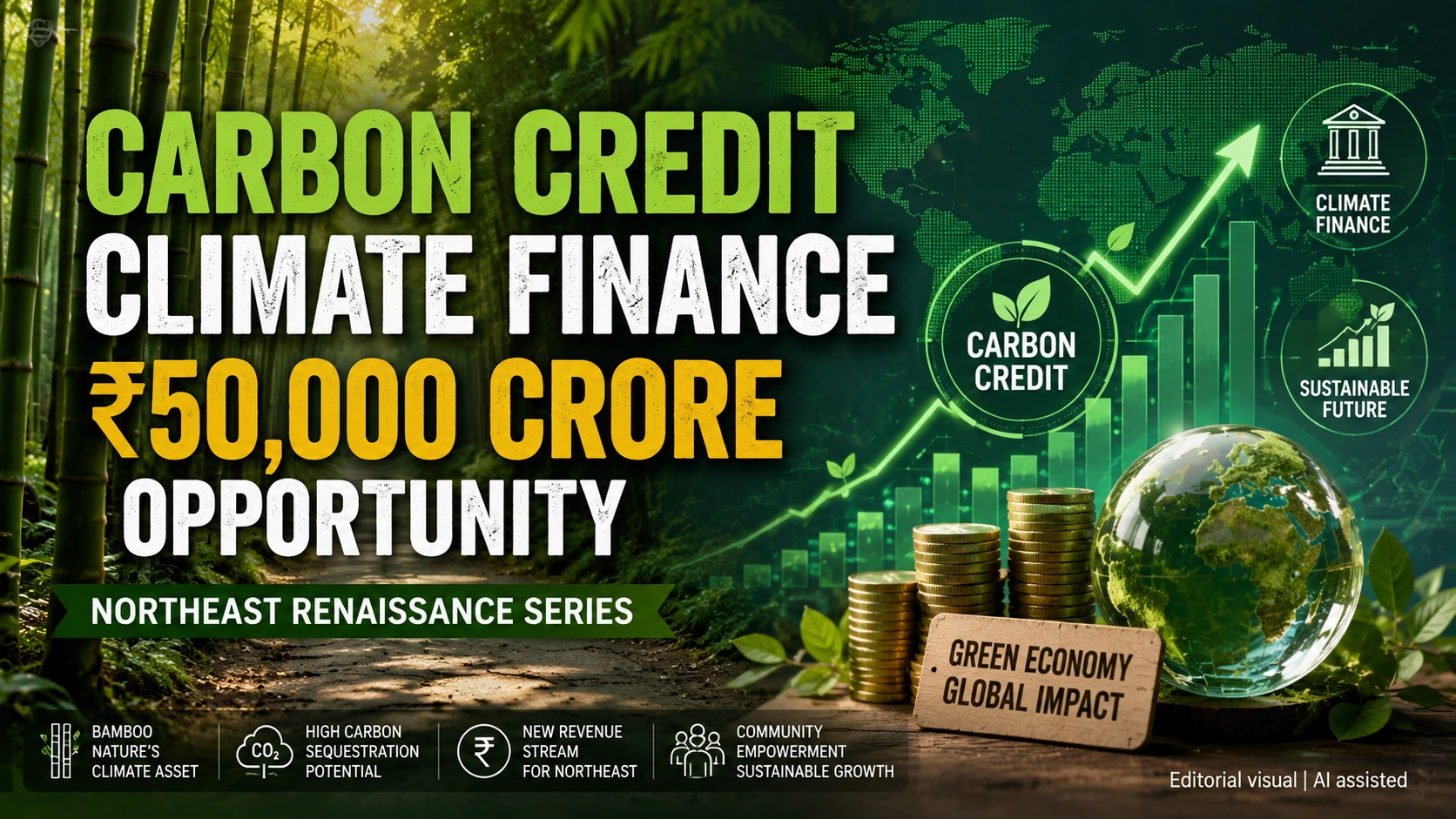
Bamboo Carbon Credits: How Northeast India Can Build a Climate Finance Industry Worth Thousands of Crores
The Northeast Renaissance Series
Ideas for a ₹50,000 Crore Indian Market and a Multi-Billion Dollar Global Future
The Most Valuable Product Bamboo May Create Is Something You Cannot See
For decades, Northeast India has largely viewed bamboo through a remarkably narrow economic lens. The conversation around bamboo has traditionally revolved around furniture manufacturing, handicrafts, construction poles, paper mills and low-value biomass applications. Even when bamboo enters industrial supply chains, public attention remains focused almost entirely on the visible product being manufactured.
Yet the most valuable product bamboo may create in the coming decades may not be something visible at all. It may not be furniture, charcoal, activated carbon or even bioplastics. The most valuable product may simply be carbon itself.
This may sound surprising at first. However, in the emerging global climate economy, companies, industries and governments are increasingly willing to pay not merely for what factories manufacture, but for how much carbon ecosystems can remove from the atmosphere.
This raises an extraordinary question worth serious attention.
Can bamboo become Northeast India’s gateway to one of the world’s fastest-growing financial markets, namely the carbon credit economy?
The answer deserves serious thought because, for the first time in history, nature itself is beginning to evolve into a financial asset.https://thequantiq.com/bamboo-bioplastics-can-northeast-india/
Why Carbon Credits Matter
The world is facing an increasingly complex climate crisis. Governments everywhere are under pressure to reduce carbon emissions in order to slow global warming and meet long-term environmental commitments. Yet reducing emissions completely is often easier said than done.
Heavy industries, airlines, shipping companies, power plants and manufacturing companies continue releasing enormous quantities of carbon dioxide into the atmosphere. Despite technological progress, many industrial sectors still find complete decarbonization extremely difficult in the short term.
This is precisely where carbon credits enter the picture.
A carbon credit represents a verified reduction or removal of greenhouse gases from the atmosphere. Simply put, if one organization successfully removes carbon from the environment, another organization can purchase that environmental benefit in order to offset its own emissions.
Carbon itself has therefore quietly evolved into a tradable financial instrument. The global economy is now building entirely new financial systems around carbon accounting, and this market is expanding rapidly.
Why Bamboo Is Emerging as a Carbon Asset
Most people continue to think of bamboo primarily as a fast-growing grass used for physical products and traditional industrial applications. What very few people realize, however, is that bamboo also functions as one of nature’s most efficient carbon sequestration systems.
Carbon sequestration simply means capturing carbon dioxide from the atmosphere and storing it inside plant biomass. Bamboo performs this function exceptionally well because unlike slow-growing hardwood forests, bamboo grows rapidly and regenerates continuously after harvesting without requiring complete replantation cycles.
This creates an important economic advantage. The faster biomass grows, the more carbon it absorbs over time.
Several global studies increasingly suggest that certain bamboo species can capture carbon at rates significantly higher than conventional tree plantations when managed scientifically.
In simple terms, bamboo is not merely a construction material. It is increasingly becoming a climate asset.
How Bamboo Carbon Credits Are Created
The process begins with bamboo plantations. However, planting bamboo alone is not enough because the real value emerges through scientific carbon accounting and internationally recognized verification systems.
Stage 1 begins with plantation development, where large bamboo plantations are established on degraded land, community land or agroforestry systems capable of supporting long-term biomass growth.
Stage 2 involves carbon measurement, where scientists and technical experts calculate how much carbon the bamboo ecosystem is capable of absorbing annually.
Stage 3 focuses on verification. Independent agencies verify carbon absorption under recognized global carbon accounting standards.
Stage 4 involves credit certification, where verified carbon sequestration is converted into tradable carbon credits.
Finally, Stage 5 allows these credits to enter carbon markets where corporations purchase them as part of their carbon offset strategies.
This is where financial value begins to emerge.
In effect, bamboo plantations begin generating an entirely new form of revenue independent of physical bamboo harvesting.https://thequantiq.com/bamboo-activated-carbon-northeast-india/
The New Climate Finance Economy
Until recently, most people associated forests and plantations primarily with timber production and conventional resource extraction. That assumption, however, is changing very rapidly.
Global financial markets are increasingly assigning measurable economic value to ecological services such as carbon removal, biodiversity preservation, soil restoration, regenerative agriculture and ecosystem protection.
In the coming decades, climate finance may emerge as one of the world’s largest financial sectors. This changes how entrepreneurs should think about plantations and ecological resources.
A bamboo plantation may no longer be simply an agricultural investment. It may increasingly function as a long-term financial asset capable of generating climate-linked revenue streams.
That distinction is profoundly important.https://thequantiq.com/bamboo-vinegar-green-chemistry-northeast-india/
Opportunity Snapshot
| Indicator | Indicative Estimate |
| Global Carbon Credit Market | US$ 100–250 Billion (Projected Future Market) |
| India Carbon Market Potential | ₹50,000–80,000 Crores |
| Voluntary Carbon Credit Market | Rapidly Expanding Globally |
| Indicative Plantation Investment | ₹25 Lakhs – ₹2 Crores |
| Estimated ROI Window | 3–7 Years |
| Potential Margin Range | Highly Variable |
| Employment Potential | High |
| Scale Potential | Global Climate Finance Integration |
Sectoral benchmarks only. Actual commercial outcomes depend on carbon verification standards, plantation scale, policy frameworks, international carbon market conditions and project certification requirements.
Why Northeast India Has a Strategic Advantage
Northeast India possesses one extraordinary advantage that very few regions in India can match at similar scale. The region already contains one of India’s richest natural bamboo ecosystems spread across multiple states with highly favorable climatic conditions.
Millions of hectares remain suitable for bamboo-based agroforestry expansion. Large tracts of degraded land can potentially support bamboo plantations while simultaneously contributing to ecological restoration.
However, bamboo alone is not the advantage because many countries around the world grow bamboo successfully.
The real advantage lies in combining natural bamboo wealth with carbon science, climate finance systems and emerging environmental markets. It is this combination that creates entirely new economic value.
Process Intelligence Is the Real Moat
Many entrepreneurs continue making a dangerous assumption. They believe success lies simply in owning plantations and growing biomass. That assumption is becoming increasingly incomplete.
In the future carbon economy, merely growing bamboo will not create sustainable competitive advantage. The real value lies in understanding carbon accounting systems, international verification standards, certification frameworks, carbon registries and global climate finance markets.
In other words, land itself is not the moat.
The process is.
This lesson extends far beyond bamboo and increasingly applies to the future climate economy itself.
The AI Era and Climate Intelligence
Artificial intelligence is already beginning to transform environmental monitoring systems globally. Satellite monitoring systems can now track biomass growth far more efficiently than traditional field inspections.
AI-driven systems increasingly estimate carbon sequestration patterns with greater accuracy while remote sensing technologies are gradually supporting plantation verification processes.
Predictive analytics can optimize plantation management, improve carbon yield projections and reduce monitoring costs significantly.
This changes the equation.
Participating in climate finance no longer requires multinational corporations alone. Smaller enterprises can increasingly enter climate-linked financial systems because knowledge barriers are beginning to fall rapidly.
Technology is democratizing access.
From Bamboo Plantations to Financial Assets
Every day, thousands of bamboo poles continue leaving Northeast India as raw material serving external industries. Yet very few people pause long enough to ask a simple but important question.
What if the bamboo itself becomes more valuable standing in the soil than leaving the region as raw biomass?
This possibility is becoming increasingly real.
The future may increasingly reward regions not merely for what they harvest, but for the invisible environmental services their ecosystems provide.
Bamboo carbon credits illustrate this reality perfectly.
The greatest value may no longer lie in harvesting bamboo. It may increasingly lie in monetizing carbon itself.
This is a radically different way of thinking.
The Quantiq Assessment
Bamboo carbon credits demonstrate why Northeast India must begin thinking beyond traditional commodity economics. The opportunity is not simply growing bamboo for furniture, handicrafts or conventional industrial products. The larger opportunity lies in integrating ecological assets with emerging global climate finance systems capable of generating entirely new revenue streams over the coming decades.
However, entrepreneurs and policymakers must also recognize that carbon markets are far more complex than they may initially appear. Plantation ownership alone does not automatically create financial value because carbon credits require scientific carbon accounting, internationally recognized certification systems, third-party verification protocols and long gestation periods before meaningful financial returns begin to emerge. Regions that underestimate this technical and regulatory complexity may discover that simply growing bamboo is not enough to participate meaningfully in the global carbon economy.
In the age of artificial intelligence, environmental monitoring systems, satellite analytics and carbon verification technologies are gradually becoming more accessible. This changes the equation significantly because smaller enterprises and regional ecosystems can now begin participating in climate-linked financial markets that were previously dominated by large institutional players.
Northeast India already possesses the ecological resource base.
The challenge now is not merely planting more bamboo.
The challenge is building climate intelligence.
Because ultimately, prosperity will not be determined by how much bamboo the region grows. It will be determined by how much financial value the region learns to extract from the invisible carbon already stored inside that bamboo before others learn to do the same.https://nbm.da.gov.in/





2 Comments