
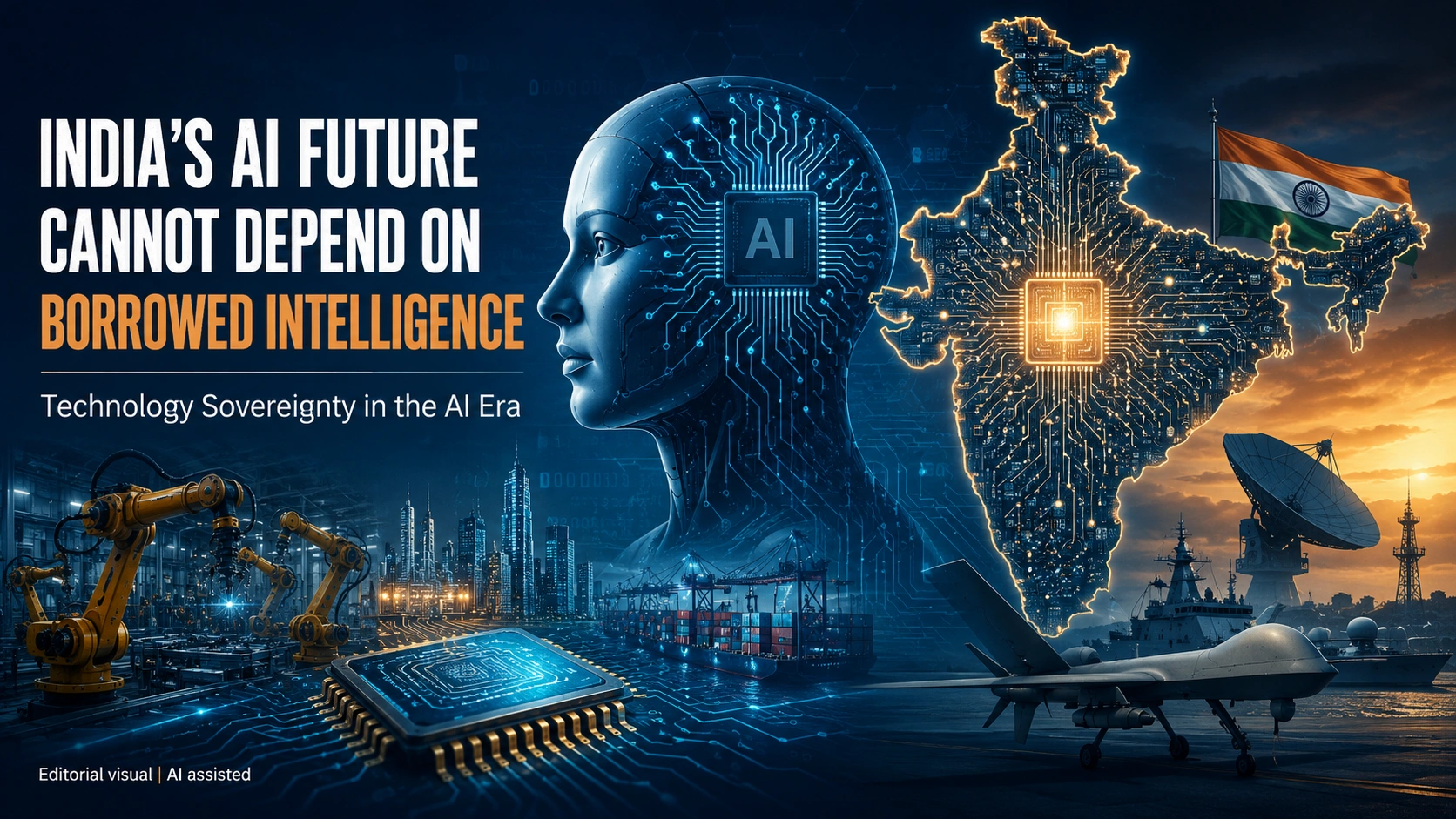
Artificial Intelligence and Sovereignty: Why India Must Build Before It Depends
There was a time when nations measured their strength by the size of their armies, the scale of their industries, or the abundance of natural resources they controlled. That era is quietly ending. In the emerging global order, one new asset is rapidly becoming the ultimate determinant of economic power, national competitiveness, and strategic influence — Artificial Intelligence. But unlike previous technological revolutions, the AI era is forcing nations to confront a far deeper question, not simply whether they can adopt technology, but whether they truly control the intelligence powering that technology.
This debate gained fresh relevance recently when Zoho founder Sridhar Vembu cautioned that India must stop becoming excessively dependent on imported artificial intelligence technologies and begin investing seriously in building indigenous capability. His statement deserves far greater national attention than it has received because the world itself is changing. For nearly three decades, globalization taught countries that technology could be sourced from anywhere. Nations built supply chains across continents, outsourced manufacturing, imported software systems, and embraced a highly interconnected digital economy. That era of unrestricted technological globalization is beginning to fracture.
Across the world, advanced technologies are increasingly being treated as strategic national assets. Semiconductors, cloud infrastructure, robotics, quantum computing, cybersecurity systems, and increasingly artificial intelligence itself are no longer viewed simply as commercial products or tools of productivity enhancement. Technology is no longer just an economic tool. It has become infrastructure, and infrastructure increasingly determines sovereignty.https://thequantiq.com/silicon-sovereignty-wars-ai-chip-industry/
India today finds itself in an interesting paradox. On one hand, the country has emerged as one of the world’s fastest adopters of artificial intelligence. Recent global studies suggest nearly 41 percent of Indian professionals now use AI tools daily, a significantly higher adoption rate than both China at 26 percent and even the United States at 19 percent. At first glance, this sounds like a remarkable achievement, and in many ways, it certainly is. But rapid adoption alone should never be confused with technological strength.
A more important transformation is already underway globally. Experts estimate that Physical AI — intelligent systems embedded into robots, industrial automation, autonomous machines, surveillance infrastructure, logistics networks, and manufacturing systems — could witness nearly 80 percent adoption globally within the next two years, with manufacturing and defence sectors leading this transition. This is where the conversation becomes far more serious because the future of artificial intelligence will not revolve only around chatbots, writing assistants, or customer support automation.
Increasingly, AI will begin making decisions inside physical systems. Smart factories will run autonomously, ports will use intelligent logistics systems, industrial robots will monitor critical infrastructure, defence systems will increasingly depend on machine-led decision architecture, surveillance systems will become autonomous, and transportation systems will become self-regulating. This raises an uncomfortable but extremely necessary question — who owns the intelligence layer behind the systems India is rapidly deploying?
When individuals use foreign AI software tools, the risks are manageable. But when nations deploy foreign-built AI systems in critical infrastructure, the equation changes dramatically. The concern is no longer convenience. The concern becomes strategic dependence, and the numbers tell an important story.https://thequantiq.com/india-semiconductor-sovereignty-niti-aayog-2035-blueprint/
Oxford Economics estimates that building a fully sovereign domestic AI stack in India between 2025 and 2035 could require nearly 102.5 billion dollars in investment. The figure is staggering, but so is the opportunity. Multiple economic projections suggest AI could contribute between 500 billion and 600 billion dollars to India’s GDP by 2035. But there is one condition attached. India must build sovereign capability alongside adoption. If the country merely becomes one of the world’s largest consumers of foreign-built AI infrastructure, much of that long-term economic value may ultimately remain outside national control.
This challenge becomes even more urgent because artificial intelligence itself is evolving rapidly. By 2026, analysts estimate agentic AI systems — intelligent systems capable of independent decision-making — will account for nearly 10 to 15 percent of global IT spending. By 2028, nearly 33 percent of enterprise software applications globally are expected to incorporate agentic AI architecture. In simple language, machines are beginning to make decisions with increasingly limited human intervention. This is not science fiction. This is the infrastructure of the next decade.
Yet across India, one notices an emerging pattern. Artificial intelligence is increasingly becoming part of what may be called a culture of performative technology adoption. Companies deploy imported AI systems, government institutions launch AI-powered platforms, large enterprises celebrate automation, press releases announce digital transformation, and public sector undertakings showcase advanced robotics and automation infrastructure. But very few conversations focus on one critical issue — whether India actually owns the intelligence behind these systems.
This concern is now being voiced by multiple Indian technology leaders. While Zoho founder Sridhar Vembu has argued that India must stop depending excessively on imported AI systems, Sarvam AI co-founder Vivek Raghavan has warned that countries like India risk falling into what may eventually become a new form of technological colonisation, where nations consume intelligence systems built elsewhere without building the capability to create foundational technologies of their own. That warning should not be ignored.
History teaches us that colonialism was never simply about territorial control. It was ultimately about controlling resources, supply chains, production systems, and economic dependence. The AI era may increasingly create similar forms of dependence, except this time, the resource being controlled is intelligence itself.
The geopolitical environment makes this debate even more relevant. In December 2025, nine countries reportedly came together under a strategic technology framework known as Pax Silica, designed around access to advanced AI infrastructure, semiconductor supply chains, and frontier computing systems. India reportedly joined this framework in early 2026. The larger message is clear. Access to advanced technology is no longer guaranteed by markets alone. Increasingly, it is being shaped by geopolitical alignment.
This does not mean India should reject foreign technology partnerships. That would be unrealistic and strategically counterproductive. International collaboration remains essential, but dependence and collaboration are not the same thing. India must now think seriously about what may be called Selective Technology Sovereignty.
Certain sectors can safely leverage global technology partnerships, but strategic sectors demand far deeper domestic capability building. Semiconductor manufacturing, sovereign cloud infrastructure, industrial robotics, cybersecurity systems, AI infrastructure, autonomous defence technologies, and critical public infrastructure cannot remain permanently dependent on imported intelligence systems.
India has already shown remarkable capability in building sovereign digital ecosystems. UPI transformed payments infrastructure, IndiaStack created digital public architecture at population scale, and Bhashini is building language infrastructure suited to Indian realities. The country clearly possesses technological talent. The next challenge lies deeper — building foundational AI infrastructure.
This conversation becomes even more important for Northeast India. As India accelerates infrastructure investments under its Act East policy, expands border management systems, develops logistics corridors, modernizes strategic transportation networks, and builds industrial ecosystems across the Northeast, questions of technology ownership become increasingly critical. The region should not merely become a market for imported intelligent infrastructure. It should actively participate in building India’s future innovation ecosystem.https://thequantiq.com/northeast-india-green-industrialisation-bamboo-manufacturing/
India’s AI journey has begun. But history offers a simple lesson. Political freedom without economic independence remains incomplete, and economic independence without technological independence eventually becomes fragile. The long-term question facing India is therefore not how quickly it adopts artificial intelligence. The real question is whether India develops the capability to build, control, audit, and evolve the technologies it increasingly depends upon.
Because in the age of artificial intelligence, nations will no longer be judged simply by how much technology they consume. They will ultimately be judged by how much intelligence they truly control. Borrowing technology may accelerate growth, but only building capability secures sovereignty.





One Comment