
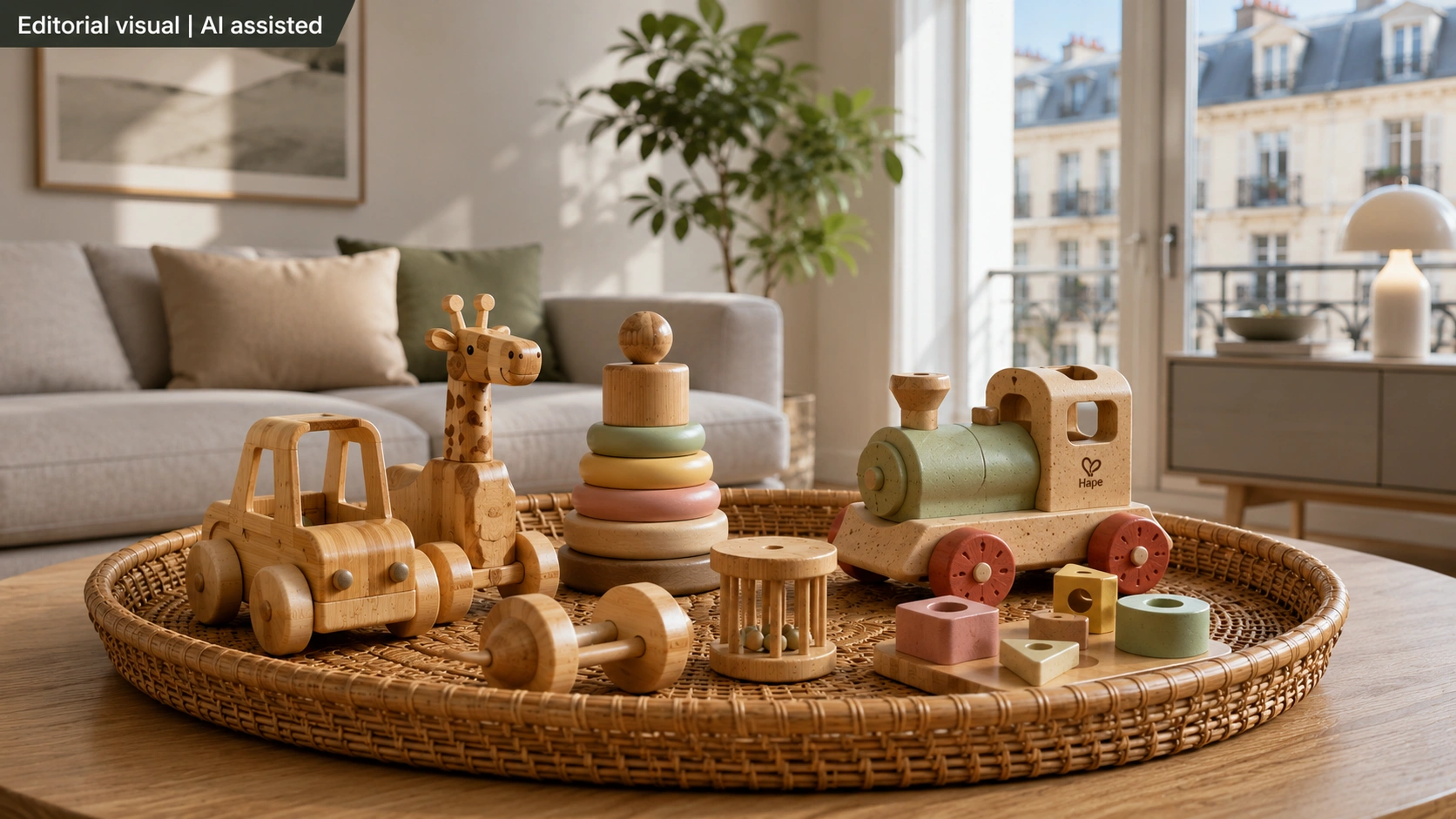
Northeast India Has Long Worked With Bamboo. Can It Now Build A Global Bamboo Toy Industry?
Walk through almost any market across Northeast India, and one immediately notices the extraordinary versatility of bamboo as a material. Across Assam, Tripura, Mizoram, Nagaland, Meghalaya, Arunachal Pradesh and Manipur, bamboo has quietly supported livelihoods for generations. Furniture, utility baskets, decorative pieces, interior products, household accessories, construction materials and hundreds of handcrafted items continue forming an important part of the region’s bamboo economy.
Yet one product category remains curiously absent from this otherwise impressive bamboo ecosystem.
Toys.
This absence raises an interesting question. At a time when the global toy industry is rapidly moving toward sustainable, non-toxic and environmentally responsible materials, why has bamboo-rich Northeast India not yet begun seriously exploring bamboo toys as a future manufacturing opportunity?
The question deserves far greater attention than it currently receives.
Because hidden behind that question lies a much larger economic opportunity that could eventually reshape how the region thinks about bamboo itself.
The Global Toy Industry Is Quietly Undergoing A Material Transition
Most people rarely associate toys with industrial opportunity. Yet the global toy industry today represents one of the world’s largest consumer manufacturing sectors, valued at well above US$ 110 billion annually and projected to continue expanding steadily over the coming decade.
For decades, the industry has relied overwhelmingly on plastic-based manufacturing. Petroleum-derived polymers have dominated everything from educational toys and dolls to action figures, puzzles and learning products. However, something important is now changing globally.
Parents are becoming increasingly conscious about the long-term environmental consequences of plastic waste. Safety concerns surrounding chemical coatings, toxic additives and synthetic materials used in children’s products are also receiving growing attention.
As a result, consumers across Europe, North America and parts of Asia are increasingly willing to pay premium prices for toys manufactured using sustainable, biodegradable and non-toxic materials.
The shift is no longer theoretical.
The future toy industry is gradually beginning to search for alternatives beyond plastic.
And bamboo is emerging as one of the most promising materials.https://toys.hape.com/?srsltid=AfmBOoq1mBH8n2L_-US8mq4VG0qLSJzr_LYACQuBQy9ehAdnF5fnf44G
India Wants To Become A Global Toy Manufacturing Hub
India itself presents an equally interesting opportunity.
For decades, India remained heavily dependent on imported toys, particularly from China, which has historically dominated global toy manufacturing through large-scale industrial ecosystems, supply chain integration and low-cost production capabilities.
Recognizing both strategic dependence and domestic opportunity, the Government of India has in recent years begun aggressively promoting domestic toy manufacturing under the broader Make in India framework. Import restrictions, quality control regulations, and policy interventions are gradually pushing Indian manufacturers toward expanding local production capacity.
India’s own toy market is projected to grow significantly over the coming decade as rising incomes, expanding middle-class consumption, and increasing educational spending continue to drive demand.
But an important question remains largely unexplored.
Can India build a globally competitive eco-friendly toy manufacturing ecosystem rather than merely replacing imported plastic toys with locally manufactured plastic toys?
This is precisely where bamboo enters the conversation.
The Hape Toys Story Proves Bamboo Has Already Entered Premium Global Manufacturing
Perhaps the strongest evidence comes from Hape International, one of the world’s leading educational toy companies.
Hape has built an internationally recognized premium toy brand using bamboo extensively in educational toys, children’s learning kits and environmentally responsible play products sold across Europe, North America and Asia. Its products command premium prices not because bamboo is exotic, but because consumers increasingly associate sustainable materials with safety, durability and responsible manufacturing.
The lesson here is important.
Bamboo is no longer merely a traditional craft material.
It is already participating in high-value global consumer manufacturing.
If global companies can build premium toy brands around bamboo, there is no reason bamboo-rich Northeast India should remain absent from this conversation.
Traditional Bamboo Toys Already Represent The First Layer Of Opportunity
At the most basic level, bamboo can already support a wide range of handcrafted toy products manufactured directly from raw bamboo.
This includes educational puzzles, stacking toys, miniature vehicles, Montessori learning tools, doll houses, balance boards, toy instruments, school learning accessories and handcrafted collector toys. The manufacturing process itself remains relatively straightforward, involving bamboo curing, precision cutting, shaping, sanding, polishing, child-safe finishing and final assembly.
This pathway remains closer to craft-led manufacturing, but it can already serve premium domestic markets as well as niche export opportunities.
Interestingly, despite Northeast India’s deep familiarity with bamboo craftsmanship, bamboo toys remain surprisingly underrepresented within the region’s current bamboo product portfolio.
That itself should invite serious reflection.
Because this may represent an overlooked opportunity hiding in plain sight.
The Future Opportunity Lies In Bamboo Bioplastics And Injection Molding Technology
However, the far bigger opportunity lies beyond handcrafted bamboo toys.
This is where science and advanced manufacturing begin changing the equation entirely.
Material scientists around the world are increasingly experimenting with bamboo cellulose extraction technologies capable of converting bamboo fiber into engineered polymer compounds and bamboo-derived bioplastic granules. Once converted into specialized bioplastic formulations, these granules can enter industrial injection molding systems similar to those already used extensively in conventional plastic manufacturing.
This changes the economic possibilities dramatically.
Instead of manually producing limited handcrafted toys, manufacturers can begin large-scale industrial production of precision toy components, STEM learning kits, molded baby-safe toys, biodegradable toy parts and sustainable mass-market consumer products.
At this stage, bamboo stops behaving like a traditional raw material.
It begins functioning as an advanced industrial feedstock.
And that distinction changes everything.https://thequantiq.com/bamboo-bioplastics-can-northeast-india/
Global Innovation Is Already Moving Toward Sustainable Materials Engineering
Countries known for advanced materials innovation, including Israel, Japan and several European manufacturing ecosystems, are increasingly investing in sustainable material science capable of replacing conventional petroleum-based plastics.
The lesson emerging globally is becoming very clear.
Future manufacturing will no longer depend simply on possessing natural resources.
It will increasingly depend on mastering the science capable of transforming biological resources into engineered industrial materials.
The competitive advantage increasingly lies not in bamboo itself.
It lies in the chemistry, polymer science, materials engineering and product design systems built around bamboo.
Machines can always be purchased.
The process behind the machine is where real value is created.https://europeanbamboo.org/
Northeast India Possesses The Raw Material. The Next Challenge Is Industrial Imagination
Northeast India already possesses many structural advantages capable of supporting such an industry.
The region has abundant bamboo resources, skilled artisan communities already familiar with bamboo processing, relatively low labor costs, improving logistics infrastructure and a growing startup ecosystem slowly beginning to explore new manufacturing possibilities.
Yet the larger industrial imagination remains missing.
Across multiple sectors, the region continues repeating a familiar pattern. Natural resources are harvested locally, while advanced manufacturing opportunities emerge elsewhere. Tea leaves the region, and branding happens outside. Agricultural products continue to be exported in raw or minimally processed form, while higher-value manufacturing occurs outside the region.
Bamboo risks following exactly the same pattern.
Unless the region begins thinking differently.https://thequantiq.com/bamboo-vinegar-green-chemistry-northeast-india/
The Future Of Bamboo May Be Much Bigger Than We Currently Realize
The real opportunity here is not simply building another cottage industry around bamboo.
The larger opportunity lies in recognizing that bamboo may increasingly become one of the world’s most important sustainable industrial materials.
Toy manufacturing is only one possible category.
The same material science eventually extends toward packaging systems, automotive interior components, biodegradable consumer products, sustainable furniture composites, advanced biomaterials and entirely new manufacturing ecosystems that are only beginning to emerge globally.
In other words, bamboo’s economic future may look very different from its historical role.
And regions that recognize this transition early will eventually control enormous value.
The Bigger Question Nobody Is Asking
The real question is not whether Northeast India can continue building bamboo products.
It has been doing that successfully for generations.
The more important question is whether the region can begin identifying entirely new industries hidden inside the resources it already possesses.
The future will not reward regions simply because they own extraordinary natural resources.
The future will reward regions that build advanced manufacturing systems, process intelligence and industrial ecosystems around those resources before global markets fully mature.
The world is already proving that bamboo can participate in tomorrow’s industries.
The only question is whether Northeast India will build those industries itself or once again watch others capture the opportunity first.
Because increasingly, prosperity will not belong to those who merely own resources.
It will belong to those who understand what those resources can become before everyone else does.https://thequantiq.com/bamboo-ev-supply-chain-northeast-india/
One Comment