
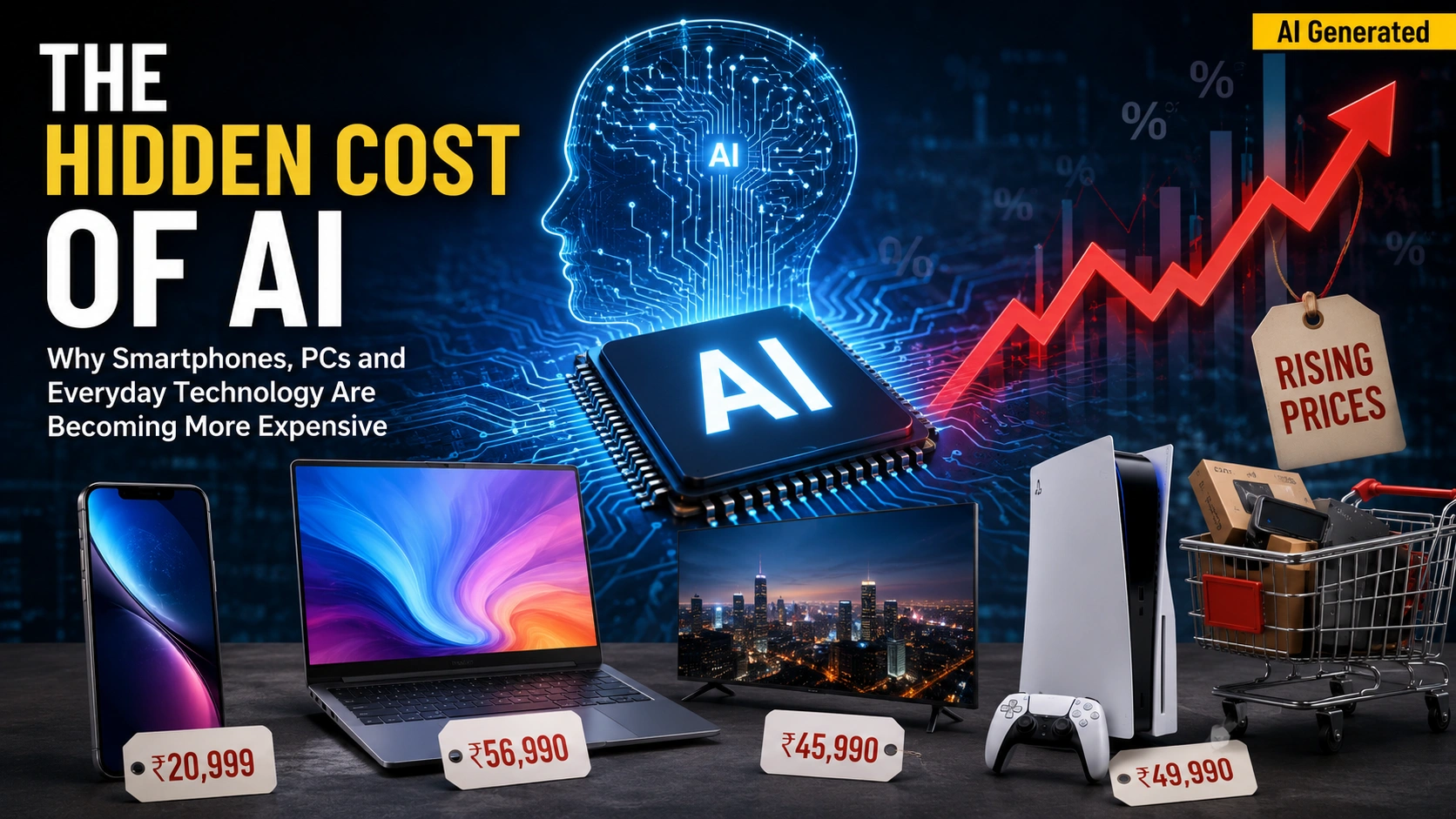
The Hidden Cost of AI: Why the Artificial Intelligence Boom Is Making Everyday Technology More Expensive
We have seen an interesting pattern for nearly three decades. Every year, technology became better, faster, smarter and, more importantly, cheaper. Mobile phones that once cost a fortune gradually became affordable to millions. Personal computers became household essentials. Televisions became smarter while becoming less expensive. The entire world grew accustomed to a simple assumption — technological progress would always reduce costs and make life easier.
That assumption is now beginning to break.
Across markets worldwide, the prices of smartphones, laptops, personal computers and several consumer electronic products are quietly moving upward. At first glance, many consumers may assume inflation or global supply chain disruptions are responsible. But beneath these rising prices lies a much deeper shift, one that surprisingly has very little to do with traditional inflation.
Ironically, the biggest reason behind this change is artificial intelligence itself.
While the world continues celebrating AI as the most transformative technological revolution of our time, an invisible economic consequence is beginning to unfold. Consumers around the world are slowly starting to pay the hidden cost of the AI boom, and this trend may only intensify in the coming years.https://thequantiq.com/netrasemi-ai-chip-india-ai-boom/
Why Smartphones and Computers Are Suddenly Becoming More Expensive
Recent global reports suggest that smartphone prices, particularly devices positioned in the budget and mid-range categories, are beginning to face strong upward pressure. Industry analysts indicate that memory component prices, especially RAM modules, have increased sharply over the past several months.
The cost of DRAM and solid-state drives, two critical components used extensively in smartphones and computers, is expected to rise further through 2026. Devices priced below the ₹20,000 category may face the biggest impact because manufacturers operating in lower-margin categories have very little room to absorb these increasing production costs.
Consumers may not immediately notice dramatic price jumps. Instead, manufacturers often respond differently. Companies begin removing premium features from lower-priced models. Storage capacity may reduce. Battery quality may decline. Camera systems may become less advanced. In other words, consumers begin paying more while often receiving less value.
The average consumer may simply assume that inflation is affecting electronics prices.
The reality, however, is far more complicated.
The Real Story: Artificial Intelligence Is Consuming The World’s Semiconductor Supply
To understand what is happening, we need to look far beyond smartphones.
Artificial intelligence has triggered an unprecedented global race among technology giants. Companies such as NVIDIA Corporation, Microsoft, Google, Meta Platforms and Amazon Web Services are collectively investing hundreds of billions of dollars in building massive AI infrastructure.
Behind every AI model that powers chatbots, image generators, autonomous systems or intelligent assistants lies enormous physical infrastructure. Data centres now require extraordinary volumes of advanced graphics processing units, high-bandwidth memory systems, DRAM modules, NAND flash storage and sophisticated semiconductor packaging technologies.
This demand has fundamentally altered global semiconductor economics.
Manufacturers such as Samsung Electronics, SK Hynix and Micron Technology are naturally prioritizing these high-margin AI components rather than conventional chips meant for consumer electronics.
As a result, smartphone manufacturers and computer makers are slowly losing access to cheaper component supply.
Consumers are quietly absorbing the consequences.
For The First Time, Technology May Be Making Life More Expensive
This represents something historically unusual.
Every major technological revolution in recent decades has largely reduced the cost of living. The internet lowered communication costs. Smartphones democratized access to information. Cloud computing reduced infrastructure costs for businesses. E-commerce reduced distribution inefficiencies.
Artificial intelligence may become the first major technological revolution that does the opposite.
As AI infrastructure expands globally, enormous computational demand is consuming vast industrial resources. Semiconductor supply chains are shifting toward enterprise-grade infrastructure rather than consumer markets. The result is a strange contradiction.
The technology designed to improve human productivity may simultaneously make everyday life more expensive.
That is a conversation the world has barely begun to acknowledge.
The Price Surge Will Not Stop With Smartphones and PCs
Mobile phones and computers may only represent the beginning.
The same semiconductor dependency exists across dozens of industries that modern consumers interact with every day.
Smart televisions rely heavily on advanced processors and memory architecture. Gaming consoles increasingly demand sophisticated semiconductor components to support higher graphics performance. Electric vehicles now function as mobile computing systems packed with thousands of semiconductor-controlled components.
Even household appliances are becoming more semiconductor dependent. Smart refrigerators, air conditioners, washing machines, IoT devices and connected home systems all rely on embedded chips and memory modules.
Telecommunication infrastructure may also face rising costs. Broadband equipment, 5G routers and networking hardware increasingly depend on advanced semiconductor supply chains.
Even medical devices are vulnerable. Portable diagnostic systems, hospital monitoring equipment and imaging systems now depend heavily on advanced electronic components.
In simple terms, artificial intelligence may begin influencing the price of far more products than consumers currently imagine.
India Faces A Serious Hardware Dependency Challenge
India finds itself in a particularly sensitive position.
Despite rapid growth in electronics manufacturing, India remains deeply dependent on global semiconductor supply chains. Most electronic products assembled domestically still rely heavily on imported components sourced from highly concentrated global semiconductor ecosystems.
This creates a strategic vulnerability.
If semiconductor shortages intensify because of growing AI demand, Indian consumers could experience sustained price increases across electronics markets over the next several years.
The bigger question policymakers must ask is whether India can build sufficient domestic resilience before global supply distortions become permanent.
Companies such as Dixon Technologies and Tata Electronics are gradually strengthening India’s electronics manufacturing ambitions.
But the scale of global AI demand is expanding faster than most national manufacturing strategies can currently respond to.https://thequantiq.com/zoho-ai-server-india-infrastructure-revolution/
Why Northeast India Suddenly Matters More Than Ever
The upcoming semiconductor testing and packaging facility being developed by Tata Electronics at Jagiroad, Assam, represents far more than a new industrial project. It signals the possibility of Northeast India gradually becoming an important participant in India’s evolving semiconductor and advanced electronics ecosystem.
For decades, Northeast India remained largely disconnected from India’s advanced industrial ecosystem. But as semiconductor supply chains become increasingly important, regions that were once considered peripheral may suddenly acquire strategic significance.
Assam, Tripura and the wider Northeast region could gradually emerge as important supporting nodes within India’s electronics manufacturing ecosystem.
Electronics assembly units, semiconductor packaging support industries, AI hardware servicing ecosystems, electronics refurbishment clusters and recycling industries could become future growth sectors for the region.
This is precisely the kind of industrial transition Northeast India must prepare for early.
Because in the age of artificial intelligence, industrial relevance is increasingly determined by technological infrastructure.https://thequantiq.com/indias-semiconductor-moment-dholera-assam-odisha/
The AI Revolution Has Hidden Costs Nobody Is Talking About
The world currently sees artificial intelligence through the lens of excitement.
We talk about productivity gains. We talk about automation. We talk about efficiency, innovation and transformation.
But beneath this optimism lies a hidden economic reality.
Building artificial intelligence at global scale requires enormous physical infrastructure. That infrastructure consumes resources, reorganizes supply chains and redirects manufacturing priorities in ways consumers rarely notice immediately.
The rising price of smartphones and computers may simply be the first visible signal.
Artificial intelligence is often described as the future of abundance.
Yet history may remember it as the first technological revolution that quietly made ordinary life more expensive before it made life better.
And perhaps, that hidden cost is the part of the AI revolution the world has still failed to fully understand.





One Comment