
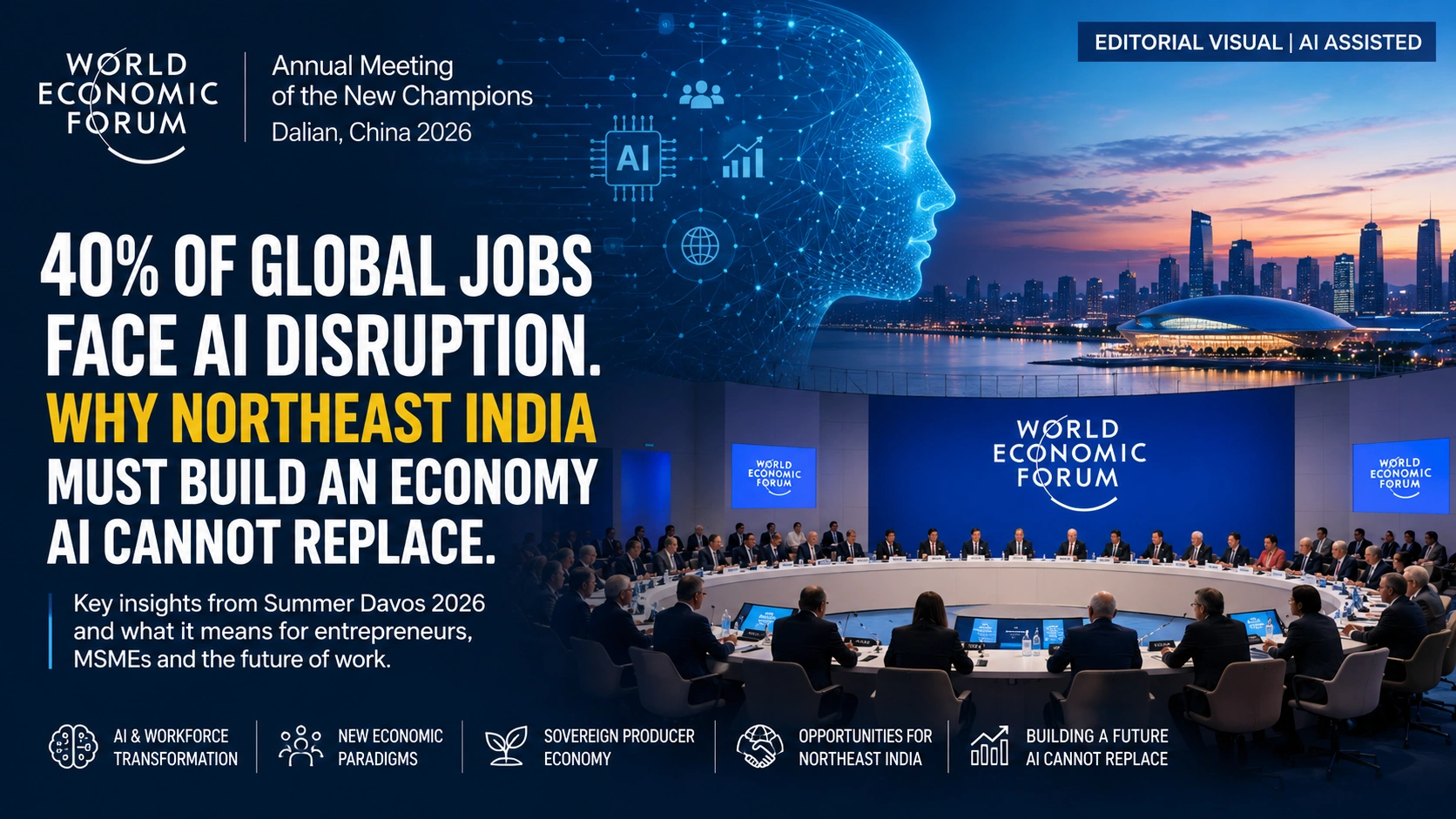
40% of Global Jobs Face AI Disruption. For Northeast India, This May Be the Biggest Economic Wake-Up Call Yet
Why the message emerging from Summer Davos 2026 in China matters far more to a bamboo entrepreneur in Assam or a handloom producer in Nagaland than most people realise.
When nearly 1,800 global leaders, policymakers, economists and technology executives gathered in the Chinese coastal city of Dalian last week for the 2026 Annual Meeting of the New Champions — more popularly known as Summer Davos — one message quietly overshadowed every discussion around innovation, growth and future economies. Artificial Intelligence is no longer a future disruption. It has already arrived, and the global workforce is dangerously unprepared.
One of the most discussed economic signals circulating during the summit came from earlier research published by the International Monetary Fund (IMF), which warned that nearly 40 percent of global jobs are now exposed to AI-driven transformation. Pause for a moment and think about what that actually means. Nearly half of the world’s workforce could see their roles fundamentally altered in the coming years.
For executives sitting inside boardrooms in New York, Singapore or London, this may simply represent another technological transition. But for a small entrepreneur running a bamboo workshop in Tripura, a weaver in Assam’s Sualkuchi, a young graduate in Imphal preparing for a government job examination, or a self-help group leader in rural Meghalaya, this is not an abstract economic statistic. This is personal, and perhaps nowhere in India should this conversation matter more urgently than in Northeast India.
The Signal Coming Out of Summer Davos 2026
The World Economic Forum’s Annual Meeting of the New Champions 2026, held in Dalian, China, focused heavily on innovation, industrial transformation and emerging technologies shaping the next phase of global economic growth. Yet behind the optimism surrounding AI innovation sat an uncomfortable truth. Technology is moving faster than the workforce can adapt.
Global workforce experts participating in the discussions repeatedly reinforced a growing reality: while Artificial Intelligence will certainly create new economic opportunities, it will simultaneously eliminate or fundamentally transform millions of existing jobs. The challenge is not simply technology adoption. The challenge is adaptation. The challenge is speed. More importantly, the challenge is understanding which jobs AI can replace and which it cannot. That distinction matters enormously for India, and it matters even more for Northeast India.
Why Northeast India Must Pay Attention Right Now
The IMF’s 40 percent estimate is a global number, but AI disruption will not affect every region equally. Some economies are built around information processing, repetitive workflows and routine administrative functions. Others are built around physical production, cultural knowledge, craftsmanship, biological resources and human relationships. Northeast India sits at a fascinating crossroads.
For decades, the region’s educated youth have been pushed toward a narrow set of employment aspirations — government jobs, teaching positions, migration to metropolitan cities for service-sector employment, and small intermediary businesses dependent on trading, logistics or administrative services. Unfortunately, these are precisely the sectors now beginning to face increasing pressure from AI-driven automation.
Consider the pattern emerging.
Business and Job Categories Most Vulnerable to AI Disruption
| Sector | AI Risk Level | Northeast Exposure |
| Data entry and administrative work | High | Medium |
| Retail trade and small merchant operations | High | Very high |
| Logistics coordination and booking services | High | High |
| Travel booking intermediaries | High | Medium |
| Routine customer service functions | High | Growing |
| Government administrative functions | Medium | Very high |
| Traditional craft production | Low | Very high |
| Agriculture and horticulture | Low | Very High |
| Bamboo and forest-based enterprise | Low | High |
| Cultural tourism and experiential services | Low | Growing |
| Healthcare and community services | Low | High |
The pattern emerging globally is unmistakable. The jobs most vulnerable are not necessarily factory workers or farmers. They are intermediary workers — the people whose primary job is moving information from one system to another, processing paperwork, managing repetitive communication, and performing tasks that increasingly intelligent machines can now execute faster and cheaper. Northeast India has a large population dependent on exactly these forms of employment.https://thequantiq.com/assam-europe-tourism-opportunity-sustainable-tourism/
The Great Irony Nobody Is Talking About
There is an irony here. For decades, Northeast India has systematically undervalued its strongest economic assets — traditional weaving, bamboo craftsmanship, organic agriculture, forest-based livelihoods, indigenous knowledge systems, cultural tourism, local artisan production. These sectors were often seen as backward, informal or economically inferior compared to white-collar service-sector employment.
But Artificial Intelligence is now forcing the world to reconsider this assumption. Because something remarkable is happening. The very forms of work we considered “low-value” for decades are suddenly becoming the most difficult for AI to replace.
Machines can write reports. Machines can process invoices. Machines can answer customer support emails. Machines can generate marketing copy. But machines cannot sit at a loom in Sualkuchi and create a handwoven Assamese mekhela chador carrying generations of cultural memory. Machines cannot understand the tacit ecological knowledge of a farmer cultivating organic produce in Nagaland. Machines cannot replicate community trust built over decades within local producer ecosystems. That changes everything.
What AI Augmentation Actually Looks Like for Northeast Entrepreneurs
There is an important nuance often lost in the global AI debate. Artificial Intelligence does not simply replace jobs. In many cases, it augments human productivity. But augmentation does not happen automatically. It benefits those who actively learn how to use these tools.
Consider a handloom entrepreneur in Assam. AI cannot replace the physical act of weaving. But AI can dramatically reduce the invisible administrative burden surrounding that business — product photography enhancement, customer communication, WhatsApp automation, social media content generation, export documentation, pricing analysis, buyer prospecting and market research.
A process that previously consumed four hours per day may now require forty minutes. The entrepreneur does not lose work. The entrepreneur gains time. The same applies to a bamboo producer in Tripura or a craft exporter in Manipur. AI becomes infrastructure, not replacement.https://thequantiq.com/bamboo-carbon-credits-climate-finance-northeast-india/
Agriculture May Become More Competitive, Not Less
This may surprise many people. Agriculture, especially premium agricultural production, may actually become stronger in the AI era. Artificial Intelligence is already helping farmers with weather intelligence, soil health analysis, crop advisory, disease prediction, supply chain optimisation and market pricing intelligence.
Large agricultural corporations have used such intelligence systems for years. Now the same capabilities are gradually reaching small farmers through smartphones.
Imagine an organic turmeric farmer in Meghalaya, a premium tea grower in Assam, or a specialty spice producer in Arunachal Pradesh. AI will not replace these producers. It may actually make them globally more competitive.
The Bigger Lesson: Northeast India Must Stop Chasing Vulnerable Economic Models
For years, development thinking in India has pushed Northeast India toward service-sector expansion through BPO centres, IT outsourcing, back-office processing, administrative employment, call centre jobs and digital service work.
But here lies the uncomfortable truth. Artificial Intelligence is now aggressively automating exactly these sectors. In hindsight, these were never durable long-term economic models. They were transitional employment structures, and now technology is exposing that weakness.
This should force Northeast India to rethink its economic identity.
The Sovereign Producer Economy May Be Northeast India’s Greatest Advantage
At The Quantiq, we have consistently argued that Northeast India must build what we call the Sovereign Producer Economy — an economy where value creation remains rooted in sectors that combine physical production, biological resources, cultural knowledge, place-specific craftsmanship, indigenous intellectual capital and human authenticity.
Artificial Intelligence has unexpectedly strengthened this argument.
Consider what AI is systematically replacing — routine information processing, template-based content creation, standardised customer service, predictable administrative functions and pattern recognition tasks.
Now consider what AI struggles to replicate — human touch, craftsmanship, biological production systems, cultural identity, trust-based community relationships and physical making.
Suddenly Northeast India finds itself holding economic assets the future may value far more than the present does.
The Youth Employment Crisis Is Becoming More Urgent
India’s youth unemployment challenge remains serious. Multiple international and domestic labour market assessments continue to show elevated youth unemployment levels, particularly among educated young graduates. Northeast India faces an even deeper structural challenge.
Generations of young people have grown up believing success follows a predictable path. Study hard, secure a government job, become a teacher, or move to Bengaluru, Delhi or Hyderabad for service-sector work.
But that economic world is changing rapidly.
Government hiring growth is slowing. Administrative functions are becoming increasingly automated. Entry-level service-sector jobs are becoming more vulnerable to AI systems. The employment map our education system prepared young people for is no longer the employment map emerging before us. This is perhaps the biggest transition challenge facing Northeast India in the coming decade.
Five Immediate Steps Every Northeast Entrepreneur Should Take
The question is no longer whether AI will affect business. It already is. The question is whether entrepreneurs prepare early enough. Here are five immediate actions every entrepreneur should begin today.
First, audit your administrative workload. List every repetitive information task inside your business — emails, forms, documentation, market research and communication. These are immediate AI opportunities.
Second, identify what AI cannot replace. Ask yourself one question. What part of my business depends on physical skill, cultural identity, trust or local knowledge? That is your economic moat. Protect it.
Third, become tool-literate, not theory-literate. Understanding AI conceptually is useless. Practical knowledge creates advantage. Learn tools like ChatGPT, Claude, Gemini, Microsoft Copilot and Perplexity. Use them daily.
Fourth, reposition your product value. If you make something uniquely human, do not compete on price. Compete on authenticity. Human-made products may become significantly more valuable in the AI era.
Fifth, build for export markets. Northeast India’s producers must stop thinking locally. AI tools now make global communication, documentation, and customer outreach dramatically easier. A bamboo producer in Assam can now reach Europe faster than ever before. Use that advantage.
The Quantiq Assessment
The message emerging from Summer Davos 2026 is brutally clear. The global economy is changing faster than the workforce is adapting. The jobs facing the greatest disruption are not highly specialised professionals, nor are they physical-world producers. The most vulnerable are intermediary workers performing routine information tasks.
This reality creates a powerful strategic insight for Northeast India. The region should stop trying to compete in economic sectors Artificial Intelligence is rapidly commoditising. Instead, it should aggressively build sectors where human capability remains irreplaceable.
The future economy may belong not to those who compete against Artificial Intelligence, but to those who understand where Artificial Intelligence has limits.
At The Quantiq, we believe Northeast India stands at a defining moment. The region can either remain a passive consumer of global technological disruption, or it can deliberately build an economy around what technology cannot replace — the hands, the land, the forests, the culture, the indigenous knowledge and the producer economy.
Artificial Intelligence should not become Northeast India’s threat. It should become the invisible infrastructure supporting an economy built around deeply human capabilities.
The future belongs to those who know the difference, and for Northeast India, that future begins now.https://thequantiq.com/bamboo-toy-industry-northeast-india/





2 Comments