
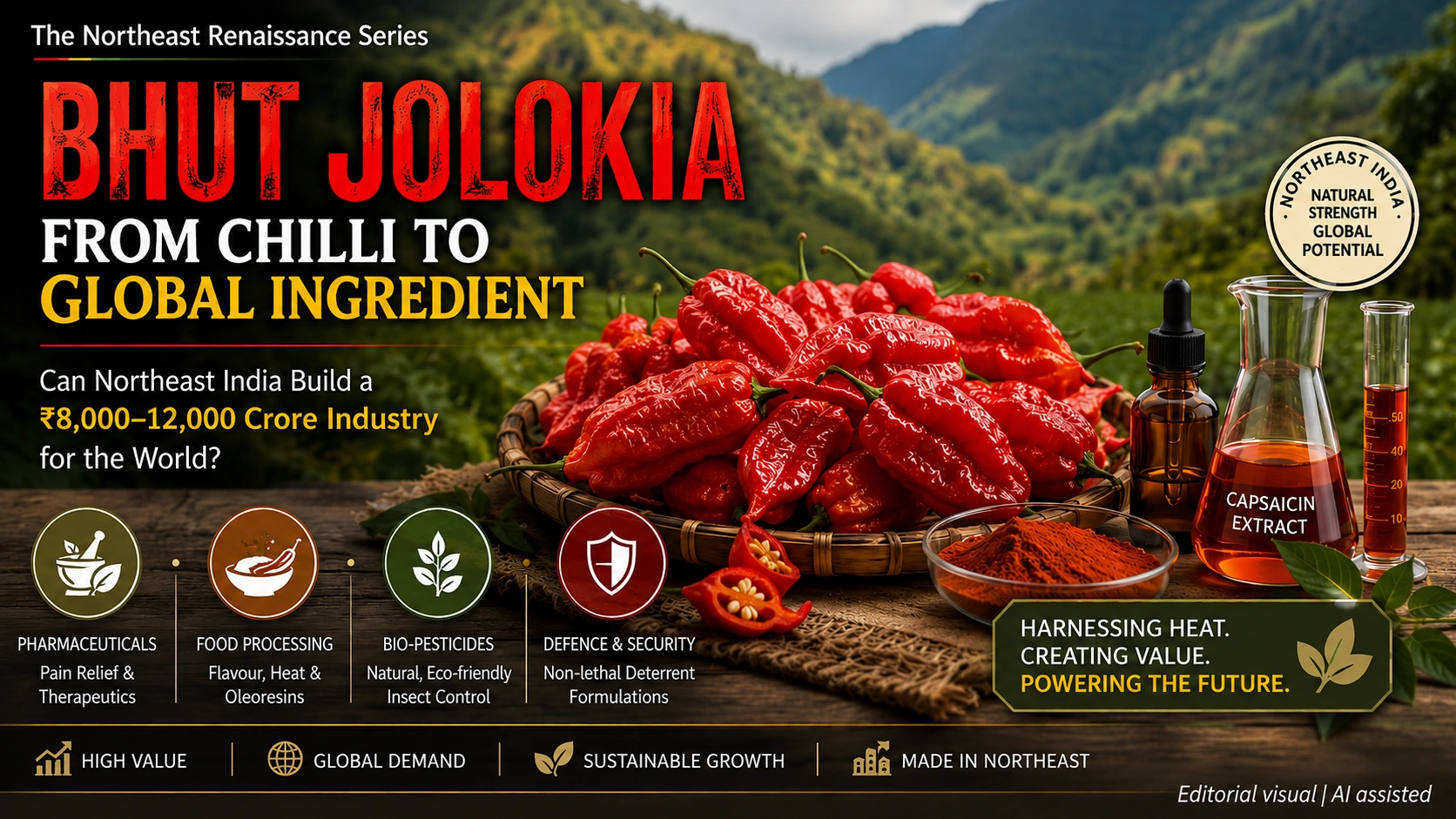
Bhut Jolokia: Can Northeast India Transform the World’s Hottest Chilli Into a Global High-Value Ingredient Industry?
The Northeast Renaissance Series
Ideas for a ₹8,000–12,000 Crore Indian Market and a Multi-Billion Dollar Global Future
For Decades, Bhut Jolokia Has Been Seen as a Chilli. The Future May Value It More as Chemistry.
For generations, Bhut Jolokia has occupied a curious place in Northeast India’s agricultural identity. Farmers across Assam and Nagaland have cultivated it traditionally, local cuisines have celebrated its extraordinary heat, and global media attention has repeatedly described it as one of the hottest chillies on Earth. Yet this entire conversation may have overlooked the most important economic truth hidden inside Bhut Jolokia itself
Its real value may not lie in food.
At the molecular level, Bhut Jolokia contains extraordinarily high concentrations of capsaicin, the bioactive compound responsible for its extreme pungency. Across global industries, capsaicin is increasingly being used in pharmaceuticals, nutraceuticals, advanced food processing systems, natural bio-pesticides, industrial ingredient manufacturing and specialized non-lethal defence formulations.
This changes the economic equation completely.
What Northeast India has traditionally treated as a niche agricultural crop may increasingly become the foundation of an entirely new high-value ingredient extraction industry serving multiple global sectors simultaneously.
The future bio-economy may increasingly reward those who understand molecular value, not those who merely cultivate agricultural commodities.
Why Capsaicin Is Quietly Becoming a High-Value Global Industrial Compound
Modern industrial chemistry increasingly seeks naturally derived bioactive compounds capable of replacing synthetic chemical ingredients dominating traditional manufacturing systems.
Capsaicin has quietly emerged as one such compound.
Globally, capsaicin extracts are now widely used in topical pain-relief formulations, arthritis treatment products, therapeutic heating creams, nutraceutical supplements and functional health products requiring anti-inflammatory bioactive ingredients. Simultaneously, food processing companies increasingly use capsaicin concentrates and chilli oleoresins for standardized flavor systems serving packaged foods, condiments and processed food manufacturing.
But the applications do not stop there.
Natural capsaicin formulations are increasingly being studied for environmentally safer insecticidal and pest-repellent systems capable of reducing dependence on synthetic agrochemicals. Specialized non-lethal law-enforcement formulations such as pepper-based deterrent sprays also rely heavily on concentrated capsaicin extraction systems.
Suddenly, a chilli stops being merely food.
It becomes industrial chemistry.https://thequantiq.com/bamboo-carbon-credits-climate-finance-northeast-india/
Why Bhut Jolokia Possesses a Rare Competitive Advantage
Not all chillies are commercially equal.
Bhut Jolokia possesses one of the highest natural capsaicin concentrations found in cultivated chilli varieties globally, often measuring over 1 million Scoville Heat Units, placing it among the most chemically potent naturally occurring capsaicin-rich agricultural crops.
This matters economically.
Industrial extraction industries do not primarily value agricultural crops by weight.
They value concentration.
The higher the concentration of commercially valuable compounds, the more economically attractive the crop becomes for extraction-based industrial systems.
In simple terms, a kilogram of Bhut Jolokia may possess significantly greater industrial value than ordinary chilli varieties when viewed through extraction chemistry rather than food markets.
And that distinction changes the opportunity dramatically.https://thequantiq.com/bamboo-bioplastics-can-northeast-india/
From Chilli to High-Value Industrial Extract
The industrial transformation begins after harvesting.
Fresh Bhut Jolokia undergoes controlled drying processes designed to preserve capsaicin concentration while reducing moisture content. The dried material is then crushed into processed feedstock suitable for extraction systems.
Using solvent extraction or advanced oleoresin extraction technologies, the capsaicin-rich compounds are gradually separated from the plant matrix. Further purification systems allow extraction of concentrated chilli oleoresin and high-purity capsaicin compounds serving multiple industrial sectors.
The final output is no longer agricultural produce.
It becomes industrial-grade chemical extract.
This single shift transforms a low-value farming activity into advanced ingredient manufacturing.
The Emerging Global Capsaicin Economy
The world is quietly moving toward bio-based industrial ingredients.
As pharmaceutical companies seek plant-based therapeutic compounds, food manufacturers increasingly standardize flavor chemistry, agricultural systems move toward bio-pesticides and industries reduce synthetic chemical dependency, demand for specialized natural extracts continues expanding rapidly.
The global capsaicin market is expected to witness strong long-term growth as wellness, food technology and green chemistry industries expand aggressively over the coming decade.
This is not merely an agricultural story.
It is part of a much larger molecular economy.
And Bhut Jolokia may quietly occupy a privileged place inside that emerging industrial transition.
Opportunity Snapshot
| Indicator | Indicative Estimate |
| Global Capsaicin Market | US$ 500 Million – 1 Billion |
| India Spice Extract Industry | ₹8,000–12,000 Crores |
| Estimated Plant Setup Cost | ₹1 – ₹5 Crores |
| Potential ROI Window | 18–30 Months |
| Potential Margin Range | 30–55% |
| Employment Potential | High |
| Scale Potential | Domestic + Export Markets |
Important Note: The estimates above are indicative and based on global market trends, comparable processing industries, available sectoral benchmarks, and potential business models. Actual investment requirements, margins, ROI timelines and market size may vary significantly depending on technology choice, production scale, regulatory approvals, quality standards and evolving market conditions.https://thequantiq.com/bamboo-vinegar-green-chemistry-northeast-india/
Why Northeast India Has a Strategic Advantage
Unlike many industrial opportunities requiring entirely new resource creation, Northeast India already possesses the core biological asset.
Assam and Nagaland remain among the most recognized production zones for Bhut Jolokia cultivation, and the chilli already carries strong global identity due to its reputation as an extreme heat variety. This gives the region a rare branding advantage that many agricultural industries spend years trying to build artificially.
The larger opportunity lies in moving beyond cultivation itself.
Instead of exporting raw produce or selling through fragmented agricultural markets, the region can gradually build value-added extraction industries capable of converting indigenous agricultural identity into globally traded industrial ingredients.
The raw material already exists.
The industrial imagination still needs to catch up.
Process Intelligence Is the Real Moat
Many entrepreneurs may wrongly assume that simply increasing Bhut Jolokia cultivation automatically creates economic opportunity.
That assumption misses the real industrial advantage.
Competitive leadership will not emerge from farming alone.
It will emerge from extraction science.
Capsaicin concentration testing, solvent extraction efficiency, purity control systems, chemical stabilization, industrial-grade processing standards and quality consistency ultimately determine whether this becomes a globally competitive ingredient industry.
The winners will not simply be farmers.
The winners will increasingly be those who master molecular extraction systems.
The AI Era and Precision Bio-Processing Systems
Artificial intelligence will quietly reshape this sector as well.
AI-assisted agricultural systems can increasingly monitor crop health, predict capsaicin concentration variability and optimize harvest timing based on chemical maturity profiles. Machine learning systems can also improve extraction efficiency, automate compound purity testing and optimize industrial processing cycles capable of improving final yield consistency.
This changes the sector fundamentally.
The future ingredient extraction industry may increasingly operate less like agriculture and more like intelligent chemical manufacturing powered by data systems.
The future bio-economy will increasingly merge farming with machine intelligence.
From Agricultural Commodity to Molecular Industry
For decades, agricultural economies have focused primarily on growing more crops while paying relatively little attention to the chemistry hidden inside those crops.
That model increasingly limits prosperity.
The future industrial economy will increasingly reward regions capable of understanding molecular value embedded inside biological resources and building industries around extraction science rather than commodity agriculture alone.
Bhut Jolokia demonstrates this principle perfectly.
A chilli appears commercially simple.
Yet hidden inside that fruit exists bioactive chemistry capable of serving pharmaceutical, food processing, agricultural biotechnology and industrial ingredient markets globally when unlocked through scientific processing systems.
The future economy may increasingly belong not to those growing more crops.
It may increasingly belong to those capable of understanding the invisible chemistry already hidden inside the crops surrounding them.https://www.ncbi.nlm.nih.gov/
The Quantiq Assessment
Bhut Jolokia represents one of the clearest examples of how Northeast India can begin rethinking agriculture itself. The region already possesses globally recognizable biological assets, but long-term economic transformation will increasingly depend on whether entrepreneurs continue selling agricultural commodities or begin building industries around molecular extraction and high-value ingredient manufacturing.
However, the opportunity is more complex than it initially appears.
Industrial extraction requires chemical processing infrastructure, specialized solvent extraction systems, quality-testing laboratories, stable procurement networks, and strong market linkages that connect local production systems with pharmaceutical, food-processing, and industrial buyers. Without this downstream infrastructure, cultivation alone will continue generating limited economic value.
The opportunity is unquestionably real.
But the future winners will not simply be those growing Bhut Jolokia.
They will increasingly be those capable of mastering chemistry, process engineering and industrial extraction systems before global ingredient markets move faster than local industry.
And that distinction may ultimately define whether Northeast India remains an agricultural supplier or evolves into a future bio-manufacturing economy.https://search.ipindia.gov.in/GIRPublicSearch/





One Comment