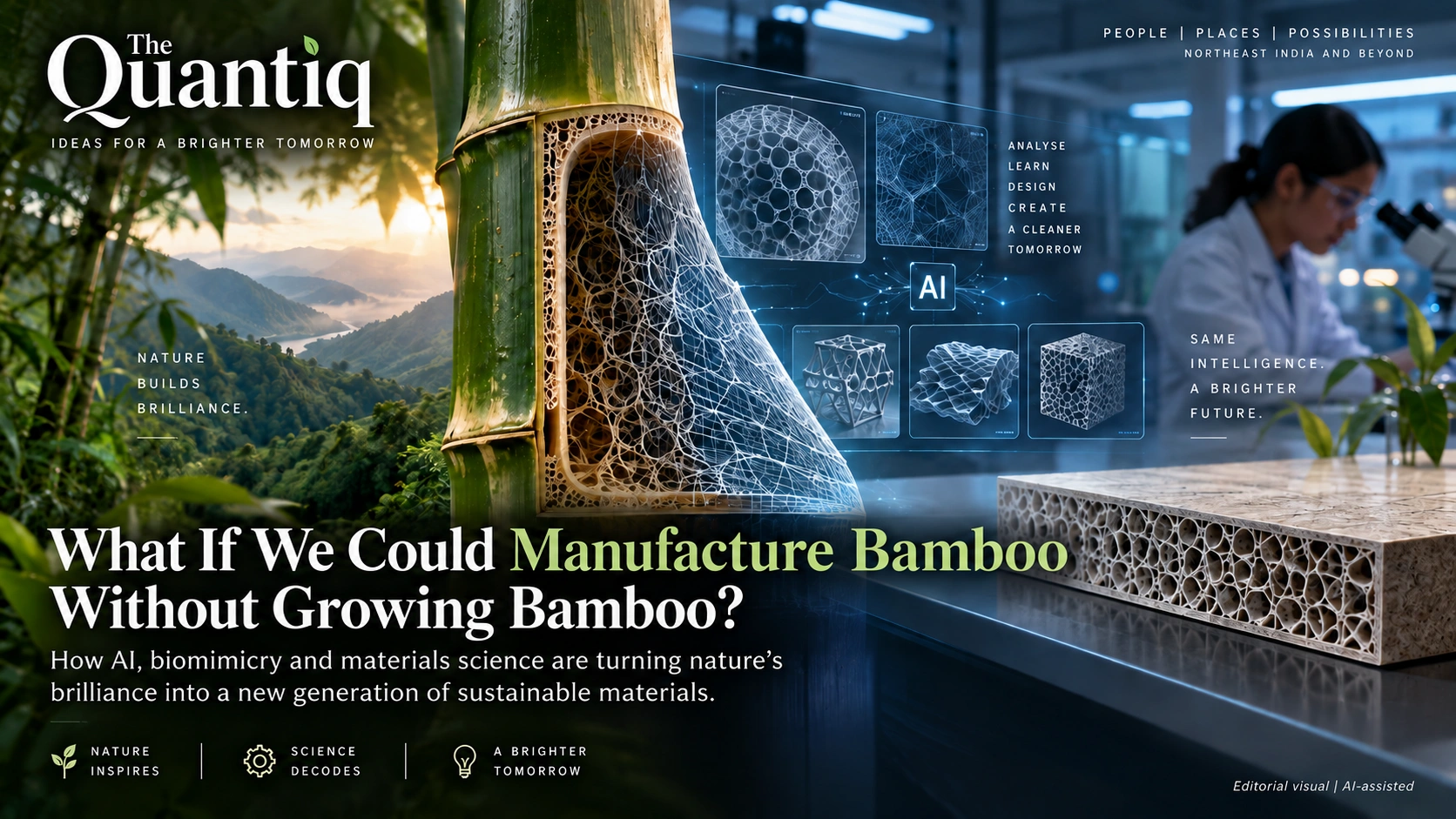
What If We Could Manufacture Bamboo Without Growing Bamboo?
AI, biomimicry and materials science are beginning to ask an extraordinary question: can we learn from bamboo’s architecture and manufacture its advantages without continually harvesting the plant?
Imagine walking into a furniture showroom sometime in the future. You pick up a beautifully finished panel. It is light, strong and slightly flexible. It feels remarkably natural, yet there is no bamboo in it.
You ask what it is made from. The answer surprises you. It is a new engineered material whose internal architecture was inspired by bamboo.
That future has not arrived yet. However, the science behind the idea is already beginning to emerge in laboratories.
Researchers are studying bamboo at increasingly microscopic levels, using advanced imaging, computational modelling, 3D printing and artificial intelligence to understand why the plant performs so efficiently as a natural structural material.
The fascinating possibility is that we may eventually learn to reproduce some of bamboo’s engineering principles without reproducing bamboo itself.
That changes the question completely.
Instead of asking how much bamboo we can grow, harvest and process, we can begin asking something much more interesting:
What if we could manufacture the intelligence of bamboo?
Bamboo is not just a material
For centuries, people have looked at bamboo primarily as a useful plant.
It has provided shelter, furniture, baskets, tools, musical instruments and countless everyday objects. In recent decades, its rapid growth and renewability have also made bamboo an important part of conversations about sustainable materials.
All of that is true. Yet there is another way of looking at bamboo.
Look closely at the plant and it begins to resemble an extraordinarily sophisticated piece of engineering.
Bamboo is a natural composite whose fibres, cells, minerals and tissues are organised at different scales. Its structure is not uniform. Material density changes through the culm, fibres are arranged in particular directions, and the hollow tubular form allows the plant to achieve useful strength without filling its entire volume with solid material.
Its performance therefore comes from more than its chemical ingredients. It comes from how those ingredients are organised.
That distinction may turn out to be one of the most important ideas in the future of sustainable materials.
Because if the secret lies partly in the architecture, perhaps we do not always need the original material. Perhaps we need to understand the architecture.
Nature has been doing materials research for millions of years
There is something humbling about the way humans approach materials. We build laboratories. We create computer simulations. We manufacture increasingly sophisticated machines. We spend years testing different combinations of chemicals, fibres and structures.
Nature has been doing something similar for millions of years. A tree has solved the problem of supporting enormous weight without steel. A seashell combines hardness and toughness through a remarkably organised structure. Spider silk achieves an unusual combination of strength and flexibility.
Bamboo has solved another problem: how to create a lightweight biological structure that can withstand forces while using relatively little material.
Nature did not have a laboratory in the conventional sense. Evolution was the laboratory. Now science is beginning to examine some of those experiments in extraordinary detail.
That field is known broadly as biomimicry or bio-inspired engineering. And artificial intelligence is adding a new dimension to it.
Scientists have started looking inside bamboo
One of the most intriguing examples appeared in Advanced Materials in 2025.
Researchers Zhao Qin and Aymeric Pierre Destree examined the microscopic structure of bamboo’s outer epidermis, where silica particles are distributed within a cellulose-rich structure. Using experimental imaging, numerical analysis and 3D printing, they investigated how this unusual arrangement contributes to bamboo’s toughness.
Then they went a step further. They used a generative AI model inspired by the bamboo structure to design particle-reinforced composites.
The resulting structures were not simply visual copies of bamboo. According to the researchers, the AI-generated samples reproduced important aspects of the failure behaviour and fracture toughness observed in the actual bamboo epidermis.
That is a remarkable shift in the way we think about biomimicry. The objective was not to manufacture fake bamboo.
It was to understand a principle found in bamboo and use computation to explore what that principle might produce in another material. This is where the story becomes much bigger than bamboo.
AI could change the way materials are discovered
Traditionally, developing a new material has involved a great deal of physical experimentation.
Researchers formulate something, manufacture a sample, test it, study the result and modify the formulation. Then they repeat the process.
The problem is that the number of possible combinations can become enormous.
A material needs to satisfy several conditions at the same time. It may need to be strong without becoming heavy, durable without becoming difficult to recycle, affordable without relying on environmentally damaging inputs, and sufficiently stable to survive real-world conditions.
AI is increasingly being used to navigate this enormous design space.
A 2025 review of AI in materials discovery describes how machine learning, generative models and autonomous laboratories are being used to accelerate material design, property prediction, synthesis planning, characterisation and optimisation.
This does not mean that computers can simply invent a sustainable material and send it directly to a factory. Physical experiments still matter.
However, AI can potentially reduce the amount of blind experimentation by identifying promising structures and formulations before researchers invest substantial laboratory time and resources in them.
That changes the economics of materials research. It also changes what becomes possible.
What if we stopped copying nature and started decoding it?
This may be the most interesting part of the entire story. Suppose researchers identify the characteristics that make bamboo structurally efficient.
The objective does not have to be reproducing bamboo fibre by fibre. Instead, scientists could ask a different question:
What mathematical and physical principles produce that performance?
Once those principles are understood, they can potentially be translated into other materials. A manufacturer might eventually create a lightweight panel whose internal geometry is inspired by bamboo but whose composition is completely different.
A packaging material could use a cellular architecture derived from biological structures rather than petroleum-based foam.
A furniture component could be designed with variable density so that material is concentrated where strength is required and reduced where it is not.
A construction component could use digitally optimised internal structures to achieve a particular combination of weight, strength and flexibility.
None of these products would be bamboo. Yet all of them could owe something to bamboo. That is a very different form of biomimicry.
This is not happening with bamboo alone
The broader scientific movement is even more interesting.
A 2025 review examining the relationship between AI and biomimicry concluded that the two fields can reinforce each other in the search for sustainable solutions. AI can help translate biological principles into computational designs, while biomimicry can provide new directions for engineering systems and materials.
Another 2025 review of bio-inspired composite structures examined how researchers are reproducing the hierarchical architectures found in natural materials through advanced fabrication techniques. The research covers biological structures ranging from bone and wood to shells and spider silk.
Meanwhile, research into AI-assisted 3D printing of natural materials is exploring how machine learning can help predict material properties, select suitable materials and optimise manufacturing parameters.
Taken together, these developments point towards something larger than a new class of bamboo products.
They point towards a future in which nature becomes a source of engineering models. That could eventually change how we think about raw materials themselves.
The raw material may become the blueprint
Industrial civilisation has generally followed a straightforward path.
We find something useful in nature, extract it, process it and turn it into a product. The next generation of manufacturing may follow a different path.
We could study something useful in nature, understand its structure, model its behaviour and then manufacture a different material based on what we have learned.
The distinction is subtle, but economically it could be enormous. A forest would no longer be valuable only because it contains timber.
A plant would no longer be valuable only because it produces biomass. A biological structure could also become valuable because it contains knowledge.
That knowledge can potentially become a design. The design can become intellectual property. The intellectual property can become a manufacturing process.
And the manufacturing process can create products that do not require the original biological resource at the same scale.
This is where sustainable materials begin to intersect with the knowledge economy.
But there is a serious sustainability question
There is a temptation to assume that anything inspired by nature must automatically be environmentally friendly. It does not.
A material can be bio-inspired and still require large amounts of energy. It can imitate an elegant natural structure while depending on toxic chemicals, fossil-derived polymers or manufacturing processes with a substantial environmental footprint.
A bamboo-inspired composite is not sustainable merely because bamboo inspired it. The real question is much harder.
Does the new material deliver useful performance while reducing its total environmental burden across its life cycle?
That means looking beyond the laboratory. The material needs to be considered from the moment its ingredients are sourced through manufacturing, transportation, use, repair, reuse, recycling and eventual disposal.
This is also why the emerging connection between AI and sustainable materials needs to be treated carefully. Recent research on AI-driven materials discovery identifies major opportunities, but also points to unresolved challenges involving data quality, experimental validation, generalisation and energy use.
The technology is promising. It is not magic. And that distinction matters if sustainability is to remain the objective rather than becoming a marketing label.
This is where Northeast India enters the story
For Northeast India, this emerging field has an unusually interesting starting point. The region does not need to abandon bamboo.
Quite the opposite. Bamboo is deeply connected to the ecology, culture, crafts, architecture and livelihoods of the Northeast. It already provides the foundation for an extensive ecosystem of farmers, artisans, manufacturers, designers and entrepreneurs.
The opportunity may be to move one level higher.
For generations, the broad economic model has been relatively simple: grow, harvest, process and sell. Imagine adding another layer to that value chain.
Researchers could study the structural behaviour of bamboo species found in the region. Universities could build datasets around fibre characteristics, density, moisture behaviour, mechanical properties and microscopic structures. Designers and engineers could then use computational tools to explore new applications.
AI could become part of that research ecosystem. The eventual product may still be a bamboo board, a textile or a piece of furniture.
But it could also be something entirely different. It could be a new composite. A new structural material. A new packaging system. A new manufacturing technique.
Or even a piece of intellectual property that has nothing obvious to do with bamboo when it reaches the global market.
That would represent a significant shift. The region would not simply be selling more of its natural resources. It would be converting knowledge derived from those resources into higher-value innovation.
Imagine a bamboo research laboratory in the Northeast
Picture a young researcher in Guwahati examining a microscopic image of bamboo on a screen. Next to her is an engineer running a structural simulation. Across the room, a designer is testing a digitally generated component.
An artisan is explaining how a traditional bamboo structure behaves under pressure. A materials scientist is analysing the composition.
An AI model is generating hundreds of possible structural configurations. The team rejects most of them.A few survive.
One looks promising. A physical prototype is printed. It fails. The data goes back into the model. Another design emerges.
This time, it works. That is not a fantasy about replacing traditional knowledge with technology.
It is a picture of what could happen when traditional knowledge, scientific research, engineering and AI begin working together.
The most interesting innovation may emerge precisely because no single discipline can solve the problem alone.
The bigger opportunity is not to manufacture bamboo
There is a seductive simplicity in the idea of replacing one material with another. Replace plastic with bamboo. Replace timber with bamboo. Replace steel with a bio-composite.
But substitution alone does not necessarily change the underlying system. The deeper opportunity is to rethink how materials are designed in the first place.
If bamboo can teach us how to distribute material more intelligently, perhaps we can manufacture structures that use less material.
If nature can teach us how to combine different substances at microscopic scales, perhaps we can design stronger composites.
If biological structures can demonstrate how to achieve multiple functions within the same architecture, perhaps our products can become more resource-efficient.
This is not about making technology look natural. It is about making technology learn from natural intelligence.
That distinction could become increasingly important as humanity confronts the material demands of a growing global economy.
Perhaps the future of bamboo is not bamboo
There is an intriguing possibility hidden inside all of this. The future of bamboo may not necessarily be about producing more bamboo products.
It may be about creating an entirely new category of products that exist because someone studied bamboo.
A future chair may contain no bamboo but may use a structural geometry derived from it.
A building panel may contain no bamboo fibre but may have been designed according to the way bamboo distributes stress.
A lightweight industrial component may use an engineered composite whose architecture was generated from biological principles first observed in a bamboo culm.
The connection may eventually become invisible to the consumer. And perhaps that is precisely what makes the idea powerful.
The most successful technologies inspired by nature may eventually become so normal that nobody remembers where the original idea came from.
From natural resources to natural intelligence
For a region like Northeast India, this distinction deserves serious attention.
The region has often been described in terms of what it possesses: forests, bamboo, minerals, biodiversity, water, agricultural resources and cultural traditions.
There is another way to describe the same landscape.
It is a vast collection of biological systems that have been solving problems for millions of years. That is a different kind of wealth.
And it suggests a different development question. Instead of asking only, “What can we extract from nature?”
We could also ask:
“What can we learn from nature?”
The first question leads towards commodities. The second can lead towards knowledge.
And knowledge, when combined with science, design, computation and entrepreneurship, can become technology.
That is where the Northeast’s next economic story could become genuinely interesting.
The most sustainable material may begin with an idea
We are still some distance from walking into a shop and buying a commercially manufactured “artificial bamboo” product that has completely replaced natural bamboo.
That is not the point. The important development is happening earlier in the chain.
Scientists are learning to examine biological structures at unprecedented levels of detail. AI is helping researchers explore enormous design spaces. Generative models are beginning to propose structures inspired by nature. Advanced manufacturing is making some of those structures physically testable.
The pieces are beginning to connect. What eventually emerges may not resemble bamboo at all. It may not even be called a bamboo-inspired material.
But somewhere in its history there may be a bamboo culm, examined under a microscope, that taught a researcher something about how nature solves a difficult engineering problem.
That is a beautiful possibility.
Because the future of sustainability may not depend entirely on finding more resources. It may depend on becoming better at learning from the resources we already have.
The Quantiq Perspective
For Northeast India, bamboo can be more than a renewable resource and more than an industrial opportunity.
It can become a gateway to materials intelligence.
The region has spent generations learning how to live with bamboo. The next generation has the opportunity to learn something different: how to decode its structure, understand its behaviour and transform that knowledge into new materials, technologies and intellectual property.
That would take the bamboo economy beyond harvesting and processing.
It would take it into research, design, computation and advanced manufacturing.
And perhaps the most valuable thing eventually exported from a bamboo forest will not be bamboo itself.
It will be the knowledge of how nature made bamboo work so well.
That is where the really interesting question begins.
What if the future of sustainable materials is not about taking less from nature, but about learning more from it?